Inverse Metabolic Engineering and Metabolic Control Analysis: A Synergistic Framework for Advanced Bioproduction and Drug Discovery
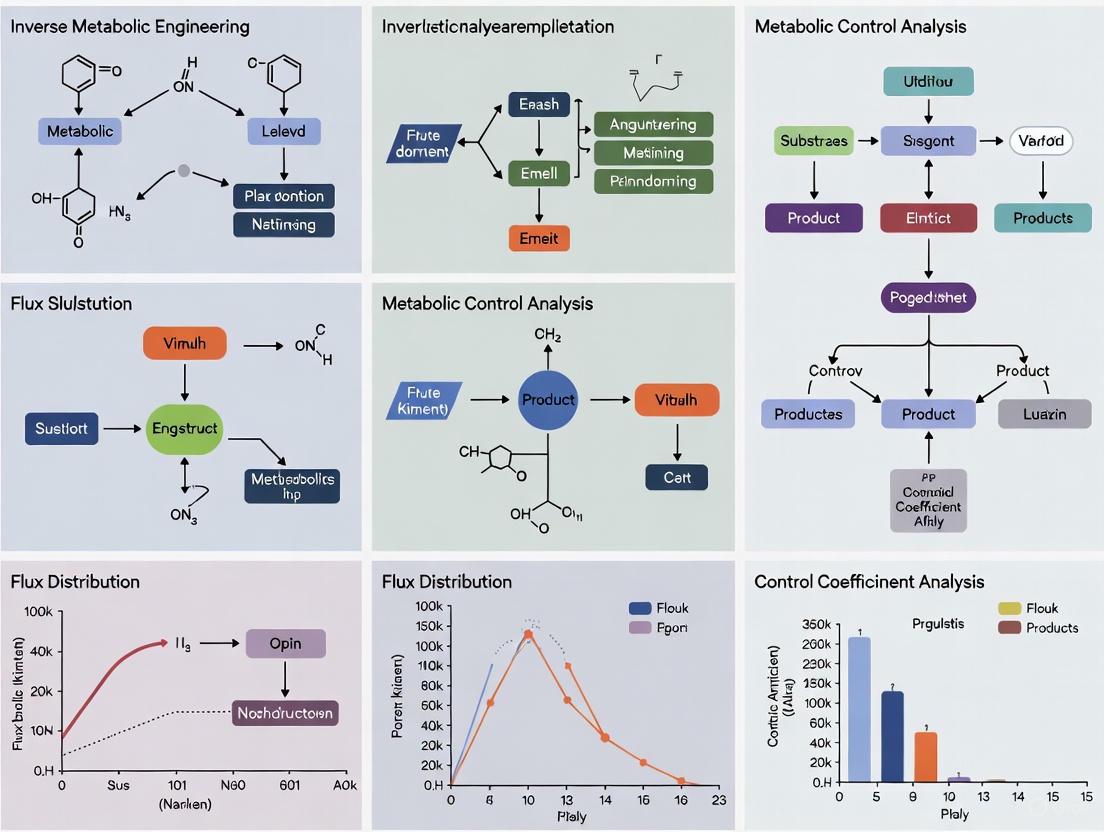
This article provides a comprehensive analysis of the synergistic relationship between inverse metabolic engineering (IME) and metabolic control analysis (MCA) for researchers and drug development professionals.
Inverse Metabolic Engineering and Metabolic Control Analysis: A Synergistic Framework for Advanced Bioproduction and Drug Discovery
Abstract
This article provides a comprehensive analysis of the synergistic relationship between inverse metabolic engineering (IME) and metabolic control analysis (MCA) for researchers and drug development professionals. It explores the foundational principles of both approaches, detailing how IME identifies key genetic targets through phenotypic screening while MCA quantifies control distribution in metabolic networks. The content covers advanced combinatorial methodologies, 'omics' integration, and computational frameworks for troubleshooting pathway bottlenecks. Through comparative case studies across microbial and plant systems, it validates the combined power of these strategies for optimizing the production of high-value pharmaceuticals and biofuels, concluding with future directions in multi-targeted therapy and AI-driven strain design.
Core Principles: From Single Rate-Limiting Steps to Distributed Metabolic Control
Inverse metabolic engineering (IME) represents a fundamental shift in the approach to strain and cell line development for biotechnological and pharmaceutical applications. Unlike classical metabolic engineering, which begins with a predetermined genetic target, IME first identifies, constructs, or calculates a desired phenotype, then determines the genetic or environmental factors conferring that phenotype, and finally endows that phenotype on another strain or organism through directed genetic or environmental manipulation [1]. This phenotype-first approach has demonstrated remarkable success in contexts ranging from eliminating growth factor requirements in mammalian cell culture to increasing the energetic efficiency of microaerobic bacterial respiration [1]. The paradigm is particularly valuable when engineering products like recombinant proteins that are intricately coupled to the growth process, where identifying beneficial genetic manipulations through direct approaches would be challenging [2].
The limitations of classical metabolic engineering approaches provide the necessary context for understanding IME's emergence. Traditional methods often focused on identifying a presumed rate-determining step in a pathway and alleviating this bottleneck through enzyme overexpression [1] [3]. However, this direct approach frequently encountered confounding factors such as intervention of other limiting steps, counter-balancing regulation, and unknown coupled pathways [1]. Metabolic Control Analysis (MCA) subsequently demonstrated that control of metabolic flux is typically distributed across multiple enzymes rather than residing in a single "rate-limiting step" [3]. This theoretical foundation explains why inverse approaches, which let the cellular system reveal which modifications yield the desired phenotype, often prove more successful than predetermined interventions.
Core Principles and Comparative Framework
Conceptual Foundation and Definitions
Inverse metabolic engineering operates on three fundamental principles that distinguish it from forward engineering approaches. First, it is phenotype-driven, meaning the desired cellular performance characteristic is defined before any genetic manipulation is considered. Second, it employs comparative analysis between strains or conditions to identify genetic basis for superior performance. Third, it utilizes directed genotype implementation to transfer identified beneficial traits to production hosts [1] [2].
The conceptual framework can be formally described as a three-step process:
- Identification of a desired phenotype through screening, construction, or computational design
- Determination of genetic/environmental basis through omics analysis, library screening, or other discovery methods
- Implementation in target host through genetic engineering or environmental optimization
Comparative Analysis: Inverse vs. Classical Metabolic Engineering
Table 1: Comparison between Classical and Inverse Metabolic Engineering Approaches
| Feature | Classical Metabolic Engineering | Inverse Metabolic Engineering |
|---|---|---|
| Starting Point | Known genetic target | Desired phenotype |
| Knowledge Requirement | Complete pathway understanding | Can work with partial knowledge |
| Control Assumption | Single rate-limiting step | Distributed control [3] |
| Approach to Complexity | Targeted manipulation | Systems-level analysis |
| Success Rate | Limited by preconceptions | Higher for complex phenotypes |
| Primary Applications | Simple pathway modifications | Complex trait engineering [2] |
Methodological Framework and Experimental Protocols
Core Workflow and Implementation Strategies
The implementation of inverse metabolic engineering follows a structured workflow that can be adapted to various biological systems and desired phenotypes. The following diagram illustrates the core iterative process:
Detailed Experimental Protocol: Library-Based Screening for Recombinant Protein Production
The following protocol, adapted from a study on E. coli strain improvement, demonstrates a practical implementation of IME for enhancing recombinant protein yields [2]:
Phase 1: Library Construction
- Genomic DNA Fragmentation: Partially digest E. coli genomic DNA to obtain fragments ranging from 200-800 bp using restriction enzymes with appropriate recognition sites.
- Vector Preparation: Prepare expression vectors (e.g., pRSET A with strong T7 promoter or pBAD33 with weaker arabinose promoter) by digestion with compatible restriction enzymes and dephosphorylation to prevent self-ligation.
- Ligation and Transformation: Ligate genomic fragments into prepared vectors and transform into appropriate host strain (E. coli BL21 pLysS for pRSET constructs). Plate transformants on selective media and incubate overnight at 37°C.
- Library Quality Assessment: Pick random colonies to verify insert size distribution by colony PCR and ensure library diversity exceeds 8,000 independent clones.
Phase 2: Phenotypic Screening
- Primary Screening for Growth Phenotype: Replica plate library clones onto induction plates containing IPTG (1 mM) or arabinose (0.2%). Identify clones showing significantly reduced growth post-induction compared to non-induced controls.
- Secondary Metabolic Activity Screening: Inoculate selected slow-growing clones into M9 minimal medium with glucose (0.4%) and allow growth to mid-log phase. Induce with appropriate inducer and monitor glucose consumption rates, selecting clones with unimpaired metabolic activity despite growth retardation.
- Tertiary Product Screening: Transform selected clones with reporter plasmid (e.g., GFP expression vector). Measure specific product yields (mg product/g DCW) post-induction, selecting clones with enhanced production capabilities.
Phase 3: Target Identification and Validation
- Insert Sequencing: Isolate plasmid DNA from superior producers and sequence inserted fragments using vector-specific primers.
- Bioinformatic Analysis: Perform BLAST search against host genome database to identify silenced genes and pathway context.
- Confirmation Studies: Construct defined knockdowns or knockouts of identified targets and validate phenotype reproduction in fresh genetic background.
Table 2: Key Genetic Targets Identified Through IME for Recombinant Protein Production
| Gene Target | Gene Function | Effect on Specific Product Yield | Proposed Mechanism |
|---|---|---|---|
| ribB | 3,4 dihydroxy-2-butanone-4-phosphate synthase | 7-fold increase | Redirects metabolic flux from growth to product synthesis [2] |
| kdpD | Sensory histidine kinase | 3.2-fold increase | Alters global regulation and stress response [2] |
| cysN | Sulfate adenylyltransferase subunit 1 | Significant improvement | Modifies cofactor availability and redox balance [2] |
| aroC | Chorismate synthase | Enhanced production | Shifts aromatic amino acid precursors [2] |
Integration with Metabolic Control Analysis
Theoretical Foundations and Complementarity
Inverse metabolic engineering and Metabolic Control Analysis (MCA) share a fundamental recognition that metabolic control is distributed across multiple pathway steps rather than residing in a single rate-limiting enzyme [3]. MCA provides the theoretical framework quantifying how enzymes exert control over fluxes and metabolite concentrations through flux control coefficients (CEJ) and concentration control coefficients [3] [4]. IME operates as the experimental implementation framework that leverages this distributed control principle by allowing the cellular system to reveal which modifications actually impact the desired phenotype.
The power of combining these approaches lies in their complementary strengths. MCA enables quantitative prediction of how perturbations will affect system behavior, while IME provides empirical validation and can identify non-intuitive targets that would be missed through purely rational design. This synergy is particularly valuable for understanding why traditional approaches of overexpressing presumed rate-limiting enzymes often fail – these enzymes typically have low flux control coefficients, and IME can identify the steps with higher control coefficients for the desired phenotype [3].
Advanced MCA Methodologies for IME Support
Modern MCA methodologies provide sophisticated tools to support IME campaigns:
Control Coefficient Determination in Intact Systems: Methodologies exist for determining control coefficients in intact metabolic systems without enzyme purification through co-response analysis of steady-state variables [4]. When metabolic fluxes and intermediate concentrations are measured in response to perturbations, the co-response coefficients (slopes when plotting logarithm of one variable against another) can be transformed through matrix operations to yield complete elasticity and control coefficient matrices [4].
Metabolic Control Analysis under Uncertainty: Computational frameworks employing Monte Carlo sampling procedures simulate uncertainty in kinetic data and apply statistical tools for identifying rate-limiting steps in metabolic networks [5]. This approach is particularly valuable for IME as it allows interpretation and prediction of metabolic network responses to genetic changes while accounting for parameter uncertainty.
Flux-Dependent Graph Analysis: Novel network constructions like Flux-Dependent Graphs (FDGs) and Mass Flow Graphs (MFGs) incorporate directional flow information and environmental context into metabolic network analysis [6]. These graphs capture how metabolic connectivity changes under different conditions, providing insights into which modifications might enhance specific fluxes.
Computational and Analytical Tools
Essential Research Reagent Solutions
Table 3: Key Research Reagents and Computational Tools for Inverse Metabolic Engineering
| Tool Category | Specific Tools/Reagents | Function in IME Workflow | Application Notes |
|---|---|---|---|
| Library Construction | pRSET A, pBAD33 vectors, E. coli BL21 pLysS | Generation of antisense libraries for partial gene silencing | Vectors with different promoter strengths enable tuning knockdown level [2] |
| Pathway Analysis | Metabolic Control Analysis, Flux Balance Analysis | Quantifying control coefficients and predicting flux distributions | Essential for interpreting IME results and identifying non-intuitive targets [3] [6] |
| Network Modeling | RuleBender, BioNetGen | Rule-based modeling of signaling and metabolic networks | Handles combinatorial complexity of metabolic systems [7] |
| Flux Analysis | Mass Flow Graphs, Normalised Flow Graphs | Context-specific metabolic network analysis | Reveals environment-dependent pathway importance [6] |
| Pathway Design | Retro-biosynthetic tools, Graph search algorithms | Designing novel metabolic pathways | Expands possible phenotypes for IME targeting [8] |
Computational Pathway Design and Analysis
Computational tools for metabolic pathway design have become essential components of the IME toolkit, enabling more systematic identification of potential metabolic interventions. These tools can be categorized based on their underlying algorithms:
Graph-Based Approaches: These methods represent metabolic networks as graphs with metabolites as nodes and reactions as edges (or vice versa). Search algorithms then identify possible pathways between target compounds and starting metabolites. These approaches benefit from intuitive representation but may generate biologically infeasible pathways without additional constraints [8].
Stoichiometric Matrix-Based Approaches: Utilizing flux balance analysis (FBA) and constraint-based modeling, these methods operate on the stoichiometric matrix of metabolic networks. They can predict optimal flux distributions for desired phenotypes and identify essential genes or reactions. These approaches incorporate mass balance constraints but require objective function definition [6] [8].
Retrosynthetic Search Algorithms: Inspired by organic chemistry retrosynthesis, these methods work backward from the target compound to identify plausible biosynthetic routes. They excel at discovering novel pathways but may require additional filtering for biological relevance [8].
The integration of these computational approaches with IME creates a powerful cycle: computational tools suggest potential phenotypes and genetic modifications, IME validates these predictions experimentally, and the resulting data refines the computational models.
Applications in Biotechnology and Pharmaceutical Development
Pharmaceutical and Bioprocessing Applications
IME has demonstrated particular value in pharmaceutical applications where complex phenotypes are required. A prominent example is the engineering of quiescent cells for recombinant protein production – non-growing but metabolically active cells that divert metabolic fluxes toward product formation rather than growth [2]. This application exemplifies how IME can identify non-intuitive targets that decouple growth and production, a longstanding challenge in biotechnology.
In biopharmaceutical development, IME approaches have been applied to enhance production of therapeutic proteins, antibiotics, and other complex natural products. The methodology is especially valuable for identifying generic host modifications that improve production across multiple products, such as engineering chaperone systems to enhance protein folding, modifying transcriptional/translational machinery, or altering central metabolism to increase precursor supply [2].
Environmental and Sustainability Applications
The principles of IME are increasingly applied in environmental biotechnology for biodetection, bioremediation, and sustainable biomanufacturing [9]. Key applications include:
Biosensor Development: IME approaches enable creation of microbial biosensors for environmental pollutants by identifying and implementing genetic elements that confer detection capabilities. For example, transcription factors that respond to heavy metals or organic pollutants can be coupled to reporter systems for sensitive detection [9].
Bioremediation Strain Development: Microorganisms with enhanced capabilities to degrade environmental contaminants can be developed through IME by first identifying desired detoxification phenotypes, then determining the genetic basis in naturally occurring strains, and finally implementing these capabilities in robust industrial hosts [9].
Waste Valorization: IME facilitates engineering of strains that convert waste streams (agricultural residues, plastic waste, C1 compounds) into valuable chemicals, supporting circular economy approaches [9].
Future Directions and Concluding Perspectives
The future development of inverse metabolic engineering is likely to be shaped by several converging technological trends. The integration of artificial intelligence and machine learning with high-throughput experimental data will enhance pattern recognition in phenotypic screens and enable more accurate prediction of genetic determinants [10]. The expanding toolkit of genome editing technologies, particularly CRISPR-based systems, will facilitate more precise implementation of identified modifications. Additionally, the continued development of multi-omics analytical methods will provide richer data for determining the genetic basis of desirable phenotypes.
The framework of inverse metabolic engineering represents a powerful paradigm for addressing complex metabolic engineering challenges where rational design approaches are insufficient. By allowing the biological system to reveal which modifications yield the desired phenotype, IME bypasses many limitations of incomplete metabolic understanding and distributed control. As computational tools advance and high-throughput experimental methods become more accessible, the application of IME is likely to expand further, accelerating development of improved microbial and cell line platforms for pharmaceutical manufacturing, sustainable chemical production, and environmental applications.
The diagram below illustrates the integrated future of IME combining computational and experimental approaches:
Metabolic Control Analysis (MCA) provides a robust mathematical and theoretical framework for describing metabolic, signaling, and genetic pathways, enabling researchers to quantify the control exerted by different components over system variables such as metabolic fluxes and metabolite concentrations [11] [12]. Developed in the 1970s by Kacser and Burns and independently by Heinrich and Rapoport, MCA offers a quantitative alternative to the outdated qualitative concept of a single "rate-limiting step" in biochemical pathways [11] [3]. This framework is particularly valuable in inverse metabolic engineering, where it helps identify non-intuitive genetic targets for optimizing industrial microbial strains when a detailed understanding of pathway regulation is lacking [13] [14].
The power of MCA lies in its ability to deal with systems of any complexity or architecture without requiring all system components to be known a priori, making it an exceptionally valuable post-genomic tool [11]. By integrating local kinetic information with systems-level properties, MCA enables researchers to determine how best to manipulate metabolic pathways for biotechnological applications such as metabolite overproduction or for clinical purposes like drug therapy design [3]. The analysis establishes that control over metabolic fluxes is typically shared among multiple pathway components, fundamentally changing our understanding of metabolic regulation and providing a more accurate basis for rational metabolic engineering strategies [11] [12].
Core Theoretical Principles of Metabolic Control Analysis
Fundamental Coefficients and Their Relationships
MCA quantifies how system variables depend on network parameters through three primary coefficients: control coefficients, elasticity coefficients, and response coefficients [12]. These parameters form the mathematical foundation for understanding and predicting pathway behavior.
Control coefficients measure the systemic response of a pathway to changes in enzyme activity. The flux control coefficient (( C{vi}^{J} )) quantifies the relative change in steady-state pathway flux (( J )) in response to a relative change in the activity of enzyme (( i )), defined as ( C{vi}^{J} = \frac{d \ln J}{d \ln vi} ) [12]. Similarly, the concentration control coefficient (( C{vi}^{S} )) expresses the relative change in metabolite concentration (( S )) in response to the same perturbation: ( C{vi}^{S} = \frac{d \ln S}{d \ln vi} ) [12].
Elasticity coefficients (( \varepsilon )) describe local enzyme properties, quantifying how the rate of an individual enzyme responds to changes in metabolite concentrations, defined as ( \varepsilonS^{vi} = \frac{\partial vi}{\partial S} \times \frac{S}{vi} ) [12]. Unlike control coefficients, which are systemic properties, elasticities are intrinsic to individual enzymes and their kinetic properties.
Response coefficients (( R )) link MCA to practical applications by describing how external factors (such as drugs or nutrients) influence system variables [12]. The response coefficient theorem states that ( Rm^X = Ci^X \varepsilon_m^i ), where ( X ) is a system variable, ( m ) is an external effector, and ( i ) is the target enzyme [12]. This relationship highlights that an external factor's effectiveness depends on both its ability to affect its target (elasticity) and the target's control over the system (control coefficient).
The Summation and Connectivity Theorems
The theoretical foundation of MCA rests on two fundamental theorems that govern the relationships between control coefficients and elasticity coefficients [12].
The summation theorems state that the sum of all flux control coefficients in a pathway equals 1 (( \sumi C{vi}^{J} = 1 )), while the sum of all concentration control coefficients for any metabolite equals 0 (( \sumi C{vi}^{S} = 0 )) [12]. These theorems mathematically formalize the concept of shared flux control, demonstrating that metabolic fluxes are emergent systemic properties rather than being controlled by a single enzyme.
The connectivity theorems establish specific quantitative relationships between control coefficients and elasticity coefficients [12]. For flux control coefficients: ( \sumi Ci^J \varepsilons^i = 0 ). For concentration control coefficients: ( \sumi Ci^{Sn} \varepsilon{Sm}^i = 0 ) when ( n \neq m ), and ( \sumi Ci^{Sn} \varepsilon{S_m}^i = -1 ) when ( n = m ) [12].
Table 1: Key Theorems in Metabolic Control Analysis
| Theorem Type | Mathematical Expression | System Interpretation |
|---|---|---|
| Flux Summation | ( \sumi C{v_i}^{J} = 1 ) | Control over flux is shared among all pathway steps |
| Concentration Summation | ( \sumi C{v_i}^{S} = 0 ) | Changes in enzyme activities balance metabolite concentrations |
| Flux Connectivity | ( \sumi Ci^J \varepsilon_s^i = 0 ) | Systemic flux control is related to local enzyme sensitivities |
| Concentration Connectivity | ( \sumi Ci^{Sn} \varepsilon{S_m}^i = \begin{cases} 0 & n \neq m \ -1 & n = m \end{cases} ) | Metabolite concentrations are interconnected through enzyme kinetics |
These theorems enable researchers to understand how control is distributed in metabolic networks and provide a mathematical basis for predicting how perturbations will affect system behavior.
Experimental Methodologies for Control Coefficient Determination
Classical Approaches for Flux Control Analysis
Several experimental methodologies have been developed to determine flux control coefficients in metabolic pathways, each with specific applications and limitations. The enzyme titration approach directly modulates enzyme activity through genetic manipulation (overexpression, knockdown) or specific inhibitors, measuring the resulting changes in pathway flux [3]. For example, Niederberger et al. demonstrated that overexpression of four of the five enzymes in the yeast tryptophan biosynthetic pathway was required to significantly increase tryptophan production, illustrating distributed flux control [11].
The inhibitor titration method uses specific, reversible inhibitors to modulate enzyme activity, with the degree of flux inhibition relative to enzyme inhibition indicating the enzyme's flux control coefficient [3]. A hyperbolic inhibition curve suggests high control, while a sigmoidal curve indicates low control. This approach was used to identify GAPDH as having significant flux control in Streptococcus lactis glycolysis using iodoacetate as a specific inhibitor [3].
Top-down control analysis allows researchers to analyze control in complex pathways by grouping reactions into blocks, simplifying the system while retaining essential regulatory features [11]. This approach was successfully applied by Krauss and Brand to quantify contributions of known and unknown signal transduction pathways in thymocyte response to mitogen stimulation, revealing a significant role (30% of total control) for calcineurin signal transduction pathways [11].
Inverse Metabolic Engineering Approaches
Inverse metabolic engineering provides powerful combinatorial methods for identifying control points when rational target selection is challenging. These approaches first generate genetic diversity, then screen for desired phenotypes, and finally identify the genetic modifications responsible [14].
Table 2: Combinatorial Approaches for Inverse Metabolic Engineering
| Methodology | Mechanism | Application Examples |
|---|---|---|
| Spontaneous Mutagenesis | Natural mutation accumulation during adaptive evolution | Increased tolerance to isobutanol and ethanol in E. coli; improved xylose utilization in S. cerevisiae [14] |
| Chemical Mutagenesis | Exposure to mutagens (e.g., EMS, NTG) | Enhanced isobutanol and full-length IgG antibody production in E. coli [14] |
| Transposon Mutagenesis | Random gene disruption via mobile genetic elements | Identification of inhibitory genes in lycopene production (E. coli); riboflavin production (B. subtilis) [14] |
| Gene Overexpression Libraries | Systematic overexpression of genomic fragments | Identification of genes enhancing alcohol tolerance and galactose fermentation in S. cerevisiae [14] |
| Coexisting/Coexpressing Genomic Libraries (CoGeLs) | Simultaneous screening of two genomic libraries | Identification of distantly located gene combinations increasing acid resistance in E. coli [14] |
These inverse approaches are particularly valuable for complex phenotypes where multiple genes may interact, such as stress tolerance or the production of compounds through poorly characterized pathways. Once genetic targets are identified through screening, MCA can provide the theoretical framework to understand how these modifications affect flux control distribution.
MCA Applications in Metabolic Engineering and Drug Development
Elucidation of Biological Design Principles
MCA has fundamentally altered our understanding of metabolic regulation by replacing the concept of a single rate-limiting step with the principle of distributed control [11]. This shift has important implications for metabolic engineering strategies, explaining why overexpressing a single "rate-limiting" enzyme often fails to increase flux, while coordinated expression of multiple pathway enzymes succeeds [11]. For example, in the urea synthetic pathway in rats, eight enzymes increased significantly when urea output rose fourfold in response to dietary protein, demonstrating natural coordination of enzyme expression [11].
The distributed control principle also explains why most mutations in diploid organisms are fully recessive [11]. Since most enzymes have low flux control coefficients, a 50% reduction in enzyme concentration from a null mutation in one allele has minimal effect on pathway flux [11]. This phenomenon was demonstrated in artificial diploids of Chlamydomonas reinhardtii, where the same extent of recessive mutations occurred without selection pressure [11].
Biotechnological Applications and Case Studies
MCA provides critical guidance for engineering microbial cell factories for bio-production. In a recent application, inverse metabolic engineering based on metabolomics identified cryptic rate-limiting steps in hydroxytyrosol production by Saccharomyces cerevisiae [13]. Researchers implemented a three-module engineering strategy: reinforcing the precursor pool, optimizing cofactor supply, and weakening competitive pathways, resulting in a 118.53% titer increase to 639.84 mg/L [13].
The same principles apply to pharmaceutical development, where MCA helps identify optimal drug targets by quantifying how strongly potential targets control flux through essential pathogen pathways [12]. The response coefficient (( Rm^X = Ci^X \varepsilonm^i )) is particularly relevant, showing that drug effectiveness depends on both the drug's ability to inhibit its target (( \varepsilonm^i )) and the target's control over the pathway (( C_i^X )) [12].
Essential Research Reagents and Tools
Successful implementation of MCA requires specific research reagents and tools that enable precise manipulation and measurement of metabolic systems.
Table 3: Essential Research Reagent Solutions for Metabolic Control Analysis
| Reagent/Tool | Function/Application | Specific Examples |
|---|---|---|
| Specific Enzyme Inhibitors | Titration of enzyme activity to determine flux control coefficients | Iodoacetate for GAPDH inhibition in glycolytic flux analysis [3] |
| Gene Deletion Collections | Systematic analysis of gene knockout effects on flux | Keio collection (E. coli K-12 knockouts); yeast deletion collection [14] |
| Gene Overexpression Libraries | Identification of limiting steps through systematic gene overexpression | ASKA library (E. coli ORFs); FLEXgene collection (yeast ORFs) [14] |
| Metabolomics Platforms | Comprehensive metabolite profiling to identify pathway bottlenecks | LC-MS/MS, GC-MS for differential metabolite analysis [13] |
| Metabolic Engineering Toolkits | Genetic manipulation of pathway enzymes | CRISPR-Cas systems, plasmid vectors for promoter engineering [13] |
| Cofactor Regeneration Systems | Optimization of cofactor supply for redox-balanced production | NADH/FADH2 regeneration modules [13] |
These reagents enable both the theoretical application of MCA principles and the practical implementation of metabolic engineering strategies identified through control analysis.
Visualizing Metabolic Control Analysis Concepts and Applications
Theoretical Framework of Metabolic Control Analysis
Diagram 1: Theoretical relationships between MCA coefficients showing how external effectors influence pathway flux through both local enzyme properties and system-level control distribution.
Inverse Metabolic Engineering Workflow
Diagram 2: Inverse metabolic engineering workflow combining combinatorial approaches for generating genetic diversity with MCA principles for strain improvement.
Modular Engineering Strategy for Metabolite Overproduction
Diagram 3: Modular metabolic engineering strategy based on metabolomics identification of rate-limiting steps, demonstrating how MCA principles guide targeted strain improvement.
For decades, metabolic engineering and drug discovery have been guided by a simplifying principle: identify and target the single rate-limiting enzyme in a pathway to enhance product yield or achieve therapeutic effect. This approach, while intuitively appealing, has proven inadequate for addressing the complex, interconnected nature of cellular metabolism. The failure of prominent single-target inhibitors in advanced clinical trials, such as the IDO1 inhibitor Epacadostat in cancer immunotherapy, starkly illustrates this limitation [15]. The inherent robustness and distributive control of biological networks often enable bypass mechanisms through pathway redundancy or compensatory regulation, leading to diminished efficacy and emergent resistance [16] [17].
This whitepaper examines the paradigm shift toward multi-target intervention strategies and sophisticated network-level analyses that are reshaping metabolic engineering and therapeutic development. Framed within the context of inverse metabolic engineering and Metabolic Control Analysis (MCA), we document the experimental and computational methodologies enabling researchers to move beyond the single rate-limiting enzyme concept toward a more holistic understanding of metabolic control. For researchers and drug development professionals, this represents a fundamental transition from reductionist to systems-level thinking, with profound implications for designing effective metabolic modifications and combination therapies.
Theoretical Foundations: Inverse Metabolic Engineering and Metabolic Control Analysis
Core Principles and Definitions
The theoretical framework for moving beyond single enzymes rests on two complementary approaches:
Inverse Metabolic Engineering: This strategy first identifies a desired phenotype, then determines the genetic or environmental conditions that confer it, and finally engineers those changes into a target host [18]. It is inherently phenotype-driven rather than gene-driven, allowing discovery of non-intuitive multi-gene interventions.
Metabolic Control Analysis (MCA): MCA quantitatively describes how control of metabolic flux is distributed among multiple enzymes in a pathway. It formally demonstrates that control is typically shared, with the degree of control (flux control coefficient) varying with physiological conditions [16].
Inverse Metabolic Control Analysis (IMCA): An extension that uses kinetic models and metabolomics data to identify which enzyme activities need modification to achieve a desired change in metabolic state [16]. IMCA represents a powerful fusion of theoretical and data-driven approaches.
The Network Control Paradigm
The key insight from these frameworks is that metabolic networks exhibit distributive control rather than single-point control. A study applying IMCA to sphingolipid metabolism in yeast found that multiple enzymes—not just the first committed step—significantly influence flux distributions and final product spectra [16]. The analysis revealed that enzymes like D-phospholipase SPO14 played prominent roles in regulating the distribution of sphingolipids among species, findings that would be missed by focusing solely on traditional rate-limiting steps.
Computational Approaches for Network-Level Analysis
Advanced Modeling Frameworks
Table 1: Computational Methods for Multi-Target Metabolic Analysis
| Method | Primary Function | Key Features | Application Scope |
|---|---|---|---|
| Inverse Metabolic Control Analysis (IMCA) [16] | Identifies enzyme modifications for desired metabolic changes | Integrates kinetic models with lipidomics data; Works with MCA | Pathway-specific engineering; Lipid metabolism |
| Quantitative Heterologous Pathway Design (QHEPath) [19] | Designs heterologous pathways to break stoichiometric yield limits | Uses cross-species metabolic network; Quality-controlled reaction database | 300+ products across 5 industrial organisms |
| Cross-Species Metabolic Network (CSMN) [19] | Provides standardized metabolic reaction database | Incorporates 28,301 reactions from 108 GEMs across 35 species; Automated error elimination | Pan-organism metabolic engineering |
| Flux Balance Analysis (FBA) with Machine Learning [20] | Predicts flux distributions in genome-scale models | Integrates multi-omics data; Scalable to multi-tissue/organ models | Context-specific network behavior prediction |
| Dynamic Genome-Scale Models [21] | Simulates transient metabolic behaviors | Uses approximative stochastic simulation; Analyzes reaction profiling over time | Transient behavior under changing conditions |
Workflow for Network Identification
The following diagram illustrates the integrated computational-experimental workflow for identifying multi-target interventions using inverse metabolic engineering principles:
Experimental Methodologies and Protocols
Inverse Metabolic Engineering Screening
Protocol: Identification of Metabolic Blocks for Enhanced Protein Production [18]
- Step 1: Library Construction - Create an antisense genomic library by cloning 200-800 bp random genomic fragments in reverse orientation under inducible promoters in expression vectors (e.g., pRSET A with T7 promoter).
- Step 2: Phenotypic Screening - Transform library into production host (e.g., E. coli BL21 pLysS) and screen >8000 transformants for slow-growth/no-growth phenotypes upon induction while maintaining metabolic activity.
- Step 3: Functional Validation - Co-transform selected clones with reporter protein plasmid (e.g., pBAD33-GFP) and measure specific product yields under induced vs. non-induced conditions.
- Step 4: Target Identification - Sequence inserts from high-performing clones and map to genomic features. Example: Down-regulation of ribB gene increased specific GFP yields 7-fold.
Quantitative Metabolomics for Dynamic Analysis
Protocol: Stable Isotope Labeled Internal Standards Method (SILIS) [22]
- Step 1: SILIS Preparation - Cultivate E. coli BW25113 on U-13C6-glucose as sole carbon source to generate fully 13C-labeled metabolites for use as internal standards.
- Step 2: Metabolite Extraction - Harvest cells and perform metabolite extraction using methanol:water:chloroform (2:1:2) with 0.1% formic acid.
- Step 3: LC-MS Analysis - Analyze samples using reversed-phase LC-MS with simultaneous detection of 12C (native) and 13C (internal standard) ions.
- Step 4: Absolute Quantification - Calculate metabolite concentrations using the ratio of 12C to 13C peak areas, normalized to internal standard concentration.
Research Reagent Solutions
Table 2: Essential Research Reagents for Multi-Target Metabolic Studies
| Reagent/Category | Specific Examples | Function/Application |
|---|---|---|
| Expression Vectors | pRSET A (T7 promoter), pBAD33 (araBAD promoter) [18] | Antisense library construction; Tunable gene expression |
| Stable Isotope Labels | U-13C6-glucose [22] | Metabolic flux analysis; Internal standard preparation |
| Analytical Standards | Pyridoxal phosphate (PLP), FeCl₃ [22] | Cofactor supplementation; Enzyme activity assays |
| Inducers | Isopropyl β-D-1-thiogalactopyranoside (IPTG), L-Arabinose [18] | Controlled gene induction; Pathway modulation |
| Model Organisms | E. coli BW25113 (Keio Collection base) [22], S. cerevisiae | Well-characterized metabolic models; Genetic manipulation |
Case Studies in Multi-Target Intervention
Metabolic Engineering: Breaking Yield Barriers
The QHEPath algorithm systematically evaluated 12,000 biosynthetic scenarios across 300 products in 5 industrial organisms, revealing that over 70% of product pathway yields could be improved by introducing appropriate heterologous reactions [19]. This study identified thirteen conserved engineering strategies (categorized as carbon-conserving and energy-conserving) effective for breaking stoichiometric yield limits, with five strategies applicable to over 100 different products.
Example: Poly(3-hydroxybutyrate) (PHB) yield in E. coli was enhanced beyond the native network's stoichiometric limit by introducing the heterologous non-oxidative glycolysis (NOG) pathway, demonstrating how multi-reaction interventions can overcome theoretical constraints [19].
Therapeutic Development: Dual-Target Inhibitors
Table 3: Representative Dual-Target Inhibitor Approaches
| Target Combination | Therapeutic Area | Rationale | Development Status |
|---|---|---|---|
| IDO1/TDO2 [15] [17] | Cancer Immunotherapy | Prevents compensatory tryptophan metabolism; Overcomes immunosuppressive TME | Three inhibitors in clinical trials |
| PD-L1/NAMPT [23] | Cancer Immunotherapy | Combines immune checkpoint blockade with metabolic targeting of NAD+ synthesis | Preclinical development |
| PD-L1/HDAC [23] | Cancer Immunotherapy | Epigenetic modulation enhances response to immune checkpoint inhibition | Preclinical development |
The following diagram illustrates the mechanistic rationale for dual IDO1/TDO2 inhibition in cancer immunotherapy:
The failure of single-agent IDO1 inhibition in Phase III trials despite promising earlier results has been attributed to compensatory TDO2 upregulation, validating the need for dual targeting approaches [15] [17]. The IDO1/TDO2-KYN-AHR axis creates an immunosuppressive tumor microenvironment by promoting Treg differentiation and MDSC expansion while suppressing effector T cells and NK cells [17].
Implementation Challenges and Future Directions
Technical and Analytical Hurdles
Implementing multi-target strategies presents several significant challenges:
- Model Quality: Large-scale metabolic models frequently contain errors that must be addressed through automated quality control workflows, such as eliminating infinite energy generation loops in cross-species models [19].
- Experimental Complexity: High-throughput screening requires sophisticated libraries and phenotyping methods, such as the antisense RNA approach for partial gene silencing in prokaryotic systems [18].
- Dynamic Analysis Limitations: Most genome-scale models are designed for steady-state analysis (FBA), with dynamic simulation remaining computationally challenging for large networks [21].
Emerging Solutions and Innovations
Promising approaches are addressing these limitations:
- Automated Model Refinement: New algorithms using parsimonious enzyme usage FBA (pFBA) can iteratively identify and remove reactions causing network errors [19].
- Approximative Stochastic Simulation: δ-leaping methods enable efficient dynamic simulation of genome-scale models by approximating reaction events [21].
- Integrated Tool Platforms: Web servers like QHEPath (https://qhepath.biodesign.ac.cn/) make sophisticated multi-target design accessible to non-specialists [19].
The paradigm shift beyond single rate-limiting enzymes represents a fundamental advancement in metabolic engineering and therapeutic development. By embracing distributive control principles and implementing network-level interventions through inverse metabolic engineering and multi-target strategies, researchers can overcome the limitations that have constrained traditional approaches. The integrated computational and experimental frameworks described in this whitepaper provide a roadmap for designing effective multi-target interventions, whether for industrial biotechnology or pharmaceutical development. As these methodologies continue to mature, they promise to unlock new possibilities for optimizing metabolic networks and developing more robust therapeutic interventions that preempt compensatory resistance mechanisms.
Metabolic engineering aims to systematically optimize cellular metabolism for the production of valuable compounds, yet researchers have historically faced a fundamental challenge: identifying which genetic modifications will yield a desired phenotypic outcome. Two powerful frameworks have emerged to address this challenge—Metabolic Control Analysis (MCA) and Inverse Metabolic Engineering (IME)—each with complementary strengths. MCA provides a quantitative theoretical framework for understanding how control is distributed across metabolic networks, moving beyond the outdated concept of a single "rate-limiting step" to recognize that flux control is typically shared among multiple enzymes [3] [24]. In parallel, IME offers a strategic methodology that begins with the identification of a desired phenotype and works backward to elucidate the genetic or environmental factors conferring that phenotype [1]. When integrated, these approaches create a powerful synergy that accelerates the design of engineered microbial strains for biomedical, pharmaceutical, and industrial applications.
The foundational principle of this synergy lies in their complementary approaches to the same problem. MCA quantitatively identifies which enzymes exert the most significant control over metabolic fluxes, while IME provides a practical engineering framework for implementing this knowledge through targeted genetic modifications. For researchers in drug development and therapeutic agent production, this integration offers a more systematic pathway for optimizing microbial factories for pharmaceutical compounds, antibiotic precursors, and therapeutic metabolites. This whitepaper examines the theoretical underpinnings of both frameworks, demonstrates their integrated application through case studies, and provides practical methodologies for implementation in research settings.
Theoretical Foundations
Principles of Metabolic Control Analysis (MCA)
Metabolic Control Analysis provides a quantitative framework for understanding how control is distributed within metabolic networks. Its foundational concept is that control of metabolic flux is typically shared among multiple enzymes rather than residing in a single "rate-limiting step" [3]. MCA introduces two key coefficients to quantify this distribution:
- Flux Control Coefficients (FCCs): These quantify the effect of a small change in enzyme activity on the steady-state flux through a pathway. An FCC value close to 1 indicates that the enzyme exerts significant control over the flux, while values near 0 suggest minimal control [3] [24].
- Concentration Control Coefficients: These measure how enzyme activities affect metabolite concentrations within the pathway.
The summation theorem of MCA states that the sum of all FCCs in a pathway equals 1, confirming that control is distributed rather than concentrated [3]. This distribution depends not only on stoichiometric structure but also on kinetic parameters, including enzyme saturation levels, distance from thermodynamic equilibrium, and presence of feedback regulatory loops [24]. Understanding these determinants is crucial for predicting how metabolic adaptation occurs in response to genetic or environmental perturbations.
The power of MCA becomes particularly evident when compared to earlier approaches that relied on identifying single "rate-limiting steps" through qualitative methods such as inspecting pathway architecture, determining non-equilibrium reactions, or identifying enzymes with the lowest Vmax values [3]. These traditional approaches often led to unsuccessful metabolic engineering attempts because they failed to account for the distributed nature of metabolic control and the complex regulatory mechanisms that maintain metabolic homeostasis.
Principles of Inverse Metabolic Engineering (IME)
Inverse Metabolic Engineering represents a paradigm shift in metabolic engineering strategy. Rather than beginning with genetic modifications whose phenotypic consequences are uncertain, IME follows a systematic three-step process:
- Identification of a desired phenotype through analysis of natural variants, laboratory evolution, or random mutagenesis [1]
- Determination of the genetic basis responsible for conferring the superior phenotype using omics technologies and functional genomics [1] [13]
- Transfer of this genetic basis to the target strain through directed genetic manipulation [1]
This approach effectively reverses the traditional metabolic engineering workflow, moving from phenotype to genotype rather than from genotype to phenotype. The power of IME lies in its ability to leverage naturally evolved or experimentally selected superior phenotypes as blueprints for engineering, thus bypassing the limited success of traditional approaches that often encountered counter-balancing regulation and unknown coupled pathways [1].
IME has been successfully applied in diverse contexts, including elimination of growth factor requirements in mammalian cell culture and increasing the energetic efficiency of microaerobic bacterial respiration [1]. With the advent of advanced omics technologies, IME has gained powerful tools for identifying the genetic determinants of desirable phenotypes, making it increasingly effective for strain optimization [13].
Theoretical Integration: How MCA Informs IME and Vice Versa
The synergy between MCA and IME emerges from their complementary approaches to understanding and manipulating metabolic networks. MCA provides the theoretical framework for predicting which enzymatic modifications will most significantly impact flux, while IME offers the engineering strategy for implementing these modifications based on phenotypic evidence.
MCA helps prioritize genetic targets for IME by identifying enzymes with high flux control coefficients, thus increasing the efficiency of the IME process. Conversely, IME can generate phenotypic data that refine MCA models, particularly regarding complex regulatory interactions that may not be fully captured in theoretical frameworks. This iterative feedback between the two approaches creates a powerful cycle of hypothesis generation and experimental validation.
The integration is particularly valuable for understanding allosteric regulation and multi-enzyme synergy in key metabolic pathways. For example, research on the shikimate pathway—fundamental for aromatic amino acid biosynthesis in bacteria, plants, and fungi—reveals how enzymes like 3-deoxy-d-arabino-heptulosonate-7-phosphate synthase (DAHPS), chorismate mutase, and tryptophan synthase function as integrated teams with sophisticated coordination mechanisms [25]. Understanding these allosteric networks through MCA provides crucial insights for IME strategies aimed at optimizing these pathways for industrial biocatalysis.
Figure 1: Theoretical Integration of MCA and IME - This diagram illustrates how MCA and IME function as complementary approaches, with MCA providing quantitative identification of key control points and IME offering a phenotype-driven implementation strategy, together creating an iterative cycle for metabolic optimization.
Quantitative Frameworks and Data Presentation
Metabolic Control Coefficients in Practice
The application of MCA requires precise quantification of flux control coefficients across metabolic pathways. Experimental determination of FCCs involves systematically modulating enzyme activities and measuring the resulting changes in metabolic fluxes. Several methodologies have been developed for this purpose, including enzyme titration using specific inhibitors, modulation of enzyme expression through genetic engineering, and monitoring flux changes in response to these perturbations [3].
Table 1: Flux Control Coefficient Ranges in Central Metabolic Pathways
| Pathway | Enzyme/Step | FCC Range | Organism | Method of Determination |
|---|---|---|---|---|
| Glycolysis | Glucose transporter | 0.2-0.4 | S. cerevisiae | Enzyme titration [3] |
| Glycolysis | Phosphofructokinase | 0.1-0.3 | S. cerevisiae | Enzyme titration [3] |
| Glycolysis | GAPDH | 0.3-0.6 | S. lactis | Iodoacetate inhibition [3] |
| Shikimate Pathway | DAHPS | 0.4-0.7 | E. coli | Enzyme overexpression [25] |
| TCA Cycle | Citrate synthase | 0.2-0.5 | Mammalian cells | 13C-MFA [26] |
The data in Table 1 illustrates how control is distributed across multiple steps in central metabolic pathways, with no single enzyme typically exerting complete control. This distribution varies significantly between organisms and growth conditions, highlighting the importance of context-specific MCA rather than general assumptions about rate-limiting steps.
Recent advances in MCA have extended its application to whole-cell analysis, considering metabolism in the evolutionary context of growth-rate maximization through optimization of protein concentrations [27]. This framework allows for predicting flux control coefficients from proteomics data or stoichiometric modeling, recognizing that genes compete for finite biosynthetic resources and all protein concentrations are interdependent [27].
Success Metrics in Inverse Metabolic Engineering
The effectiveness of IME strategies can be quantified through specific success metrics, particularly the fold-increase in product yield or titer achieved through identified genetic modifications. Case studies across different microbial platforms and target compounds demonstrate the consistent success of this approach.
Table 2: IME Success Metrics in Various Bioproduction Applications
| Target Compound | Host Organism | Identified Gene Target | Fold-Increase | Reference |
|---|---|---|---|---|
| Hydroxytyrosol | S. cerevisiae | Multiple modules (precursor, cofactor, competition) | 1.2x (118.53% increase) | [13] |
| Recombinant GFP | E. coli | ribB (3,4 dihydroxy-2-butanone-4-phosphate synthase) | 7x specific yield | [18] |
| Recombinant GFP | E. coli | kdpD (histidine kinase) | 3.2x specific yield | [18] |
| Recombinant GFP | E. coli | mfd (mutation frequency decline protein) | 4x specific yield | [18] |
The data in Table 2 demonstrates how IME can identify non-intuitive genetic targets that significantly enhance product formation. For example, the identification of ribB as a target for downregulation to enhance recombinant protein production in E. coli was unexpected, as this gene encodes 3,4 dihydroxy-2-butanone-4-phosphate synthase involved in riboflavin biosynthesis [18]. This highlights the power of IME to uncover non-obvious genetic determinants of desirable phenotypes.
Methodologies and Experimental Protocols
Experimental Workflow for Integrated MCA-IME Approach
The synergy between MCA and IME is most effectively realized through a systematic experimental workflow that leverages the strengths of both approaches. This integrated methodology provides a structured pathway from initial phenotypic identification to strain optimization.
Figure 2: Integrated MCA-IME Experimental Workflow - This diagram outlines a systematic approach combining MCA and IME methodologies, beginning with phenotype identification, proceeding through modeling and genetic analysis, and culminating in targeted genetic modifications with an iterative feedback loop for continuous optimization.
Protocol 1: Determining Flux Control Coefficients
Objective: Quantify the flux control coefficients for enzymes in a target metabolic pathway using enzyme titration and metabolic flux analysis.
Materials:
- Specific enzyme inhibitors or CRISPRi system for targeted knockdown
- Isotopically labeled substrates (e.g., 13C-glucose)
- LC-MS or GC-MS system for flux analysis
- Stoichiometric model of the metabolic network
Procedure:
- Cultivate cells under controlled conditions in chemically defined medium
- Implement graded enzyme inhibition using specific inhibitors or titratable CRISPRi system
- Supplement with 13C-labeled substrates (e.g., [1-13C]glucose) during metabolic steady-state
- Measure extracellular fluxes (substrate uptake, product secretion rates)
- Quench metabolism and extract intracellular metabolites
- Analyze mass isotopomer distributions using LC-MS or GC-MS
- Calculate metabolic fluxes using computational tools such as INCA or OpenFlux
- Determine FCCs from the relationship between enzyme activity changes and flux changes
Calculation: FCC = (ΔJ/J) / (ΔE/E) Where J is the pathway flux and E is the enzyme activity [3] [24]
Protocol 2: Implementing Inverse Metabolic Engineering
Objective: Identify genetic determinants of a high-production phenotype and transfer them to a production host.
Materials:
- Reference strain with desired production phenotype
- Production host strain for engineering
- Genomic library construction kit
- Metabolomics and transcriptomics platforms
- CRISPR-Cas9 system for genome editing
Procedure:
- Identify or create a reference strain with superior production characteristics through adaptive laboratory evolution or screening of natural isolates
- Conduct multi-omics analysis comparing reference and base strains:
- Perform metabolomic profiling to identify differential metabolite pools
- Conduct transcriptomic analysis to identify differentially expressed genes
- Integrate omics data with genome-scale metabolic models using constraint-based approaches
- Construct targeted genomic library or identify specific genetic modifications for testing
- Implement genetic modifications in production host using CRISPR-Cas9 or other genome editing tools
- Screen engineered strains for production phenotype and growth characteristics
- Validate performance in controlled bioreactor conditions [13] [18]
The Scientist's Toolkit: Essential Research Reagents
Table 3: Key Research Reagent Solutions for MCA and IME Studies
| Reagent/Category | Specific Examples | Function/Application | Technical Notes |
|---|---|---|---|
| Flux Analysis Tools | [1-13C]Glucose, [U-13C]Glucose | Isotopic labeling for MFA | Enables precise flux measurements through metabolic networks [26] |
| Gene Modulation Systems | CRISPRi, antisense RNA, sRNA | Targeted gene knockdown | Enables partial gene silencing for flux control studies [28] [18] |
| Omics Platforms | LC-MS, GC-MS, RNA-seq | Comprehensive molecular profiling | Identifies differential expression and metabolite pools [13] |
| Computational Tools | COBRA Toolbox, INCA, TIDE | Metabolic modeling and analysis | Predicts flux distributions and control coefficients [29] [26] |
| Genome Engineering | CRISPR-Cas9, TALENs, ZFNs | Precise genetic modifications | Implements identified targets from IME screens [28] |
Case Studies in Therapeutic Applications
Drug Target Identification through MCA-IME Integration
The integration of MCA and IME has proven particularly valuable in drug discovery, especially for identifying potential targets in pathogenic organisms. A compelling application involves the shikimate pathway, which is essential in bacteria, plants, and fungi but absent in mammals, making it an attractive target for antimicrobial development [25].
Research on Mycobacterium tuberculosis (Mtb) demonstrates how MCA can identify key control points in this pathway. Studies revealed that DAHPS (3-deoxy-d-arabino-heptulosonate-7-phosphate synthase), which catalyzes the first committed step, exhibits significant flux control with FCC values ranging from 0.4-0.7 in various bacterial systems [25]. Furthermore, Mtb DAHPS demonstrates sophisticated inter-enzyme allostery through direct interaction with chorismate mutase (CM), creating a regulated metabolic complex that controls aromatic amino acid biosynthesis [25].
IME approaches complemented these findings by identifying natural variants with altered flux through the shikimate pathway and determining the genetic basis for these phenotypes. This combination allows researchers to not only identify potential drug targets but also predict resistance mechanisms that might emerge through metabolic adaptation, enabling the design of more robust therapeutic interventions.
Cancer Metabolism and Therapeutic Synergy
The MCA-IME framework has also advanced cancer metabolism research and therapeutic development. A recent study investigated the metabolic effects of kinase inhibitors and their synergistic combinations in gastric cancer cells using genome-scale metabolic models and transcriptomic profiling [29].
Researchers applied the Tasks Inferred from Differential Expression (TIDE) algorithm to infer pathway activity changes following treatment with TAK1, MEK, and PI3K inhibitors, both individually and in combination. The analysis revealed widespread down-regulation of biosynthetic pathways, particularly in amino acid and nucleotide metabolism [29]. Combinatorial treatments induced condition-specific metabolic alterations, including strong synergistic effects in the PI3Ki–MEKi condition affecting ornithine and polyamine biosynthesis.
This approach demonstrates how MCA principles can identify control points in cancer metabolism, while IME strategies help understand the metabolic basis of drug synergy. The integration of these frameworks provides insights into drug synergy mechanisms and highlights potential therapeutic vulnerabilities that might not be apparent through traditional pharmacological approaches alone.
Implementation Challenges and Future Directions
Technical Limitations and Solutions
Despite the powerful synergy between MCA and IME, researchers face several implementation challenges. A primary limitation is the resource intensity of determining precise flux control coefficients experimentally, particularly in eukaryotic systems with compartmentalized metabolism. Advances in computational modeling, including constraint-based reconstruction and analysis (COBRA) and 13C-metabolic flux analysis (13C-MFA), are helping to address this challenge by enabling more accurate predictions of flux distributions [26].
Another significant challenge is the context-dependence of flux control coefficients, which can vary with growth conditions, genetic background, and metabolic network state. This necessitates condition-specific analyses rather than relying on universal FCC values. Multi-omics integration approaches help address this limitation by providing comprehensive molecular data that capture the dynamic nature of metabolic control [13].
Emerging single-cell technologies present both challenges and opportunities for the MCA-IME framework. While traditional MCA assumes population homogeneity, single-cell metabolomics and flux analysis reveal significant heterogeneity in metabolic states [26]. Developing approaches to account for this heterogeneity will enhance the predictive power of integrated MCA-IME strategies.
Emerging Technologies and Methodological Advances
Several emerging technologies promise to enhance the integration of MCA and IME in metabolic engineering and drug discovery:
Machine Learning Integration: Computational approaches are being developed to predict flux control coefficients from omics data, reducing the experimental burden of traditional MCA [26]. These models can learn from IME datasets to improve their predictive accuracy.
Single-Cell Metabolomics: Advances in mass spectrometry enable metabolic flux analysis at single-cell resolution, revealing heterogeneity in metabolic control within populations [26]. This resolution is particularly valuable for understanding cancer metabolism and microbial community dynamics.
Dynamic Flux Analysis: Traditional MCA focuses on steady-state conditions, but new approaches enable monitoring of flux dynamics in response to perturbations [26]. This temporal dimension provides insights into metabolic adaptation processes.
CRISPRi/a Screening Platforms: High-throughput CRISPR interference and activation screens enable systematic mapping of gene expression effects on metabolic fluxes [28]. These platforms generate valuable data for both MCA and IME applications.
The continued integration of MCA and IME represents a promising frontier in metabolic engineering, particularly for drug development professionals seeking to optimize microbial production of therapeutic compounds or identify novel drug targets in pathogenic and cancer metabolism. As both frameworks evolve with technological advances, their synergy will likely become increasingly central to rational metabolic design strategies.
Key Historical Developments and Foundational Research
Inverse metabolic engineering represents a paradigm shift from classical metabolic engineering approaches. While conventional forward metabolic engineering relies on a deep understanding of specific metabolic networks, gene functions, and regulatory elements to rationally design genetic modifications, inverse metabolic engineering adopts a fundamentally different strategy [13] [14]. This approach first identifies or constructs a desired phenotype, then determines the genetic or environmental factors conferring that phenotype, and finally transfers these factors to the target strain or organism [1] [18].
The field of metabolic engineering has evolved through three distinct waves of innovation [30]. The first wave (1990s) utilized rational pathway analysis and flux optimization to redirect metabolic fluxes. The second wave (2000s) incorporated systems biology and genome-scale metabolic models to bridge genotype-phenotype relationships. The current third wave leverages synthetic biology tools to design, construct, and optimize complete metabolic pathways for producing both natural and non-natural compounds [30]. Inverse metabolic engineering has emerged as a powerful strategy within this third wave, particularly for complex phenotypes where rational design is challenging.
Historical Development and Foundational Concepts
The term "inverse metabolic engineering" was formally codified in 2002 by Bailey and colleagues, who defined it as: "the elucidation of a metabolic engineering strategy by: first, identifying, constructing, or calculating a desired phenotype; second, determining the genetic or the particular environmental factors conferring that phenotype; and third, endowing that phenotype on another strain or organism by directed genetic or environmental manipulation" [1].
This approach was developed in response to the limitations of classical metabolic engineering, where intervention at presumed rate-determining steps often led to unexpected outcomes due to counter-balancing regulation and unknown coupled pathways [1]. The foundational principle of inverse metabolic engineering acknowledges that for many industrially valuable phenotypes, the critical genetic determinants are either unknown or would be impossible to predict through rational approaches alone [14].
Table 1: Key Historical Milestones in Inverse Metabolic Engineering
| Year | Development | Significance | Reference |
|---|---|---|---|
| 2002 | Formal codification of inverse metabolic engineering | Provided clear methodology for phenotype-driven strain engineering | [1] |
| 2012 | Application to recombinant protein production in E. coli | Demonstrated anti-sense RNA library screening for quiescent cell factories | [18] |
| 2013 | Comprehensive review of combinatorial approaches | Cataloged genetic diversity generation methods for inverse metabolic engineering | [14] |
| 2024 | Inverse engineering for hydroxytyrosol production in yeast | Showed integration of metabolomics with modular pathway engineering | [13] |
Fundamental Methodologies and Approaches
Core Workflow and Implementation Framework
The implementation of inverse metabolic engineering follows a systematic three-phase approach that distinguishes it from conventional methods [1] [14]:
Phenotype Identification: A desired phenotype is first identified through analysis of natural variants, laboratory evolution, or computational modeling of ideal properties.
Determinant Elucidation: The genetic, metabolic, or environmental basis for the superior phenotype is determined using various analytical methods.
Phenotype Transfer: The identified determinants are transferred to the target production host through appropriate genetic engineering.
The following workflow diagram illustrates the comparative strategies between classical and inverse metabolic engineering approaches:
Genetic Diversity Generation Methods
A critical component of inverse metabolic engineering is the generation of genetic diversity, which enables the identification of non-obvious genetic determinants of superior phenotypes. Multiple methods have been developed for this purpose:
Table 2: Genetic Diversity Generation Methods in Inverse Metabolic Engineering
| Method | Mechanism | Applications | Advantages | Limitations |
|---|---|---|---|---|
| Spontaneous Mutagenesis | Natural accumulation of mutations during serial passaging | Ethanol/isobutanol tolerance in E. coli; xylose utilization in yeast [14] | Models natural evolution; minimal technical requirements | Time-consuming; mutations randomly distributed |
| Chemical/UV Mutagenesis | DNA damage using mutagens (EMS, NTG) or UV irradiation | Isobutanol production, membrane protein expression in E. coli [14] | High mutation frequency; genome-wide coverage | Potential for undesirable mutations |
| Transposon Mutagenesis | Random insertion of mobile genetic elements | Identification of inhibitory genes in lycopene, riboflavin production [14] | Direct genotype-phenotype links; comprehensive knockout libraries | Limited to non-essential genes; insertion bias |
| Genomic Library Overexpression | Expression of random genomic fragments in vectors | Alcohol tolerance, galactose fermentation in yeast [14] | Identifies gain-of-function improvements; covers essential genes | Screening complexity; false positives |
| Antisense RNA Libraries | Gene silencing via antisense RNA expression | Recombinant protein production in E. coli [18] | Tunable gene expression; targets essential genes; partial silencing | Variable silencing efficiency; design complexity |
Analytical Framework for Determinant Identification
Once genetic diversity is generated and desired phenotypes are identified, the next critical phase involves determining the specific genetic factors responsible. Modern inverse metabolic engineering heavily relies on multi-omics integration for this purpose [13]:
- Metabolomics: Provides quantitative analysis of metabolic differentials, identifying rate-limiting steps and pathway bottlenecks through comparison with reference strains [13].
- Genome Sequencing: Reveals mutations, insertions, deletions, and rearrangements contributing to improved phenotypes.
- Flux Correlation Analysis: Examines relationships between reaction fluxes over all feasible steady states, using reaction correlation coefficients (φij) to identify key regulatory nodes [31].
- Transcriptomics/Proteomics: Identifies expression changes underlying phenotypic improvements.
The following diagram illustrates the integrated omics framework for identifying genetic determinants in inverse metabolic engineering:
Experimental Protocols and Case Studies
Protocol: Inverse Metabolic Engineering for Hydroxytyrosol Production inS. cerevisiae
A recent landmark application of inverse metabolic engineering demonstrates the efficient production of hydroxytyrosol, a valuable plant-derived phenolic compound, in Saccharomyces cerevisiae [13]. The detailed methodology exemplifies modern inverse metabolic engineering approaches:
Background and Objective: Hydroxytyrosol possesses significant antioxidant, antisteatotic, and neuroprotective properties, but its natural extraction is complex and chemical synthesis environmentally unfriendly [13]. Previous metabolic engineering achieved 308.65 mg/L, but hidden rate-limiting steps remained.
Experimental Workflow:
Metabolomic Profiling: Comprehensive metabolomics compared the engineered hydroxytyrosol-producing strain (YLYJ4-Pac) with the wild-type BY4741 reference strain under identical conditions [13].
Differential Metabolite Analysis: Identified significant alterations in central carbon metabolism, cofactor balances, and competing pathway fluxes.
Modular Pathway Engineering Implementation:
- Module I: Reinforced precursor (tyrosol) pool through promoter engineering and key pathway gene overexpression (aro4K229L, aro7G141S for tyrosine feedback inhibition relief; Pcaasopt, Bbxfpkopt for flux rewiring).
- Module II: Optimized cofactor supply (NADH and FADH2) through regeneration and reconstruction of cofactor cycles.
- Module III: Weakened competitive pathways by deleting competing genes (pdc, gpd) [13].
Validation: Combined regulation of three modules increased hydroxytyrosol titer by 118.53% over the initial background strain, reaching 639.84 mg/L in shake-flask fermentation [13].
Table 3: Quantitative Results from Hydroxytyrosol Inverse Metabolic Engineering
| Engineering Module | Specific Genetic Modifications | Hydroxytyrosol Titer (mg/L) | Fold Improvement |
|---|---|---|---|
| Base Strain (YLYJ4-Pac) | Previous metabolic engineering | 308.65 | Reference |
| Module I | Precursor enhancement: aro4K229L, aro7G141S, promoter engineering | 427.82 | 1.39x |
| Module II | Cofactor optimization: NADH/FADH2 regeneration | 385.46 | 1.25x |
| Module III | Competitive pathway reduction: Δpdc, Δgpd | 352.17 | 1.14x |
| Combined Modules | Integrated all modifications | 639.84 | 2.07x |
Protocol: Inverse Metabolic Engineering for Recombinant Protein Production
Another foundational protocol demonstrates inverse metabolic engineering for designing improved E. coli hosts for recombinant protein production [18]:
Objective: Generate non-growing but metabolically active quiescent cells to divert metabolic fluxes toward recombinant protein production rather than growth.
Experimental Design:
Antisense Library Construction:
- Partial digestion of E. coli genomic DNA to generate 200-800 bp fragments.
- Ligation into pRSET A vector (strong T7 promoter) and pBAD33 (weaker arabinose promoter).
- Transformation into E. coli BL21 pLysS strain, generating ~8,000 transformants.
Phenotype Screening:
- Primary screening for slow-growth/no-growth phenotype upon IPTG induction.
- Secondary screening for metabolic activity via glucose consumption rates.
- Identification of 17 clones with growth retardation but maintained metabolic activity.
Protein Production Screening:
- Co-transformation with pBAD33-GFP reporter plasmid.
- Assessment of GFP fluorescence under induced vs. control conditions.
- Identification of clones with significantly increased specific product yields.
Key Findings:
- Down-regulation of ribB (3,4-dihydroxy-2-butanone-4-phosphate synthase) increased specific product yield 7-fold.
- Down-regulation of mfd (mutation frequency decline protein) increased specific yield 4-fold.
- Down-regulation of kdpD (histidine kinase) increased specific yield 3.2-fold [18].
The Scientist's Toolkit: Essential Research Reagents
Table 4: Essential Research Reagents for Inverse Metabolic Engineering
| Reagent/Category | Specific Examples | Function/Application | Key References |
|---|---|---|---|
| Vector Systems | pRSET A (T7 promoter), pBAD33 (araBAD promoter) | Antisense library construction; tunable expression | [18] |
| Host Strains | E. coli BL21 pLysS, S. cerevisiae BY4741 | Model platforms for library screening and validation | [18] [13] |
| Mutagenic Agents | N-methyl-N'-nitro-N-nitrosoguanidine (NTG), ethyl methanesulfonate (EMS) | Chemical mutagenesis for genetic diversity generation | [14] |
| Transposon Systems | Commercial transposon kits; Keio collection (E. coli knockout library) | Genome-wide gene disruption studies | [14] |
| Analytical Platforms | GC-MS, LC-MS for metabolomics; NGS for genome sequencing | Determinant identification and validation | [13] [31] |
| Reporter Systems | GFP, antibiotic resistance markers | Phenotype screening and selection | [18] |
| Pathway Assembly Tools | Golden Gate assembly, CRISPR-Cas systems | Modular pathway engineering for phenotype transfer | [13] [30] |
Integration with Metabolic Control Analysis
Inverse metabolic engineering interfaces strongly with metabolic control analysis (MCA), particularly through advanced computational approaches. The Probabilistic Minimum Dominating Set (PMDS) model represents one such integration, identifying minimum sets of driver nodes that control entire metabolic networks in contexts of probabilistic interaction failures [31].
Key Research Findings:
- Cancer metabolic states generally show higher flux correlations than healthy states in breast, kidney, and urothelial tissues.
- Cancer states require fewer controller nodes than healthy states, suggesting more streamlined flux distributions.
- Central metabolic pathways (glycolysis, pyruvate metabolism, citrate cycle) are enriched in controller nodes across both healthy and cancer networks [31].
This integration enables more sophisticated identification of control points for inverse metabolic engineering strategies, particularly for complex phenotypes involving multiple interconnected pathways.
Inverse metabolic engineering has evolved from a conceptual framework to a robust methodology that complements conventional metabolic engineering approaches. The integration of multi-omics technologies, high-throughput screening, and computational modeling has significantly enhanced its predictive power and application scope [13] [30] [31].
Future developments will likely focus on:
- Machine learning integration for more efficient determinant identification from complex datasets.
- Expanded application to non-model organisms through adapted genetic tools.
- Dynamic regulation systems for real-time metabolic flux optimization.
- Integration with genome-scale metabolic models for more comprehensive pathway contextualization.
The continued refinement of inverse metabolic engineering approaches promises to accelerate the development of microbial cell factories for sustainable production of high-value chemicals, pharmaceuticals, and materials, addressing critical challenges in resource efficiency, environmental protection, and climate change mitigation [13] [30].
Integrated Workflows: From Genetic Screening to Pathway Optimization
Inverse Metabolic Engineering (IME) serves as a powerful framework for integrating evolutionary engineering approaches with direct metabolic engineering strategies. IME is defined by a three-step process: first, the identification or calculation of a desired phenotype; second, the determination of the genetic or environmental factors conferring that phenotype; and third, the endowment of that phenotype on another strain or organism through directed genetic or environmental manipulation [32]. This approach has become increasingly valuable for developing microbial cell factories that produce useful chemicals, fuels, and materials from renewable resources, representing a key enabling technology for sustainable biomanufacturing [30].
The fundamental advantage of IME lies in its ability to first identify successful phenotypes through evolutionary or screening methods, then reverse-engineer the genetic basis for these desirable traits. This contrasts with traditional "forward" metabolic engineering that often begins with specific genetic modifications whose phenotypic effects must then be characterized. IME has been successfully applied to engineer strains with improved growth characteristics, recombinant protein production, and specific chemical production capabilities [32]. As metabolic engineering has progressed through its technological waves—from initial rational approaches to systems biology integration and now synthetic biology applications—IME methodologies have evolved to leverage increasingly sophisticated genomic tools [30].
Foundational Principles and Relationship to Metabolic Control Analysis
Metabolic Control Analysis (MCA) provides a theoretical foundation for understanding how cells control their metabolism through enzyme activity adjustments. Unlike the traditional concept of a single "rate-limiting step," MCA establishes how to quantitatively determine the degree of control that multiple enzymes exert on metabolic fluxes and metabolite concentrations [3]. This distributed control perspective is crucial for IME, as it explains why successful metabolic engineering often requires coordinated modifications of multiple genes rather than targeting a single presumed bottleneck.
The principles of MCA reveal that metabolic pathways are typically controlled by several enzymes and transporters working in concert, with control shared among multiple steps in a pathway [3]. This understanding directly informs IME strategies by identifying which steps should be modified to successfully alter flux or metabolite concentrations in pathways of biotechnological or clinical relevance. When MCA is extended to a whole-cell context considering evolutionary growth-rate maximization through protein concentration optimization, it provides a framework for predicting flux control coefficients from proteomics data or stoichiometric modeling [27]. This whole-cell MCA perspective helps explain why elementary flux modes emerge as optimal metabolic networks and informs their control properties in engineered strains.
Mutagenesis Techniques for IME
Random Mutagenesis Approaches
Random mutagenesis forms the cornerstone of IME by generating diverse genetic variants for phenotypic screening. Established methods include:
Retroviral Insertional Mutagenesis (RIM): Infected retroviruses integrate into genomic DNA, with their long terminal repeat sequences activating nearby gene expression or causing gene disruption when integrated into coding regions. RIM can be applied to both in vitro and in vivo models, particularly in mouse models for cancer research [33].
Transposon-Based Mutagenesis: Transposon systems like "Sleeping Beauty" enable strong gene activation through modified promoters and can facilitate comprehensive screening of tumor suppressor genes. A key advantage is the ability to perform in vivo screening with organ-specific random mutagenesis using tissue-specific promoters [33].
Chemical Mutagenesis: Although traditionally labor-intensive, chemical mutagenesis combined with next-generation sequencing now enables efficient identification of mutagen-responsible genes through analysis of chemically-induced tumor samples [33].
Targeted and Screening-Oriented Mutagenesis
For more directed engineering approaches, several targeted mutagenesis methods have been developed:
CRISPR-Cas9 Screening: CRISPR-associated nuclease Cas9 introduces loss-of-function mutations at specific genomic loci using synthetic single-guide RNAs, enabling generation of frameshift insertion/deletion mutations. Specific gRNA sequences can be synthesized at scale through array-based oligonucleotide library synthesis, enabling pooled genome-scale functional screening [33] [34].
Saturation Mutagenesis with Degenerate Primers: Using overlap extension PCR with degenerate codons enables introduction of massive numbers of mutations through a simple two-step process. This approach can generate libraries with diversity on the order of 10⁴–10⁷ variants, making it ideal for promoter engineering and protein optimization [35].
Table 1: Comparison of Mutagenesis Methods in IME
| Method Type | Basic Principle | Key Advantages | Primary Applications |
|---|---|---|---|
| Retroviral Insertional Mutagenesis | Gene activation/knockout via LTR sequences | Strong gene activation; suitable for in vivo models | Identification of cooperative genetic interactions in disease models [33] |
| Transposon Systems | Gene activation/knockout with strong promoter elements | Organ-specific random mutagenesis; strong gene activation | In vivo screening; comprehensive tumor suppressor gene identification [33] |
| CRISPR Library | Gene knockout, activation, or interference using Cas9 and gRNAs | High specificity and simplicity; scalable library generation | Genome-wide functional screening; essential gene identification [33] [34] |
| Saturation Mutagenesis | Targeted randomization using degenerate primers in PCR | Cost-effective; controlled diversity generation | Promoter engineering; protein optimization; biosensor development [35] |
High-Throughput Screening Methodologies
Fluorescence-Activated Cell Sorting (FACS)
FACS represents a powerful screening methodology when coupled with fluorescent reporters in whole-cell biosensors. This approach enables rapid screening of combinatorial libraries containing hundreds of thousands to millions of variants. Through multiple rounds of positive and negative sorting based on reporter response, libraries can rapidly converge to optimal variants with desired phenotypes. The entire process from library construction to initial screening typically requires 6-9 days for library construction and transformation, plus 3-5 days for FACS screening [35].
CRISPR Screening Platforms
CRISPR screening has emerged as a transformative technology for functional genomics in IME applications. The development of extensive single-guide RNA libraries enables high-throughput screening that systematically investigates gene-drug interactions across the entire genome. This approach has broad applications in identifying drug targets for cancer, infectious diseases, metabolic disorders, and neurodegenerative conditions [34]. Recent advancements include the integration of CRISPR screening with single-cell and spatial analyses, enabling investigation of cell-cell and spatial interactions that more closely mimic in vivo microenvironments [33].
Genomic Library Screening
Molecular barcoding and microarray-based insertional mutation analysis utilize DNA microarrays to improve the efficiency of identifying genes essential to particular phenotypes. These approaches involve creating libraries of cell variants with specific genes interrupted by DNA sequences that facilitate identification of insertion sites through microarray analysis. Libraries of such cells can be mixed, grown in competition under different conditions, and the relative abundance of each mutant determined by microarray hybridization, enabling identification of genes affecting growth or other selectable phenotypes [32].
Target Identification Strategies
Genomic and Transcriptional Profiling
The identification of genetic determinants underlying desirable phenotypes represents a critical step in IME. Genomic technologies have dramatically improved our ability to identify these genetic factors:
Whole-Genome Sequencing: Rapid advances in sequencing technology have made whole-genome sequencing of industrial, natural, or engineered strains feasible for metabolic engineering projects. Comparative genomics between original and evolved strains can identify mutations responsible for improved phenotypes [32].
Transcriptional Profiling: DNA microarrays enable evaluation of genome-wide mRNA expression levels, providing powerful characterization of cellular phenotypes. While traditionally limited by the fact that expression levels of hundreds of genes often change in cells exhibiting different phenotypes, advanced bioinformatics can help identify core regulatory changes most likely to contribute to the phenotype of interest [32].
Molecular Barcoding: This approach uses DNA microarrays to track the abundance of specific mutants in pooled libraries under different growth conditions, enabling identification of genes essential for particular phenotypes or conditions [32].
Functional Genomics Approaches
Plasmid-Based Genomic Libraries: Traditional screening of plasmid-based libraries can identify genes for which overexpression confers desirable phenotypes. The primary challenge has been efficient identification of genes located in the fragmented genomic DNA inserted into vectors, though microarray-based methods now facilitate this process [32].
Analysis of Essential Genes: Genome-wide gene disruption libraries enable systematic identification of genes essential for specific phenotypes or growth conditions. When combined with molecular barcoding and microarray technologies, this approach allows high-throughput assessment of gene importance across multiple conditions [32].
Table 2: Target Identification Methods in IME
| Method | Key Principle | Throughput | Information Gained |
|---|---|---|---|
| Whole-Genome Sequencing | Comparison of genomes from original and evolved strains | Medium to High | Comprehensive identification of all genetic changes between strains [32] |
| Transcriptional Profiling | Genome-wide mRNA expression analysis using DNA microarrays | High | Expression changes associated with desirable phenotypes; regulatory insights [32] |
| Molecular Barcoding | Tracking mutant abundance in pooled libraries under selection | Very High | Quantitative assessment of gene importance under specific conditions [32] |
| CRISPR Screening | Functional assessment of genes through targeted disruption | Very High | Direct identification of genes essential for specific phenotypes [33] [34] |
Experimental Protocols and Workflows
CRISPR Screening Protocol
A standard CRISPR knockout screening workflow involves the following key steps:
Library Design: Selection of gRNA library targeting genes of interest, typically with multiple gRNAs per gene to ensure comprehensive coverage and control for off-target effects.
Virus Production: Packaging of gRNA library into lentiviral vectors for delivery into target cells.
Cell Infection and Selection: Infection of target cells at low multiplicity of infection to ensure single integrations, followed by selection with antibiotics to generate a representative library of mutant cells.
Phenotypic Screening: Application of selective pressure or sorting based on desired phenotype, often using FACS for fluorescence-based reporters.
Sequencing and Analysis: Recovery of integrated gRNAs by PCR amplification and next-generation sequencing to identify enriched or depleted gRNAs under selective conditions.
Validation: Confirmation of hits using individual gRNAs or complementary approaches.
Saturation Mutagenesis and FACS Screening Protocol
For promoter or protein engineering through saturation mutagenesis:
Library Design: Design degenerate primers targeting specific regions of interest, such as promoter elements or key protein residues.
Two-Step PCR:
- First PCR: Amplify gene fragments using degenerate primers and flanking primers
- Second PCR: Assemble full-length mutated constructs using overlap extension PCR
Library Cloning: Clone assembled fragments into appropriate expression vectors.
Transformation: Introduce library into host cells, ensuring sufficient transformation efficiency to maintain library diversity.
FACS Screening:
- Initial pre-sort to remove non-fluorescent or low-fluorescent populations
- Multiple rounds of positive and negative selection based on fluorescence intensity
- Collection of extreme populations exhibiting desired fluorescence characteristics
Sequence Analysis: Isolve individual clones from sorted populations and sequence to identify mutations conferring desired phenotype.
Research Reagent Solutions
Table 3: Essential Research Reagents for IME Methodologies
| Reagent/Category | Specific Examples | Function in IME |
|---|---|---|
| CRISPR Systems | Cas9, Cas12, Cas13 proteins; sgRNA libraries | Targeted gene knockout, activation, or interference [33] [34] |
| Mutagenesis Tools | Transposon systems (Sleeping Beauty), retroviral vectors | Random mutagenesis for phenotype generation [33] |
| Screening Reagents | Fluorescent reporters, FACS dyes, selection antibiotics | Phenotypic screening and mutant isolation [35] |
| Library Construction | Degenerate primers, overlap extension PCR components | Generation of targeted mutant libraries [35] |
| Analysis Tools | DNA microarrays, next-generation sequencing platforms | Target identification and mutation characterization [32] |
| Specialized Vectors | Inducible promoters, reporter constructs, expression plasmids | Pathway engineering and phenotype assessment [35] |
Visualization of IME Workflows
Core IME Methodology
High-Throughput Screening Pipeline
IME methodologies have evolved significantly with advances in genomics, synthetic biology, and high-throughput screening technologies. The integration of CRISPR screening with other omics technologies represents a particularly powerful approach for identifying therapeutic targets and optimizing metabolic pathways. Future developments in IME will likely involve increased integration of machine learning and artificial intelligence for predicting optimal genetic modifications, as well as further refinement of single-cell technologies for more precise phenotypic screening.
The continuing reduction in cost for whole-genome sequencing will make comparative genomics increasingly accessible for identifying mutations in evolved strains, while advances in DNA synthesis will enable more comprehensive testing of targeted mutations. As these technologies mature, IME will continue to bridge the gap between evolutionary engineering and rational design, accelerating the development of optimized microbial cell factories for sustainable bioproduction and identifying novel therapeutic targets for drug development.
Metabolic Control Analysis (MCA) is a powerful mathematical framework developed to quantitatively describe the control and regulation of metabolic, signaling, and genetic pathways [12]. Unlike simplistic models that designate a single "rate-limiting enzyme," MCA recognizes that control is distributed across multiple pathway steps [36]. It provides a system-level understanding of how metabolic fluxes and metabolite concentrations depend on network parameters, bridging the gap between isolated enzyme kinetics and whole-system behavior [37] [36]. This quantitative approach is particularly valuable in inverse metabolic engineering, where the goal is to identify genetic modifications that yield a desired phenotype, such as increased product titers of pharmaceuticals or biofuels [38] [39]. By quantifying the control coefficients of various enzymes, MCA provides a rational basis for selecting the most effective targets for metabolic engineering, thereby accelerating the development of high-performing microbial cell factories [38] [40].
At the core of MCA are three key concepts: Flux Control Coefficients (FCCs), Concentration Control Coefficients (CCCs), and Elasticity Coefficients [37] [12] [36]. The following diagram illustrates the logical relationships between these core concepts and the fundamental theorems that connect them.
Core Principles and Mathematical Definitions
Fundamental Coefficients of MCA
The MCA framework is built upon three primary coefficients that describe system-wide control, local enzyme kinetics, and their interrelationships [37] [12].
Flux Control Coefficient (FCC): The Flux Control Coefficient ((C{vi}^{J})) quantifies the system-wide effect of a small change in the activity of an enzyme or reaction ((vi)) on a metabolic flux ((J)) [12]. It is defined as the ratio of the fractional change in steady-state flux to the fractional change in the reaction rate that caused it [12] [36]: ( C{vi}^{J} = \frac{d \ln J}{d \ln vi} = \left( \frac{dJ}{dp} \frac{p}{J} \right) / \left( \frac{\partial vi}{\partial p} \frac{p}{vi} \right) ) An FCC of 1 implies that a 1% increase in the enzyme's activity yields a 1% increase in pathway flux, indicating that this step exerts full control over the flux. Conversely, an FCC of 0 suggests that modulating the enzyme has no effect on the flux [12].
Concentration Control Coefficient (CCC): The Concentration Control Coefficient ((C{vi}^{S})) measures the systemic response of a metabolite concentration ((S)) to a perturbation in the rate of a reaction ((vi)) [12]. It is defined as: ( C{vi}^{S} = \frac{d \ln S}{d \ln vi} ) This coefficient reveals which enzymes act as significant regulators of metabolite pool sizes, which is crucial for understanding cellular homeostasis and avoiding toxic intermediate accumulation [12].
Elasticity Coefficient: An elasticity coefficient (( \varepsilonx^{vi} )) is a local property of an individual enzyme, describing the sensitivity of its reaction rate ((vi)) to changes in the concentration of a metabolite, effector, or substrate ((x)), while all other parameters are held constant [37] [12]. It is defined as: ( \varepsilonx^{vi} = \frac{\partial \ln vi}{\partial \ln x} ) A large positive elasticity indicates that the reaction rate is highly sensitive to increases in the metabolite concentration (e.g., a substrate), while a negative value typically indicates inhibition (e.g., by a product) [37].
The Summation and Connectivity Theorems
The power of MCA lies in the rigorous mathematical relationships that connect local enzyme properties (elasticities) to system-wide behavior (control coefficients). These are formalized in the summation and connectivity theorems [37] [12].
Flux Summation Theorem: This theorem states that the sum of all Flux Control Coefficients for a given flux is equal to 1 [12]: ( \sum{i=1}^{n} C{v_i}^{J} = 1 ) This formally establishes that control over a metabolic flux is shared among all steps in the pathway. The concept of a single "rate-limiting step" is therefore a misnomer; in reality, control is distributed, though not necessarily equally [12] [36].
Concentration Summation Theorem: This theorem states that the sum of all Concentration Control Coefficients for a given metabolite is equal to 0 [12]: ( \sum{i=1}^{n} C{v_i}^{S} = 0 ) This reflects the homeostatic nature of metabolic networks, where perturbations that increase a metabolite's concentration are balanced by perturbations that decrease it [12].
Connectivity Theorems: These theorems link control coefficients to elasticity coefficients. For a flux FCC and a metabolite (S), the connectivity theorem states [37] [12]: ( \sum{i} C{vi}^{J} \varepsilonS^{vi} = 0 ) For concentration CCCs, the relationships are [12]: ( \sum{i} C{vi}^{Sn} \varepsilon{Sm}^{vi} = 0 \quad (n \neq m); \qquad \sum{i} C{vi}^{Sn} \varepsilon{Sn}^{v_i} = -1 \quad (n = m) ) These theorems are critical because they allow for the calculation of system-level control coefficients from a knowledge of local enzyme kinetics [37].
Table 1: Key Theorems of Metabolic Control Analysis
| Theorem | Mathematical Expression | System-Level Interpretation |
|---|---|---|
| Flux Summation | (\sum{i=1}^{n} C{v_i}^{J} = 1) | Control of flux is distributed across all pathway enzymes. |
| Concentration Summation | (\sum{i=1}^{n} C{v_i}^{S} = 0) | The system resists changes in metabolite concentrations. |
| Flux Connectivity | (\sum{i} C{vi}^{J} \varepsilonS^{v_i} = 0) | System flux control is linked to local enzyme sensitivities. |
Calculation of Control Coefficients
Analytical Solutions for Simple Pathways
The summation and connectivity theorems allow for the derivation of closed-form solutions for control coefficients in straightforward pathways. Consider a simple two-step pathway where (Xo \rightarrow S \rightarrow X1), with reactions (v1) and (v2), and external pools (Xo) and (X1) fixed [12].
The two governing equations from the theorems are:
- (C{v1}^{J} + C{v2}^{J} = 1) (Flux Summation)
- (C{v1}^{J} \varepsilonS^{v1} + C{v2}^{J} \varepsilonS^{v2} = 0) (Flux Connectivity)
Solving these two equations simultaneously for the two unknowns yields the flux control coefficients [37] [12]: [ C{v1}^{J} = \frac{\varepsilonS^{v2}}{\varepsilonS^{v2} - \varepsilonS^{v1}} \quad \text{and} \quad C{v2}^{J} = \frac{-\varepsilonS^{v1}}{\varepsilonS^{v2} - \varepsilonS^{v1}} ]
The concentration control coefficients for the metabolite (S) are given by [12]: [ C{v1}^{S} = \frac{1}{\varepsilonS^{v2} - \varepsilonS^{v1}} \quad \text{and} \quad C{v2}^{S} = \frac{-1}{\varepsilonS^{v2} - \varepsilonS^{v1}} ]
These solutions reveal that the distribution of control is entirely determined by the elasticities of the enzymes toward their common metabolite, (S). If enzyme (v1) is completely insensitive to (S) ((\varepsilonS^{v1} = 0), representing a zero-order reaction), then (C{v1}^{J} = 1) and (C{v_2}^{J} = 0). This is the rare classical case where the first step is fully rate-limiting. In practice, most enzymes have non-zero elasticities, leading to a distribution of control [12].
For a three-step pathway (Xo \rightarrow S1 \rightarrow S2 \rightarrow X1), the flux control coefficients are [12]: [ C{v1}^{J} = \frac{\varepsilon1^{2} \varepsilon2^{3}}{D}, \quad C{v2}^{J} = \frac{-\varepsilon1^{1} \varepsilon2^{3}}{D}, \quad C{v3}^{J} = \frac{\varepsilon1^{1} \varepsilon2^{2}}{D} ] where the denominator (D) is (\varepsilon1^{2}\varepsilon2^{3} - \varepsilon1^{1}\varepsilon2^{3} + \varepsilon1^{1}\varepsilon2^{2}). The notation (\varepsilon_n^{m}) denotes the elasticity of the (m)-th enzyme with respect to the (n)-th metabolite.
Matrix Formulation for Complex Networks
For larger, more complex metabolic networks, an analytical solution becomes infeasible. The control coefficients are instead solved using a matrix formulation that incorporates the stoichiometry of the network and the elasticity matrix [12].
The general matrix equation for calculating flux control coefficients is: [ \mathbf{C^J} = \mathbf{I - \varepsilon \, (\mathbf{N \, \varepsilon})^{-1} \, N} ] Where:
- (\mathbf{C^J}) is the matrix of Flux Control Coefficients.
- (\mathbf{I}) is the identity matrix.
- (\mathbf{\varepsilon}) is the matrix of elasticity coefficients.
- (\mathbf{N}) is the stoichiometric matrix of the metabolic network.
This approach is computationally intensive but can be implemented using various modeling and simulation software packages, allowing MCA to be applied to genome-scale metabolic models [38] [27].
Experimental Protocols for Determining Coefficients
Quantifying control coefficients relies on experimental measurements of how pathway fluxes respond to targeted perturbations of enzyme activity.
Enzyme Titration and Modulation: The most direct method involves systematically modulating the activity of a specific enzyme. This can be achieved in vitro by titrating purified enzymes into a reconstituted system or, more commonly in vivo, by using titratable promoters to finely control gene expression levels in a genetically engineered microbe [27] [39]. The flux is measured at each activity level, and the FCC is determined from the slope of the flux versus activity plot at the wild-type point [12].
Use of Specific Inhibitors: Another classical approach involves using specific, reversible inhibitors. The enzyme activity is perturbed by adding different sub-saturating concentrations of the inhibitor, and the corresponding changes in flux are measured. The fractional change in activity is inferred from the inhibitor's effect on the isolated enzyme's kinetics [12]. The workflow for this and other key experimental protocols is summarized below.
The following table outlines key reagents and computational tools essential for conducting MCA.
Table 2: Research Reagent and Tool Solutions for MCA
| Category | Item | Specific Function in MCA |
|---|---|---|
| Genetic Tools | Titratable Promoter Systems | Enables fine, tunable control of specific enzyme concentration/activity in vivo for perturbation studies [39]. |
| CRISPR-Cas9 Genome Editing | Allows for precise gene knock-outs or the introduction of specific mutations to create a series of activity levels for an enzyme [39]. | |
| Biochemical Reagents | Specific Enzyme Inhibitors | Used to selectively perturb the activity of a target enzyme to measure its effect on system fluxes and concentrations [12]. |
| Stable Isotope Tracers (e.g., ¹³C-Glucose) | Serves as the carbon source for ¹³C-MFA, enabling accurate measurement of intracellular metabolic fluxes [41]. | |
| Analytical & Computational Tools | Mass Spectrometry (MS) | Measures the incorporation of stable isotopes into metabolites, providing the data for flux estimation [41]. |
| ¹³C-MFA Software (e.g., INCA, OpenFLUX) | Uses isotopomer data and stoichiometric models to compute intracellular metabolic fluxes at steady state [41]. | |
| Stoichiometric Modeling Platforms (e.g., COBRA) | Provides the framework for genome-scale metabolic models used in FBA and for setting up MCA calculations [38]. |
MCA in the Context of Inverse Metabolic Engineering
Inverse metabolic engineering (IME) begins with a desired phenotype and works backward to identify the genetic basis conferring that phenotype, which is then transferred to a target strain [42] [39]. This approach is powerful for complex phenotypes where a full mechanistic understanding of the underlying pathway is lacking.
MCA is a critical enabler for IME. Once a superior producer strain is identified (e.g., through adaptive laboratory evolution or random mutagenesis), MCA can be applied to dissect why it is superior [38] [39]. By quantifying the flux and concentration control coefficients in the evolved strain, researchers can identify which enzymatic steps have gained or lost control over the desired flux (e.g., bioethanol production). This pinpoints the most impactful biochemical bottlenecks that were alleviated during selection. This knowledge, in turn, directs targeted genetic interventions—such as overexpressing high-control enzymes or down-regulating competing pathways—to rationally reconstruct the high-performance phenotype in industrial strains, thereby closing the IME loop [38] [42] [40].
The Response Coefficient (( Rm^X )) is a key concept linking MCA to IME and drug discovery. It quantifies the effect of an external factor (e.g., a drug, nutrient, or environmental stress) on a system variable like flux ((J)) [12]. According to the Response Coefficient Theorem: [ Rm^X = \sum{i=1}^{n} Ci^X \, \varepsilonm^i ] This shows that an external factor's effect (( Rm^X )) depends on two factors: 1) its ability to affect its direct protein target ( quantified by the elasticity ( \varepsilonm^i )), and 2) the ability of that protein's activity to affect the system-wide phenotype ( quantified by the control coefficient ( Ci^X )) [12]. A drug will be most effective only if it targets an enzyme that is both highly sensitive to the drug (high elasticity) and exerts significant control over the pathway flux (high control coefficient). This makes MCA an invaluable tool for pharmaceutical development, as it provides a quantitative framework for prioritizing drug targets [12].
Advanced Applications and Future Directions
The application of MCA is being extended and enhanced by modern technologies. Whole-cell MCA integrates metabolic networks with gene expression and protein synthesis, considering the competition for finite biosynthetic resources [27]. This allows for predicting flux control coefficients from proteomics data and understanding control in an evolutionary context of growth-rate maximization [27].
Furthermore, the integration of MCA with omics data and artificial intelligence is shaping the future of metabolic engineering. The incorporation of high-throughput genomics, transcriptomics, and proteomics data into genome-scale models creates more accurate in silico platforms for MCA predictions [38] [40]. Machine learning techniques, when applied to these rich omics datasets, can help predict optimal gene manipulation targets, thereby complementing and accelerating the traditional MCA-driven design process [38]. This synergistic combination of MCA, systems biology, and AI is paving the way for more efficient and robust engineering of cell factories for the production of biofuels, pharmaceuticals, and renewable chemicals [38] [39] [40].
This case study details the successful application of Inverse Metabolic Engineering (IME) to develop a Saccharomyces cerevisiae strain with significantly enhanced glutathione production. The approach circumvented the need for a complete, upfront understanding of the complex glutathione metabolic network by first isolating a mutant with a desired high-production phenotype and then retrospectively identifying the causative genetic mutations. A mutant strain, #ACR3-12, exhibiting 1.8-fold higher glutathione content than the wild-type D452-2 strain, was isolated through acrolein resistance-mediated screening. Subsequent genomic analysis identified key mutations in the SSD1 and YBL100W-B genes as crucial for the enhanced phenotype. Validation via overexpression confirmed these genes' roles, with the engineered strain achieving a 2.1-fold higher glutathione concentration and a 1.6-fold increase in maximum dry cell weight, demonstrating IME's power for rapid, effective microbial cell factory development [43].
Glutathione (GSH), a tripeptide (L-γ-glutamyl-L-cysteinylglycine), is a critical cellular redox regulator with immense value in the pharmaceutical, nutraceutical, and cosmetic industries [44] [45]. Its production in Saccharomyces cerevisiae is particularly attractive due to the yeast's GRAS (Generally Recognized As Safe) status and well-characterized metabolism [45]. Traditional metabolic engineering approaches often target known genes in the glutathione biosynthesis pathway ( GSH1 and GSH2) [46]. However, this strategy is limited by an incomplete understanding of the broader regulatory and stress-response networks that influence production efficiency [43].
Inverse Metabolic Engineering (IME) offers a powerful alternative. This strategy begins with the generation of a diverse microbial library and the selection of mutants based on a desired phenotype, such as high GSH production or related stress resistance. The genetic basis for the superior performance is then elucidated, identifying non-intuitive targets for engineering [43]. This case study delineates the application of IME to enhance glutathione production in S. cerevisiae, providing a detailed technical roadmap for researchers.
Core Methodological Framework
Phenotype-Driven Mutant Screening
The initial and critical phase of IME involves selecting a high-producing variant from a pool of random mutants.
- Selection Pressure and Mutant Generation: A library of genetically diverse mutants was created using UV-induced random mutagenesis on the wild-type strain S. cerevisiae KACC 48331 [45]. Screening for high GSH producers was achieved by leveraging acrolein resistance. Acrolein, a toxic aldehyde, is detoxified within the cell via conjugation with glutathione. Consequently, mutants with elevated intracellular GSH levels exhibit a higher tolerance to acrolein, providing a direct functional selection method [43] [45].
- Isolation of High-Performer: From the mutant library, the #ACR3-12 mutant was isolated based on its ability to grow in the presence of 14 mM acrolein. Physiological characterization confirmed this mutant possessed 1.8-fold higher glutathione content than the wild-type D452-2 strain, validating the success of the phenotypic screen [43].
Genomic Analysis for Target Identification
The second phase focuses on identifying the genetic alterations responsible for the enhanced phenotype.
- Genomic Sequencing and Mutation Mapping: The genomes of the high-producing #ACR3-12 mutant and the parental wild-type strain were sequenced and compared. This analysis identified mutations that occurred during the mutagenesis process [43].
- Key Genetic Targets Identified: Two genes were pinpointed as primary contributors to the enhanced GSH production:
Validation and Strain Reconstruction
The final phase confirms the causal relationship between the identified genes and the phenotype.
- Functional Validation: The roles of SSD1 and YBL100W-B were confirmed by overexpressing them in the wild-type D452-2 strain. The strain overexpressing YBL100W-B showed a 2.1-fold increase in glutathione concentration and a 1.6-fold increase in maximum dry cell weight, conclusively linking this gene to the improved traits [43]. This step is crucial to confirm that the identified mutations are responsible for the phenotype and not merely bystander mutations.
The following diagram illustrates the complete IME workflow implemented in this case study.
Experimental Protocols & Data Analysis
Detailed Mutant Screening Protocol
This protocol outlines the key steps for isolating high-glutathione producers.
- Culture Conditions:
- Pre-culture: Inoculate wild-type yeast into 5 mL of YP20D medium (10 g/L yeast extract, 20 g/L Bacto Peptone, 20 g/L glucose). Incubate at 30°C with shaking at 250 rpm for 48 hours [45].
- Mutagenesis: Subject the cultured cells to UV radiation to achieve a survival rate of approximately 2%. Plate the population on solid YP20D agar plates and incubate at 30°C for 48 hours to allow colony formation [45].
- Acrolein Resistance Screening:
- Glutathione Quantification:
- Extraction: Harvest cells by centrifugation. Wash the pellet with PBS and disrupt cells using ultrasonication in an ice bath. Remove cellular debris by centrifugation [45] [47].
- Analysis: Quantify GSH and GSSG (oxidized glutathione) using HPLC with a YMC-Pack ODS-A column. Use a mobile phase of 5% (v/v) acetonitrile, 0.05% (v/v) trifluoroacetic acid, and 0.1 M sodium perchlorate. Detect glutathione using a UV detector at 220 nm [45]. Alternatively, a spectrophotometric DTNB method can be employed [47].
Quantitative Performance Data
The following table summarizes the performance metrics of the engineered strain compared to the wild-type and other engineering strategies.
Table 1: Comparative Performance of S. cerevisiae Strains for Glutathione Production
| Strain / Approach | Engineering Strategy | GSH Titer (mg/L) | GSH Content (mg/g DCW) | Fold Increase vs. WT | Culture System |
|---|---|---|---|---|---|
| Wild-type (D452-2) | None | ~74 [44] | 8.27 [44] | 1.0x | Shake flask |
| Mutant #ACR3-12 | IME (Acrolein Screening) | Not Specified | Not Specified (1.8x content) [43] | 1.8x (Content) | Shake flask |
| D452-2 + YBL100W-B | IME (Target Validation) | 2.1x Concentration [43] | Not Specified | 2.1x (Concentration) | Shake flask |
| NJ-SQYY (Plasmid-Free) | Systems Metabolic Engineering | 339.3 [44] | Not Specified | 4.6x (Titer) | Shake flask |
| NJ-SQYY Fed-Batch | Systems Metabolic Engineering + Bioprocessing | 997.46 [44] | 33.85 [44] | ~13.5x (Titer) | 5-L Bioreactor |
| Non-GMO Mutant #14 | Random Mutagenesis (UV) | 1980 (1.98 g/L) [45] | Not Specified | ~2.7x (Titer vs. parent) | Fed-Batch Bioreactor |
Fermentation Process Optimization
Maximizing GSH yield requires optimized fermentation conditions. The following table outlines key parameters and their optima based on empirical data.
Table 2: Optimized Fermentation Parameters for Enhanced Glutathione Production
| Parameter | Optimal Condition | Impact / Rationale | Source |
|---|---|---|---|
| Temperature | 20°C - 30°C | Lower temperatures (20°C) can improve GSH yield in batch fermentation; 30°C is standard for growth. | [45] |
| pH | 4.5 | Maximizes GSH production in a controlled bioreactor environment. | [45] |
| Carbon Source | Molasses (10% v/v) | Cost-effective agro-industrial byproduct; performs comparably to pure glucose. | [45] |
| Nitrogen Source | Corn Steep Liquor (CSL, 5-25% v/v) | Inexpensive organic nitrogen source; optimal concentration depends on other medium components. | [45] |
| Key Medium Components | Peptone (2.5 g/L), KH₂PO₄ (0.13 g/L), Glutamic Acid (0.1 g/L) | Statistically optimized concentrations significantly boost GSH titer. | [47] |
| Process Strategy | Fed-Batch Fermentation | Prevents substrate inhibition and allows for high cell density, dramatically increasing final titer. | [44] [45] |
The Scientist's Toolkit: Research Reagent Solutions
This section catalogs essential reagents, strains, and tools used in the featured IME study and related GSH production research.
Table 3: Key Research Reagents and Materials for IME in S. cerevisiae
| Item | Function / Application | Example / Specification |
|---|---|---|
| S. cerevisiae Strains | Host organisms for engineering. | D452-2 (laboratory strain), KACC 48331 (wild-type isolate) [43] [45]. |
| Selection Agent | Phenotypic screening for high GSH producers. | Acrolein (14 mM in YP20D medium) [43] [45]. |
| Mutagenesis Agent | Creating genetic diversity for screening. | UV Radiation (dose for ~2% survival) [45]. |
| Culture Media | Cell growth and fermentation. | YP20D (10 g/L Yeast Extract, 20 g/L Peptone, 20 g/L Glucose); Molasses/CSL (cost-effective alternative) [45]. |
| Precursor Amino Acids | Substrates for GSH biosynthesis pathway. | L-Glutamic Acid, L-Cysteine, Glycine (optimized concentrations enhance yield) [47]. |
| Analytical Tool - HPLC | Precise quantification of GSH and GSSG. | Column: YMC-Pack ODS-A; Detection: UV at 220 nm [45]. |
| Analytical Tool - Spectrophotometry | Biomass estimation and GSH measurement (DTNB method). | OD600 for cell density; 412 nm for GSH-DTNB complex [45] [47]. |
| Key Genetic Targets | Validated genes for enhancing GSH production via IME. | SSD1, YBL100W-B [43]. |
Integration with Broader Research Context
Relating IME to Metabolic Control Analysis (MCA)
The IME approach perfectly complements Metabolic Control Analysis (MCA), a framework for quantifying how enzymes control flux through metabolic pathways. While MCA under uncertainty can theoretically identify "primary controlling enzymes" in a network like central carbon metabolism [48], it requires a detailed model and extensive experimental data. IME bypasses this need for a priori knowledge. The identification of SSD1 and YBL100W-B through IME reveals non-obvious, system-wide controllers that would be difficult to pinpoint with traditional MCA alone. These genes likely influence GSH production indirectly by altering the global physiological state, such as stress response and translational regulation, thereby redistributing metabolic control. The synergy of IME and MCA provides a more holistic understanding for strain engineering.
Comparative Analysis of Engineering Strategies
This case study allows for a critical comparison of different engineering paradigms:
- Traditional Metabolic Engineering: Directly overexpressing GSH1 and GSH2 is a logical but often sub-optimal approach due to complex regulatory feedback, such as GSH inhibition of Gsh1p activity [46].
- Systems Metabolic Engineering: A highly effective strategy that combines multiple approaches (e.g., Gsh1-Gsh2 enzyme fusion to resolve bottleneck, promoter engineering, and bioprocess optimization) to achieve very high titers (e.g., 997 mg/L in a bioreactor) [44]. This is a top-down, rational approach.
- Inverse Metabolic Engineering (IME): As demonstrated here, IME is a phenotype-driven, discovery-based approach. Its strength lies in identifying novel and non-intuitive genetic targets (SSD1, YBL100W-B) that simultaneously enhance both GSH production and biomass, leading to robust, high-yielding strains without the need for a complete metabolic model [43].
The pathway diagram below situates the key targets from various engineering strategies within the context of glutathione biosynthesis and regulation in yeast.
This case study establishes Inverse Metabolic Engineering as a highly effective strategy for enhancing complex phenotypic traits like glutathione production in S. cerevisiae. By starting with a phenotypic screen for acrolein resistance, we successfully isolated a high-producing mutant and identified novel genetic targets (SSD1 and YBL100W-B) that confer increased GSH production and biomass. This approach efficiently uncovered non-intuitive engineering targets that would be difficult to predict through rational design alone. The resulting strain, validated through meticulous reconstruction, demonstrates significant improvements in both titer and cellular yield. When integrated with other powerful strategies like systems metabolic engineering and optimized fed-batch bioprocessing, IME contributes to a comprehensive toolkit for developing robust microbial cell factories for industrial glutathione biomanufacturing.
Metabolic engineering has evolved from a trial-and-error discipline to a sophisticated, data-driven science for rewiring cellular metabolism to produce valuable chemicals. Within this field, inverse metabolic engineering has emerged as a powerful paradigm that starts by identifying a desired phenotype, then uses system-level analyses to elucidate the underlying genetic and metabolic factors responsible for that phenotype, and finally engineers those traits into a target production strain [13]. This approach is particularly valuable for complex pathway optimization where rate-limiting steps are not obvious.
The core of inverse metabolic engineering relies on omics technologies and metabolic control analysis to reveal hidden bottlenecks in engineered systems. By comparing high-performing and reference strains using metabolomics, fluxomics, and transcriptomics, researchers can identify critical metabolic nodes and regulatory elements that control carbon flux toward desired products [13]. This review examines how this framework is being applied across biological kingdoms—from microbial to plant systems—to develop efficient biofactories for chemical and pharmaceutical production.
Microbial Metabolic Engineering: From Inverse Design to Efficient Production
Core Principles and Historical Development
Microbial metabolic engineering has progressed through three distinct waves of innovation. The first wave in the 1990s relied on rational approaches to pathway analysis and flux optimization, exemplified by lysine overproduction in Corynebacterium glutamicum where identification of pyruvate carboxylase and aspartokinase as bottlenecks led to a 150% productivity increase [30]. The second wave in the 2000s incorporated systems biology with genome-scale metabolic models bridging genotype-phenotype relationships. The current third wave leverages synthetic biology to design, construct, and optimize complete metabolic pathways for noninherent chemicals, pioneered by artemisinin production in engineered microbes [30].
Inverse Metabolic Engineering in Practice: A Hydroxytyrosol Case Study
A recent application of inverse metabolic engineering demonstrates its power for optimizing complex pathway expression. In developing a Saccharomyces cerevisiae strain for hydroxytyrosol production (a valuable phenolic compound with antioxidant properties), researchers began with a baseline strain producing 308.65 mg/L [13]. Through comparative metabolomics with the wild-type BY4741 strain, they identified three cryptic rate-limiting modules:
- Precursor imbalance: Insufficient tyrosol pool despite previous pathway optimization
- Cofactor limitation: Inadequate NADH and FADH2 supply for the phenol hydroxylase reaction
- Competitive pathway diversion: Metabolic flux siphoned to byproducts [13]
The subsequent engineering strategy employed a modular approach:
- Module I reinforced the precursor pool through promoter engineering and key pathway gene overexpression
- Module II optimized cofactor supply via regeneration and reconstruction of cofactor cycles
- Module III weakened competitive pathways through strategic gene deletions [13]
This inverse engineering approach resulted in a 118.53% increase in hydroxytyrosol titer, reaching 639.84 mg/L in shake-flask fermentation, demonstrating the power of omics-guided strain optimization [13].
Table 1: Key Analytical Methods in Metabolic Engineering
| Method Category | Specific Techniques | Throughput | Key Applications | Limitations |
|---|---|---|---|---|
| Target Molecule Detection | GC/LC-MS, HPLC | 10-100 samples/day | Confident identification and quantification of targets | Lower throughput, requires standards |
| High-Throughput Screening | Biosensors, FACS | 1,000-10,000 samples/day | Rapid strain optimization | Limited flexibility, development intensive |
| Omics Technologies | Metabolomics, Transcriptomics, Proteomics | 10-100 samples/study | System-level bottleneck identification | Cost, data integration challenges |
| Modeling Approaches | Constraint-based, Kinetic | Varies | Prediction of engineering targets | Data requirements, validation needed |
Cross-Kingdom Expression Systems
A significant advancement in microbial metabolic engineering is the development of technologies for cross-kingdom gene expression. Recent computational-experimental approaches enable redesign of biosynthetic gene clusters (BGCs) with hybrid genetic elements functional in diverse hosts [49]. The computer-aided design (CAD) strategy addresses multiple expression layers simultaneously:
- Coding sequence optimization considering six factors including depletion of 5'-mRNA secondary structure, codon usage balancing, and avoidance of internal regulatory sequences
- Hybrid transcriptional signals compatible with both prokaryotic and eukaryotic systems
- Mobilization strategies for stable genetic cargo integration across diverse hosts [49]
This approach successfully activated silent BGCs from Lactobacillus iners, leading to the discovery of tyrocitabines—a novel class of nucleotide metabolites with translational inhibition activity [49]. The technology demonstrates how decoupling biosynthetic capacity from host-specific regulation enables discovery and production of valuable compounds.
Plant Metabolic Engineering: Harnessing Specialized Metabolism
The Plant Metabolic Engineering Landscape
Plant metabolic engineering faces distinct challenges and opportunities compared to microbial systems. Plants produce an enormous diversity of specialized metabolites with significant applications in pharmaceuticals, cosmetics, and food industries. However, these compounds often exist in trace amounts within complex metabolic mixtures, and extraction can be environmentally taxing and economically challenging [50]. For instance, producing one gram of the cardiac glycoside digoxin requires approximately 4 kg of freeze-dried Digitalis leaves, while similar amounts of dried Papaver capsules yield only one gram of the analgesic codeine [50].
Metabolic engineering in plants offers solutions to these challenges through two primary strategies:
- Optimizing native biosynthetic pathways in source plants
- Transferring complete metabolic routes to more amenable plant species [50]
The economic potential is substantial, with techno-economic analyses demonstrating that in planta production can surpass microbial synthesis in cost-efficiency and scalability for high-value compounds [50].
Inverse Approaches in Plant Phenylpropanoid Engineering
The phenylpropanoid pathway serves as an instructive case study for plant metabolic engineering. This pathway generates a diverse array of compounds with structural, defensive, and signaling functions in plants, and also provides valuable compounds for human use [50]. Inverse engineering approaches begin by analyzing high-producing phenotypes to identify rate-controlling enzymes and regulators.
Key strategies for phenylpropanoid pathway engineering include:
- Transcription factor modulation to coordinately regulate multiple pathway genes
- Enzyme engineering to overcome substrate specificity limitations
- Subcellular compartmentalization to mitigate metabolite toxicity
- Transport engineering to facilitate product sequestration [50]
Unlike microbial systems where synthetic biology enables complete pathway refactoring, plant engineering often works with endogenous regulatory networks, making inverse approaches that build on high-performing natural phenotypes particularly valuable.
Table 2: Representative Production Metrics in Engineered Systems
| Product | Host Organism | Titer | Yield | Productivity | Key Engineering Strategies |
|---|---|---|---|---|---|
| Hydroxytyrosol | S. cerevisiae | 639.84 mg/L | N/A | N/A | Inverse engineering, modular optimization, cofactor balancing [13] |
| 3-Hydroxypropionic acid | C. glutamicum | 62.6 g/L | 0.51 g/g glucose | N/A | Substrate engineering, genome editing [30] |
| Lactic acid | C. glutamicum | 212-264 g/L | 0.95-0.98 g/g glucose | N/A | Modular pathway engineering [30] |
| Succinic acid | E. coli | 153.36 g/L | N/A | 2.13 g/L/h | Modular pathway engineering, high-throughput genome engineering [30] |
| Lysine | C. glutamicum | 223.4 g/L | 0.68 g/g glucose | N/A | Cofactor engineering, transporter engineering, promoter engineering [30] |
Analytical and Modeling Frameworks for Metabolic Control Analysis
Analytical Technologies for the DBTL Cycle
Advancing metabolic engineering requires sophisticated analytical tools that fit within the design-build-test-learn (DBTL) paradigm. The "Test" component is particularly critical for inverse metabolic engineering, as it generates the data needed to identify limiting factors [51]. Analytical methods balance throughput against information content:
- Chromatography methods (GC, LC with UV or MS detection) provide confident identification and quantification but have moderate throughput (10-100 samples/day)
- Direct mass spectrometry approaches increase throughput (100-1000 samples/day) while maintaining flexibility
- Biosensors and screens enable ultra-high-throughput (1000-10,000+ samples/day) but require extensive development and offer limited flexibility [51]
The choice of analytical method depends on the DBTL stage: broad screening for initial strain selection versus targeted, information-rich analysis for bottleneck identification in inverse engineering approaches.
Modeling for Metabolic Control Analysis
Mathematical models formalize expert knowledge into objective decision-making frameworks for metabolic engineering. The choice of modeling approach should align with the research question, available data, and engineering goals [52]. Key modeling frameworks include:
- Constraint-based models (e.g., Flux Balance Analysis): Use genome-scale metabolic networks to predict flux distributions; require less parameterization but offer limited dynamic information
- Kinetic models: Incorporate enzyme mechanisms and regulatory rules; more predictive but parameter-intensive
- Hybrid approaches: Combine multiple frameworks to leverage respective advantages [52]
Successful implementation requires careful model parametrization—finding parameter values that best describe the system based on agreement with experimental data [52]. For inverse metabolic engineering, models are particularly valuable for interpreting multi-omics datasets and predicting non-intuitive metabolic interactions.
Integrated Cross-Kingdom Applications
Bridging Plant and Microbial Systems
The most advanced metabolic engineering strategies leverage strengths from both plant and microbial systems. Plants offer advantages in compartmentalization, precursor availability, and handling complex enzymatic pathways that require specific post-translational modifications [50]. Microbial systems provide rapid growth, established genetic tools, and high volumetric productivity [13] [30].
Integrated approaches include:
- Plant pathway discovery followed by microbial production for scalable manufacturing
- Plant enzyme engineering to improve catalytic efficiency when expressed in microbial hosts
- Co-culture systems where different pathway modules are distributed across specialized microbial strains [53]
For example, the phenylpropanoid pathway has been successfully engineered in both plants and microbes, with microbial production advantageous for simpler compounds like hydroxytyrosol [13], while complex polyphenols with multiple chiral centers may benefit from plant-based production [50].
Emerging Technologies and Future Directions
The field of cross-kingdom metabolic engineering is rapidly advancing with several emerging technologies:
- Artificial intelligence integration: Machine learning algorithms analyze complex omics datasets to predict optimal engineering strategies [54]
- Computer-aided biological design: Computational tools like CAD-SGE enable redesign of genetic elements for cross-kingdom functionality [49]
- Hierarchical engineering: Simultaneous optimization at part, pathway, network, genome, and cell levels [30]
- Dynamic regulation: Engineering feedback-controlled systems that automatically adjust metabolic flux in response to pathway intermediates [13]
Future applications will increasingly focus on sustainability and climate resilience, with engineered plants and microbes producing biofuels, bioplastics, and carbon-sequestering compounds [54]. The integration of AI with high-throughput automation promises to accelerate the DBTL cycle, potentially enabling fully automated strain optimization.
The Scientist's Toolkit: Essential Research Reagents and Methods
Table 3: Key Research Reagent Solutions for Metabolic Engineering
| Reagent/Method | Function/Application | Examples/Specific Uses |
|---|---|---|
| Computer-Aided Design (CAD) Platforms | Redesign biosynthetic genes for cross-kingdom expression | CAD-SGE for synthetic genetic elements functional in diverse hosts [49] |
| Metabolomics Platforms | System-level identification of metabolic bottlenecks | LC-MS, GC-MS for differential metabolite analysis between reference and production strains [13] |
| Genome Editing Tools | Precise genetic modifications in host organisms | CRISPR-Cas9 for gene knockouts, promoter replacements, pathway integrations [30] |
| Biosensors | High-throughput screening of strain libraries | Transcription factor-based or RNA aptamer-based reporters for target metabolite detection [51] |
| Modular Cloning Systems | Rapid assembly of multigene pathways | Golden Gate, MoClo systems for combinatorial pathway optimization [30] |
| Genome-Scale Models | In silico prediction of metabolic engineering targets | Constraint-based modeling using organism-specific GEMs [52] |
| Hybrid Expression Signals | Cross-kingdom genetic part functionality | Synthetic promoters and regulatory elements functional in prokaryotes and eukaryotes [49] |
Inverse metabolic engineering represents a paradigm shift from traditional trial-and-error approaches to systematic, data-driven strain optimization. By leveraging omics technologies and metabolic control analysis across microbial and plant systems, researchers can identify and address the true limiting factors in bio-production pathways. The cross-kingdom applications discussed demonstrate how integration of plant pathway discovery with microbial production capabilities enables sustainable manufacturing of high-value compounds. As analytical technologies advance and computational models become more predictive, the inverse engineering framework will continue to accelerate development of efficient cell factories for chemical and pharmaceutical production.
Integration of Omics Data for Comprehensive Pathway Analysis
The field of systems biology has been revolutionized by high-throughput omics technologies that generate comprehensive profiles of biomolecules within cells and tissues. A holistic understanding of complex biological systems requires the integration of multiple data modalities to reveal the intricate molecular processes governing cellular behavior [55]. This technical guide explores the methodologies and applications for integrating multi-omics data into comprehensive pathway analyses, with particular emphasis on the context of inverse metabolic engineering and metabolic control analysis research.
Inverse metabolic engineering represents a powerful approach for developing superior microbial strains for industrial biotechnology and pharmaceutical production. Unlike conventional metabolic engineering that requires extensive prior knowledge of metabolic networks, inverse metabolic engineering begins with the identification of desired phenotypes, followed by system-level analysis to pinpoint genetic determinants responsible for those phenotypes [13]. This strategy has been successfully applied to create stress-tolerant strains and enhance production of valuable compounds such as hydroxytyrosol in Saccharomyces cerevisiae [13] [56]. The implementation of inverse metabolic engineering relies heavily on omics technologies—including genomics, transcriptomics, proteomics, and metabolomics—to provide a multidimensional view of cellular physiology and identify critical regulatory nodes in metabolic networks.
Foundational Concepts and Frameworks
Genome-Scale Metabolic Models (GEMs) as Integration Scaffolds
Genome-scale metabolic models (GEMs) provide a mathematical framework representing the entirety of an organism's metabolism through its biochemical reactions, metabolites, and gene-protein-reaction associations. These models have evolved significantly over the past decades, with landmark reconstructions including Recon 1, Recon 2, and Recon 3D for human metabolism, as well as models for industrially relevant microorganisms [57]. GEMs serve as structured knowledge bases that enable researchers to simulate metabolic fluxes under different genetic and environmental conditions, effectively bridging the gap between genotype and phenotype.
The constraint-based reconstruction and analysis (COBRA) approach provides the mathematical foundation for GEMs, typically using linear programming to simulate flux distributions that optimize a cellular objective (e.g., biomass production) under stoichiometric and capacity constraints [57]. The integration of omics data into GEMs allows for the creation of condition-specific models that more accurately represent the metabolic state of cells under particular experimental or industrial conditions. This integration can occur through various methods, including the creation of tissue-specific models, the incorporation of transcriptomic data to constrain reaction bounds, and the coupling of microbial and host models for studying host-microbiome interactions [57].
Data Types in Multi-omics Studies
Understanding the nature of different data types is crucial for effective integration and visualization. Biological data can be classified into four measurement levels, each with distinct characteristics and appropriate analysis methods [58]:
Table 1: Levels of Measurement in Biological Data
| Level | Measurement Resolution | Measure Property | Mathematical Operators | Central Tendency |
|---|---|---|---|---|
| Nominal | Lowest | Classification, membership | =, ≠ | Mode |
| Ordinal | Low | Comparison, level | >, < | Median |
| Interval | High | Difference, affinity | +, - | Mean, deviation, variance |
| Ratio | Highest | Magnitude, amount | ×, / | Geometric mean, coefficient of variation |
Additionally, omics data can be categorized as qualitative (categorical) or quantitative (numerical). Quantitative data, which includes measurements like gene expression counts, protein abundances, and metabolite concentrations, forms the backbone of most multi-omics studies [59] [58]. Proper handling of these data types requires appropriate statistical approaches and visualization strategies to extract meaningful biological insights.
Methodological Approaches for Omics Data Integration
Directional Data Integration Frameworks
Directional integration represents an advanced approach for combining multi-omics datasets by incorporating biological knowledge about expected relationships between molecular layers. The Directional P-value Merging (DPM) method provides a statistical framework for this purpose, enabling researchers to prioritize genes and pathways that show consistent directional changes across multiple omics datasets [55].
The DPM method integrates P-values and directional changes (e.g., fold-changes) from multiple omics datasets using a user-defined constraints vector (CV) that encodes expected directional relationships. For example, researchers might specify that mRNA and protein expression should correlate positively based on the central dogma, or that DNA methylation in gene promoters should correlate negatively with gene expression [55]. The core equation for DPM calculates a directionally weighted score:
Where Pi represents the P-value from dataset i, oi is the observed directional change, and ei is the expected direction from the constraints vector [55]. This approach prioritizes genes with significant changes that align with biological expectations while penalizing those with conflicting patterns, leading to more biologically relevant findings.
Metabolic-Informed Neural Networks
Recent advances in machine learning have enabled the development of hybrid approaches that combine mechanistic models with data-driven algorithms. The Metabolic-Informed Neural Network (MINN) represents one such approach, embedding GEMs within neural network architectures to predict metabolic fluxes from multi-omics data [60].
MINN leverages the structured knowledge in GEMs while maintaining the pattern recognition capabilities of neural networks. This architecture has demonstrated superior performance compared to traditional methods like parsimonious Flux Balance Analysis (pFBA) and random forests, particularly when analyzing multi-omics datasets from E. coli single-gene knockout strains grown in minimal glucose medium [60]. The MINN framework handles the trade-off between biological constraints and predictive accuracy, offering a promising platform for integrating diverse data sources with mechanistic metabolic knowledge.
Network Inference from Metabolomics Data
Reverse engineering of metabolic networks from high-throughput metabolomics data represents a top-down approach to pathway analysis. Unlike bottom-up reconstruction from literature, this method infers network connectivity directly from observational data capturing biological variation [61].
Statistical similarity measures form the basis of many network inference approaches. Studies comparing different similarity measures have shown the superiority of conditioning or pruning-based scores that can eliminate indirect interactions [61]. Research indicates that metabolic variations observed at steady state under slightly varying conditions can provide sufficient information to infer network connectivity with low false-positive rates when proper similarity-score approaches are employed [61].
Table 2: Statistical Methods for Metabolic Network Inference
| Method Category | Representative Approaches | Key Features | Optimal Application Context |
|---|---|---|---|
| Similarity Measures | Pearson Correlation, Mutual Information | Linear and non-linear association detection | Initial network inference from steady-state data |
| Conditioning Methods | Partial Correlation, Information-Theoretic Pruning | Elimination of indirect interactions | Refining network connectivity |
| Integration Frameworks | DPM, ActivePathways | Directional multi-omics data fusion | Pathway prioritization with biological constraints |
| Hybrid Approaches | MINN, Constraint-Based Embedding | Combines mechanistic and data-driven modeling | Metabolic flux prediction from multi-omics data |
Experimental Protocols and Workflows
Multi-omics Data Generation and Preprocessing
High-quality data generation forms the foundation of reliable pathway analysis. The experimental workflow typically begins with careful sample preparation under controlled conditions, followed by platform-specific data acquisition using technologies such as RNA sequencing for transcriptomics, mass spectrometry for proteomics and metabolomics, and various array-based or sequencing-based methods for epigenomics [55].
Data preprocessing represents a critical step that significantly impacts downstream analyses. Key preprocessing steps include:
- Quality Control: Identification and removal of outliers, correction of technical artifacts, and filtering of low-quality measurements [57].
- Normalization: Standardization of data across samples and conditions using methods appropriate for specific data types (e.g., quantile normalization for gene expression arrays, TMM for RNA-seq data, central tendency-based methods for proteomics and metabolomics) [57].
- Batch Effect Correction: Application of methods like ComBat or remove unwanted variation (RUV) to eliminate technical biases introduced during different experimental batches [57].
- Missing Value Imputation: Use of algorithm-specific approaches to handle missing data points, which are common in proteomics and metabolomics datasets [57].
The specific normalization methods vary by data type. For RNA-seq data, tools like DESeq2, edgeR, and limma-voom are widely used, while metabolomics data may require specialized approaches like NOMIS (Normalization using Optimal selection of Multiple Internal Standards) [57].
Case Study: Inverse Metabolic Engineering for Hydroxytyrosol Production
A representative example of integrated omics analysis in inverse metabolic engineering comes from work on enhancing hydroxytyrosol production in S. cerevisiae. Hydroxytyrosol is a valuable plant-derived polyphenol with numerous health-promoting properties, including antioxidant, anti-inflammatory, and neuroprotective effects [13].
The experimental protocol involved:
- Strain Development: Construction of a base strain (YLYJ4-Pac) capable of producing hydroxytyrosol from glucose by integrating heterologous genes from Pseudomonas aeruginosa and implementing previous metabolic engineering strategies [13].
- Metabolomics Analysis: Comprehensive profiling of intracellular metabolites in the engineered strain compared to a reference strain (BY4741) to identify differential metabolites and potential bottlenecks [13].
- Module Engineering: Implementation of a customized engineering strategy based on metabolomics findings, organized into three modules:
- Module I: Reinforcement of precursor (tyrosol) supply through overexpression of key pathway genes and promoter engineering
- Module II: Optimization of cofactor supply (NADH and FADH2) via regeneration and reconstruction of cofactor cycles
- Module III: Weakening of competitive pathways by deleting competing genes [13]
- Performance Validation: Evaluation of hydroxytyrosol production in shake-flask fermentation, demonstrating a 118.53% increase over the base strain, reaching 639.84 mg/L [13].
This systematic approach demonstrates how metabolomics-guided inverse metabolic engineering can identify and eliminate cryptic rate-limiting steps that are not apparent through traditional approaches.
Visualization and Interpretation of Integrated Pathways
Effective Visualization of Quantitative Data
The communication of complex multi-omics findings requires careful consideration of visualization strategies. Different chart types serve specific purposes in representing quantitative data [59]:
- Bar Charts: Ideal for comparing data across categories (e.g., metabolite levels in different strains)
- Line Charts: Effective for visualizing trends over time (e.g., metabolite production during fermentation)
- Scatter Plots: Suitable for analyzing relationships and correlations between variables (e.g., transcript vs. protein levels)
- Heatmaps: Powerful for depicting data density and patterns across multiple conditions (e.g., gene expression across multiple strains or timepoints)
Color selection represents a critical aspect of effective visualization. The use of perceptually uniform color spaces like CIE Luv and CIE Lab is recommended over traditional RGB or CMYK spaces for scientific visualization [58]. These advanced color spaces better align with human visual perception, ensuring that measured distances in color space correspond to perceived differences.
Color Best Practices for Biological Data Visualization
Effective use of color in biological visualizations follows several key principles [62] [58]:
- Semantic Consistency: Where established color conventions exist (e.g., red blood cells, CPK coloring for atoms), maintain these conventions unless there is express reason to deviate.
- Accessibility: Ensure sufficient color contrast and consider color vision deficiencies by avoiding problematic color combinations like red-green.
- Perceptual Uniformity: Use color spaces that approximate human visual perception, such as CIE Lab/Luv.
- Functional Application: Employ color to establish visual hierarchy, with high luminance colors typically used to emphasize focus molecules while desaturated colors recede context elements into the background [62].
Table 3: Research Reagent Solutions for Omics Integration Studies
| Reagent/Tool Category | Specific Examples | Function in Analysis | Application Context |
|---|---|---|---|
| Genome-Scale Metabolic Models | Recon 3D, Human1, BiGG Models | Structured knowledge base for metabolic simulations | Contextualizing omics data within biochemical networks |
| Data Analysis Suites | COBRA Toolbox, RAVEN, Microbiome Modeling Toolbox | Constraint-based modeling and omics data integration | Metabolic flux prediction, network visualization |
| Statistical Analysis Tools | DESeq2, edgeR, limma | Differential expression analysis | Identifying significant changes in omics datasets |
| Pathway Databases | Gene Ontology, Reactome, KEGG | Curated biological pathway information | Functional enrichment analysis, pathway mapping |
| Normalization Methods | ComBat, TMM, RUVSeq, Quantile Normalization | Batch effect correction and data standardization | Preparing omics data for integration across platforms |
| Network Inference Tools | Various similarity measures, conditioning methods | Reverse engineering of network topology | Inferring metabolic connectivity from correlation patterns |
Implementation Considerations and Challenges
Data Integration Challenges
The integration of multi-omics data presents several significant challenges that researchers must address:
- Data Heterogeneity: Different omics platforms measure diverse molecules with distinct technical biases and data characteristics, making direct comparisons problematic [57] [55].
- Missing Data: Sparse measurements are common in certain omics datasets (particularly proteomics and metabolomics), requiring appropriate imputation strategies [57].
- Scale and Complexity: The volume and dimensionality of multi-omics data can complicate analysis and interpretation, necessitating sophisticated computational approaches [57].
- Biological Context Specificity: Metabolic networks and their regulation vary across tissues, conditions, and genetic backgrounds, requiring context-specific modeling approaches [57].
Methodological Considerations for Reproducible Research
To ensure reproducibility and reliability of integrated pathway analyses, researchers should:
- Document Data Processing Steps: Thoroughly record all normalization, transformation, and filtering procedures applied to raw data.
- Implement Version Control: Track versions of databases, software tools, and computational scripts used in analyses.
- Validate with Independent Methods: Confirm key findings using alternative analytical approaches or experimental validation.
- Share Code and Processed Data: Make analysis workflows publicly available to enable verification and building upon published work.
The integration of omics data into comprehensive pathway analyses represents a powerful approach for advancing our understanding of complex biological systems. By combining multiple data modalities within structured frameworks like GEMs and employing advanced integration methods like DPM and MINN, researchers can uncover novel insights into metabolic regulation and identify strategic interventions for inverse metabolic engineering applications. As these methodologies continue to evolve, they hold great promise for accelerating developments in biotechnology, pharmaceutical research, and precision medicine.
Overcoming Bottlenecks: Strategies for Enhanced Metabolic Flux
Identifying and Overcoming Distributed Control Limitations
The traditional concept of a single "rate-limiting step" has long guided metabolic engineering, suggesting that overcoming one enzymatic bottleneck would unlock linear metabolic pathways. Metabolic Control Analysis (MCA) has fundamentally challenged this paradigm, demonstrating that control over metabolic flux and metabolite concentrations is typically distributed across multiple enzymes within a network [3] [63]. This distributed control explains why classical metabolic engineering efforts—which often targeted single enzymes—frequently achieved only modest flux improvements [1].
The summation theorem, a cornerstone of MCA, mathematically formalizes this distribution by establishing that the sum of all Flux Control Coefficients (FCCs) in a pathway equals 1 [63]. Consequently, enzymes once considered merely "infrastructural" can exert significant influence, and overexpressing a single enzyme often merely redistributes control throughout the network rather than enhancing overall output [3]. This understanding is crucial for Inverse Metabolic Engineering (IME), a discipline that first identifies a desired phenotype and then works backward to determine the genetic basis conferring that phenotype [32] [1]. Within the IME framework, acknowledging distributed control is essential for correctly interpreting the complex genetic basis of improved strains and for designing effective multi-target engineering strategies. This whitepaper provides a technical guide for identifying and overcoming these distributed limitations, leveraging the synergistic power of MCA and IME.
Theoretical Foundations of Metabolic Control Analysis
MCA provides a quantitative framework for analyzing distributed control, replacing qualitative notions of rate-limiting steps with precise coefficients.
Core Coefficients and Theorems
The following coefficients are essential for quantifying control [63]:
- Flux Control Coefficient (FCC): Measures the fractional change in steady-state pathway flux ((J)) in response to a fractional change in the activity of an enzyme ((Ei)). It quantifies the enzyme's global control over the network. (C{Ei}^J = \frac{dJ/J}{dEi/E_i})
- Concentration Control Coefficient (CCC): Measures the fractional change in the concentration of a metabolite ((Sm)) in response to a fractional change in enzyme activity. (C{Ei}^{Sm} = \frac{dSm/Sm}{dEi/Ei})
- Elasticity Coefficient: Measures the local sensitivity of an enzyme's reaction rate ((v)) to changes in the concentration of a metabolite ((S)). This is a local property, in contrast to the systemic properties measured by FCC and CCC. (\varepsilon_S^v = \frac{dv/v}{dS/S})
These coefficients are interrelated by two fundamental theorems [63]:
- Summation Theorem: (\sum C{Ei}^J = 1). The sum of all FCCs in a pathway equals unity, confirming that control is shared.
- Connectivity Theorem: (\sum C{Ei}^J \cdot \varepsilonS^{vi} = 0). This relates FCCs to elasticity coefficients, linking local enzyme kinetics to global systemic control.
Quantifying Distributed Control
The following table summarizes the key quantitative relationships in MCA.
Table 1: Key Quantitative Relationships in Metabolic Control Analysis
| Coefficient/Theorem | Mathematical Expression | Quantitative Interpretation |
|---|---|---|
| Flux Control Coefficient (FCC) | (C{Ei}^J = \frac{dJ/J}{dEi/Ei}) | An FCC of 0.2 means a 1% increase in enzyme activity yields a 0.2% increase in flux. |
| Concentration Control Coefficient (CCC) | (C{Ei}^{Sm} = \frac{dSm/Sm}{dEi/E_i}) | Can be positive or negative; indicates if an enzyme increases or decreases a metabolite pool. |
| Elasticity Coefficient | (\varepsilon_S^v = \frac{dv/v}{dS/S}) | A high positive elasticity means the reaction rate is highly sensitive to substrate concentration. |
| Summation Theorem | (\sum{i=1}^n C{E_i}^J = 1) | If one enzyme has an FCC of 0.6, the remaining control (0.4) is distributed among all other steps. |
Figure 1: Core Concepts and Theorems of MCA. This diagram illustrates the relationships between the fundamental coefficients and theorems that form the basis of Metabolic Control Analysis.
Methodologies for Identifying Distributed Control
Identifying enzymes with significant FCCs requires a combination of experimental and computational approaches.
Experimental Determination of Flux Control Coefficients
A classic method for determining FCCs is enzyme titration. This involves systematically modulating the activity of a specific enzyme within a pathway and measuring the resulting changes in flux.
Titration Method Protocol:
- Modulate Activity: Create a series of strains with progressively increasing or decreasing activity of a target enzyme ((E_i)). This can be achieved via:
- Inducible promoters of varying strength [18].
- CRISPRi for targeted knockdowns.
- Expressing enzyme isoforms with different specific activities.
- Measure Steady-State Flux: Cultivate each strain under controlled conditions and measure the steady-state flux ((J)) through the pathway of interest. For production pathways, this is often the specific production rate of the target metabolite.
- Calculate FCC: Plot the pathway flux ((J)) against the activity of (Ei) (e.g., measured as in vitro enzyme activity or protein abundance). The FCC at a given reference state is the slope of this curve, normalized to the flux and enzyme activity [63]: (C{Ei}^J = \frac{dJ}{dEi} \cdot \frac{E_i}{J})
Example: In an E. coli L-tryptophan production strain with glycerol as a carbon source, MCA via metabolic perturbation revealed significant FCCs for multiple enzymes, including tryptophan synthase (trpB) and 3-dehydroquinate synthase (aroB), demonstrating that control was distributed between the aromatic amino acid and serine biosynthetic pathways [64].
Inverse Metabolic Engineering for Phenotype-Driven Discovery
IME offers a powerful, phenotype-first approach to identify distributed control points without prior knowledge of the network [14] [32].
Standard IME Workflow Protocol:
- Generate Genetic Diversity: Create a large library of microbial variants using:
- Random Mutagenesis: Exposure to UV light or chemical mutagens like N-methyl-N'-nitro-N-nitrosoguanidine (NTG) [14].
- Transposon Mutagenesis: Create random gene knockouts to identify negative regulators [14].
- Genomic Library Overexpression: Clone genomic fragments into expression vectors to identify genes whose overexpression enhances the phenotype [14] [18].
- Impose Selective Pressure: Screen or select the variant library for a desired phenotype (e.g., high product yield, stress tolerance). Selections based on growth are particularly high-throughput.
- Genotype Improved Variants: Isolate superior clones and identify the genetic modifications responsible. Techniques include:
- Reverse Engineering: The identified genetic targets—which may include seemingly unrelated genes—are interpreted as points of distributed control. These targets are then rationally introduced into a naive host strain to reconstitute the improved phenotype [32] [1].
Example of an IME Strategy: To create a quiescent E. coli host for recombinant protein production, an antisense genomic library was constructed to randomly downregulate genes. Screening for slow growth coupled with high Green Fluorescent Protein (GFP) yield identified downregulation of ribB (3,4 dihydroxy-2-butanone-4-phosphate synthase) as a key hit, which when engineered, resulted in a 7-fold increase in specific GFP yield [18].
Figure 2: Inverse Metabolic Engineering Workflow. This diagram outlines the iterative process of IME, from creating genetic diversity to identifying and validating the genetic basis of a desired phenotype.
Computational and Advanced Frameworks
Modern MCA is enhanced by computational models that integrate multiple layers of biological data.
Constraint-Based and Network Response Analysis
Network Response Analysis (NRA) is a advanced computational framework that extends classical MCA. It integrates MCA with Thermodynamics-based Flux Analysis (TFA) and physiological constraints into a Mixed-Integer Linear Programming (MILP) problem [65].
NRA Workflow:
- Model Construction: Build a genome-scale metabolic model.
- Constraint Integration: Incorporate:
- Thermodynamic constraints: Ensure flux directions are thermodynamically feasible.
- Physiological constraints: Include measured enzyme expression levels and metabolite concentrations.
- Engineering constraints: Define which genes are amenable to editing (e.g., knockout, overexpression).
- Target Identification: The NRA algorithm solves the optimization problem to identify a set of genetic modifications that maximize a desired objective (e.g., product flux) while respecting all constraints. This provides a list of predicted control points that collectively overcome distributed limitations [65].
This approach was successfully applied to improve L-tryptophan production in E. coli, where MCA identified several enzymes with shared control. Subsequent strain engineering targeting four enzymes (trpC, trpB, serB, aroB) led to a 28% increase in production [64].
Table 2: Research Reagent Solutions for MCA and IME Studies
| Reagent / Tool | Function in Analysis | Specific Example(s) |
|---|---|---|
| Gene Knockout Library | Systematically identify essential genes and negative regulators of a phenotype. | Keio collection (E. coli single-gene knockouts) [14]. |
| ORF Overexpression Library | Identify genes whose overexpression improves a phenotype, revealing flux-control points. | ASKA library (E. coli ORFs) [14]. |
| Transposon Mutagenesis Kit | Generate random gene disruptions to discover novel genomic loci affecting phenotype. | Commercial kits with mariner or Himar1 transposons. |
| Metabolite Assay Kits | Quantify intracellular metabolite concentrations for CCC calculation and metabolomics. | Kits for central carbon metabolites (e.g., glucose-6-P, ATP). |
| Inducible Promoter Systems | Precisely titrate enzyme activity for FCC determination. | L-rhamnose-, ATc-, or IPTG-inducible systems [18]. |
| Genome-Scale Metabolic Model | Provide a computational scaffold for MCA and NRA. | Models for E. coli (iML1515), S. cerevisiae (Yeast8). |
The paradigm of distributed control is a fundamental principle in cellular metabolism, necessitating a shift from single-target to multi-target engineering strategies. Effectively identifying and overcoming these limitations requires the synergistic application of Metabolic Control Analysis and Inverse Metabolic Engineering. MCA provides the theoretical and quantitative framework to understand and measure how control is distributed, while IME offers a powerful, unbiased experimental approach to discover the genetic basis of improved phenotypes, often revealing non-intuitive control points.
The future of rational strain design lies in integrating these approaches with advanced computational frameworks like Network Response Analysis and high-throughput omics technologies. By embracing the distributed nature of metabolic control, researchers and drug development professionals can design more effective and robust engineering strategies to optimize microbial cell factories for the production of biofuels, pharmaceuticals, and valuable chemicals.
Combinatorial Approaches for Generating Genetic Diversity
In the field of metabolic engineering, the targeted improvement of cellular properties has traditionally relied on a deep understanding of biochemical pathways to rationally select genetic modifications. However, for many complex phenotypes—such as resistance to organic solvents or the high-level production of certain metabolites—the necessary genetic determinants may be unknown, involve genes of unknown function, or act through indirect mechanisms that are impossible to predict [42] [14]. Inverse metabolic engineering provides an alternative paradigm, wherein a desired phenotype is first identified and the genetic basis conferring that phenotype is subsequently determined [18]. A critical first step in this approach is the generation of genetic diversity, creating a library of variants that can be screened for the trait of interest [42].
Combinatorial approaches are central to this strategy, allowing researchers to create vast populations of cells with different genetic modifications without prior knowledge of the optimal cellular targets [66]. These methods enable the multivariate optimization of complex systems, which is often essential for successful metabolic engineering because control over metabolic fluxes is typically distributed across multiple enzymes rather than residing in a single rate-limiting step [3] [66]. This guide reviews classical and contemporary combinatorial methods for generating genetic diversity, detailing their protocols and applications within inverse metabolic engineering frameworks.
Classical Combinatorial Methods
Classical methods for generating genetic diversity have been successfully used for decades to create microbial strains with industrially relevant properties. These approaches introduce random changes across the genome, which can then be screened for desired phenotypes.
Table 1: Classical Methods for Generating Genetic Diversity
| Method | Key Feature | Example Application | Reference |
|---|---|---|---|
| Spontaneous Mutagenesis | Relies on natural mutation rates during adaptive evolution. | Increased tolerance to isobutanol and ethanol in E. coli; improved xylose utilization in S. cerevisiae. | [14] |
| Chemical/UV Mutagenesis | Uses mutagens (e.g., NTG, EMS) or UV light to induce random point mutations. | Enhanced production of isobutanol and full-length IgG antibodies in E. coli. | [14] |
| Transposon Mutagenesis | Random insertion of transposable elements to disrupt gene function. | Identification of genes inhibiting lycopene production in E. coli and riboflavin production in B. subtilis. | [14] |
| Genomic Library Overexpression | Cloning and overexpression of random genomic DNA fragments. | Identified genes that enhance alcohol tolerance and galactose fermentation in S. cerevisiae. | [14] |
Detailed Protocol: Creating an Antisense RNA Library for Gene Silencing
This protocol, adapted from a study designing an improved E. coli platform for recombinant protein production, creates diversity through partial gene silencing [18].
1. Principle: Small genomic DNA fragments are cloned in reverse orientation into an expression vector. Upon induction, the resulting antisense RNA hybridizes with the sense mRNA of specific genes, leading to partial gene "silencing" or down-regulation. This is particularly useful for probing the effects of essential genes, which cannot be simply knocked out [18].
2. Reagents and Equipment:
- Host organism genomic DNA (e.g., E. coli MG1655)
- Expression vectors with different promoter strengths (e.g., pRSET A with T7 promoter, pBAD33 with arabinose promoter)
- Restriction enzymes and ligase
- Competent cells of the desired host strain (e.g., E. coli BL21 pLysS)
- LB agar and liquid media with appropriate antibiotics
- Inducers (e.g., IPTG, arabinose)
3. Procedure:
- Genomic DNA Fragmentation: Perform a partial digestion of the genomic DNA with a frequent-cutting restriction enzyme (e.g., Sau3AI) to generate fragments ranging from 200–800 base pairs. This size is sufficient for effective antisense silencing in prokaryotes.
- Vector Preparation: Digest the chosen expression vector with a compatible restriction enzyme.
- Ligation and Transformation: Ligate the genomic fragments into the prepared vector and transform into a competent host strain. Plate the transformants on selective media to create the library.
- Phenotypic Screening:
- Primary Screen: Replica-plate the colonies onto inductive and non-inductive plates. Select clones that exhibit slow growth or no growth upon induction, indicating successful disruption of critical genes.
- Secondary Screen: Inoculate selected clones into liquid inductive media. Monitor growth and metabolic activity (e.g., glucose consumption rate) to identify clones that are metabolically active but non-growing ("quiescent").
- Identification of Silenced Genes: Isolate the plasmid from candidate clones and sequence the inserted genomic fragment. Use BLAST against the host genome database to identify the silenced gene.
4. Application in Inverse Metabolic Engineering: The resulting library of strains with down-regulated genes can be screened for improved phenotypes. For example, silencing the ribB gene (involved in riboflavin biosynthesis) led to a 7-fold increase in the specific yield of a recombinant Green Fluorescent Protein (GFP), while silencing kdpD (a histidine kinase) resulted in a 3.2-fold increase [18].
Modern Combinatorial Toolkits and Approaches
Recent advances in synthetic biology have provided more sophisticated and targeted tools for combinatorial optimization. These methods allow for the systematic variation of multiple genetic parameters simultaneously.
Combinatorial Pathway Assembly and Optimization
A primary modern goal is the balanced optimization of multi-gene metabolic pathways. This involves combinatorially assembling different versions of each gene along with regulatory elements to find the optimal combination for high product yield [67].
- DNA Assembly Methods: A wide variety of enzyme-based methods exist for assembling DNA parts into functional pathways. These include restriction enzyme-based methods (Golden Gate), homology-based methods (Gibson Assembly), and ligase-independent methods. The choice depends on the number of parts, cost, and desired scarlessness [67].
- Modular Toolkits: Standardized toolkits like GoldenBraid and MoClo provide pre-characterized biological parts (promoters, RBS, coding sequences, terminators) that can be efficiently mixed and matched using standardized assembly rules, greatly accelerating the construction of combinatorial libraries [67].
- Microbial Consortia: An advanced strategy involves distributing different modules of a metabolic pathway across multiple engineered organisms in a co-culture. This approach can separate incompatible enzyme reactions, alleviate metabolic burden on a single strain, and improve overall pathway yield [67].
Advanced Orthogonal Regulators
Fine-tuning gene expression is crucial for pathway balancing. Advanced orthogonal regulators allow for precise, independent control of multiple genes within a host [66].
- CRISPR/dCas9 Systems: A catalytically dead Cas9 (dCas9) can be fused to transcriptional activation or repression domains and targeted to specific promoters via guide RNAs. Libraries of guide RNAs can be used to create diverse expression profiles for multiple genes simultaneously.
- Orthogonal Transcription Factors (TFs): Plant-derived TFs and synthetic zinc-finger or TALE-based TFs have been developed to act as strong, inducible regulators in microbial hosts, offering an alternative to native promoters [66].
- Optogenetic Systems: Light-inducible systems allow for extremely precise temporal control of gene expression using specific light wavelengths, enabling dynamic pathway optimization that responds to changing fermentation conditions [66].
The following diagram illustrates the strategic relationship between the tools for creating diversity and the goals of inverse metabolic engineering.
Detailed Protocol: VEGAS (Versatile Genetic Assembly System)
VEGAS is an example of a modern combinatorial workflow that enables the assembly and optimization of multi-gene pathways in a single pot reaction [66].
1. Principle: VEGAS uses homologous recombination in yeast to assemble multiple genetic modules from a library of parts into a single pathway. The assembled DNA is then directly transferred into a production host (e.g., E. coli) for screening [66].
2. Reagents and Equipment:
- S. cerevisiae host strain (e.g., BY4741)
- Libraries of standardized parts (promoters, gene variants, terminators) with terminal homology
- Yeast culture media (e.g., YPD, SC dropout)
- Equipment for yeast transformation and plasmid extraction
- Production host (e.g., E. coli) and its culture media
3. Procedure:
- Module Design: Design each gene module to be flanked by homology arms (40-80 bp) for assembly. Each module consists of a promoter, a coding sequence (from a library of candidates), and a terminator.
- One-Pot Yeast Assembly: Co-transform the pool of linearized vector and the library of PCR-amplified modules into competent yeast cells. The yeast's highly efficient homologous recombination system will assemble functional plasmids in vivo.
- Harvest and Transfer: Pool the yeast cultures, extract the assembled plasmid library, and transform it into the target production host.
- Screening: Screen or select the resulting library of production hosts for the desired phenotype (e.g., high metabolite production). High-throughput screening can be facilitated by biosensors that link product concentration to a fluorescent signal [66].
The Scientist's Toolkit: Essential Research Reagents
Successful implementation of combinatorial strategies relies on a core set of biological and computational tools.
Table 2: Key Research Reagent Solutions for Combinatorial Optimization
| Reagent / Tool Category | Specific Examples | Function in Experiments |
|---|---|---|
| Strain Collections | Keio Collection (E. coli Knockouts), Yeast Deletion Collection | Libraries of defined single-gene knockouts for systematic screening of loss-of-function effects. |
| Plasmid-Based ORF Libraries | ASKA Library (E. coli ORFs), FLEXgene Collection (Yeast ORFs) | Collections of individual open reading frames (ORFs) for screening gain-of-function effects via overexpression. |
| DNA Assembly Toolkits | Golden Gate MoClo Toolkits, Gibson Assembly Master Mix | Standardized, efficient methods for assembling multiple DNA parts into functional constructs and pathways. |
| Advanced Regulator Systems | CRISPR/dCas9 VP64/p65, Plant-Derived TFs, Light-Inducible Systems | Orthogonal, tunable systems for fine-control of gene expression levels in a combinatorial manner. |
| Metagenomic Libraries | Fosmid/Cosmid libraries from environmental DNA | Access to the vast functional genomic diversity of unculturable microorganisms for discovering novel enzymes. |
| Software for DNA Design | SBOL Visual, Teselagen, Benchling | Computational tools to assist in the design, modeling, and management of combinatorial DNA constructs. |
Combinatorial approaches for generating genetic diversity are powerful engines for inverse metabolic engineering. From classical random mutagenesis to sophisticated modern toolkits for pathway assembly, these methods enable researchers to navigate the complexity of biological systems without requiring complete prior knowledge. The key to success lies in effectively coupling the generation of high-quality, diverse genetic libraries with robust high-throughput screening or selection methods. As the tools for creating diversity—such as CRISPR-based regulators and automated DNA assembly—continue to advance and merge with machine learning for design, the scope and efficiency of combinatorial optimization will further expand. This will accelerate the development of robust microbial cell factories for sustainable chemical production, novel therapeutics, and other groundbreaking applications in biotechnology.
MCA-Guided Identification of Multi-Target Intervention Points
Metabolic Control Analysis (MCA) provides a rigorous mathematical framework to quantitatively determine the control distribution of flux and metabolite concentrations in biochemical pathways, effectively replacing the qualitative concept of a single 'rate-limiting step' [12] [3]. This principle is fundamental to understanding how to effectively manipulate metabolic systems. Inverse metabolic engineering utilizes a three-step process: (1) constructing or identifying a desired phenotype, (2) determining the genetic or environmental factors conferring that phenotype, and (3) engineering those factors into another strain or organism [68]. The integration of MCA with inverse metabolic engineering creates a powerful paradigm for identifying multi-target intervention strategies, as MCA provides the theoretical and experimental tools to pinpoint which combinations of enzymes and transporters exert the most significant control over a desired metabolic output [69] [3].
The foundational principle of this integrated approach is that control in metabolic pathways is typically shared among multiple steps. This is formally expressed by the flux control summation theorem: for any metabolic pathway, the sum of the flux control coefficients (CiJ) of all steps equals 1 [12]. Consequently, attempts to manipulate a pathway by over-expressing or inhibiting only a single presumed 'key' enzyme often yield diminishing returns because the control is redistributed among other steps [3]. For rational strain design or drug target identification, a multi-target strategy, informed by MCA, is therefore essential for successful pathway manipulation.
Core Principles of Metabolic Control Analysis
Key Coefficients and Theorems
MCA defines three primary coefficients that describe the systemic and local properties of a metabolic network [12]:
- Flux Control Coefficient (CviJ): Measures the relative steady-state change in pathway flux (J) in response to a relative change in the activity of an enzyme or transporter (vi). It is defined as CviJ = dlnJ / dlnvi.
- Concentration Control Coefficient (CviS): Measures the relative steady-state change in a metabolite concentration (S) in response to a relative change in the activity of an enzyme or transporter (vi). It is defined as CviS = dlnS / dlnvi.
- Elasticity Coefficient (εSi): A local property measuring the sensitivity of an individual enzyme's rate (vi) to changes in the concentration of a metabolite (S), independent of the rest of the network. It is defined as εSi = (∂vi/∂S) * (S/vi).
The relationships between these coefficients are governed by the Summation and Connectivity Theorems [12]:
- Flux Summation Theorem: ∑i CviJ = 1
- Concentration Summation Theorem: ∑i CviS = 0
- Flux Connectivity Theorem: ∑i CviJ εSi = 0
- Concentration Connectivity Theorem: ∑i CviSn εSmi = -1 if n=m, and 0 if n≠m.
The Response Coefficient and Drug Design
The Response Coefficient (RmX) is a crucial concept for applying MCA in drug discovery. It describes how an external factor (e.g., a drug, 'm') affects a system variable (e.g., flux or concentration, 'X') and is given by the response coefficient theorem [12]: RmX = CiX εmi This theorem states that a drug's effectiveness depends on two factors: 1) its ability to affect its direct target (quantified by the elasticity εmi), and 2) the ability of that target's activity to influence the overall system property (quantified by the control coefficient CiX). A drug is most effective when both the elasticity and the control coefficient are high [12]. This explains why a drug that potently inhibits an enzyme in vitro may fail in vivo if that enzyme exerts little control over the pathway flux under physiological conditions.
Quantitative Determination of Control Coefficients
Experimental determination of control coefficients is essential for identifying intervention points. The following table summarizes the primary methodological approaches.
Table 1: Experimental Methods for Determining Flux Control Coefficients
| Method | Underlying Principle | Key Steps | Applicability |
|---|---|---|---|
| Titration with Specific Inhibitors [3] | The fractional reduction in pathway flux is plotted against the fractional reduction in the activity of a specific enzyme. The initial slope of this curve is the Flux Control Coefficient. | 1. Identify a specific, titratable inhibitor for the enzyme of interest.2. Measure pathway flux and enzyme activity at increasing inhibitor concentrations.3. Plot normalized flux (J/J0) vs. normalized enzyme activity (v/v0).4. The FCC is the slope at the origin (v/v0 = 1). | Best suited for in vitro systems or permeabilized cells. Requires highly specific inhibitors. |
| In Vivo Over-expression/Modulation [3] | The enzyme activity is modulated through molecular biology techniques, and the resulting change in flux is measured. | 1. Create a series of isogenic strains with varying expression levels of the target enzyme.2. Quantify the enzyme activity and the steady-state pathway flux for each strain.3. Plot flux vs. enzyme activity. The FCC is the slope of the tangent to the curve at the wild-type activity level. | Broadly applicable to microbial and cell culture systems. Technically demanding. |
| Double Modulation / Co-response Analysis | The activities of two enzymes are modulated simultaneously to determine their control coefficients and elasticities from the system's co-responses. | 1. Modulate the activity of two enzymes (e.g., via inhibitors or genetic manipulation).2. Measure changes in fluxes and metabolite concentrations.3. Solve a set of equations based on the summation and connectivity theorems to calculate coefficients. | Powerful for analyzing interactions within a pathway. Complex experimental design. |
Detailed Protocol: Inhibitor Titration for FCC Determination
This protocol is adapted from studies on glycolysis in lactobacteria using iodoacetate [3].
- Sample Preparation: Cultivate cells to mid-exponential phase under defined conditions. Harvest and wash cells, then resuspend in an appropriate reaction buffer. For non-permeant inhibitors, cells may need to be permeabilized using low concentrations of detergents like digitonin.
- Inhibitor Titration: Prepare a stock solution of a specific inhibitor (e.g., iodoacetate for GAPDH). Incubate cell suspensions with a series of increasing inhibitor concentrations for a fixed time to ensure binding equilibrium.
- Enzyme Activity Assay: From each incubation, take an aliquot to measure the activity of the target enzyme. This typically involves lysing the cells and performing a spectrophotometric assay that couples the target enzyme's reaction to the consumption or production of NADH.
- Pathway Flux Measurement: Simultaneously, measure the overall pathway flux in the intact (or permeabilized) cells. For glycolysis, this could be the glucose consumption rate or the lactate production rate under anaerobic conditions.
- Data Analysis: Normalize both the enzyme activity (v/v0) and pathway flux (J/J0) to the values from the uninhibited control (0% inhibitor). Plot J/J0 versus v/v0. The flux control coefficient (CviJ) is the slope of the tangent to this curve at the point (1,1). A linear relationship indicates a high FCC, while a hyperbolic curve suggests a low FCC.
Integrating MCA with Inverse Metabolic Engineering
The power of MCA within an inverse metabolic engineering framework lies in its ability to systematically deconstruct the genetic basis of a desirable phenotype. The workflow involves comparative MCA of different strains to identify the key mechanistic differences that confer improved performance [68].
Figure 1: MCA-Guided Inverse Metabolic Engineering Workflow
- Phenotype Identification: A strain with a desirable industrial or clinical trait (e.g., high metabolite production, drug resistance) is identified. Ideally, multiple strains with a gradient of this trait are selected for comparison [68].
- Global 'Ome' Analyses: High-throughput techniques (genomics, transcriptomics, proteomics, metabolomics) are used to comprehensively map the differences between the wild-type and superior strain(s). This provides a list of candidate genes, proteins, and metabolites that may contribute to the phenotype [68].
- MCA and Model Integration: Metabolic control analysis is performed on the pathway(s) of interest in the different strains. The calculated control coefficients are integrated with genome-scale mathematical models to understand how the genetic differences alter the control architecture of the network. This step moves from correlation to causality.
- Target Identification: Enzymes or transporters that show significantly altered control coefficients in the high-performing strain are prime candidates for multi-target engineering. The goal is to replicate the control structure of the superior phenotype.
- Implementation and Validation: The identified genetic modifications are introduced into a new host strain. The engineered strain's performance and its metabolic control profile are validated to confirm the successful transfer of the phenotype.
Application in Drug Discovery and Development
MCA provides a rational framework for selecting drug targets, especially for infectious diseases and cancer, where inhibiting specific metabolic pathways is therapeutically valuable. The response coefficient theorem is directly applicable to predicting drug efficacy [12] [3].
For a drug targeting a single enzyme, its efficacy is proportional to RmJ = CiJ εmi. However, due to the summation theorem, a multi-target drug cocktail is often required to achieve a significant flux reduction. The combined response coefficient for multiple drugs is the sum of the individual response coefficients: RmX = ∑i=1n CiX εmi [12]. This explains the success of Highly Active Anti-Retroviral Therapy (HAART) for HIV, which uses a multi-drug cocktail to simultaneously inhibit several key viral enzymes, thereby exerting strong control over viral replication.
Table 2: MCA-Based Strategy for Multi-Target Drug Design Against a Pathogen
| Step | Action | Objective |
|---|---|---|
| 1. Pathway Selection | Identify an essential metabolic pathway in the pathogen that is absent or sufficiently different from the host. | Find a selective therapeutic window. |
| 2. Control Analysis | Determine the Flux Control Coefficients (FCCs) for all enzymes in the target pathway within the pathogen. | Rank potential drug targets based on their control strength, not just in vitro potency. |
| 3. Target Prioritization | Select 2-3 enzymes with the highest FCCs. Ensure these enzymes have structural differences from the host homologs to minimize off-target effects. | Identify a combination of targets that collectively exert high control. |
| 4. Drug Design/Screening | Develop or screen for inhibitors against the prioritized targets. | Obtain compounds with high elasticity (εmi), i.e., potent inhibitors. |
| 5. Combination Therapy | Administer the drug cocktail and monitor efficacy. | Exploit the additive nature of response coefficients to achieve strong pathway inhibition and reduce the risk of resistance. |
The Scientist's Toolkit: Essential Research Reagents and Materials
Table 3: Key Reagents for MCA and Inverse Metabolic Engineering Experiments
| Reagent / Material | Function / Application | Technical Notes |
|---|---|---|
| Specific Enzyme Inhibitors (e.g., Iodoacetate) | Titration of enzyme activity to determine Flux Control Coefficients in vitro or in permeabilized cells [3]. | Selectivity is critical. Use over a concentration range to generate a titration curve. |
| CRISPR-Cas9 / ZFNs / TALENs | Precise genomic editing for modulating enzyme expression levels (over-expression, knockdown, knockout) in vivo [69]. | Enables creation of isogenic strains with graded expression of target enzymes for FCC determination. |
| Stable Isotope Tracers (e.g., ¹³C-Glucose) | Quantifying intracellular metabolic fluxes (Fluxomics) via Mass Spectrometry (MS) or Nuclear Magnetic Resonance (NMR) [68]. | Essential for measuring the J in Flux Control Coefficients under physiological conditions. |
| RNA-seq & Proteomics Kits | Global analysis of transcript and protein levels to identify differences between engineered and wild-type strains [68]. | Provides candidate genes for the "determination of factors" step in inverse metabolic engineering. |
| Genome-Scale Metabolic Models (GEMs) | Computational platforms for integrating omics data and predicting the effects of genetic modifications on network flux [69]. | Used to interpret MCA data and propose new multi-target intervention strategies in silico. |
Visualizing Multi-Target Control in a Simple Pathway
The following diagram and analysis illustrate how MCA quantifies the shared control of flux in a simple, linear three-step pathway and how this insight directly informs multi-target strategies.
Figure 2: Control Coefficients in a Three-Step Pathway
For the pathway X₀ → S₁ → S₂ → X₁, the flux control coefficients for each enzyme are given by the formulas in the diagram [12]. The denominator D is the same for all three coefficients. The key insight is that the control coefficient of each enzyme depends not on its own kinetic properties alone, but on the elasticities of other enzymes in the pathway. For example:
- If enzyme E₂ is saturated with its substrate S₁ (εₛ₁² ≈ 0), then Cv1J ≈ 0, and control shifts to E₂ and E₃.
- If enzyme E₂ is strongly inhibited by its product S₂ (a negative εₛ₂²), this would increase the control coefficient of E₃ (Cv3J).
This interconnectedness demonstrates why a multi-target approach is necessary. Amplifying the activity of a single enzyme, for instance E₁, will increase its control coefficient (Cv1J). However, to achieve a large increase in flux, it may be necessary to co-amplify E₁ and E₃, or to relieve the product inhibition on E₂, thereby manipulating the elasticities to achieve a more favorable distribution of control. This systematic, quantitative approach is the cornerstone of MCA-guided identification of multi-target intervention points.
Addressing Uncertainty in Kinetic Parameters through Computational Frameworks
Inverse metabolic engineering aims to purposefully manipulate cellular metabolism to achieve desired industrial or therapeutic outcomes. A cornerstone of this approach is Metabolic Control Analysis (MCA), which provides a rigorous theoretical framework for quantifying how system parameters, such as enzyme activities, influence metabolic fluxes and metabolite concentrations at a steady state [70] [71]. However, a persistent and significant hurdle in the practical application of MCA is the pervasive uncertainty in kinetic parameters. These parameters, which include catalytic constants ((k{cat})) and Michaelis constants ((Km)), are often derived from in vitro experiments, show extensive variation, and may not accurately represent the in vivo physiological environment [70]. This uncertainty propagates through computational models, compromising the reliability of predictions about network responses to genetic and environmental perturbations.
Fortunately, advanced computational frameworks have been developed to address this challenge directly. These frameworks enable researchers to interpret and predict the behavior of metabolic networks even in the face of incomplete and variable kinetic information. By systematically simulating and analyzing the effects of parameter uncertainty, these approaches facilitate the identification of rate-limiting steps, guide metabolic engineering strategies, and aid in the identification of novel drug targets [70] [72]. This technical guide provides an in-depth exploration of these frameworks, detailing their core methodologies, applications, and implementation protocols for a research audience.
Foundational Concepts of Metabolic Control Analysis under Uncertainty
Core Principles of Metabolic Control Analysis
Metabolic Control Analysis defines two key coefficients that quantify control within a network. The Flux Control Coefficient ((C^JE)) expresses the fractional change in a steady-state flux ((J)) in response to a fractional change in the activity of an enzyme ((E)). The Concentration Control Coefficient ((C^SE)) similarly expresses the sensitivity of a metabolite concentration ((S)) to changes in enzyme activity [70] [71]. Mathematically, they are defined as: [ C^JE = \frac{dJ/J}{dE/E} \quad \text{and} \quad C^SE = \frac{dS/S}{dE/E} ] A fundamental tenet of MCA is that control is a systemic property, meaning it is distributed across multiple steps in a pathway rather than residing in a single "rate-limiting" enzyme.
The (log)linear formalism of MCA provides a powerful way to compute these coefficients. It involves linearizing and scaling the system of differential equations that describe metabolite mass balances around the steady state. The control coefficients can be derived from the system's stoichiometry (N), the steady-state flux distribution (V), and the elasticity matrices (Ei and Ed), which represent the local sensitivities of individual enzymatic reaction rates to changes in metabolite concentrations [70].
Uncertainty in kinetic parameters arises from several sources:
- In vitro versus in vivo conditions: Kinetic parameters are often measured under idealized laboratory conditions that may not reflect the crowded, compartmentalized cellular environment.
- Experimental variation: Data from different experimental setups, organisms, or laboratories can show extensive scatter.
- Cell-to-cell heterogeneity: Measurements on cell populations represent ensemble averages, masking individual cellular variations [70].
This uncertainty directly translates into uncertainty in the calculated control coefficients and, consequently, in predictions of how a metabolic network will respond to perturbations. Without properly accounting for this uncertainty, predictions regarding the efficacy of a genetic modification or the identification of a potential drug target may be unreliable.
Several computational strategies have been developed to manage kinetic parameter uncertainty. They can be broadly categorized into sampling-based methods, Bayesian estimation techniques, and frameworks that integrate thermodynamics with kinetic analysis.
Table 1: Key Computational Frameworks for Kinetic Parameter Uncertainty
| Framework Name/Methodology | Core Approach | Primary Application | Key Features |
|---|---|---|---|
| Monte Carlo MCA [70] | Uses Monte Carlo sampling to simulate uncertainty in kinetic data and applies statistical tools to identify rate-limiting steps. | General metabolic networks; identification of drug targets and metabolic engineering guides. | Propagates uncertainty through the (log)linear MCA formalism; provides statistical characterization of network responses. |
| PathParser [72] | Integrates thermodynamics (Max-Min Driving Force) and kinetics to estimate minimal enzyme requirements and perform robustness analysis. | Rational design and analysis of natural and synthetic metabolic pathways. | Python-based; combines data from multiple databases (e.g., eQuilibrator, BRENDA); enables perturbation tests. |
| Constrained Square-Root Unscented Kalman Filter (CSUKF) [73] | A Bayesian sequential estimation method that treats parameters as state variables to be estimated from noisy data. | Parameter estimation for kinetic biological models, especially with noisy or incomplete data. | Handles constraints to ensure biologically meaningful parameter values; addresses practical non-identifiability. |
| Response Surface / Active Subspace Methods [74] | Uses polynomial chaos expansion or other techniques to create a mathematical model (response surface) between inputs and outputs. | Complex, computationally expensive models like chemical kinetics in combustion and detonation. | Reduces the number of required simulations for uncertainty quantification; identifies dominant reactions. |
The following workflow diagram illustrates how these different frameworks can be integrated into a cohesive process for analyzing metabolic pathways under uncertainty.
Detailed Methodologies and Experimental Protocols
Monte Carlo-based Metabolic Control Analysis
This framework employs a Monte Carlo sampling procedure to simulate the propagation of kinetic uncertainty through a metabolic network [70].
Protocol:
- Model Formulation: Define the metabolic network stoichiometry (matrix N) and the steady-state flux distribution (vector v).
- Parameter Definition: Define the vector of system parameters p, which includes enzyme kinetic parameters ((k{cat}), (Km)), enzyme concentrations, and conserved moiety concentrations.
- Define Probability Distributions: Assign probability distributions (e.g., log-normal, uniform) to each uncertain kinetic parameter based on available experimental data or plausible ranges.
- Monte Carlo Sampling: Generate a large number (e.g., 10,000) of parameter sets by randomly sampling from the defined distributions.
- Calculate Control Coefficients: For each sampled parameter set, compute the flux and concentration control coefficients using the (log)linear formalism [70]: [ C^J = V \cdot (Ei \cdot (NR \cdot V)^{-1} \cdot NR - I) \cdot \Pie ] [ C^S = - (Ei \cdot (NR \cdot V)^{-1} \cdot NR - I) \cdot \Pie ] Here, (C^J) and (C^S) are matrices of control coefficients, (V) is a diagonal matrix of steady-state fluxes, (Ei) is the elasticity matrix, (NR) is the reduced stoichiometric matrix, and (\Pi_e) is the parameter elasticity matrix.
- Statistical Analysis: Analyze the resulting distributions of control coefficients to identify consistently high-control (rate-limiting) steps and assess the confidence in predictions.
A Unified Framework for Parameter Estimation using CSUKF
The Constrained Square-Root Unscented Kalman Filter (CSUKF) provides a robust method for estimating parameters even with noisy data and non-identifiable models [73].
Protocol:
- State-Space Representation: Reformulate the parameter estimation problem as a state estimation problem. Create an augmented state vector, (x_{aug} = [x \, \theta]), that includes both the original state variables (metabolite concentrations, (x)) and the unknown kinetic parameters ((\theta)).
- Define State-Space Equations: [ \begin{array}{l} \dot{x} = F(x, \theta, u, t) + w, \quad x(t0) = x(0) \ \dot{\theta} = 0, \quad \theta(t0) = \theta(0) \ y = H(x, \theta, t) + v \end{array} ] where (F) is the non-linear function defining the system dynamics, (H) is the observation function, (w) is process noise (~N(0,Q)), and (v) is measurement noise (~N(0,R)).
- Initialization: Initialize the augmented state estimate ((\hat{x}{aug,0})) and its error covariance matrix ((P0)).
- CSUKF Iteration: For each time step with new measurement data (yk), perform the CSUKF update, which involves:
- Sigma Point Generation: Calculate a set of sigma points that capture the mean and covariance of the state distribution.
- Prediction Step: Propagate the sigma points through the non-linear model (F) to predict the state and covariance at the next time step.
- Update Step: Update the predicted state and covariance using the new measurement (yk). The square-root formulation of the covariance matrix ensures numerical stability, and constraints are applied to keep parameters within biologically plausible ranges [73].
- Informed Priors for Non-Identifiability: If parameters are non-identifiable (structurally or practically), use the CSUKF with an "informed prior" derived from the identifiability analysis to converge on a unique, biologically reasonable solution.
Integrated Thermodynamic and Kinetic Analysis with PathParser
PathParser is a Python-based computational tool that integrates thermodynamic and kinetic analysis to evaluate pathway feasibility, cost, and robustness [72].
Protocol:
- Thermodynamic Feasibility Analysis:
- Calculate the standard Gibbs free energy change ((\Delta G'^0)) for each reaction using tools like eQuilibrator.
- Compute the mass-action ratio ((\Gamma)) and the actual Gibbs free energy ((\Delta G' = \Delta G'^0 + R T \ln \Gamma)).
- Apply the Max-Min Driving Force (MDF) method: Find the metabolite concentration profile that maximizes the least favorable (most positive) (\Delta G') in the pathway, ensuring it is sufficiently negative for flux to proceed.
- Enzyme Cost Minimization:
- For a given target flux, use a generalized kinetic rate law (e.g., the common modular rate law) to calculate the required enzyme concentration ((E)) for each reaction [72]: [ v{net} = E \cdot \frac{ k{cat}^+ \prodi \left( \frac{Si}{K{m,Si}} \right)^{ni} - k{cat}^- \prodi \left( \frac{Pi}{K{m,Pi}} \right)^{ni} }{ \prodi \left(1 + \frac{Si}{K{m,Si}} \right)^{ni} + \prodi \left(1 + \frac{Pi}{K{m,Pi}} \right)^{n_i} - 1 } ]
- The total enzyme cost is the sum of all enzyme concentrations. Find the metabolite concentrations that minimize this total cost.
- Robustness and Control Analysis:
- Perform an ensemble modeling analysis by sampling enzyme concentrations around their optimal values.
- Simulate the steady-state for each ensemble member to determine the range of possible fluxes and metabolite concentrations.
- Calculate flux control coefficients from the ensemble results to identify enzymes with high control over the pathway flux.
Table 2: Key Research Reagents and Computational Tools
| Item / Resource | Function / Description | Relevance to Kinetic Modeling |
|---|---|---|
| Live-cell Metabolic Analyzer (LiCellMo) [75] | Measures continuous changes in glucose consumption and lactate production in cultured human cells. | Provides real-time, in vivo metabolic flux data for model validation and parameter estimation. |
| BRENDA Database | Comprehensive enzyme and enzyme-ligand information database. | Source of in vitro kinetic parameters (e.g., (k{cat}), (Km)) for initializing models and defining sampling ranges. |
| eQuilibrator [72] | Biochemical thermodynamics calculator. | Provides estimates of standard Gibbs free energy changes ((\Delta G'^0)) and reactant concentrations for thermodynamic analysis. |
| Markov Random Field (MRF) Models [76] | A probabilistic graphical modeling approach for analyzing network data. | Used in Metabolic Network Segmentation (MNS) to identify sites of metabolic regulation from non-targeted metabolomics data. |
| Structure-Preserving Physics-Informed Neural Networks (PINNs) [77] | Neural networks trained to respect the physical laws embedded in model equations. | Serves as a low-fidelity, fast surrogate for high-fidelity kinetic models to accelerate uncertainty quantification. |
Advanced Topics and Future Directions
Addressing Non-Identifiability
A critical issue in kinetic parameter estimation is non-identifiability, where multiple parameter sets fit the available experimental data equally well. This can be structural (due to the model formulation) or practical (due to insufficient or poor-quality data) [73]. The unified framework involving CSUKF with informed priors is a powerful approach to this problem. Furthermore, global sensitivity analysis, particularly Green (given-data) sensitivity analysis, is emerging as a valuable tool for understanding the influence of input parameters on model outputs and for guiding model reduction without sacrificing accuracy [78].
The Role of Machine Learning and Surrogate Modeling
Machine learning is increasingly integrated with traditional UQ methods to handle complex, high-dimensional models. Structure-preserving neural networks, trained in a physics-informed fashion, can act as efficient surrogate models (or emulators) for costly kinetic simulations. These surrogates can then be used within multi-fidelity Monte Carlo methods, significantly reducing the computational burden of UQ while preserving key physical properties like entropy dissipation [77].
Integration with Multi-Omics Data for Enhanced Inference
When comprehensive kinetic data is unavailable, frameworks that leverage other data types are essential. The Metabolic Network Segmentation (MNS) algorithm uses probabilistic graphical modeling (Markov Random Fields) on non-targeted metabolomics data [76]. It segments the metabolic network into modules of metabolites with consistent changes, identifying "fractures" between modules as the most likely sites of metabolic regulation. This provides a data-driven method to pinpoint where regulatory events occur, informing and constraining kinetic models.
Optimizing Pathway Efficiency through Coordinated Enzyme Expression
The optimization of metabolic pathways for enhanced production of value-added compounds represents a central challenge in biotechnology and pharmaceutical development. Traditional approaches focused on overexpressing presumed rate-limiting enzymes have often yielded suboptimal results, as metabolic control is distributed across multiple pathway components rather than residing in a single step. This whitepaper examines the integration of metabolic control analysis (MCA) with inverse metabolic engineering strategies to systematically identify key regulatory nodes and implement coordinated enzyme expression profiles. By presenting quantitative frameworks, experimental methodologies, and visualization tools, we provide researchers with a comprehensive technical guide for optimizing pathway efficiency through multivariate modulation of enzyme expression, enabling more predictable engineering of microbial cell factories for therapeutic compound production.
Inverse Metabolic Engineering Framework
Inverse metabolic engineering represents a paradigm shift from traditional rational design approaches by first identifying desired phenotypes and subsequently determining the genetic modifications that confer them [14]. This methodology begins with the generation of genetic diversity through combinatorial approaches such as spontaneous mutagenesis, chemical mutagenesis, transposon mutagenesis, or gene overexpression libraries [14]. Populations of cells subjected to these mutagenic processes are then screened or selected for clones exhibiting the target phenotype, such as increased product titers or enhanced stress tolerance. The genetic basis of superior performance in selected clones is then elucidated, revealing non-intuitive engineering targets that would be difficult to identify through rational approaches alone [14]. This strategy is particularly valuable for complex cellular phenotypes where comprehensive mechanistic understanding is lacking, as it allows the cellular system to reveal its own optimization solutions.
Principles of Metabolic Control Analysis
Metabolic Control Analysis (MCA) provides a quantitative framework for understanding how control over metabolic fluxes and metabolite concentrations is distributed among enzymatic steps in a pathway [3] [24]. Unlike the historical concept of a single "rate-limiting step," MCA establishes that control is typically shared among multiple enzymes, with the distribution dependent on both stoichiometric constraints and kinetic determinants [24]. MCA introduces key coefficients to quantify control properties: Flux Control Coefficients (CiJ) represent the relative change in steady-state flux (J) resulting from an infinitesimal change in the activity of enzyme (i), while Elasticity Coefficients (ε) describe the sensitivity of an individual enzyme's rate to changes in metabolite concentrations or parameters [37]. The foundational summation theorem states that the sum of all Flux Control Coefficients in a pathway equals 1, formally establishing the distributed nature of metabolic control [37].
Quantitative Frameworks for Pathway Optimization
Metabolic Control Analysis Coefficients
Table 1: Key coefficients in Metabolic Control Analysis and their interpretations
| Coefficient | Mathematical Definition | Physiological Interpretation | Application in Pathway Optimization |
|---|---|---|---|
| Flux Control Coefficient (CiJ) | CiJ = (dJ/J)/(dvi/vi) | Quantifies the fractional change in system flux per fractional change in enzyme i activity | Identifies enzymes whose modulation most significantly impacts pathway flux |
| Elasticity Coefficient (εxvi) | εxvi = (dvi/vi)/(dx/x) | Measures the sensitivity of reaction i to metabolite x in isolation | Reveals regulatory interactions and metabolite effectors that influence enzyme kinetics |
| Concentration Control Coefficient | CiS = (dS/S)/(dvi/vi) | Describes how enzyme i activity affects metabolite S concentration | Predicts changes in metabolite pool sizes upon enzyme modulation |
The integration of these coefficients through summation and connectivity theorems enables researchers to move beyond the outdated "rate-limiting step" concept and instead understand the systems-level properties of metabolic networks [3] [37]. For instance, the flux-control summation property (C1J + C2J + ... + CnJ = 1) confirms that control is distributed across multiple steps, while the connectivity theorem relates local enzyme properties (elasticities) to system-level control [37].
Advanced MCA Frameworks
Recent advances have extended MCA to whole-cell contexts, considering metabolism within the framework of growth-rate maximization through optimization of protein concentrations [27]. This perspective acknowledges that genes compete for finite biosynthetic resources, making all protein concentrations interdependent. In this evolutionary optimum, elementary flux modes (EFMs) emerge naturally as optimal metabolic networks, with their control properties becoming predictable [27]. For example, studies of S. cerevisiae in glucose-limited chemostats revealed that the organism utilizes only two EFMs prior to the onset of fermentation and four EFMs during fermentation, demonstrating how pathway utilization shifts under different physiological conditions [27].
Experimental Methodologies for Identification of Control Points
Genetic Diversity Generation for Inverse Metabolic Engineering
Table 2: Combinatorial approaches for generating genetic diversity in inverse metabolic engineering
| Method | Mechanism | Applications | Key Examples |
|---|---|---|---|
| Spontaneous Mutagenesis | Natural accumulation of mutations during cultivation under selective pressure | Strain adaptation to stress conditions, substrate utilization | Increased tolerance to isobutanol and ethanol in E. coli; improved xylose utilization in S. cerevisiae [14] |
| Chemical/UV Mutagenesis | Random chromosomal mutations induced by mutagens (e.g., EMS, NTG) or UV irradiation | Enhanced metabolite production, tolerance engineering | Improved isobutanol production, enhanced membrane protein expression in E. coli [14] |
| Transposon Mutagenesis | Random gene disruption via mobile genetic elements | Identification of inhibitory genes, functional genomics | Identification of genes negatively impacting lycopene production in E. coli; improved riboflavin production in B. subtilis [14] |
| Gene Overexpression Libraries | Systematic overexpression of genomic fragments or specific ORFs | Identification of enhancer genes, tolerance engineering | Improved alcohol tolerance in S. cerevisiae; enhanced lycopene production in E. coli [14] |
| Coexisting/Coexpressing Genomic Libraries (CoGeLs) | Simultaneous screening of two compatible genomic libraries | Identification of synergistic gene combinations | Identification of distantly located factors imparting acid resistance in E. coli [14] |
Protocol for Genomic Library Screening to Identify Flux-Enhancing Genes
Principle: Genomic overexpression libraries allow identification of genes that enhance pathway flux when overexpressed, revealing non-intuitive targets for coordinated expression [14].
Procedure:
- Library Construction: Fragment genomic DNA from the target organism using mechanical shearing or restriction enzyme digestion. Size-fractionate fragments (typically 2-10 kb) and clone into expression vectors under control of inducible promoters.
- Transformation: Introduce the library into the host production strain. Ensure library coverage of 3-5x genome size to achieve >95% probability of containing any specific gene.
- Screening/Selection: Plate transformed cells on selective media or subject to high-throughput screening for desired phenotype (e.g., fluorescence-activated cell sorting for product-specific fluorescence, or growth selection for product utilization).
- Hit Validation: Isolate plasmid DNA from selected clones, retransform into naive host to confirm phenotype linkage to genomic insert.
- Sequence Analysis: Sequence genomic inserts from validated hits to identify genes responsible for enhanced performance.
- Mechanistic Studies: Characterize the role of identified genes through targeted deletion, expression analysis, and metabolic flux measurements.
Applications: This approach has successfully identified genes enhancing alcohol tolerance and production in S. cerevisiae, acetate and butanol tolerance in E. coli, and butyrate tolerance in Clostridium acetobutylicum [14].
Protocol for Modulating Transcriptional Landscapes Using Global Regulators
Principle: Engineering global transcriptional regulators enables coordinated expression of multiple pathway genes, potentially redistributing flux control more effectively than individual gene manipulations [14].
Procedure:
- Target Selection: Identify components of global transcriptional machinery (e.g., RNA polymerase subunits, transcription factors regulating multiple pathway genes).
- Diversity Generation: Create mutant libraries of selected targets through error-prone PCR, DNA shuffling, or site-saturation mutagenesis of functional domains.
- Library Screening: Screen mutant libraries for desired phenotype improvements using high-throughput assays (e.g., microtiter plate production assays, fluorescence-based sensors).
- Control Analysis: Characterize flux control coefficients in selected mutants to quantify redistribution of control relative to wild-type strain.
- Transcriptomic Validation: Perform RNA sequencing to validate changes in transcriptional landscape and identify coordinately regulated gene sets.
- Integration: Combine beneficial regulator mutations with pathway-specific modifications to achieve synergistic improvements.
Integration of MCA with Inverse Metabolic Engineering: A Workflow
The following diagram illustrates the integrated workflow combining inverse metabolic engineering with metabolic control analysis for optimizing pathway efficiency through coordinated enzyme expression:
The Scientist's Toolkit: Essential Research Reagents
Table 3: Key research reagents for inverse metabolic engineering and metabolic control analysis
| Reagent/Resource | Type | Function/Application | Example/Reference |
|---|---|---|---|
| Keio Collection | Single-gene knockout library | Systematic identification of genes with negative impact on desired phenotypes | E. coli K-12 non-essential gene knockouts [14] |
| ASKA Library | ORF expression library | Systematic overexpression screening to identify enhancer genes | E. coli ORFs in inducible expression vectors [14] |
| FLEXgene Collection | ORF expression library | Yeast homolog for overexpression screening | S. cerevisiae ORF collection [14] |
| Chemical Mutagens | Small molecules | Random mutagenesis for generating genetic diversity | EMS, NTG, UV irradiation [14] |
| Transposon Systems | Mobile genetic elements | Random gene disruption for functional genomics | Himar1, Tn5 derivatives [14] |
| CoGeL Vectors | Compatible plasmid system | Identification of synergistic gene combinations | Dual-vector system for coexpression screening [14] |
Case Studies in Pathway Optimization
Glycolytic Flux Optimization in Yeast
The glycolytic pathway in Saccharomyces cerevisiae exemplifies the distributed nature of metabolic control. Early attempts to increase glycolytic flux through overexpression of presumed rate-limiting enzymes (hexokinase, phosphofructokinase-1, or pyruvate kinase) often yielded minimal flux improvements despite significant increases in enzyme activities [3]. MCA revealed that control of glycolytic flux is distributed across multiple steps, with significant contributions from glucose transport, ATP utilization, and downstream pathways [3]. Inverse metabolic engineering approaches involving adaptive evolution under high glycolytic flux conditions have identified non-intuitive mutations in regulatory proteins that coordinately modulate multiple glycolytic enzymes, resulting in more significant flux enhancements than single-enzyme manipulations [14].
Biofuel Production Pathways in E. coli
Engineering E. coli for production of advanced biofuels like isobutanol has demonstrated the power of combining inverse metabolic engineering with MCA principles. Initial rational engineering efforts produced strains with limited isobutanol tolerance and production [14]. Subsequent inverse approaches using spontaneous mutagenesis and selection identified mutations in global regulators that unexpectedly enhanced both production and tolerance [14]. Analysis of flux control coefficients in production strains revealed that control shifted from biosynthetic enzymes to membrane transporters and cofactor regeneration systems as pathway engineering progressed, necessitating sequential redesign of expression levels throughout the optimization process [14].
Conceptual Relationship Between MCA and Inverse Metabolic Engineering
The following diagram illustrates the conceptual relationship between metabolic control analysis and inverse metabolic engineering in pathway optimization:
The integration of metabolic control analysis with inverse metabolic engineering represents a powerful paradigm for optimizing pathway efficiency through coordinated enzyme expression. By combining quantitative control analysis with empirical discovery of effective genetic modifications, researchers can overcome the limitations of purely rational approaches and address the distributed nature of metabolic control. Future advances in whole-cell MCA [27], sophisticated protein expression systems [79], and automated genetic diversity generation will further enhance our ability to precisely engineer metabolic pathways for pharmaceutical production and therapeutic applications. As these methodologies continue to mature, they will enable increasingly predictable redesign of cellular metabolism for the production of complex therapeutic compounds, driving innovations in drug development and industrial biotechnology.
Case Studies and Efficacy Assessment Across Biological Systems
The field of metabolic engineering continually seeks more efficient strategies to optimize microbial cell factories for the production of valuable chemicals. While traditional metabolic engineering (TME) has historically relied on forward-engineering approaches guided by mechanistic understanding, inverse metabolic engineering (IME) has emerged as a powerful complementary paradigm. This whitepaper provides a comparative analysis of these methodologies, examining their theoretical foundations, implementation workflows, and experimental outcomes. By evaluating quantitative data across multiple studies and presenting detailed protocols, we demonstrate that IME offers distinct advantages in diagnostic capability and discovery potential, though TME maintains strengths in rational pathway design. The integration of both approaches within a framework of metabolic control analysis represents the most promising path forward for advanced metabolic engineering research.
Traditional Metabolic Engineering (TME)
Traditional metabolic engineering operates on a forward-engineering principle, where modifications are designed based on existing knowledge of pathway architecture, regulation, and enzyme kinetics. This approach typically follows the Design-Build-Test-Learn (DBTL) cycle, beginning with computational modeling and prior mechanistic understanding to identify potential metabolic bottlenecks [51]. The classical TME strategy involves the systematic identification and manipulation of presumed "rate-limiting steps" through techniques such as promoter engineering, codon optimization, and enzyme overexpression [3]. This methodology requires substantial preliminary knowledge of the metabolic network and its regulation, making it particularly effective for well-characterized pathways but less suited for exploring complex or poorly understood metabolic systems.
Inverse Metabolic Engineering (IME)
Inverse metabolic engineering reverses the conventional approach by first identifying desired phenotypes and then working backward to determine the genetic basis responsible for those phenotypes [43]. This strategy begins with the generation of genetic diversity through random mutagenesis or adaptive laboratory evolution, followed by high-throughput screening to isolate superior production strains. The genetic determinants of enhanced performance are subsequently elucidated through genomic analysis, and these beneficial mutations are finally introduced into naive production hosts [80]. IME is particularly valuable when comprehensive knowledge of metabolic regulation is lacking, as it allows the cellular system itself to reveal optimal configurations without requiring complete a priori understanding of the underlying network architecture.
Theoretical Frameworks and Analytical Approaches
Metabolic Control Analysis (MCA)
Metabolic Control Analysis provides a quantitative theoretical framework that has largely superseded the simplistic concept of a single "rate-limiting step" in metabolic pathways [3]. MCA establishes that flux control is typically distributed across multiple enzymatic steps in a pathway, with the degree of control exerted by each enzyme quantified by its flux control coefficient (FCC) [81]. This framework enables researchers to quantitatively determine how much control a given enzyme exerts on flux and metabolite concentrations, replacing intuitive qualitative concepts with measurable parameters. The application of MCA allows for more rational identification of which steps should be modified to successfully alter flux or metabolite concentrations, making it invaluable for both TME and IME approaches [3].
Multivariate Modular Metabolic Engineering (MMME)
A significant advancement in TME methodology is Multivariate Modular Metabolic Engineering, which addresses pathway bottlenecks by redefining metabolic networks as collections of distinct modules [82]. The MMME approach assesses and eliminates regulatory and pathway bottlenecks simultaneously by treating groups of metabolic reactions as coordinated units rather than individually manipulating single enzymes. This strategy has demonstrated remarkable success in complex metabolic engineering projects, such as taxane production in E. coli, effectively debunking the notion that this bacterium is a sub-optimal host for terpenoid production [82]. MMME leverages modern cloning technologies and decreased gene synthesis costs to rapidly optimize multi-gene pathways.
Analytical Technologies for Metabolic Assessment
Advanced analytical technologies play crucial roles in both TME and IME approaches. Untargeted metabolomics has emerged as a particularly powerful tool, providing a comprehensive analysis of small molecules in biological systems [83]. In comparative studies, untargeted metabolomics has demonstrated a 6-fold higher diagnostic yield compared with conventional metabolic screening approaches, identifying 70 different metabolic conditions versus only 14 detected by traditional methods [84]. This capability makes it invaluable for understanding global metabolic changes resulting from engineering interventions. Additionally, stable isotope labeled internal standards (SILIS) enable precise quantitative metabolomics for dynamic metabolic engineering, allowing accurate measurement of metabolic fluxes [22]. For high-throughput screening, biosensors have been developed that can process 1,000-10,000 samples per day, bridging the gap between comprehensive analytics and rapid strain screening [51].
Table 1: Analytical Techniques in Metabolic Engineering
| Technique | Sample Throughput (per day) | Sensitivity | Key Applications |
|---|---|---|---|
| Chromatography | 10-100 | mM | Target molecule verification |
| Direct Mass Spectrometry | 100-1000 | nM | Pathway intermediate monitoring |
| Biosensors | 1000-10,000 | pM | High-throughput strain screening |
| Untargeted Metabolomics | 10-50 | Variable | Global metabolic profiling |
| Selections | 10⁷+ | nM | Library screening |
Experimental Outcomes and Comparative Performance
Case Study: Glutathione Production inS. cerevisiae
A direct comparison of TME and IME approaches is illustrated in recent work on glutathione production in Saccharomyces cerevisiae. Traditional approaches focused on manipulating genes directly associated with glutathione biosynthesis, such as those encoding glutamate-cysteine ligase and glutathione synthetase, but achieved limited success due to the complex regulatory networks influencing production [43]. In contrast, an IME approach began with acrolein resistance-mediated screening to isolate a mutant strain (#ACR3-12) exhibiting 1.8-fold higher glutathione content than the wild-type strain [80]. Genomic analysis revealed that mutations in the SSD1 and YBL100W-B genes – which encode a translational repressor of cell wall protein synthesis and a Ty2 retrotransposon, respectively – were responsible for the enhanced production [43]. Subsequent engineering to overexpress YBL100W-B resulted in a strain with 1.6- and 2.1-fold higher maximum dry cell weight and glutathione concentration compared to the wild-type [80]. This case demonstrates IME's ability to identify non-obvious targets that would be difficult to predict through rational design alone.
Diagnostic Capabilities in Metabolic Disorders
The comparative diagnostic capabilities of broad screening approaches (analogous to IME) versus targeted methods (analogous to TME) are evident in clinical metabolomics research. A comprehensive study comparing untargeted metabolomic profiling with traditional metabolic screening for inborn errors of metabolism (IEMs) revealed striking differences in efficacy [83]. Traditional metabolic screening of 1,483 cases identified only 19 families with IEMs, resulting in a 1.3% diagnostic rate and detection of 14 distinct conditions. In contrast, untargeted metabolomic profiling of 1,807 families identified 128 unique cases with IEMs, yielding a 7.1% diagnostic rate and detecting 70 different metabolic conditions [84]. This 6-fold higher diagnostic yield demonstrates the power of comprehensive profiling approaches over targeted methods for identifying a broader spectrum of abnormalities.
Table 2: Performance Comparison of Metabolic Screening Approaches
| Parameter | Traditional Metabolic Screening | Untargeted Metabolomics |
|---|---|---|
| Diagnostic Rate | 1.3% (19/1483 families) | 7.1% (128/1807 families) |
| Conditions Detected | 14 | 70 |
| Non-RUSP Conditions* | 3 | 49 |
| Patient Age Range | 0-65 years | 0-80 years |
| Pediatric Percentage | 98.8% | 92.1% |
*Conditions not included on the Recommended Uniform Screening Panel for newborn screening
Systematization and Predictive Capabilities
A significant challenge in TME is the development of generalizable tools and principles that can be predictably applied across different hosts and pathways. Despite decades of research, metabolic engineering has largely remained "a collection of elegant demonstrations" rather than evolving into a systematic discipline with standardized design rules [82]. This limitation stems from the context-dependence of biological parts, where regulatory elements and enzymes behave differently across host organisms and metabolic backgrounds. While TME has succeeded in numerous proof-of-concept examples, the transferability of specific strategies between systems remains limited. IME addresses this challenge by allowing the cellular system itself to determine optimal configurations within specific contexts, though this approach sacrifices some predictive power for demonstrated efficacy.
Experimental Protocols and Methodologies
Protocol: Inverse Metabolic Engineering for Metabolite Production
The following detailed protocol outlines the IME approach used for enhancing glutathione production in S. cerevisiae [43] [80]:
Strain Generation and Selection:
- Subject the wild-type S. cerevisiae strain (D452-2) to random mutagenesis using chemical mutagens or UV radiation.
- Implement acrolein resistance-mediated screening by plating on agar media containing progressively higher concentrations of acrolein (0.5-2.0 mM).
- Isolate resistant colonies through two rounds of screening and evaluate glutathione content using the Tietze enzymatic assay or HPLC.
- Select the highest-producing mutant (#ACR3-12) for further analysis.
Genomic Analysis:
- Extract genomic DNA from the selected mutant and sequence using whole-genome sequencing platforms.
- Compare sequences with the wild-type reference genome to identify single-nucleotide polymorphisms, insertions, deletions, and copy number variations.
- Confirm causality of identified mutations through complementation tests or reverse engineering.
Genetic Engineering:
- Amplify identified target genes (YBL100W-B) using PCR with high-fidelity DNA polymerase.
- Clone into an appropriate expression vector under control of a strong constitutive promoter (e.g., TEF1 or ADH1 promoter).
- Transform the expression vector into the wild-type host strain using lithium acetate transformation.
- Verify integration and expression through colony PCR and RT-qPCR.
Fermentation and Analysis:
- Inoculate engineered strains in minimal media with 2% glucose and culture at 30°C with shaking at 250 rpm.
- Monitor cell growth by measuring optical density at 600 nm.
- Quantify glutathione production at various time points using HPLC or LC-MS/MS.
- Calculate dry cell weight after fermentation by filtering a known volume of culture and drying at 80°C until constant weight.
Protocol: Multivariate Modular Metabolic Engineering
For implementing MMME in a heterologous pathway [82]:
Pathway Modularization:
- Divide the target metabolic pathway into discrete functional modules (e.g., precursor supply, cofactor regeneration, product formation).
- Design combinatorial assembly strategies for each module using standardized genetic parts (promoters, RBS, terminators).
Combinatorial Assembly:
- Generate module variants with different expression levels using promoter and RBS libraries.
- Assemble full pathways using Golden Gate assembly or Gibson assembly with varying module combinations.
- Transform the pathway libraries into the production host.
Screening and Optimization:
- Screen the variant library for product formation using high-throughput assays (biosensors, colorimetric screens).
- Isolate top performers and characterize using analytical methods (LC-MS, GC-MS).
- Iterate the process by recombining beneficial module variations.
The Scientist's Toolkit: Essential Research Reagents
Table 3: Key Research Reagent Solutions for Metabolic Engineering
| Reagent/Resource | Function | Application Examples |
|---|---|---|
| Promoter Libraries | Tunable control of gene expression | Fine-tuning metabolic flux [85] |
| CRISPR/Cas9 Systems | Precision genome editing | Gene knockouts, integrations [85] |
| Stable Isotope Labels | Metabolic flux analysis | Quantifying pathway activity [22] |
| Biosensors | High-throughput screening | Detection of metabolites without natural chromophores [51] |
| Bio-orthogonal Reporters | Target molecule detection | Tracking metabolites in complex matrices [51] |
| SILIS Mixtures | Quantitative metabolomics | Absolute quantification of metabolites [22] |
| Bicistronic Design Vectors | Predictable gene expression | Reducing context-dependent variation [85] |
Integrated Workflow and Pathway Engineering
The following diagrams illustrate the fundamental workflows for both traditional and inverse metabolic engineering approaches, highlighting their distinct logical structures and integration points:
The comparative analysis of inverse and traditional metabolic engineering reveals complementary strengths that can be strategically leveraged in metabolic engineering projects. TME provides a rational framework grounded in mechanistic understanding and is particularly effective for initial pathway implementation and modular optimization. IME excels at identifying non-intuitive genetic solutions and complex regulatory relationships that would be difficult to predict through rational design alone. The most effective metabolic engineering strategies increasingly integrate both approaches, using IME for target discovery and TME for mechanism elucidation and implementation.
Future advancements in metabolic engineering will depend on continued improvement of analytical technologies, particularly in the realms of multi-omics integration and real-time metabolic monitoring. The application of machine learning to identify patterns across large datasets generated from both TME and IME projects will help derive more robust design principles. Furthermore, the development of more sophisticated biosensors and high-throughput screening methods will bridge the gap between the comprehensive understanding offered by detailed analytics and the rapid iteration enabled by screening approaches. By embracing a integrated framework that combines the systematic approach of TME with the discovery power of IME, metabolic engineers can more effectively tackle the complex challenges of optimizing microbial cell factories for pharmaceutical and industrial applications.
Validation of Novel Gene Targets in Industrial Bioprocesses
The successful development of efficient microbial cell factories hinges on the precise identification and validation of gene targets that control metabolic flux. Within the framework of inverse metabolic engineering and metabolic control analysis, validation is the critical step that transitions from computational prediction or experimental observation to confirmed biological function. This process determines which genetic modifications will optimally rewire cellular metabolism to enhance the production of target chemicals, biofuels, and materials from renewable resources [30]. The contemporary third wave of metabolic engineering, heavily influenced by synthetic biology, leverages an expanded toolkit of gene editing technologies and systematic analytical methods to achieve this goal with unprecedented precision [30] [28]. This guide provides an in-depth technical overview of current methodologies for validating novel gene targets, framing them within the core principles of inverse metabolic engineering—which first identifies a desired phenotype and then determines the genetic basis for that phenotype—and metabolic control analysis, which quantitatively assesses the control exerted by individual enzymes over pathway flux.
Foundational Concepts and Validation Strategies
The Role of Target Validation in Metabolic Engineering
Metabolic engineering aims to modify cellular metabolism through targeted genetic changes to improve the production of valuable compounds [28]. Within this field, gene attenuation has emerged as a particularly powerful validation strategy, occupying a middle ground between gene knockout (complete loss of function) and gene overexpression. Attenuation allows for fine-tuning of metabolic pathways, which is often necessary to optimize flux toward a desired product without causing metabolic imbalances or undue cellular stress that can impair overall factory performance [28]. The selection of a validation strategy is directly influenced by the nature of the genetic manipulation, which can range from complete gene knockouts to precise base edits or transcriptional modulation using CRISPR interference (CRISPRi) or activation (CRISPRa) [86].
A Hierarchical Framework for Validation
Validation strategies can be conceptualized across multiple biological hierarchies, from individual parts to entire cellular systems [30]:
- Part & Pathway Level: Validation focuses on enzyme efficiency, specificity, and the flux through a defined metabolic segment.
- Network & Genome Level: Analysis expands to system-wide interactions, requiring tools like genome-scale models and omics technologies.
- Cell Level: Ultimate validation occurs through physiological characterization and assessment of production metrics in the engineered strain.
Computational and Functional Prediction Methods
Before embarking on laborious experimental validation, computational tools can prioritize high-confidence targets.
Leveraging Genetic Interaction Networks
The CG-TARGET (Chemical Genetic Translation via A Reference Genetic nETwork) method systematically integrates large-scale chemical-genetic interaction screening data with a global genetic interaction network to predict the biological processes perturbed by compounds or genetic modifications [87]. This approach is particularly valuable for inverse metabolic engineering, as it helps decipher the genetic basis of observed desirable phenotypes, such as chemical resistance or overproduction.
Experimental Protocol: Chemical-Genetic Interaction Profiling [87]
- Strain Library Preparation: Utilize a pooled library of haploid gene deletion mutants (e.g., the ~300-mutant diagnostic set for S. cerevisiae or a genome-wide CRISPR knockout library for mammalian cells).
- Compound Challenge: Treat the mutant library with the compound of interest at a predetermined concentration, alongside a DMSO vehicle control.
- Growth and Monitoring: Allow competitive growth in a bioreactor or deep-well plates for a defined number of generations.
- Fitness Measurement: Harvest cells and use next-generation sequencing to count the barcode abundance for each mutant in both treated and control conditions.
- Data Analysis: Calculate a chemical-genetic interaction score (e.g., z-score) for each mutant, representing the deviation of its observed fitness in the treated condition from the expected fitness based on the control. Negative scores indicate hypersensitivity (synthetic sickness/lethality), while positive scores indicate resistance.
The resulting chemical-genetic interaction profile serves as a quantitative, system-wide readout of the biological functions affected by the perturbation.
Experimental Validation of Gene Targets
Once candidate targets are identified, direct experimental validation is required. The following table summarizes the core genetic manipulation tools and their applications in validation.
Table 1: Genetic Manipulation Tools for Target Validation
| Genetic Manipulation | Application in Validation | Key Tools & Methods | Validation Readouts |
|---|---|---|---|
| Gene Knockout [86] [28] | Validate essentiality; confirm gene function by observing loss-of-function phenotype. | CRISPR/Cas9, homologous recombination. | Loss of product, accumulation of precursors, growth defects. |
| Gene Attenuation [28] | Fine-tune expression to optimize flux without complete pathway disruption. | CRISPRi, antisense RNA, sRNAs, promoter engineering. | Titratable changes in metabolite levels, improved titer/yield without growth burden. |
| Gene Overexpression [28] | Confirm sufficiency of a gene to enhance flux through a pathway. | Strong promoters, multi-copy plasmids. | Increased product formation, diversion of flux from competitive branches. |
| Homology-Directed Repair (HDR) [86] | Validate the function of specific point mutations or insert tags for protein analysis. | CRISPR/Cas9 with donor DNA template. | Altered enzyme activity, localization studies, functional complementation. |
| Base Editing [86] | Validate the impact of specific nucleotide changes on enzyme function. | Base editors (dCas9 or nCas9 fused to deaminase). | Changes in substrate specificity, product spectrum, or catalytic efficiency. |
Gene Attenuation Techniques
As a cornerstone of modern metabolic engineering, gene attenuation requires specific methodological approaches for successful validation.
Experimental Protocol: CRISPRi for Gene Attenuation [86] [28]
- gRNA Design: Design guide RNAs (gRNAs) to target the promoter region or the coding strand of the gene of interest to block transcription initiation or elongation, respectively.
- Vector Construction: Clone the gRNA sequence into an appropriate expression vector containing a nuclease-deficient Cas9 (dCas9), often fused to a transcriptional repressor domain like KRAB.
- Delivery: Transform or transduce the constructed vector into the host microbial cell factory (e.g., E. coli, S. cerevisiae, C. glutamicum).
- Validation of Knockdown: Quantify the attenuation efficiency by measuring mRNA levels using reverse transcription quantitative PCR (RT-qPCR) and/or assess the resulting protein levels.
- Phenotypic Assessment: Ferment the engineered strain and quantify the changes in the target metabolite titer, yield, and productivity, as well as cell growth parameters.
Analytical Methods for Assessing Validation Outcomes
The success of a genetic validation experiment is quantified by measuring its impact on the host's metabolism and production capabilities.
Gene Expression Analysis by RT-qPCR
Reverse transcription quantitative PCR (RT-qPCR) is a cornerstone technique for validating changes in gene expression following a genetic manipulation [88].
Experimental Protocol: RT-qPCR Gene Expression Analysis [88]
- RNA Extraction: Harvest cells from the fermentation culture and extract high-quality, intact total RNA.
- Reverse Transcription (RT): Convert RNA to complementary DNA (cDNA) using reverse transcriptase. This can be primed using oligo-d(T) primers (for mRNA), random hexamers (for total RNA), or gene-specific primers.
- qPCR Amplification: Amplify the target cDNA using gene-specific primers and a fluorescent detection system (e.g., SYBR Green or TaqMan probes).
- Data Analysis: The PCR cycle at which the fluorescence crosses a defined threshold (CT value) is recorded. Use the comparative CT (ΔΔCT) method for relative quantitation:
- Normalize the target gene CT values to one or more stable reference genes (e.g., housekeeping genes).
- Compare the normalized expression levels (ΔCT) between the engineered strain and the control strain to calculate a fold-change in expression.
Metabolite and Flux Analysis
Beyond gene expression, confirming changes in metabolic output is crucial.
- Extracellular Metabolomics: Analyze culture supernatants using HPLC, GC-MS, or LC-MS to quantify the titers of the target product, byproducts, and key precursors.
- 13C Metabolic Flux Analysis (MFA): Use carbon-13 labeled substrates (e.g., 13C-glucose) to track the distribution of flux through central carbon metabolism. This provides a quantitative map of metabolic pathway activity in the engineered strain compared to the control, directly validating the impact of the genetic modification on the metabolic network [30].
The Scientist's Toolkit: Essential Reagents and Materials
The following table details key reagents and tools required for the experimental validation of gene targets.
Table 2: Research Reagent Solutions for Target Validation
| Reagent / Tool Category | Specific Examples | Function & Application in Validation |
|---|---|---|
| Gene Editing Systems | CRISPR/Cas9 plasmids [86], Base editors [86], CRISPRi/dCas9-KRAB [86] [28] | Enables precise genome modifications (knockout, knockdown, base editing) to test gene function. |
| gRNA Design & Cloning | Predesigned validated gRNAs [86], gRNA cloning vectors, Restriction enzymes / Ligases | Provides the targeting component for CRISPR systems; essential for constructing validation strains. |
| Oligonucleotides | PCR primers, qPCR primers, TaqMan probes [88], Donor DNA templates for HDR [86] | Used for vector construction, gene expression analysis, and introducing specific mutations. |
| Expression Vectors | Plasmid backbones with inducible/const. promoters [28], Viral delivery vectors (Lentivirus, AAV) [86] | For gene overexpression, stable integration, and delivery of editing machinery into host cells. |
| Analytical Kits & Reagents | RNA extraction kits, Reverse transcriptase [88], SYBR Green qPCR master mix [88], Metabolite assay kits | Essential for quantifying molecular and phenotypic changes (expression, metabolite levels). |
| Cell Culture & Fermentation | Defined growth media, Bioreactors / Fermenters, Selection antibiotics | Provides the controlled environment for growing and characterizing engineered strains. |
Integrated Data Analysis and Target Prioritization
Validation generates multi-dimensional data that must be integrated to conclusively prioritize targets for scale-up.
Key Performance Indicators (KPIs) for Target Validation:
- Physiological KPIs: Specific growth rate, biomass yield, substrate consumption rate.
- Production KPIs: Product titer (g/L), yield (g product/g substrate), productivity (g/L/h).
- Molecular KPIs: Fold-change in target gene expression, efficiency of editing/attenuation, flux through the target pathway.
A successfully validated gene target should show a consistent and statistically significant improvement in the primary production KPIs without critically compromising the physiological KPIs of the cell factory. The integration of data from multiple validated targets, guided by metabolic control analysis, can then inform the next cycle of engineering, potentially combining multiple modifications to achieve synergistic improvements in performance [30] [28].
Metabolic Control Analysis (MCA) is a powerful quantitative framework for evaluating the control and regulation of flux and metabolite concentrations in complex reaction networks. Originally developed to understand cellular biochemical pathways, MCA has revolutionized the traditional concept of a single "rate-limiting step" by demonstrating that control is typically distributed across multiple enzymes or processes within a system [89]. The core principle of MCA involves calculating sensitivity coefficients that quantify how system variables respond to parameter perturbations. The two fundamental coefficients are the Flux Control Coefficient (FCC), which represents the degree of control that a given enzyme exerts on pathway flux, and the Concentration Control Coefficient (CCC), which quantifies the control over metabolite concentrations [81] [89]. These coefficients are systemic properties that are mechanistically determined by elasticity coefficients, which describe the sensitivity of individual enzyme rates to changes in their metabolic ligands (substrates, products, activators, or inhibitors) [89].
The field has recently undergone significant expansion beyond its traditional biochemical boundaries. Where classical MCA focused primarily on well-mixed metabolic networks within cells, generalized MCA now enables the analysis of systems with explicit spatial structure and diverse processes including physical transport, microbial population dynamics, and reaction-advection-diffusion models [90]. This theoretical advancement allows researchers to apply MCA principles to complex multi-scale systems ranging from intracellular metabolism to global biogeochemical cycles, creating a unified framework for analyzing control structures across biological and Earth systems [90]. The applicability of generalized MCA depends on a crucial condition: the existence of focal parameters whose uniform rescaling leaves the system's steady state unchanged but rescales fluxes by the same factor, analogous to how enzyme activities function in classical biochemical networks [90].
Theoretical Foundations of Metabolic Control Analysis
Core Mathematical Principles and Definitions
The mathematical foundation of MCA centers on the precise definition of control coefficients and the relationships between them. The Flux Control Coefficient (FCC) is formally defined as:
[ C{vi}^J = \frac{\delta J}{\delta vi} \cdot \frac{vi^0}{J^0} ]
where (\delta J/\delta vi) describes the variation in flux (J) when an infinitesimal change is made in the enzyme activity (vi) [89]. In practical experimental terms, infinitesimal changes are often not feasible, so measurable non-infinitesimal changes are used instead, with the assumption that all expressed protein is active. If a 1% change in (v_i) promotes a significant variation in flux (>0.2%), the enzyme exerts substantial flux control [89]. A fundamental theorem of MCA, the summation theorem, states that the sum of all flux control coefficients in a pathway equals 1, confirming that control is distributed rather than concentrated at a single step [89].
The distinction between flux control and concentration control is crucial for both theoretical understanding and practical applications. A particular enzymatic step can have significant control over metabolite concentrations without substantially affecting pathway flux, while flux-controlling steps typically also exert strong control over multiple metabolite concentrations [89]. This differentiation is particularly important for biotechnology applications where the engineering objective may be to modify either pathway flux (for product yield) or specific metabolite concentrations (for signaling or intermediate accumulation).
Generalized MCA for Complex Systems
Recent theoretical advances have extended MCA to spatially distributed and multi-scale systems through a generalized formulation. For a reaction-advection-diffusion system in one spatial dimension, the dynamics can be described by:
[ \frac{\partial Uj}{\partial t} = \frac{\partial}{\partial z}\left[Dj(z)\frac{\partial Uj}{\partial z}\right] - \frac{\partial}{\partial z}\left(vj(z) \cdot Uj(z)\right) + Sj(z, \mathbf{U}) ]
where (z) represents a spatial coordinate, (Uj) are state variables (e.g., chemical concentrations or microbial densities), (Dj) are diffusivities, (vj) are advection speeds, and (Sj) are source terms accounting for chemical or biological processes [90]. The steady state of such systems (where (\partial U_j/\partial t = 0)) can be analyzed using generalized MCA to determine the control exerted by various parameters on system-level fluxes and concentrations.
This generalized framework maintains the core principles of classical MCA while expanding its applicability to systems with spatial heterogeneity and multiple process types. The conditions for applicability require that the system reaches a steady state and contains focal parameters whose scaling proportionally affects fluxes, similar to enzyme activities in metabolic networks [90]. This generalization enables MCA to address questions at organismal to planetary scales, including sediment column biogeochemistry, ocean carbon cycling, and global nutrient cycles.
Table 1: Key Coefficients in Metabolic Control Analysis
| Coefficient | Mathematical Definition | Biological Interpretation | Theoretical Constraint |
|---|---|---|---|
| Flux Control Coefficient (FCC) | ( C{vi}^J = \frac{\delta J}{\delta vi} \cdot \frac{vi^0}{J^0} ) | Fractional change in steady-state flux per fractional change in enzyme activity | Summation Theorem: (\sum C{vi}^J = 1) |
| Concentration Control Coefficient (CCC) | ( C{vi}^{Sm} = \frac{\delta Sm}{\delta vi} \cdot \frac{vi^0}{S_m^0} ) | Fractional change in metabolite concentration per fractional change in enzyme activity | Summation Theorem: (\sum C{vi}^{S_m} = 0) |
| Elasticity Coefficient | ( \varepsilon{Sm}^{vi} = \frac{\delta vi}{\delta Sm} \cdot \frac{Sm^0}{v_i^0} ) | Sensitivity of enzyme rate to changes in metabolite concentration | Connectivity Theorem: (\sum C{vi}^J \varepsilon{Sm}^{v_i} = 0) |
MCA Methodologies and Experimental Protocols
Determining Control Coefficients Experimentally
The accurate determination of flux control coefficients requires carefully designed experimental protocols that enable precise perturbation of enzyme activities with minimal disruption to other pathway components. The fundamental approach involves making small, specific variations in the content or activity of a target enzyme and quantitatively measuring the resulting changes in metabolic fluxes or biological functions [89]. For intracellular enzymes, this typically involves genetic modifications to modulate expression levels, coupled with metabolic flux analysis using isotopic tracers to quantify pathway fluxes. Critical considerations for these experiments include: (1) ensuring that perturbations are sufficiently small to approximate the derivative in the FCC definition, (2) verifying that only the target enzyme is affected by the perturbation, and (3) confirming that the system reaches a new steady state before measurements are taken [89].
For the determination of GAPDH flux control in the Warburg effect, as described in [91], the experimental protocol involves several key steps. First, baseline glycolytic flux is established by measuring lactate production rates in cancer cell lines under controlled conditions. Next, GAPDH activity is titrated using specific inhibitors like koningic acid (KA), with careful monitoring of enzyme activity and metabolic responses. Metabolite profiling then tracks the accumulation of upstream glycolytic intermediates (glucose-6-phosphate, fructose-1,6-bisphosphate, glyceraldehyde-3-phosphate) and the decrease in downstream products (pyruvate, lactate). Finally, flux control coefficients are calculated from the relationship between the reduction in GAPDH activity and the decrease in lactate production flux, typically using multiple data points across a range of inhibition levels [91].
Computational Approaches and Modeling
Computational modeling provides an essential complement to experimental MCA, particularly for complex systems where comprehensive experimental parameterization is challenging. For classical metabolic pathways, ordinary differential equation (ODE) models based on enzyme kinetic mechanisms can simulate progress curves (concentration vs. time) and predict flux control coefficients [81]. Software tools such as VCell and COPASI enable these simulations and allow comparison of isolated enzyme reactions with their behavior in embedded metabolic "mini-pathways" [81].
For spatially extended biogeochemical systems, reaction-advection-diffusion models implemented in frameworks like tmm4py (Transport Matrix Method for Python) enable efficient simulation of tracers driven by circulations from state-of-the-art physical models [92]. These computational approaches facilitate MCA by allowing in silico parameter variations and sensitivity analysis, which is particularly valuable when experimental perturbations are technically challenging or economically prohibitive. The integration of computational modeling with experimental validation creates a powerful cycle for hypothesis testing and model refinement in MCA studies.
Diagram 1: MCA Experimental Workflow (87 characters)
MCA Applications in Cellular Systems
Targeting the Warburg Effect in Cancer Metabolism
A compelling application of MCA in biomedical research involves identifying therapeutic targets for cancer metabolism, particularly the Warburg effect (aerobic glycolysis). Traditional approaches assumed three primary rate-controlling enzymes in glycolysis: hexokinase, phosphofructokinase, and pyruvate kinase [91]. However, MCA revealed that glyceraldehyde-3-phosphate dehydrogenase (GAPDH) exhibits significantly increased flux control during the Warburg effect, making it a potential therapeutic target [91]. This finding was particularly important because it demonstrated that flux control is not a fixed property but depends on the metabolic state of the system.
The experimental approach involved calculating flux control coefficients and reaction free energies for each glycolytic step using a mathematical model of glycolysis [91]. While hexokinase and phosphofructokinase showed consistently high FCCs, GAPDH's flux control coefficient increased specifically during conditions mimicking the Warburg effect. This predictive model suggested that partial inhibition of GAPDH would selectively impair highly glycolytic tumor cells while sparing normal cells with lower glycolytic activity [91]. Validation experiments using the natural GAPDH inhibitor koningic acid (KA) confirmed this prediction, demonstrating that KA efficacy correlated with the extent of the Warburg effect across multiple cancer cell lines, rather than with the status of individual genes [91].
Metabolic Engineering of Terpenoid Biosynthesis
MCA principles have been successfully applied to optimize terpenoid biosynthesis in both microbial and plant systems. In native medicinal plants, MCA-inspired approaches have identified 3-hydroxy-3-methylglutaryl-CoA reductase (HMGR) as a key control point in the mevalonate pathway leading to terpenoid precursors [93]. Strategic overexpression of this rate-limiting enzyme, combined with CRISPR-Cas9-mediated knockout of competing pathways, has achieved remarkable yield improvements, including a 25-fold increase in paclitaxel production and a 38% enhancement in artemisinin yield [93].
The application of MCA in terpenoid engineering demonstrates several important principles. First, control is often distributed across multiple pathway steps, requiring coordinated manipulation of several enzymes rather than a single "rate-limiting" step. Second, the optimal engineering strategy depends on the specific host system (native plants, microbial chassis, or heterologous plant hosts), as each presents different control structures and constraints [93]. Third, MCA helps identify which steps in complex biosynthetic pathways exert the greatest control over end-product yield, enabling more efficient engineering strategies. For example, in yeast-based terpenoid production, MCA has guided the balancing of precursor supply from both the mevalonate and methylerythritol phosphate pathways to maximize yields while avoiding cytotoxic intermediate accumulation [93].
Table 2: MCA Applications Across Different Systems
| System Type | Key Controlled Process | Major Finding | Practical Implication |
|---|---|---|---|
| Cancer Metabolism (Warburg Effect) | Glycolytic flux to lactate | GAPDH flux control increases during Warburg effect [91] | Selective targeting of highly glycolytic tumors with GAPDH inhibitors |
| Terpenoid Engineering (Artemisinin) | Sesquiterpene biosynthetic pathway | HMGR overexpression enhances precursor supply [93] | 38% yield improvement in artemisinin production |
| Ocean Biogeochemistry (Oxygen Minimum Zones) | Fixed nitrogen loss | Physical transport dominates control over microbial kinetics [90] | Model simplification by focusing on transport processes |
| Sediment Biogeochemistry (Sulfate-Methane Transition) | Anaerobic methane oxidation | Diffusion is primary rate-limiting factor [90] | Insight into large-scale methane cycling |
MCA Applications in Biogeochemical Systems
Analyzing Marine Sediment Biogeochemistry
The application of generalized MCA to the sulfate-methane transition zone in Black Sea sediments demonstrates how this framework can identify rate-limiting processes in complex environmental systems [90]. In this system, methane ascending from deeper sediments meets sulfate diffusing downward from the water column, enabling anaerobic oxidation of methane coupled to sulfate reduction. Traditional approaches might focus on the microbial kinetics of these processes, but MCA revealed that physical transport processes, particularly molecular diffusion, exert the dominant control over methane oxidation rates [90].
This finding has profound implications for modeling and predicting methane fluxes in marine environments. Rather than requiring precise parameterization of complex microbial metabolic networks, models can focus on accurately representing physical transport processes, significantly reducing computational complexity and parameter uncertainty [90]. Furthermore, this insight suggests that environmental changes affecting sediment structure and diffusion characteristics may have greater impacts on methane release than changes directly affecting the methanotrophic microbial communities themselves.
Understanding Ocean Oxygen Minimum Zones
In the oxygen minimum zone (OMZ) of Saanich Inlet, generalized MCA has been applied to analyze controls on fixed nitrogen loss, a critical process in the global nitrogen cycle [90]. The analysis considered processes operating across multiple scales, including hydrodynamic transport, molecular diffusion, microbial metabolism, and population dynamics. Similar to the sediment system, MCA revealed that physical transport mechanisms, rather than microbial metabolic kinetics, dominated the control of nitrogen loss fluxes [90].
This application demonstrates how generalized MCA can identify the subset of processes that are most critical for accurate system prediction, thereby guiding prioritization of parameter estimation efforts. For example, laborious incubation experiments to determine microbial metabolic kinetics may be unnecessary if physical transport processes exert primary control over system fluxes [90]. This insight enables more efficient allocation of research resources and more parsimonious model structures for predicting system responses to environmental change.
Diagram 2: Biogeochemical MCA Finding (65 characters)
Research Toolkit for MCA Applications
Essential Research Reagents and Solutions
Table 3: Key Research Reagents for MCA Studies
| Reagent/Solution | Composition/Specifications | Primary Function in MCA | Example Application |
|---|---|---|---|
| Koningic Acid (KA) | Natural product from Trichoderma fungus, GAPDH inhibitor [91] | Titration of GAPDH activity to determine flux control coefficients | Selective targeting of Warburg effect in cancer cells [91] |
| Uniformly Labeled (U-13C) Glucose | Glucose with 13C isotope incorporated at all carbon positions | Metabolic flux analysis through isotopic tracing | Quantifying glycolytic flux changes in response to perturbations [91] |
| IPTG Inducer | Isopropyl β-D-1-thiogalactopyranoside, typically 1 mM concentration [94] | Induction of protein expression in recombinant systems | Controlled expression of metabolic enzymes in E. coli [94] |
| Nickel Affinity Chromatography Materials | Resin with immobilized Ni2+ ions, imidazole buffers (low and high concentration) [94] | Purification of His-tagged recombinant proteins | Isolation of engineered metabolic enzymes for functional assays [94] |
Computational and Modeling Tools
The implementation of MCA, particularly for complex systems, relies on specialized software tools. For classical metabolic networks, COPASI (Complex Pathway Simulator) provides comprehensive capabilities for metabolic control analysis, including calculation of control coefficients and elasticities [81]. For spatially extended biogeochemical systems, tmm4py implements the Transport Matrix Method in Python, enabling efficient simulation of tracers driven by ocean circulations and facilitating MCA of global-scale processes [92]. Additional specialized tools include VCell for spatial modeling of cellular processes and various genome-scale metabolic modeling platforms that incorporate MCA principles for strain design in metabolic engineering [81].
The selection of appropriate tools depends on the system complexity, spatial scales, and specific research questions. For cellular metabolism in well-mixed conditions, COPASI provides a user-friendly environment with dedicated MCA functions. For environmental systems with significant spatial heterogeneity, custom implementations of generalized MCA using frameworks like tmm4py may be necessary. In all cases, model validation against experimental data remains essential for ensuring the biological relevance of MCA predictions.
Metabolic Control Analysis has evolved from a theoretical framework for analyzing biochemical pathways to a versatile approach applicable to systems ranging from intracellular metabolism to global biogeochemical cycles. The core insight—that control is typically distributed across multiple processes rather than concentrated at single rate-limiting steps—has profound implications for both basic understanding and practical manipulation of complex systems [89] [90]. In biomedical contexts, MCA provides a rational basis for targeting metabolic vulnerabilities in diseases like cancer, where it has revealed the importance of GAPDH flux control during the Warburg effect [91]. In biotechnology, MCA guides metabolic engineering strategies for producing valuable compounds, enabling systematic optimization rather than trial-and-error approaches [93]. In environmental sciences, generalized MCA identifies dominant controls in biogeochemical systems, often revealing the unexpected importance of physical transport processes over microbial kinetics [90].
Future developments in MCA will likely focus on several frontiers. First, the integration of machine learning approaches with MCA may enable more efficient parameter estimation and sensitivity analysis for highly complex systems [93]. Second, the application of MCA principles to multi-omics datasets could provide insights into regulatory hierarchies across transcriptional, translational, and metabolic levels. Third, continued development of generalized MCA frameworks will expand its applicability to increasingly complex multi-scale systems, potentially addressing challenges in fields ranging from microbial ecology to Earth system science. As these methodological advances progress, MCA will continue to provide a rigorous quantitative foundation for understanding and manipulating control structures across biological and environmental systems.
Metabolic engineering is a key enabling technology for rewiring cellular metabolism to enhance the production of chemicals, biofuels, and materials from renewable resources [30]. The field has evolved through three distinct waves of innovation: the first wave focused on rational pathway analysis and flux optimization; the second wave incorporated systems biology and genome-scale metabolic models; and the current, third wave leverages synthetic biology tools for designing and constructing complete metabolic pathways for noninherent chemicals [30]. Within this context, inverse metabolic engineering has emerged as a powerful approach that begins with a desired phenotype, identifies key genetic factors through system-level analyses, and finally engineers those factors into production strains [13]. As metabolic engineering strategies grow increasingly complex, the development of robust, quantitative metrics for evaluating success becomes paramount for advancing the field and enabling rational design of efficient cell factories.
Core Quantitative Metrics for Strain Performance
Fundamental Bioprocess Metrics
The performance of engineered strains is quantitatively assessed using three primary metrics that provide crucial information for evaluating bioprocess feasibility and scalability. These metrics form the foundation for comparing different engineering strategies and tracking progress toward commercial viability.
Table 1: Fundamental Metrics for Bioprocess Performance Evaluation
| Metric | Definition | Calculation | Typical Units | Industrial Target Range |
|---|---|---|---|---|
| Titer | Concentration of target product in fermentation broth | Measured concentration | g/L or mg/L | >50 g/L for bulk chemicals |
| Yield | Conversion efficiency of substrate to product | Mass product / Mass substrate | g/g or % theoretical max | >80% theoretical maximum |
| Productivity | Rate of product formation | Titer / Fermentation time | g/L/h | >2.0 g/L/h for continuous processes |
The application of these metrics is exemplified in the engineering of Saccharomyces cerevisiae for hydroxytyrosol production, where inverse metabolic engineering based on metabolomics profiling enabled a 118.53% titer increase over the background strain, reaching 639.84 mg/L in shake-flask fermentation [13]. Similarly, in the production of organic acids, engineered Corynebacterium glutamicum has achieved lactic acid titers of 212 g/L with yields of 97.9 g/g glucose, while Escherichia coli platforms have reached succinic acid titers of 153.36 g/L with productivities of 2.13 g/L/h [30].
Metabolic Control Analysis Metrics
Metabolic Control Analysis (MCA) provides a mathematical framework for quantifying control properties of metabolic systems, replacing the qualitative concept of a single "rate-limiting step" with quantitative coefficients that describe how control is distributed across multiple pathway enzymes [3].
Table 2: Metabolic Control Analysis Coefficients and Definitions
| Coefficient | Symbol | Definition | Mathematical Expression | Interpretation |
|---|---|---|---|---|
| Flux Control Coefficient | CiJ | Sensitivity of system flux to perturbation in enzyme i | CiJ = (dJ/J)/(dE/E) | Degree of control enzyme i exerts on pathway flux |
| Concentration Control Coefficient | CiS | Sensitivity of metabolite concentration to perturbation in enzyme i | CiS = (dS/S)/(dE/E) | Degree of control enzyme i exerts on metabolite S |
| Elasticity Coefficient | εSi | Sensitivity of reaction rate to changes in metabolite S | εSi = (dv/v)/(dS/S) | Local response of enzyme i to metabolite S |
The fundamental relationships in MCA are governed by two key theorems. The flux summation theorem states that the sum of all flux control coefficients in a pathway equals 1 (C1J + C2J + ... + CnJ = 1), indicating that control is shared among multiple steps [37]. The flux connectivity theorem describes the relationship between flux control and elasticity coefficients, stating that for a metabolite S that affects multiple reactions, the sum of the products of each flux control coefficient multiplied by the corresponding elasticity coefficient equals zero (C1JεSv1 + C2JεSv2 = 0) [37].
Complexity Metrics for Engineering Designs
The LASER Database Framework
The LASER database (Learning Assisted Strain EngineeRing) provides a platform for understanding metabolic engineering practices through the curation of engineered strains, their growth conditions, genetic modifications, and performance metrics [95]. The expanded LASER database contains 622 curated metabolic engineering designs from 450 papers, including 433 E. coli and 190 S. cerevisiae strains, enabling systematic analysis of engineering complexity and its relationship to strain performance [95].
Winkler-Gill Complexity Metric
The Winkler-Gill Complexity (WGC) metric estimates metabolic engineering design complexity based on four key properties derived from the LASER database: the number of genes mutated (η1), the variety of methods used to introduce mutations (η2), how manipulated components interact within metabolic and regulatory networks (η3), and the intended effect of each mutation (η4) [95]. This framework allows researchers to quantify the expected number of effects per genetic modification, with the underlying assumption that modifications causing more severe physiological perturbations are more difficult to optimize. The WGC metric enables quantitative comparison of engineering complexity across different studies and organisms.
Frequency Complexity Metric
Frequency Complexity (FC) provides an alternative approach to quantifying design complexity by estimating complexity from the frequency at which specific mutations and methods are used in LASER database designs [95]. This metric captures the "novelty" or "unconventionality" of an engineering strategy, with less frequently used genetic modifications contributing more significantly to the overall complexity score. The FC metric is particularly valuable for identifying established versus innovative engineering approaches and their correlation with performance improvements.
Experimental Protocols for Metric Determination
Metabolomics Profiling for Inverse Metabolic Engineering
Protocol Title: Identification of Cryptic Rate-Limiting Steps via Metabolomics Profiling
Objective: To identify hidden metabolic bottlenecks by comparing metabolite profiles between production and reference strains.
Materials and Reagents:
- Quenching solution: 60% methanol buffered with 0.1 M ammonium acetate, pH 7.0, maintained at -40°C
- Extraction solvent: 75% ethanol with 0.1% formic acid
- Internal standards: deuterated amino acids and organic acids for quantification
- LC-MS system with reverse-phase C18 column (1.8 μm, 2.1 × 100 mm)
- Mobile phase A: 0.1% formic acid in water
- Mobile phase B: 0.1% formic acid in acetonitrile
Procedure:
- Culture reference strain (e.g., BY4741) and production strain (e.g., YLYJ4-Pac) in biological triplicates under identical conditions.
- At mid-exponential phase (OD600 ≈ 1.0), rapidly collect 5 mL culture aliquots and quench in 15 mL of pre-cooled quenching solution at -40°C.
- Centrifuge quenched samples at 4,000 × g for 5 minutes at -20°C and discard supernatant.
- Resuspend cell pellets in 1 mL of extraction solvent and incubate at -20°C for 1 hour with intermittent vortexing.
- Centrifuge at 14,000 × g for 15 minutes at 4°C and collect supernatant for analysis.
- Analyze extracts using LC-MS with gradient elution: 0-2 min, 5% B; 2-12 min, 5-95% B; 12-14 min, 95% B; 14-15 min, 95-5% B; 15-20 min, 5% B.
- Acquire data in both positive and negative ionization modes with mass range m/z 50-1000.
- Process raw data using XCMS or similar software for peak detection, alignment, and annotation.
- Perform multivariate statistical analysis (PCA, PLS-DA) to identify significantly different metabolites (p < 0.05, fold change > 2).
- Map differential metabolites to metabolic pathways using KEGG or MetaCyc databases to identify potential bottlenecks.
Applications: This protocol was successfully applied to identify three modules for engineering in hydroxytyrosol-producing S. cerevisiae: precursor (tyrosol) pool reinforcement, cofactor supply optimization, and competitive pathway attenuation [13].
Metabolic Control Analysis Determination
Protocol Title: Determination of Flux Control Coefficients Using Titration Approaches
Objective: To quantitatively determine the control exerted by individual enzymes on metabolic fluxes.
Materials and Reagents:
- Specific enzyme inhibitors or CRISPRi system for graded repression
- Isotopically labeled substrates (e.g., [U-13C]glucose)
- Rapid sampling device for time-course experiments
- GC-MS or LC-MS for flux analysis
- Metabolic modeling software (e.g., COBRApy, ScrumPy)
Procedure:
- Select target enzymes based on pathway architecture and preliminary omics data.
- Design a series of strains with progressively reduced enzyme activities (10-100% of wild-type) using specific inhibitors or titratable repression systems.
- Cultivate strains under controlled conditions and measure metabolic fluxes at steady state using isotopically labeled substrates.
- Quantify metabolic intermediate concentrations and extracellular fluxes.
- Calculate flux control coefficients from the relationship between enzyme activity and pathway flux: CiJ = (dJ/J)/(dE/E) ≈ (ΔJ/J)/(ΔE/E)
- Validate control coefficients using multiple independent approaches.
- Apply connectivity theorem to relate control coefficients to elasticity coefficients.
Applications: MCA has been successfully applied to identify controlling steps in glycolysis, oxidative phosphorylation, and amino acid biosynthesis pathways, enabling rational design of overexpression and knockdown strategies [3].
Visualizing Engineering Strategies and Metabolic Relationships
Inverse Metabolic Engineering Workflow
Metabolic Control Analysis Relationships
Hierarchical Metabolic Engineering Framework
The Scientist's Toolkit: Essential Research Reagents and Materials
Table 3: Essential Research Reagents for Metabolic Engineering Studies
| Reagent/Material | Function | Application Example | Key Considerations |
|---|---|---|---|
| CRISPR-Cas9 Systems | Targeted genome editing | Gene knockouts, promoter replacements | Efficiency varies by host organism; requires careful gRNA design |
| RNA-seq Kits | Transcriptome profiling | Identification of differentially expressed genes | Strand-specific protocols preferred for antisense transcription detection |
| LC-MS Grade Solvents | Metabolite extraction and separation | Metabolomics profiling for inverse metabolic engineering | Low UV absorbance crucial for HPLC detection |
| Isotopically Labeled Substrates | Metabolic flux analysis | 13C metabolic flux analysis | Position-specific labeling provides different flux information |
| Specific Enzyme Inhibitors | Metabolic control analysis | Titration of enzyme activity for control coefficient determination | Specificity validation essential to avoid off-target effects |
| Fluorescent Reporter Plasmids | Real-time monitoring of pathway activity | Promoter strength characterization in vivo | Codon-optimized for host organism; consider plasmid copy number effects |
| Cofactor Regeneration Systems | Cofactor balancing | NADPH/NADH regeneration for oxidative reactions | Enzyme-based systems preferred over substrate-based for specificity |
| Pathway-Specific Enzymes | Heterologous pathway construction | Hydroxytyrosol biosynthesis in S. cerevisiae [13] | Codon optimization, temperature stability, and substrate specificity critical |
The advancement of metabolic engineering relies on robust quantitative frameworks for evaluating and comparing engineering strategies. The integration of performance metrics (titer, yield, productivity), complexity assessments (WGC, FC), and control analyses (MCA coefficients) provides a comprehensive toolkit for rational strain design and optimization. Inverse metabolic engineering, empowered by omics technologies and quantitative analysis, enables systematic identification and elimination of rate-limiting steps, as demonstrated by the successful improvement of hydroxytyrosol production in S. cerevisiae through module-based engineering [13]. As the field progresses toward more complex and ambitious engineering goals, these quantitative frameworks will play an increasingly critical role in guiding efficient resource allocation and maximizing the return on engineering investments.
Multi-Omics Validation of Metabolic Engineering Interventions
The central challenge in modern metabolic engineering is the inability to reliably predict cellular behavior after genetic modification [96]. This predictive gap hinders the efficient design of microbial cell factories for producing biofuels, pharmaceuticals, and chemicals [96]. While traditional metabolic engineering often focused on single-gene manipulations—typically the overexpression of presumed rate-limiting enzymes—this approach has frequently proven unsuccessful because metabolic control is distributed across multiple pathway enzymes and transporters, not held by a single step [3].
Two foundational frameworks address this complexity: Metabolic Control Analysis (MCA) and Inverse Metabolic Engineering. MCA provides a quantitative mathematical framework for determining the degree of control (flux control coefficients) that individual enzymes exert over pathway fluxes and metabolite concentrations, replacing the qualitative concept of a single "rate-limiting step" [37] [3]. Inverse Metabolic Engineering is a strategy that first identifies a desired phenotype, then determines the genetic or environmental factors conferring that phenotype, and finally transfers those determinants to another strain to recreate the superior phenotype [1] [13].
The integration of multi-omics technologies—genomics, transcriptomics, proteomics, and metabolomics—provides the data-rich foundation necessary to apply these frameworks [96] [97]. By generating and integrating these datasets, researchers can move beyond simplistic models, identify complex regulatory nodes, and validate the comprehensive physiological impact of metabolic interventions, thereby enabling more predictive and successful strain engineering [97].
Theoretical Foundations
Metabolic Control Analysis (MCA) in the Multi-Omics Era
Metabolic Control Analysis offers a formal set of principles for understanding how control is distributed in metabolic networks. Its core coefficients are essential for interpreting multi-omics data and designing effective engineering strategies.
The following table defines the fundamental coefficients of MCA.
Table 1: Key Coefficients in Metabolic Control Analysis
| Coefficient | Mathematical Definition | Physiological Meaning |
|---|---|---|
| Flux Control Coefficient (CiJ) | ( Ci^J = \frac{dJ/J}{dvi/v_i} ) | Quantifies the fractional change in system flux (J) resulting from an infinitesimal fractional change in the activity of enzyme (i). It is a system-level property. |
| Elasticity Coefficient (( \epsilonx^{vi} )) | ( \epsilonx^{vi} = \frac{dvi/vi}{dx/x} ) | Measures the sensitivity of a single reaction rate (vi) to changes in a metabolite concentration (x) or parameter, while all other variables are held constant. It is a local property of the enzyme. |
| Concentration Control Coefficient (( Ci^{Sx} )) | ( Ci^{Sx} = \frac{dSx/Sx}{dvi/vi} ) | Describes the fractional change in the steady-state concentration of a metabolite (Sx) resulting from an infinitesimal fractional change in the activity of enzyme (i). |
The power of MCA lies in the relationships between these coefficients, primarily the Summation and Connectivity Theorems [37]. The Flux Summation Theorem states that the sum of the Flux Control Coefficients of all enzymes on a given pathway flux equals 1: ( C1^J + C2^J + ... + Cn^J = 1 ). This confirms that control is shared, not vested in a single step. The Flux Connectivity Theorem links local and system properties by stating that for a metabolite S affecting multiple reactions, the sum of the products of the Flux Control Coefficients and the corresponding Elasticity Coefficients is zero: ( C1^J \epsilonS^{v1} + C2^J \epsilonS^{v_2} = 0 ) [37].
In a multi-omics context, transcriptomics and proteomics data can suggest which enzymes are present, but MCA is required to understand their functional impact. Metabolomics data, revealing steady-state concentrations, provides the substrate for calculating elasticity coefficients. By integrating these data, MCA moves the field from a qualitative list of changed enzymes to a quantitative model of metabolic control.
The Inverse Metabolic Engineering Workflow
Inverse Metabolic Engineering provides a systematic, data-driven workflow for strain improvement, positioning multi-omics validation as its core analytical engine. The process can be codified into three logical stages [1] [13]:
- Identification of a Desired Phenotype: A superior strain is identified or constructed, often through random mutagenesis and screening or adaptive laboratory evolution. This strain exhibits a target trait, such as high product titer, yield, or robustness.
- Elucidation of Causative Mechanisms: The engineered strain with the desired phenotype is compared to a reference strain (e.g., a wild-type or low-producing parent) using multi-omics analyses. The goal is to identify the genetic, regulatory, or metabolic differences that are causally linked to the improved performance.
- Rational Design and Deployment: The key genetic or metabolic determinants identified in Stage 2 are engineered into a new production host. The resulting new strain is then rigorously validated to confirm the successful transfer of the phenotype.
This workflow transforms metabolic engineering from a trial-and-error process into a hypothesis-driven cycle of learning and design. Multi-omics technologies are the critical link in Stage 2, enabling a comprehensive and unbiased comparison to pinpoint the underlying mechanisms of success [13].
The following diagram illustrates the integrated DBTL (Design-Build-Test-Learn) cycle, powered by multi-omics and the principles of Inverse Metabolic Engineering and MCA.
Experimental Protocols for Multi-Omics Validation
Validating a metabolic engineering intervention requires a coordinated series of experiments to generate multi-layered molecular data. The following protocols detail the key methodologies.
Cultivation and Sampling for Multi-Omics
Objective: To generate reproducible, high-quality biological samples for subsequent omics analyses, capturing temporal dynamics of growth and production.
Protocol:
- Strains: Use the reference strain (e.g., wild-type) and the metabolically engineered strain, ideally with multiple biological replicates (n ≥ 3).
- Medium and Cultivation: Cultivate strains in a defined medium under controlled conditions in bioreactors to ensure environmental consistency. Monitor and control key parameters: temperature, pH, dissolved oxygen.
- Sampling Time Points: Collect samples at multiple growth phases to distinguish between growth-associated and non-growth-associated effects [97].
- Inoculum: Time zero.
- Exponential Phase: Mid-exponential growth.
- Transition Point: As growth slows, often when a key nutrient is depleted.
- Stationary/Production Phase: After growth has ceased, when many products may accumulate.
- Sample Processing: Rapidly quench metabolism (e.g., using cold methanol). Split the sample for the different omics analyses:
- Transcriptomics: Pellet cells, snap-freeze in liquid N₂, and store at -80°C until RNA extraction.
- Proteomics: Pellet cells, wash, snap-freeze.
- Metabolomics: For intracellular metabolomics, quickly separate cells from medium (e.g., via fast filtration), and quench in cold extraction solvent (e.g., 40:40:20 methanol:acetonitrile:water). Process extracellular medium separately.
Generating Synthetic Multi-Omics Data for Algorithm Testing
Objective: To create large volumes of biologically credible multi-omics data computationally, which is useful for testing analysis algorithms and scaling studies when experimental data is prohibitively expensive [96].
Protocol (Using the OMG Library):
- Define the Metabolic Model: Select a genome-scale metabolic model (GEM) for the organism of interest (e.g., the iJO1366 model for E. coli).
- Simulate Fluxes with FBA: Perform Flux Balance Analysis (FBA) assuming a cellular objective (e.g., growth rate maximization). Use constraints to reflect experimental conditions (e.g., glucose uptake rate) [96]. The core FBA problem is: Maximize V_biomass subject to: Σ_j S_ij V_j = 0 and lb_j ≤ V_j ≤ ub_j [96].
- Create Time-Series Data: Run a batch simulation. For each time point, run FBA and update extracellular metabolite concentrations based on the calculated exchange fluxes and the current biomass [96].
- Derive Other Omics Data:
- Output: The result is a synchronized dataset of simulated fluxes, protein levels, and metabolite concentrations over time.
Integrated Multi-Omics Analysis Workflow
Objective: To integrate disparate omics datasets to identify key regulatory nodes, potential flux control points, and non-obvious interactions that underlie the engineered phenotype.
Protocol:
- Data Pre-processing: Normalize and scale each omics dataset (transcriptome, proteome, metabolome) individually. Log-transformation is often applied.
- Differential Analysis: For each data layer, perform a statistical comparison (e.g., t-test, ANOVA) between the engineered and reference strain at matched time points to identify significantly altered genes, proteins, and metabolites.
- Pathway and Enrichment Analysis: Map significantly altered molecules to metabolic pathways (using databases like KEGG or MetaCyc) to identify pathways most affected by the engineering intervention.
- Data Integration:
- Multi-Layered Correlation Analysis: Construct correlation networks between transcripts, proteins, and metabolites to identify strong inter-relationships that may indicate regulatory hubs.
- Mapping to Genome-Scale Models: Integrate transcriptomic and proteomic data as constraints into a GEM to create a context-specific model. Use this to predict flux distributions (via methods like rFBA or GIMME) and compare them between strains [96] [97].
- Inferring MCA Coefficients: While direct measurement of control coefficients requires enzymatic activity modulation, integrative approaches can provide estimates. For instance, using multi-omics data with kinetic models or employing regression models that correlate enzyme levels (from proteomics) with flux changes (from ¹³C-MFA or predicted from models) to infer flux control coefficients.
The following diagram maps this complex analytical workflow, showing how raw data from different omics layers is processed and integrated to yield biological insight.
Data Presentation and Visualization
Effective communication of multi-omics data is critical for validating metabolic interventions. The following tables summarize quantitative findings and essential research tools.
The following tables consolidate different types of quantitative data generated during a multi-omics validation study.
Table 2: Example Quantitative Data from a Multi-Omics Study (e.g., Isoprenol Production Strain)
| Strain / Condition | Isoprenol Titer (g/L) | Max Growth Rate (h⁻¹) | Key Gene Expression (Log2 Fold Change) | Key Metabolite Change |
|---|---|---|---|---|
| Reference Strain | 1.5 ± 0.2 | 0.45 ± 0.03 | - | - |
| Engineered Strain A | 1.8 ± 0.1 | 0.42 ± 0.02 | geneA: +1.5 | Acetyl-CoA: -30% |
| Engineered Strain B | 2.3 ± 0.2 | 0.40 ± 0.04 | geneB: +3.2, geneC: -2.1 | IPP: +150%, NADPH/NADP⁺: +25% |
Table 3: Inferred Flux Control Coefficients (CJ) for Target Pathway Flux
| Pathway Enzyme / Transporter | Flux Control Coefficient (CJ) | Justification / Data Source |
|---|---|---|
| Glucose Transporter (GLUT) | 0.05 | Low control inferred from minimal flux change upon minor overexpression. |
| Enzyme A (Pathway Entry) | 0.25 | High, positive correlation between protein level (proteomics) and pathway flux. |
| Enzyme B (Mid-Pathway) | 0.60 | Highest control coefficient; overexpression in Strain B led to largest titer increase. |
| Enzyme C (Competitive Branch) | -0.15 | Negative control; knockout/knockdown in Strain B increased target flux. |
| ATP Maintenance | 0.25 | Significant drain on energy precursors; modulation affects yield. |
A successful multi-omics validation project relies on a suite of computational and experimental tools.
Table 4: Key Research Reagent Solutions for Multi-Omics Validation
| Tool / Resource Name | Type | Primary Function in Validation |
|---|---|---|
| Inventory of Composable Elements (ICE) | Data Repository | An open-source platform for managing information about biological parts (DNA, strains) [96]. |
| Experiment Data Depot (EDD) | Data Repository | An open-source online repository for storing and organizing experimental data and metadata [96]. |
| Automated Recommendation Tool (ART) | Computational Library | Leverages machine learning on multi-omics and strain performance data to recommend new strain designs [96]. |
| Omics Mock Generator (OMG) | Computational Library | Generates synthetic, biologically credible multi-omics data for testing algorithms and tools [96]. |
| COBRApy | Computational Library | Provides Python tools for constraint-based reconstruction and analysis of metabolic models, essential for FBA [96]. |
| Jupyter Notebooks | Computational Tool | Interactive documents for creating reproducible computational workflows that combine code, equations, and text [96]. |
| Genome-Scale Model (e.g., iJO1366) | Knowledgebase | A computational representation of an organism's metabolism, used for FBA and interpreting omics data [96]. |
Case Studies in Multi-Omics Validation
Inverse Metabolic Engineering for Hydroxytyrosol Production in Yeast
This study exemplifies the inverse metabolic engineering paradigm, using metabolomics to identify and overcome hidden bottlenecks.
- Initial Challenge: An engineered S. cerevisiae strain produced hydroxytyrosol at 308.65 mg/L, but further obvious pathway optimizations were exhausted [13].
- Multi-Omics in Action: The researchers conducted a comparative metabolomics analysis of the production strain (YLYJ4-Pac) versus a control strain (BY4741). This revealed differential levels of metabolites in three key modules: the tyrosol precursor pool, cofactor cycles (NADH and FADH₂), and competing pathways [13].
- Validation & Intervention: Guided by this analysis, a three-module engineering strategy was implemented:
- Precursor Module: Fine-tuning the expression of key pathway genes to reinforce the tyrosol precursor pool.
- Cofactor Module: Engineering NADH and FADH₂ supply via regeneration pathways.
- Competition Module: Weakening competing metabolic pathways that drain precursors.
- Result: The combined intervention successfully increased hydroxytyrosol titer by 118.53% to 639.84 mg/L, validating the metabolomics-driven hypotheses [13].
Multi-Omics Guided Lipid Overproduction in Microalgae
Microalgae are promising platforms for lipid production, but a common trade-off exists between lipid accumulation and biomass growth.
- Multi-Omics Integration: Studies on species like Nannochloropsis and Schizochytrium integrate genomics, transcriptomics, and metabolomics to dissect the complex regulatory networks activated under stress conditions (e.g., nitrogen deprivation) that induce lipid synthesis [97].
- Target Identification: Omics analyses consistently identified key genes involved in acetyl-CoA carboxylation (ACCase), malic enzyme (providing NADPH), and various transcription factors (e.g., MYB1) as critical nodes controlling the lipid accumulation phenotype [97].
- Validation via Engineering: Overexpression of a glucose-6-phosphate dehydrogenase gene in Schizochytrium sp. H016, a target identified to enhance NADPH supply, successfully improved docosahexaenoic acid (DHA) production, validating the omics-derived insight [97]. This demonstrates a move from simply observing correlations to experimentally validating causal relationships.
Conclusion
The integration of inverse metabolic engineering and metabolic control analysis represents a powerful paradigm shift in metabolic engineering, moving beyond the outdated concept of single rate-limiting steps toward a sophisticated understanding of distributed metabolic control. This synergistic framework enables researchers to systematically identify non-intuitive genetic targets through phenotypic screening while quantitatively understanding control distribution across metabolic networks. For biomedical and clinical research, these approaches hold significant promise for developing multi-targeted therapeutic strategies for complex diseases like cancer, where distributed control necessitates intervention at multiple pathway nodes. Future directions will likely involve greater integration of AI and machine learning for predictive strain design, expanded application of generalized MCA to multi-scale biological systems, and the development of more sophisticated combinatorial tools to accelerate the engineering of microbial cell factories for pharmaceutical production. As these methodologies continue to converge and evolve, they will fundamentally enhance our ability to manipulate biological systems for drug discovery and sustainable bioproduction.
References
- 1. Inverse metabolic engineering: a strategy for directed ... [https://pubmed.ncbi.nlm.nih.gov/12209828/]
- 2. An inverse metabolic engineering approach for the design of ... [https://pmc.ncbi.nlm.nih.gov/articles/PMC3537655/]
- 3. Metabolic Control Analysis: A Tool for Designing Strategies to ... [https://pmc.ncbi.nlm.nih.gov/articles/PMC2447884/]
- 4. Determination of control coefficients in intact metabolic ... [https://pmc.ncbi.nlm.nih.gov/articles/PMC1137949/]
- 5. Metabolic Control Analysis under Uncertainty: Framework ... [https://www.sciencedirect.com/science/article/pii/S0006349504738436]
- 6. Flux-dependent graphs for metabolic networks [https://www.nature.com/articles/s41540-018-0067-y]
- 7. RuleBender: integrated modeling, simulation and visualization ... [https://pmc.ncbi.nlm.nih.gov/articles/PMC3355338/]
- 8. A review of computational tools for design and ... [https://www.sciencedirect.com/science/article/pii/S2405805X17300820]
- 9. Metabolic engineering and synthetic biology for the environment [https://biotechforenvironment.biomedcentral.com/articles/10.1186/s44314-025-00029-2]
- 10. Unexpected Trends Reshaping the Metabolic Engineering ... [https://www.openpr.com/news/4126381/unexpected-trends-reshaping-the-metabolic-engineering-market]
- 11. Metabolic control analysis: biological applications and ... [https://pmc.ncbi.nlm.nih.gov/articles/PMC138895/]
- 12. Metabolic control analysis [https://en.wikipedia.org/wiki/Metabolic_control_analysis]
- 13. Inverse metabolic engineering based on metabonomics for ... [https://www.sciencedirect.com/science/article/abs/pii/S0960852424008915]
- 14. Combinatorial approaches for inverse metabolic engineering ... [https://pmc.ncbi.nlm.nih.gov/articles/PMC3962077/]
- 15. Dual-target inhibitors of indoleamine 2, 3 dioxygenase 1 ... [https://pubmed.ncbi.nlm.nih.gov/35696861/]
- 16. A method for analysis and design of metabolism using metabolomics... [https://pubmed.ncbi.nlm.nih.gov/27113440/]
- 17. Targeting the kynurenine pathway: another therapeutic ... [https://www.frontiersin.org/journals/oncology/articles/10.3389/fonc.2024.1524651/full]
- 18. An inverse approach for the design of an... metabolic engineering [https://microbialcellfactories.biomedcentral.com/articles/10.1186/1475-2859-11-93]
- 19. Unveiling Metabolic Engineering Strategies by Quantitative ... [https://pmc.ncbi.nlm.nih.gov/articles/PMC11615770/]
- 20. Advances in flux balance analysis by integrating machine ... [https://www.sciencedirect.com/science/article/pii/S2001037021003354]
- 21. Towards dynamic genome-scale models - PMC [https://pmc.ncbi.nlm.nih.gov/articles/PMC6781584/]
- 22. Quantitative metabolomics for dynamic metabolic ... [https://www.sciencedirect.com/science/article/abs/pii/S1389172321002413]
- 23. Rational design of NAMPT-based dual inhibitors with ... [https://www.sciencedirect.com/science/article/abs/pii/S0223523425007317]
- 24. Control analysis in the identification of key enzymes driving ... [https://www.sciencedirect.com/science/article/pii/S0303264723001594]
- 25. Multi-Enzyme Synergy and Allosteric Regulation in the ... [https://www.mdpi.com/2073-4344/15/8/718]
- 26. A contribution of metabolic engineering to addressing ... [https://www.sciencedirect.com/science/article/abs/pii/S1096717623000605]
- 27. Whole-cell metabolic control analysis [https://www.sciencedirect.com/science/article/pii/S0303264723002423]
- 28. The Strategy and Application of Gene Attenuation in ... [https://www.mdpi.com/2076-2607/13/4/927]
- 29. Constraint based modeling of drug induced metabolic ... [https://pmc.ncbi.nlm.nih.gov/articles/PMC12501097/]
- 30. Hierarchical metabolic engineering for rewiring cellular ... [https://pmc.ncbi.nlm.nih.gov/articles/PMC12514951/]
- 31. Probabilistic controllability approach to metabolic fluxes in ... [https://www.nature.com/articles/s41467-019-10616-z]
- 32. Enabling inverse metabolic engineering through genomics [https://www.sciencedirect.com/science/article/abs/pii/S0958166903001162]
- 33. Identification of Target Genes Using Innovative Screening ... [https://pmc.ncbi.nlm.nih.gov/articles/PMC12184300/]
- 34. CRISPR screening redefines therapeutic target ... [https://www.sciencedirect.com/science/article/pii/S2095177925001741]
- 35. Targeted mutagenesis and high-throughput screening of ... [https://pmc.ncbi.nlm.nih.gov/articles/PMC10400447/]
- 36. 14.3: The Flux Control Coefficient [https://bio.libretexts.org/Bookshelves/Biochemistry/Fundamentals_of_Biochemistry_(Jakubowski_and_Flatt)/02%3A_Unit_II-_Bioenergetics_and_Metabolism/14%3A_Principles_of_Metabolic_Regulation/14.03%3A_The_Flux_Control_Coefficient]
- 37. Metabolic control analysis [https://bio-protocol.org/exchange/minidetail?id=3217315&type=30]
- 38. Metabolic pathway engineering: Perspectives and ... [https://www.sciencedirect.com/science/article/abs/pii/S0169260719321133]
- 39. From Saccharomyces cerevisiae to Ethanol: Unlocking the ... [https://www.mdpi.com/2309-608X/9/10/984]
- 40. Metabolic Engineering - an overview [https://www.sciencedirect.com/topics/medicine-and-dentistry/metabolic-engineering]
- 41. Metabolic flux analysis: a comprehensive review on sample ... [https://pmc.ncbi.nlm.nih.gov/articles/PMC9449821/]
- 42. Combinatorial approaches for inverse metabolic ... [https://pubmed.ncbi.nlm.nih.gov/24688681/]
- 43. Enhancement of glutathione production in Saccharomyces ... [https://pubmed.ncbi.nlm.nih.gov/40412477/]
- 44. Systems metabolic engineering of glutathione biosynthesis ... [https://www.sciencedirect.com/science/article/pii/S2667370325000578]
- 45. Enhanced glutathione production by a non-GMO ... [https://link.springer.com/article/10.1007/s10068-025-01995-9]
- 46. Saccharomyces cerevisiae glutathione biosynthesis [https://pathway.yeastgenome.org/YEAST/new-image?type=PATHWAY&object=GLUTATHIONESYN-PWY]
- 47. Optimization of glutathione production in Saccharomyces ... [https://pmc.ncbi.nlm.nih.gov/articles/PMC9832740/]
- 48. Analysis of yeast metabolism using metabolic control analysis ... [https://infoscience.epfl.ch/entities/publication/6998eca9-bec7-4537-b934-c3fda8872ca7/statistics]
- 49. Cross-kingdom expression of synthetic genetic elements ... [https://pmc.ncbi.nlm.nih.gov/articles/PMC10619838/]
- 50. Nature's laboratory: plant metabolic engineering methods ... [https://biotechnologyforbiofuels.biomedcentral.com/articles/10.1186/s13068-025-02684-9]
- 51. Analytics for Metabolic Engineering - PMC - PubMed Central [https://pmc.ncbi.nlm.nih.gov/articles/PMC4561385/]
- 52. Questions, data and models underpinning metabolic ... [https://www.frontiersin.org/journals/systems-biology/articles/10.3389/fsysb.2022.998048/full]
- 53. Metabolic engineering and synthetic biology of plant ... [https://www.sciencedirect.com/science/article/pii/S221466282030044X]
- 54. 2025 Plant Metabolic Engineering Conference GRC [https://www.grc.org/plant-metabolic-engineering-conference/2025/]
- 55. Directional integration and pathway enrichment analysis ... [https://www.nature.com/articles/s41467-024-49986-4]
- 56. INVERSE METABOLIC ENGINEERING BY INTEGRATION ... [https://www.sciencedirect.com/science/article/pii/S1474667016328361]
- 57. Integrating Omics Data in Genome-Scale Metabolic Modeling [https://pmc.ncbi.nlm.nih.gov/articles/PMC10383060/]
- 58. Ten simple rules to colorize biological data visualization - PMC [https://pmc.ncbi.nlm.nih.gov/articles/PMC7561171/]
- 59. Visualizing Quantitative Data: Best Practices [https://ajelix.com/data/visualizing-quantitative-data-best-practices/]
- 60. MINN: A metabolic-informed neural network for integrating ... [https://www.sciencedirect.com/science/article/pii/S2001037025003265]
- 61. Metabolic network discovery through reverse engineering of ... [https://pmc.ncbi.nlm.nih.gov/articles/PMC2731157/]
- 62. Considering best practices in color palettes for molecular ... [https://pmc.ncbi.nlm.nih.gov/articles/PMC9377702/]
- 63. | Systems Biology Class Notes | Fiveable Metabolic control analysis [https://fiveable.me/systems-biology/unit-11/metabolic-control-analysis/study-guide/fAx7TsOTZndpDaiK]
- 64. enables rational improvement of E. coli... Metabolic control analysis [https://microbialcellfactories.biomedcentral.com/articles/10.1186/s12934-022-01930-1]
- 65. Constraint-based metabolic control analysis for rational ... [https://www.sciencedirect.com/science/article/pii/S1096717621000392]
- 66. Application of combinatorial optimization strategies in ... [https://www.nature.com/articles/s41467-020-16175-y]
- 67. Combinatorial metabolic pathway assembly approaches ... [https://www.sciencedirect.com/science/article/abs/pii/S1096717620301853]
- 68. Impact of 'ome' analyses on inverse metabolic engineering [https://www.sciencedirect.com/science/article/pii/S1096717604000163]
- 69. Metabolic pathway engineering: Perspectives and ... [https://pubmed.ncbi.nlm.nih.gov/32199314/]
- 70. Metabolic Control Analysis under Uncertainty: Framework ... [https://pmc.ncbi.nlm.nih.gov/articles/PMC1304888/]
- 71. Metabolic control analysis. An application of signal flow ... [https://pmc.ncbi.nlm.nih.gov/articles/PMC1131543/]
- 72. A generalized computational framework to streamline ... [https://www.sciencedirect.com/science/article/abs/pii/S1096717619302587]
- 73. A unified framework for estimating parameters of kinetic ... [https://bmcbioinformatics.biomedcentral.com/articles/10.1186/s12859-015-0500-9]
- 74. Chemical kinetics uncertainty quantification on the dynamic ... [https://www.sciencedirect.com/science/article/abs/pii/S0010218025001452]
- 75. Live-cell metabolic analyzer protocol for measuring ... [https://www.sciencedirect.com/science/article/pii/S266616672400683X]
- 76. Metabolic network segmentation - Research journals - PLOS [https://journals.plos.org/ploscompbiol/article?id=10.1371/journal.pcbi.1005577]
- 77. Structure-preserving neural network surrogates ... - SIMAI 2025 [https://simai2025.cimne.com/event/contribution/11376f3e-2999-11f0-a4d3-000c29ddfc0c]
- 78. Accepted Minisymposia - Uncecomp 2025 [https://2025.uncecomp.org/content/accepted-minisymposia]
- 79. Synthetic metabolism: Metabolic engineering meets enzyme ... [https://pmc.ncbi.nlm.nih.gov/articles/PMC7610756/]
- 80. Enhancement of glutathione production in Saccharomyces ... [https://www.sciencedirect.com/science/article/pii/S1871678425000512]
- 81. 14.2: Basic Principles of Metabolic Control Analysis (MCA) [https://bio.libretexts.org/Bookshelves/Biochemistry/Fundamentals_of_Biochemistry_(Jakubowski_and_Flatt)/02%3A_Unit_II-_Bioenergetics_and_Metabolism/14%3A_Principles_of_Metabolic_Regulation/14.02%3A_Basic_Principles_of_Metabolic_Control_Analysis_(MCA)]
- 82. The Future of Metabolic Engineering and Synthetic Biology [https://pmc.ncbi.nlm.nih.gov/articles/PMC3615475/]
- 83. Comparison of Untargeted Metabolomic Profiling vs ... - PubMed [https://pubmed.ncbi.nlm.nih.gov/34251446/]
- 84. Comparison of Untargeted Metabolomic Profiling vs ... [https://pmc.ncbi.nlm.nih.gov/articles/PMC8276086/]
- 85. The Need for Integrated Approaches in Metabolic ... [https://pmc.ncbi.nlm.nih.gov/articles/PMC5088530/]
- 86. Plan Your CRISPR Experiment [https://www.addgene.org/guides/crispr/plan-your-experiment/]
- 87. Predicting bioprocess targets of chemical compounds ... [https://pmc.ncbi.nlm.nih.gov/articles/PMC6226211/]
- 88. Introduction to Quantitative PCR (qPCR) Gene Expression ... [https://www.thermofisher.com/us/en/home/life-science/pcr/real-time-pcr/real-time-pcr-learning-center/gene-expression-analysis-real-time-pcr-information/introduction-gene-expression.html]
- 89. Metabolic Control - an overview [https://www.sciencedirect.com/topics/engineering/metabolic-control]
- 90. Metabolic control analysis of biogeochemical systems [https://www.nature.com/articles/s43247-025-02135-1]
- 91. Metabolic Control Analysis Uncovers a Predictive Model for ... [https://pmc.ncbi.nlm.nih.gov/articles/PMC5629112/]
- 92. New software enables global ocean biogeochemical ... [https://www.us-ocb.org/new-software-global-bgc-modeling-python/]
- 93. Metabolic Engineering of Terpenoid Biosynthesis in Medicinal ... [https://pmc.ncbi.nlm.nih.gov/articles/PMC12468511/]
- 94. Engineering Success | MCA - iGEM 2025 [https://2025.igem.wiki/mca/engineering]
- 95. Quantifying complexity in metabolic engineering using the ... [https://pmc.ncbi.nlm.nih.gov/articles/PMC5779719/]
- 96. Multiomics Data Collection, Visualization, and Utilization ... [https://pmc.ncbi.nlm.nih.gov/articles/PMC7902046/]
- 97. Advances in multi-omics technologies for identifying ... [https://www.sciencedirect.com/science/article/abs/pii/S0960852425004675]