Flux Balance Analysis in the DBTL Cycle: Accelerating Metabolic Engineering and Drug Discovery
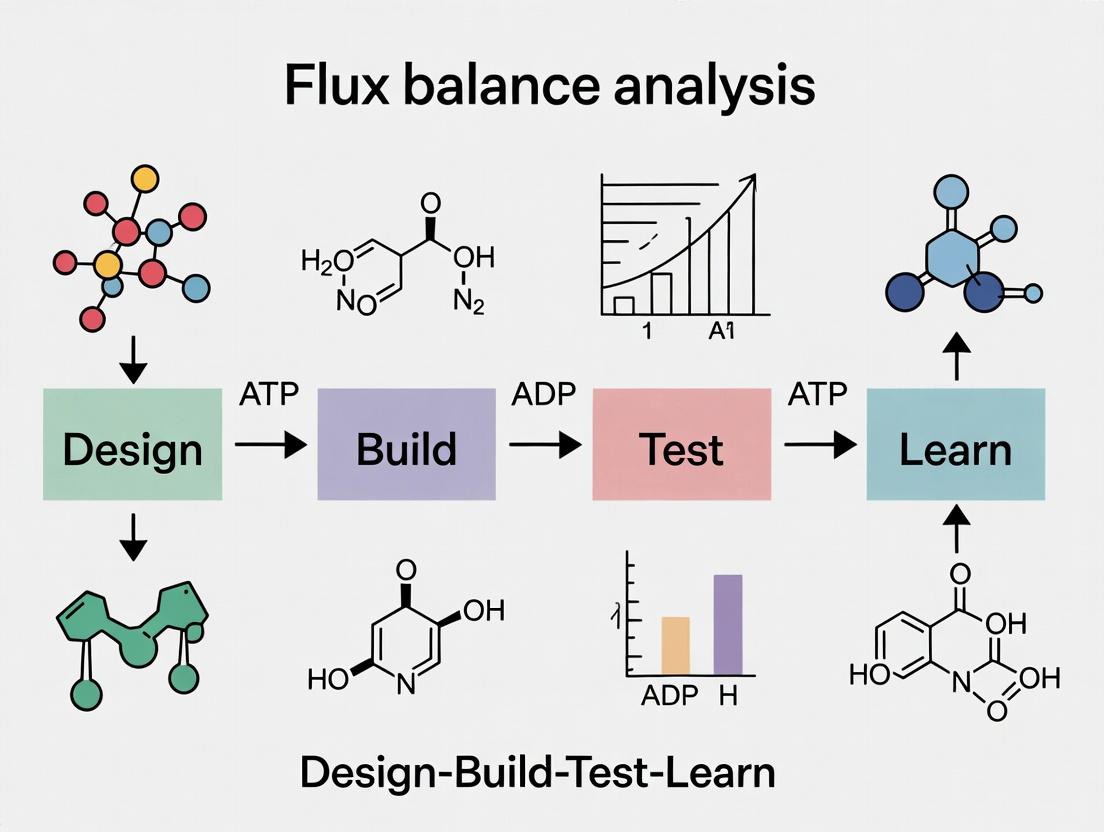
This article explores the critical role of Flux Balance Analysis (FBA), a core computational systems biology tool, within the iterative Design-Build-Test-Learn (DBTL) framework.
Flux Balance Analysis in the DBTL Cycle: Accelerating Metabolic Engineering and Drug Discovery
Abstract
This article explores the critical role of Flux Balance Analysis (FBA), a core computational systems biology tool, within the iterative Design-Build-Test-Learn (DBTL) framework. We provide a comprehensive guide tailored for researchers and drug development professionals, detailing how FBA informs metabolic model design, predicts optimal genetic modifications, and interprets omics data. The scope covers foundational principles, practical methodological applications within bioengineering workflows, strategies for troubleshooting model discrepancies, and comparative validation against experimental results. By synthesizing current methodologies and case studies, we demonstrate how FBA-powered DBTL cycles drastically reduce development timelines for microbial cell factories and novel therapeutic targets.
What is FBA and Why is it a Cornerstone of Modern DBTL Cycles?
The Design-Build-Test-Learn (DBTL) cycle is an iterative framework central to modern synthetic biology and metabolic engineering. It provides a structured, rational approach for the development of microbial cell factories, therapeutic proteins, and novel biosynthetic pathways. Within the context of Flux Balance Analysis (FBA), the DBTL cycle transforms from a conceptual loop into a quantitatively driven, predictive engine for bioengineering. FBA provides the mathematical backbone for the "Design" and "Learn" phases, enabling model-driven hypothesis generation and systematic interpretation of omics data, thereby accelerating the engineering of biological systems with desired phenotypes.
The DBTL Cycle Phases: Integration with Flux Balance Analysis
Table 1: Phases of the DBTL Cycle with FBA Integration
| Phase | Core Activity | Key FBA & Computational Tools | Primary Output |
|---|---|---|---|
| Design | In silico model simulation and hypothesis generation. | Genome-scale metabolic models (GEMs), FBA, OptKnock, dFBA. | A set of genetic targets (e.g., gene knockouts, overexpression) predicted to optimize flux toward a desired product. |
| Build | Physical genetic engineering of the biological system. | DNA synthesis, CRISPR-Cas9, MAGE, automated strain engineering platforms. | A library of genetically distinct microbial strains or cell lines. |
| Test | Phenotypic characterization of engineered constructs. | High-throughput screening, LC-MS, RNA-Seq, exo-metabolomics, extracellular flux analyzers. | Quantitative multi-omics data (fluxomics, transcriptomics, metabolomics) and product titers/yields. |
| Learn | Data integration and model refinement to inform the next cycle. | Constraint-based reconstruction and analysis (COBRA), Machine Learning (ML), omics data integration into GEMs (e.g., rFBA). | Refined GEM, new mechanistic insights, and a new, improved set of design hypotheses. |
Detailed Protocols
Protocol 1:In SilicoStrain Design Using FBA and OptKnock
Objective: To computationally identify gene knockout combinations that maximize product yield while maintaining cellular growth.
- Model Preparation: Acquire or reconstruct a genome-scale metabolic model (GEM) for your host organism (e.g., E. coli iJO1366, S. cerevisiae iMM904).
- Define Objective Functions: Set the primary objective to
Biomass_reaction. Define a secondary reaction representing your target product (e.g.,EX_succ_efor succinate). - Run OptKnock Simulation: Use the COBRA Toolbox (MATLAB) or cobrapy (Python). Implement a bilevel optimization where the outer layer maximizes product flux, and the inner layer maximizes biomass flux subject to gene knockout constraints.
- Output Analysis: The algorithm returns a set of reaction/gene knockouts predicted to couple product synthesis with growth. Rank solutions by predicted product yield and growth rate.
Protocol 2: High-Throughput Exo-metabolomic Profiling for DBTL
Objective: To rapidly quantify extracellular metabolite fluxes (exo-metabolome) of engineered strain libraries.
- Cultivation: Inoculate 96-well deep-well plates with strains from the Build phase. Use defined medium. Grow in a plate reader or incubator with shaking.
- Sample Collection: At defined timepoints (exponential and stationary phase), centrifuge plates (4000 x g, 10 min, 4°C).
- Metabolite Extraction: Transfer 100 µL of supernatant to a new 96-well plate. Add 400 µL of cold (-20°C) 80% methanol with internal standards (e.g., 13C-labeled amino acids) for metabolite quenching and extraction.
- LC-MS Analysis:
- Chromatography: Use a HILIC column (e.g., SeQuant ZIC-pHILIC). Mobile phase A: 20mM ammonium carbonate in water; B: acetonitrile. Gradient: 80% B to 20% B over 15 min.
- Mass Spectrometry: Operate in negative/positive electrospray ionization mode with full-scan (m/z 70-1000) on a high-resolution MS (e.g., Q-Exactive).
- Data Processing: Use software (e.g., XCMS, MS-DIAL) for peak alignment, picking, and annotation against standard libraries. Calculate uptake/secretion rates from concentration time-courses.
Visualizations
Diagram 1: DBTL Cycle Powered by FBA and GEMs
Diagram 2: Core FBA Workflow for DBTL Design Phase
The Scientist's Toolkit: Key Research Reagent Solutions
Table 2: Essential Reagents and Materials for DBTL Experiments
| Item | Function in DBTL Cycle | Example Product/Kit |
|---|---|---|
| Genome-Scale Metabolic Model | Foundational in silico tool for the Design and Learn phases. | E. coli iML1515, Yeast 8.4, Human1 from public repositories (BiGG, VMH). |
| CRISPR-Cas9 System | Enables precise, multiplexed genome editing in the Build phase. | Alt-R S.p. HiFi Cas9 Nuclease V3 (IDT), plasmid kits (pCAS, pTargetF). |
| Automated DNA Assembler | High-throughput cloning and assembly for genetic part libraries. | Gibson Assembly Master Mix, Golden Gate Assembly Kit (NEB). |
| Defined Microbial Media | Essential for reproducible cultivation and accurate FBA model constraints. | M9 Minimal Medium, MOPS EZ Rich Defined Medium (Teknova). |
| Extracellular Flux Analyzer | Measures real-time metabolic fluxes (e.g., OCR, ECAR) in the Test phase. | Seahorse XFe96 Analyzer (Agilent). |
| Metabolomics Standard Kit | For absolute quantification of metabolites in LC-MS based flux analysis. | MxP Quant 500 Kit (Biocrates). |
| RNAseq Library Prep Kit | Generates transcriptomic data for integrative learning with GEMs (e.g., rFBA). | NEBNext Ultra II Directional RNA Library Prep Kit (NEB). |
| COBRA Software Suite | Primary computational tool for running FBA and related algorithms. | COBRA Toolbox (MATLAB), cobrapy (Python). |
Flux Balance Analysis (FBA) is a cornerstone computational method in systems biology and metabolic engineering. Within the Design-Build-Test-Learn (DBTL) cycle, FBA serves as a critical "Design" and "Learn" tool. It enables the in silico prediction of optimal metabolic fluxes for a desired biochemical objective (e.g., maximal growth or target compound production), guiding the engineering of microbial cell factories. After experimental testing ("Test"), FBA models are refined with new data ("Learn"), creating an iterative loop for strain optimization—a core paradigm in modern drug development for producing therapeutic precursors, antibiotics, and biologics.
Core Principles and Mathematical Foundation
FBA is based on leveraging the stoichiometric matrix of a metabolic network to calculate the flow of metabolites through biochemical reactions (fluxes) under steady-state conditions.
Mathematical Foundation:
- Stoichiometric Matrix (S): An m x n matrix where m is the number of metabolites and n is the number of reactions. Each element ( S_{ij} ) represents the stoichiometric coefficient of metabolite i in reaction j (negative for substrates, positive for products).
- Flux Vector (v): An n-dimensional vector containing the flux (reaction rate) of each reaction in the network.
- Mass Balance Constraint: At steady-state, the production and consumption of each intracellular metabolite are balanced. This is expressed as: [ S \cdot v = 0 ]
- Objective Function: A linear combination of fluxes to be maximized or minimized (e.g., biomass formation, ATP production). Represented as ( Z = c^{T}v ), where ( c ) is a vector of weights.
- Flux Constraints: Upper and lower bounds (( v{min} ) and ( v{max} )) are set for each reaction based on thermodynamic irreversibility and measured uptake/secretion rates: ( v{min} \leq v \leq v{max} ).
The FBA problem is formulated as a Linear Programming (LP) optimization: [ \begin{aligned} & \text{Maximize (or Minimize)} & Z = c^{T}v \ & \text{subject to} & S \cdot v = 0 \ & & v{min} \leq v \leq v{max} \end{aligned} ]
Key Assumptions and Limitations
The power of FBA arises from simplifying assumptions, which also define its limitations.
Table 1: Core Assumptions of Classical FBA
| Assumption | Description | Implication/Limitation |
|---|---|---|
| Steady-State | Intracellular metabolite concentrations do not change over time. | Applicable to balanced growth conditions, not transient states. |
| Mass Balance | Only stoichiometry governs metabolite turnover; no explicit kinetics. | Predicts flux distributions but not metabolite concentrations or dynamic responses. |
| Optimality | The network is evolved/engineered to optimize a defined biological objective. | Predictions may fail if cells are not optimal or if the wrong objective is chosen. |
| Network Completeness | The reconstructed metabolic network contains all relevant reactions. | Gaps or errors in the reconstruction lead to incorrect predictions. |
| Constraint Linearity | System constraints (bounds, mass balance) are linear. | Cannot directly model enzyme saturation or regulatory feedback. |
Application Notes & Protocols
Protocol 1: Performing a Standard FBA Simulation for Growth Prediction
Objective: Predict the maximal growth rate of E. coli under aerobic, glucose-limited conditions.
Materials & Computational Tools:
- Reconstructed Genome-Scale Model (GEM): e.g., E. coli iML1515 or a similar model (SBML format).
- Software Environment: COBRA Toolbox (MATLAB), COBRApy (Python), or similar.
- Solver: A Linear Programming solver (e.g., GLPK, CPLEX, Gurobi).
Procedure:
- Load Model: Import the SBML file of the metabolic reconstruction into your chosen software environment.
- Define Medium: Set the lower bounds of exchange reactions to define the extracellular environment. For minimal glucose medium:
- Set lower bound of
EX_glc__D_eto -10 mmol/gDW/h (uptake). - Set lower bound of
EX_o2_eto -20 mmol/gDW/h. - Set all other carbon source exchange reactions to 0 (no uptake).
- Set lower bound of
- Set Objective: Define the biomass reaction (e.g.,
BIOMASS_Ec_iML1515_core_75p37M) as the objective function to be maximized. - Apply Constraints: Ensure thermodynamic constraints are applied (irreversible reactions have a lower bound of 0).
- Run FBA: Execute the linear programming optimization to maximize the biomass objective.
- Extract Solution: The optimal growth rate (objective value) and the complete flux distribution (
v) are retrieved for analysis.
Protocol 2:In SilicoGene Knockout Simulation
Objective: Identify gene deletion targets to maximize succinate production in E. coli.
Procedure:
- Prepare Wild-Type Model: Load the model and set conditions for anaerobic growth on glucose.
- Redefine Objective: Change the objective function from biomass to the succinate exchange reaction (
EX_succ_e). - Implement Knockout: Use the
singleGeneDeletionfunction (or equivalent). This algorithm sets the fluxes of all reactions catalyzed by the gene product to zero. - Run Simulation: Perform FBA with the new constraints to calculate the maximal succinate production for each knockout.
- Rank Targets: Compare production yields (succinate produced per glucose consumed) across all single-gene knockouts. Top candidates often include genes in competing pathways (e.g.,
pflB,ldhA,pta-ackA).
The Scientist's Toolkit: Research Reagent Solutions
Table 2: Essential Resources for FBA Research
| Item | Function in FBA Research |
|---|---|
| Genome-Scale Metabolic Model (GEM) [SBML File] | The core computational representation of an organism's metabolism, containing stoichiometric data for all known reactions, genes, and metabolites. |
| COBRA Toolbox / COBRApy | Standard software suites providing functions for constraint-based reconstruction and analysis, including loading models, running FBA, and performing knockouts. |
| Linear Programming (LP) Solver | Computational engine (e.g., Gurobi, CPLEX) that performs the numerical optimization to find the flux distribution that maximizes the objective function. |
| Biolog Phenotype MicroArray Data | Experimental data on substrate utilization and chemical sensitivity, used to validate and refine model predictions of growth phenotypes. |
| 13C-Metabolic Flux Analysis (13C-MFA) Data | Gold-standard experimental flux measurements using isotopic tracers. Used for rigorous validation of in silico FBA predictions. |
| Gene Knockout Strain Library | Physical collection of strains (e.g., Keio collection for E. coli). Essential for experimentally testing in silico predicted knockout phenotypes in the "Test" phase of DBTL. |
Visualizations
DBTL Cycle with FBA Integration
FBA Mathematical Workflow
Within the Design-Build-Test-Learn (DBTL) cycle for metabolic engineering and drug discovery, Flux Balance Analysis (FBA) is a cornerstone computational method for predicting organism behavior. However, the predictive accuracy of FBA is entirely dependent on the quality of the underlying genome-scale metabolic model (GEM). The reconstruction of this metabolic network from genomic data is therefore a critical, foundational step. This protocol outlines the systematic process of transforming annotated genomic data into a computational-ready metabolic network, setting the stage for robust FBA simulations within a DBTL framework.
Application Notes: Key Principles & Challenges
Core Principles:
- Genome-Centric Basis: Reconstruction is initiated from a high-quality, annotated genome sequence. Each metabolic reaction must be linked to genetic evidence (e.g., EC number, Gene Ontology term).
- Iterative Curation: The process is inherently iterative, involving continuous gap-filling, manual curation, and validation against experimental data.
- Standardization: Employing community standards (e.g., MIRIAM compliance, use of identifiers from databases like MetaCyc, KEGG, ChEBI) is essential for model sharing, reproducibility, and integration.
Primary Challenges:
- Gap Identification: Automated annotations often miss promiscuous enzymes, pathways involving non-canonical chemistry, or species-specific reactions.
- Compartmentalization: Correctly assigning intracellular localization (cytosol, mitochondria, peroxisome) is difficult but critical for accurate simulation.
- Biomass Definition: Formulating a biologically accurate biomass reaction that reflects the macromolecular composition of the target organism/cell type is non-trivial.
Protocol: A Step-by-Step Guide for Metabolic Network Reconstruction
This protocol describes a standardized workflow for draft reconstruction and refinement.
Stage 1: Automated Draft Reconstruction
- Objective: Generate a preliminary, genome-informed network.
- Input: Annotated genome file (e.g., GenBank, GFF format).
- Tools: KBase, ModelSEED, RAVEN Toolbox, CarveMe.
- Method:
- Upload genome annotation to the chosen platform.
- Map annotated genes to reaction databases via enzyme commission (EC) numbers or orthology.
- Generate a draft network comprising all associated reactions, including transport and exchange reactions.
- Define a preliminary biomass objective function based on literature or phylogenetically similar organisms.
Stage 2: Network Curation and Refinement (Manual)
- Objective: Transform the draft into a high-fidelity, functional model.
- Input: Draft reconstruction in SBML format.
- Tools: Cobrapy (Python), COBRA Toolbox (MATLAB), Escher for visualization.
- Method:
- Gap Analysis: Perform flux variability analysis (FVA) on the draft model to identify dead-end metabolites and blocked reactions.
- Gap Filling: Propose and add missing reactions to connect disconnected network parts, using:
- Biochemical literature on the organism.
- Pathway databases (MetaCyc, KEGG).
- Phylogenetic analysis of related organisms.
- Compartmentalization: Review and correct reaction localization using proteomic or literature evidence.
- Biomass Refinement: Update the biomass reaction composition with organism-specific data (e.g., lipid, protein, carbohydrate fractions).
- Charge & Mass Balance: Verify that all reactions are stoichiometrically balanced for mass and charge.
Stage 3: Validation and Debugging
- Objective: Ensure the model produces biologically plausible phenotypes.
- Input: Curated reconstruction.
- Method:
- Essentiality Test: Simulate single gene knockouts in silico and compare growth predictions with known essential gene data.
- Phenotype Comparison: Under defined in silico media conditions, compare predicted growth/no-growth outcomes, substrate utilization patterns, or byproduct secretion with published experimental data (e.g., from Phenotype Microarrays).
- Network Topology Analysis: Calculate properties like connectivity and pathway redundancy.
Data Presentation
Table 1: Comparison of Automated Reconstruction Platforms
| Platform/Tool | Primary Method | Input Required | Key Output | Best For |
|---|---|---|---|---|
| ModelSEED | RAST annotation & reaction mapping | Genome sequence or RAST ID | Draft SBML Model | High-throughput draft generation |
| KBase | Integrated suite (ModelSEED, etc.) | Genome/Annotation | Draft Model & App workflows | Collaborative, reproducible pipelines |
| CarveMe | Universal model carving | Protein sequences (.faa) | SBML Model (curated) | Consistent, gap-filled draft models |
| RAVEN Toolbox | Orthology-based (KEGG/MetaCyc) | Annotated genome | Draft MATLAB structure | Customization within MATLAB environment |
Table 2: Common Network Statistics for Validated Genome-Scale Models
| Metric | E. coli (iML1515) | S. cerevisiae (iMM904) | H. sapiens (Recon3D) | Typical Range for Bacteria |
|---|---|---|---|---|
| Genes | 1,517 | 1,046 | 2,235 | 500 - 2,500 |
| Metabolites | 1,877 | 1,567 | 4,140 | 800 - 2,500 |
| Reactions | 2,712 | 1,578 | 10,600 | 1,000 - 3,500 |
| Compartments | 5 | 5 | 8 | 2 - 8 |
Diagrams
The Scientist's Toolkit
Table 3: Key Reagents & Resources for Metabolic Reconstruction
| Item | Function/Application | Example/Source |
|---|---|---|
| Annotated Genome | The foundational data source. Requires high-quality gene calls and functional predictions. | NCBI GenBank, RAST, Prokka annotation output. |
| Reaction Database | Provides standardized biochemical reaction templates with metabolite IDs. | MetaCyc, KEGG, Rhea, BiGG Models. |
| Metabolite Database | Provides chemical structures, formulas, and charges for mass/charge balancing. | ChEBI, PubChem, HMDB. |
| Curation Software | Enables manual editing, simulation, and analysis of network models. | COBRApy (Python), COBRA Toolbox (MATLAB). |
| SBML File | The standard exchange format for computational models. Essential for sharing and tool interoperability. | Systems Biology Markup Language (SBML) Level 3, Version 1. |
| Phenotype Data | Used for critical model validation and parameterization (e.g., growth rates, uptake/secretion rates). | Literature, Biolog Phenotype Microarrays, experimental lab data. |
Flux Balance Analysis (FBA) is a cornerstone constraint-based modeling approach used to predict metabolic flux distributions in biological systems. Within the Design-Build-Test-Learn (DBTL) cycle for metabolic engineering and drug target discovery, FBA provides critical quantitative predictions that guide hypothesis generation and experimental design. This protocol details the application of FBA to generate its three key predictive outputs: growth rates, product yields, and system-wide flux maps, contextualized within iterative DBTL research.
Table 1: Key Quantitative Outputs from a Standard FBA Simulation
| Output Type | Symbol | Unit | Description | Typical Application in DBTL |
|---|---|---|---|---|
| Growth Rate | μ | hr⁻¹ | Predicted biomass production rate. | Test Phase: Compare with measured growth to validate model. Learn Phase: Identify growth-coupled production strategies. |
| Product Yield | Yp/s | mmol gDW⁻¹ hr⁻¹ | Moles of target metabolite produced per gram of substrate consumed. | Design Phase: Evaluate theoretical yield of a design. Learn Phase: Assess impact of genetic modifications. |
| Flux Distribution | v | mmol gDW⁻¹ hr⁻¹ | A vector of all reaction fluxes in the network at optimality. | Learn Phase: Identify key pathway usage, bottlenecks, and alternative pathways. |
Table 2: Example FBA Output for E. coli on Glucose (Minimal Media)
| Objective Function | Predicted Growth (hr⁻¹) | Max Theoretical Succinate Yield (mmol/g Glucose) | Key Flux (mmol gDW⁻¹ hr⁻¹) |
|---|---|---|---|
| Maximize Biomass | 0.85 | 1.12 | Glucose Uptake: 10.0 |
| Maximize Succinate Production | 0.10 | 10.0 (Constraint: >0.05 hr⁻¹ growth) | Succinate Export: 5.0 |
Protocol: Predicting Growth and Yield with FBA
Materials & Software
- Genome-Scale Model (GEM): A stoichiometric matrix (S) of m metabolites and n reactions, with associated gene-protein-reaction (GPR) rules.
- Constraints: Vector (b) of lower (
lb) and upper (ub) bounds for allnreactions (e.g., uptake rates). - Objective Vector (c): A binary vector defining the reaction(s) to be optimized (e.g., biomass reaction).
- Solver: Linear programming (LP) solver (e.g., GLPK, CPLEX, Gurobi).
- Platform: COBRA Toolbox (MATLAB), COBRApy (Python), or similar.
Step-by-Step Procedure
Step 1: Model Setup and Constraining
- Load the GEM (e.g.,
iML1515for E. coli). - Set the environmental constraints:
- Define the carbon source uptake (e.g., glucose:
EX_glc__D_elb = -10mmol gDW⁻¹ hr⁻¹). - Set oxygen uptake if applicable (
EX_o2_e). - Close all other exchange reactions for a minimal medium (
lb = 0).
- Define the carbon source uptake (e.g., glucose:
- Set the objective function, typically the biomass reaction (
BIOMASS_Ec_iML1515_core_75p37M).
Step 2: Perform FBA
- Solve the linear programming problem: Maximize cᵀv subject to S·v = 0 and lb ≤ v ≤ ub.
- The primary output is the optimal objective value (e.g., maximal growth rate, μ_max).
- The full flux vector (v) is the flux distribution.
Step 3: Yield Calculation
- From the optimized flux vector, identify the substrate uptake flux (
v_substrate). - Identify the product formation/secretion flux (
v_product). - Calculate the yield: Yp/s = vproduct / |vsubstrate|.
Step 4: Flux Variability Analysis (FVA) for Robustness
- Fix the objective function at a high percentage (e.g., 99%) of its optimal value.
- For each reaction in the network, solve two LPs: maximize and minimize its flux subject to the constrained objective.
- This identifies the range of possible fluxes for each reaction while maintaining near-optimal growth/yield, highlighting flexible and rigid nodes in the network.
FBA Protocol in the DBTL Cycle
Protocol: Analyzing Metabolic Flux Distributions
Materials
- Optimized flux vector (v) from FBA.
- Pathway mapping database (e.g., MetaCyc, KEGG).
- Visualization software (e.g., Escher, CytoScape).
Procedure for Flux Map Analysis
Step 1: Parse and Normalize Fluxes
- Filter reactions with zero or negligible flux (|v| < ε, e.g., ε = 1e-6).
- Normalize fluxes for visualization, often relative to substrate uptake rate (divide all v by |v_substrate|).
Step 2: Map to Central Carbon Pathways
- Identify reactions belonging to glycolysis, TCA cycle, pentose phosphate pathway, etc.
- Create a data table linking reaction ID, flux value, pathway, and gene association.
Step 3: Identify Critical Nodes and Bottlenecks
- High-Flux Nodes: Reactions carrying >80% of input carbon, indicating major metabolic highways.
- Choke Points: Essential reactions with zero (or minimal) flux variability from FVA, indicating potential regulatory or thermodynamic constraints.
- Alternative Pathways: Assess parallel pathways (e.g., ED vs. EMP glycolysis) to identify non-active routes that could be engineered.
Step 4: Generate Flux Map Diagram
- Use the following DOT script as a template for a subsystem flux map.
Example Central Carbon Flux Distribution
The Scientist's Toolkit: Research Reagent Solutions
Table 3: Essential Materials for Integrating FBA with DBTL Experiments
| Item / Reagent | Function in Context | Example / Specification |
|---|---|---|
| Genome-Scale Metabolic Model | The in-silico representation of the organism's metabolism for FBA simulations. | E. coli: iML1515 or EcoCyc. S. cerevisiae: Yeast8 or iMM904. |
| Constraint-Based Modeling Suite | Software to perform FBA, FVA, and related analyses. | COBRA Toolbox (MATLAB), COBRApy (Python), Raven Toolbox. |
| Chemically Defined Growth Media | Essential for translating FBA predictions (which use precise uptake rates) to lab experiments. | M9 minimal media (bacteria), Synthetic Complete (yeast), with controlled carbon source concentration. |
| Continuous Cultivation System | Enables steady-state growth at a set dilution rate (μ), allowing direct comparison to FBA-predicted growth rates and fluxes. | Bioreactor or Chemostat with controlled feed and harvest. |
| Metabolite Assay Kits | Quantify extracellular substrate consumption and product formation rates to calculate experimental yields (Yp/s). | Glucose assay kit (hexokinase), Organic acid HPLC/MS assay, Enzymatic assay kits. |
| Isotope Tracers (e.g., ¹³C-Glucose) | Used in ¹³C-Metabolic Flux Analysis (MFA) to measure in vivo intracellular fluxes, providing the critical "Test" data to validate/refine the FBA model. | [1-¹³C]-, [U-¹³C]-Glucose. Required for advanced model validation in the Learn phase. |
| CRISPR or Lambda Red Toolkit | For precise genetic modifications (Build phase) suggested by FBA predictions (e.g., gene knockout, overexpression). | Specific to host organism (e.g., pKO3 for E. coli gene knockouts). |
Application Notes: The Role of FBA in the DBTL Cycle
Flux Balance Analysis (FBA) is a cornerstone computational method in systems biology and metabolic engineering, serving as the critical "Learn" component in the Design-Build-Test-Learn (DBTL) cycle. By integrating quantitative omics data from the "Test" phase, FBA generates actionable hypotheses that directly inform the subsequent "Design" phase, creating a closed-loop, iterative framework for strain and therapy development.
Core Function: FBA uses a genome-scale metabolic model (GEM) as a stoichiometric matrix to calculate steady-state reaction fluxes that optimize a defined cellular objective (e.g., biomass production, target metabolite yield). After experimental testing of a designed microbial strain or cell line, FBA assimilates the resulting data (e.g., growth rates, substrate uptake, byproduct secretion) to:
- Validate and refine the model.
- Identify unforeseen metabolic bottlenecks or suboptimal flux distributions.
- Predict genetic and environmental modifications to improve system performance.
Key Outputs for Next Design:
- Identification of over- or under-expressed reaction pathways.
- Prediction of gene knockout/knockdown or overexpression targets.
- Discovery of alternative substrate utilization pathways.
- Elucidation of competing metabolic reactions that divert flux from the desired product.
Quantitative Impact of FBA-Guided Learning in DBTL Cycles: Table 1: Representative Improvements from FBA-Informed Design Iterations
| Product/Organism | Initial Titer (g/L) | After FBA-Informed Redesign (g/L) | Key FBA-Predicted Modification | Primary Reference (Year) |
|---|---|---|---|---|
| Succinate (E. coli) | 10.2 | 30.4 | Deletion of competing acetate & lactate pathways | Jantama et al. (2008) |
| Lycopene (S. cerevisiae) | 2.5 | 8.9 | Upregulation of MVA pathway, redox cofactor balancing | Chen et al. (2020) |
| PHB Bioplastic (C. necator) | 15 | 45 | Optimization of NADPH/ATP flux in central metabolism | Liu et al. (2022) |
| Therapeutic mAb (CHO Cell) | 1.2 | 3.5 | Identification of glutamine limitation and overflow | Kyriakopoulos et al. (2018) |
Detailed Experimental Protocols
Protocol 2.1: Integrating RNA-Seq Data with FBA to Inform Knockout Strategies
Objective: To use transcriptomic data from a tested strain to constrain a GEM and predict gene knockout targets that increase yield of a target compound.
Materials: See "The Scientist's Toolkit" below. Duration: 2-3 days computational analysis.
Procedure:
- Data Acquisition & Preprocessing:
- Obtain RNA-Seq data (FPKM or TPM values) from the engineered strain cultivated under test conditions.
- Map transcript abundances to corresponding metabolic reactions in the GEM using a gene-protein-reaction (GPR) association matrix.
- Normalize expression data to a reference condition (e.g., wild-type strain).
Model Constraint via Transcriptomic Integration:
- Apply a method such as E-Flux or OMNI to convert expression data into constraints for reaction flux bounds (vi).
- For each reaction i, set the upper bound: vi, max = k * Ei, where Ei is the normalized expression level and k is a scaling factor.
- Maintain the default lower bound for reversible reactions or set to 0 for irreversible reactions.
In Silico Knockout Simulation & Target Identification:
- Perform single- and double-gene knockout simulations using the constrained model.
- For each knockout, run FBA maximizing for product secretion flux.
- Rank knockout candidates by the predicted increase in product yield while ensuring non-zero growth flux (maintain >10% of wild-type prediction).
- Validate essentiality predictions against essential gene databases (e.g., DEG).
Output for Next Design Cycle:
- Generate a prioritized list of gene knockout targets.
- Provide the predicted flux redistribution map highlighting the resolved bottleneck.
Protocol 2.2: FBA-Guided Media Optimization for Mammalian Cell Bioprocessing
Objective: To use FBA and exo-metabolomic data to identify nutrient limitations and design an optimized feed medium for increased monoclonal antibody (mAb) production in CHO cells.
Materials: See "The Scientist's Toolkit" below. Duration: 3-4 days computational analysis.
Procedure:
- Model Contextualization:
- Acquire a CHO cell-specific GEM (e.g., iCHO1766).
- Set the objective function to maximize biomass production, while adding a maintenance ATP requirement.
Integration of Test-Phase Data:
- Input measured exchange fluxes (uptake/secretion rates) for key metabolites (glucose, glutamine, lactate, ammonia, amino acids) from bioreactor experiments.
- Constrain the model's exchange reaction bounds to the measured ranges (±10%).
- Constrain the mAb production reaction to the measured specific production rate.
Flux Variability Analysis (FVA) and Bottleneck Identification:
- Perform FVA on the constrained model to identify reactions with low variability (tightly constrained) near their upper bounds—these are potential bottlenecks.
- Analyze the shadow prices of nutrients. A high shadow price indicates that increasing the availability of that nutrient would significantly increase the objective function (biomass or product).
In Silico Media Design:
- Systematically relax the upper bounds of nutrients with high shadow prices (e.g., cysteine, tyrosine).
- Re-run FBA to predict the increase in biomass and product formation.
- Simulate the effect of adding specific nutrient combinations, avoiding the predicted accumulation of inhibitory byproducts (e.g., lactate).
Output for Next Design Cycle:
- Propose an optimized medium formulation with adjusted concentrations of key nutrients.
- Suggest a feeding strategy based on predicted depletion timelines.
Visualization: Pathways and Workflows
FBA as the Learn Phase in the DBTL Cycle
FBA Integrates Test Data to Inform Design
The Scientist's Toolkit: Essential Research Reagents & Solutions
Table 2: Key Materials for FBA-Guided 'Learn' Phase Experiments
| Item Name & Vendor Example | Function in Protocol |
|---|---|
| Genome-Scale Metabolic Model (GEM)(e.g., BiGG Models, MetaNetX) | Stoichiometric reconstruction of metabolism. Serves as the computational scaffold for all FBA simulations. |
| Constraint-Based Modeling Software(e.g., COBRApy, RAVEN Toolbox) | Programming environment to load models, integrate data, perform FBA, FVA, and knockout simulations. |
| Transcriptomic Data(e.g., RNA-Seq aligned reads, TPM matrix) | Used to infer enzyme capacity and constrain reaction fluxes in the model (Protocol 2.1). |
| Exo-Metabolomic Data(e.g., HPLC/MS measurements of extracellular metabolites) | Provides experimental exchange flux constraints for precise model contextualization (Protocol 2.2). |
| Gene Essentiality Database(e.g., DEG, OGEE) | Reference data for validating model-predicted gene knockouts and avoiding lethal designs. |
| High-Performance Computing (HPC) Cluster | Enables large-scale computational simulations (e.g., all double knockouts) in a feasible time frame. |
| Strain Engineering Kit(e.g., CRISPR-Cas9 plasmids, homology templates) | Required to implement the FBA-predicted genetic modifications in the subsequent Build phase. |
Flux Balance Analysis (FBA) has undergone a radical transformation from a specialized academic methodology in systems biology to a cornerstone industrial technology. Within the Design-Build-Test-Learn (DBTL) cycle, FBA now serves as the primary in silico Design and Learn engine. Its core value lies in predicting metabolic flux distributions in genome-scale metabolic models (GEMs) under given physiological and genetic constraints, enabling model-driven strain and process optimization.
Key Evolutionary Milestones
The table below summarizes the quantitative shift in FBA's scope and impact over the past decades.
Table 1: Evolution of FBA Scale and Application
| Era | Primary User | Typical Model Size (Genes/Reactions) | Primary Output | Industrial Application |
|---|---|---|---|---|
| 1990s-2000s (Academic) | Systems Biologists | ~500 / ~600 (e.g., E. coli core) | Theoretical flux maps, hypothesis generation | None |
| 2010s (Transition) | Metabolic Engineers | ~1,000-2,000 / ~1,500-2,500 | Prediction of gene knockout targets | Pilot-scale biochemical production |
| 2020s (Industrial) | Bioprocess Engineers, Drug Developers | >5,000 / >10,000 (e.g., human RECON3D) | Strain design, media optimization, drug target identification | Commercial production of therapeutics, chemicals, and fuels |
Protocols: Integrating FBA into the DBTL Cycle
Protocol:In SilicoStrain Design for Metabolite Overproduction
Application: Design of a microbial chassis for high-yield production of a target compound (e.g., an antibiotic precursor).
Research Reagent Solutions & Essential Materials:
| Item | Function in Protocol |
|---|---|
| Genome-Scale Model (GEM) | A computational representation of organism metabolism (e.g., iML1515 for E. coli). |
| Constraint-Based Reconstruction and Analysis (COBRA) Toolbox | MATLAB/Python software suite for performing FBA and related simulations. |
| Linear Programming (LP) Solver | Software (e.g., Gurobi, CPLEX) to solve the optimization problem at FBA's core. |
| Relevant -Omics Datasets | Transcriptomic or proteomic data to apply context-specific constraints. |
| Biolog Phenotype Microarray Data | Experimental data on substrate utilization to validate and refine model predictions. |
Methodology:
- Model Curation: Load the appropriate GEM. Set constraints: exchange reaction bounds based on defined growth medium; glucose uptake = -10 mmol/gDW/hr; oxygen uptake = -20 mmol/gDW/hr.
- Objective Definition: Set the biomass reaction as the objective function for wild-type growth simulation. Perform FBA to validate base model growth rate.
- Intervention Design: Use algorithms like OptKnock (for gene knockouts) or OptForce (for up/down-regulations) to couple biomass formation with production of the target metabolite.
- Simulation & Scoring: Simulate all proposed genetic interventions. Rank designs based on predicted yield (mol product / mol substrate), productivity, and growth rate.
- Output for Build Phase: Generate a list of target gene knockouts (KO), knock-ins (KI), or regulatory changes for experimental implementation.
Diagram Title: FBA-Driven Strain Design Workflow
Protocol: Context-Specific Model Creation for Drug Target Identification
Application: Generate a tissue- or disease-specific metabolic model to identify potential drug targets in cancer or pathogenic infections.
Methodology:
- Data Integration: Start with a generic human GEM (e.g., RECON3D). Integrate high-throughput transcriptomic data (RNA-Seq) from the target tissue (e.g., tumor vs. normal).
- Algorithmic Reconstruction: Use algorithms like INIT (Integrative Network Inference for Tissues) or FASTCORE to extract a context-specific subnetwork. Reactions are included based on enzyme expression thresholds.
- Model Validation: Compare model-predicted essential genes and secretion/uptake profiles with established experimental data (e.g., essentiality screens from CRISPR libraries).
- Target Identification: Perform in-silico gene essentiality analysis (single and double knockouts) specifically in the disease model, while ensuring non-essentiality in a generic (or healthy tissue) model. Reactions essential only in the disease model are high-confidence drug targets.
- Output for Test/Learn: Generate a ranked list of candidate enzyme targets for in vitro and in vivo validation.
Diagram Title: Protocol for FBA-Based Drug Target Discovery
Industrial Workflow Integration
FBA is now embedded in automated, high-throughput DBTL platforms. The diagram below illustrates its role as the central computational module.
Diagram Title: FBA as the Core of the Industrial DBTL Cycle
Implementing FBA in Your DBTL Pipeline: A Step-by-Step Methodology
Application Notes
Flux Balance Analysis (FBA) is a cornerstone mathematical approach for analyzing metabolic networks, enabling the prediction of organism growth, metabolic yields, and optimal gene knockouts. Within the Design-Build-Test-Learn (DBTL) cycle for metabolic engineering and drug target discovery, FBA tools are indispensable in the Design and Learn phases. They allow for in silico design and hypothesis generation, which are later validated experimentally. This overview details three major software toolkits—COBRA, Merlin, and RAVEN—highlighting their specific roles, capabilities, and integration into modern research workflows.
The COBRA (Constraint-Based Reconstruction and Analysis) Toolbox is the most established platform, providing a MATLAB/SciPy-based suite for model reconstruction, simulation, and analysis. It is central for performing core FBA, parsimonious FBA (pFBA), and regulatory on/off minimization (ROOM). RAVEN (Reconstruction, Analysis, and Visualization of Metabolic Networks) is a complementary MATLAB toolbox, excelling in automated genome-scale model reconstruction from KEGG and MetaCyc databases and in gap-filling. Merlin is a standalone Java application specialized in the manual, expert-curated reconstruction of metabolic networks from genomic and bibliomic data, offering unparalleled control over the reconstruction process.
For drug development, these tools are used to model pathogen metabolism (e.g., Mycobacterium tuberculosis) to identify essential genes as potential novel drug targets. In industrial biotechnology, they are employed to design microbial cell factories for the optimized production of therapeutics like antibiotics or biotherapeutics.
Comparison of Key FBA Software Toolkits
Table 1: Quantitative and Functional Comparison of FBA Platforms
| Feature | COBRA Toolbox | Merlin | RAVEN Toolbox |
|---|---|---|---|
| Primary Language | MATLAB, Python | Java | MATLAB |
| Core Strength | Simulation & Analysis | Manual Curation & Reconstruction | Automated Reconstruction & Gap-Filling |
| Model Reconstruction | Manual, import from SBML | Extensive manual curation with genomic data integration | Highly automated from KEGG, MetaCyc, BioCyc |
| Key Algorithms | FBA, pFBA, ROOM, MoMA, FVA | Pathway analysis, compartmentalization, transport reaction mapping | getModel, gap-filling, metabolite names standardization |
| Visualization | Basic plots, flux maps | Detailed pathway maps | Metabolic maps, comparative genomics |
| Typical Model Size (Reactions) | 1,000 - 10,000+ | 500 - 3,000+ | 1,000 - 10,000+ |
| Integration with DBTL | High (Simulation for Design/Learn) | High (High-quality Design) | High (Rapid Design/Reconstruction) |
| License | Open Source (GPL) | Open Source (GPL) | Open Source (GPL) |
| Primary Citation (approx.) | ~7,000 (Becker et al., 2007) | ~250 (Dias et al., 2015) | ~700 (Wang et al., 2018) |
Essential Research Reagent Solutions
Table 2: Key Research Materials for FBA-Informed DBTL Cycles
| Item | Function in FBA/DBTL Context |
|---|---|
| Genome-Annotated Strain | Provides the genetic template for in silico model reconstruction (Merlin/RAVEN). |
| SBML File | Standardized XML format for exchanging and importing/exporting metabolic models between all platforms. |
| Curated Metabolic Database (e.g., KEGG, MetaCyc, BIGG) | Reference databases containing reaction stoichiometry, EC numbers, and metabolite IDs essential for reconstruction. |
| Fluxomic Data (13C or 15N tracing) | Experimental data used to constrain and validate model predictions in the Learn phase. |
| Gene Essentiality Data (Knockout Libraries) | Experimental phenotypic data used to benchmark model predictions of gene essentiality for drug targets. |
| Chemically Defined Growth Media | Enables precise definition of nutritional constraints in the FBA model, matching in vitro conditions. |
Experimental Protocols
Protocol 1:In SilicoGene Essentiality Screening for Drug Target Identification Using COBRApy
Objective: To identify essential metabolic genes in a pathogen (e.g., Pseudomonas aeruginosa) as potential novel drug targets.
Materials:
- Genome-scale metabolic model (GEM) of target organism in SBML format.
- COBRApy (Python version of COBRA toolbox) installed.
- Jupyter Notebook or Python IDE.
- List of exchange reactions defining in vitro growth medium conditions.
Methodology:
- Model Import and Preparation:
- Establish Wild-Type Growth Baseline:
- Perform Single-Gene Deletion Analysis:
- Identify Essential Genes:
- Validation and Prioritization:
- Compare list with essentiality databases (e.g., DEG).
- Check for homology to human genes to assess potential toxicity.
- Select genes with no human homolog as high-priority targets for the Build phase (e.g., CRISPR knockout).
Protocol 2:De NovoMetabolic Network Reconstruction Using Merlin
Objective: To reconstruct a compartmentalized genome-scale metabolic model from a newly sequenced fungal genome.
Materials:
- Merlin software (v4.0 or higher) installed.
- Fungal genome file (FASTA format) and its annotation (GFF3 format).
- Reference databases (local installs of KEGG, BIGG, ChEBI recommended).
- Bibliographic references on organism's physiology.
Methodology:
- Project Setup and Data Import:
- Launch Merlin and create a new project.
- Import the genomic FASTA and GFF3 annotation files via
Datasets > Genomics > Add DNA Sequence. - Perform ORF calling if annotations are unavailable.
- Functional Annotation & Reaction Assignment:
- Use the integrated BLAST to assign EC numbers to protein sequences against the Swiss-Prot/UniProt database.
- For each identified EC number, use
Reactions > Get reactions from EC numberto query KEGG/BIGG and add candidate reactions. - Manually review and curate each reaction, checking for mass and charge balance.
- Compartmentalization and Transport:
- Define relevant cellular compartments (e.g., cytosol, mitochondria, peroxisome, extracellular) via
Compartments. - Assign subcellular localization to proteins/enzymes using prediction tools (e.g., TargetP) or literature.
- Add transport reactions between compartments to allow metabolite exchange.
- Define relevant cellular compartments (e.g., cytosol, mitochondria, peroxisome, extracellular) via
- Biomass Reaction Formulation:
- Create a
Biomassreaction underMetabolites. - Add macromolecular precursors (amino acids, nucleotides, lipids) with experimentally determined or literature-derived coefficients.
- Create a
- Model Export and Validation:
- Generate and review detailed pathway maps within Merlin.
- Export the draft model in SBML format (
File > Export > SBML file). - Import the SBML into the COBRA Toolbox to perform sanity checks (e.g., check for blocked reactions, energy-generating cycles).
Protocol 3: Rapid Draft Model Reconstruction and Gap-Filling Using RAVEN
Objective: To quickly generate a functional draft model for a novel bacterium and fill gaps to enable growth simulation.
Materials:
- RAVEN Toolbox for MATLAB.
- KEGG ID of the target organism (or a closely related species).
- Annotated genome in .faa (protein sequence) format.
Methodology:
- Automated Draft Reconstruction:
- Define Biomass and Medium Constraints:
- Perform Gap-Filling:
- Model Refinement and Export:
- Use
checkModelStructto identify any structural issues. - Manually inspect and curate the list of added reactions from gap-filling.
- Export the functional draft model:
exportModel(draftModel, 'sbml', 'draftModel.xml');
- Use
Visualizations
FBA in the DBTL Cycle
COBRApy Gene Screening Workflow
RAVEN Reconstruction Workflow
Flux Balance Analysis (FBA) serves as the foundational computational Design phase in the iterative Design-Build-Test-Learn (DBTL) cycle for metabolic engineering and antimicrobial drug development. By leveraging genome-scale metabolic models (GEMs), FBA enables the in silico prediction of optimal genetic modifications to achieve desired phenotypes, such as enhanced biochemical production or the identification of essential genes as putative drug targets. This phase prioritizes candidates, drastically reducing the experimental burden in subsequent Build and Test phases.
Application Notes: Core Strategies & Quantitative Outcomes
Table 1: Primary FBA-Based Strategies for Strain Design and Target Identification
| Strategy | Objective | Key Algorithm/Approach | Typical Output Metrics |
|---|---|---|---|
| OptKnock | Design producer strains with coupled growth & production. | Bi-level optimization (max growth, then max product). | Product Yield (g/gDW), Growth Rate (1/h). |
| MoMA (Min. Metabolic Adjustment) | Predict flux states after gene knockout. | Quadratic programming; minimize Euclidean distance from wild-type flux. | Predicted Flux Distribution (mmol/gDW/h). |
| ROOM (Regulatory On/Off Minimization) | Predict flux states with regulatory constraints. | Mixed-integer linear programming; minimize significant flux changes. | Number of Flux Changes, Production Rate. |
| Gene Deletion Analysis | Identify essential & conditionally essential genes as drug targets. | Single/multiple gene knockout simulation. | Essentiality Score, Predicted Growth Impairment (%). |
| FVA (Flux Variability Analysis) | Assess flexibility of predicted fluxes. | Calculate min/max possible flux through each reaction. | Flux Range (min, max) for Target Reactions. |
Table 2: Example Quantitative Output from an E. coli Succinate Production Design Study
| Design Strategy | Target Gene Modifications | Predicted Max. Succinate Yield (mol/mol Glc) | Predicted Growth Rate (1/h) | Computational Time (s)* |
|---|---|---|---|---|
| Wild-Type | None | 0.09 | 0.85 | <1 |
| OptKnock | ΔldhA, ΔpflB | 1.10 | 0.45 | ~120 |
| MoMA-based | Δpta, ΔackA | 0.95 | 0.52 | ~45 |
| Gene Essentiality | murA knockout (target ID) | 0.00 (no growth) | 0.00 | <5 |
*Based on a model with ~2,300 reactions using COBRApy on a standard workstation.
Detailed Experimental Protocols
Protocol 3.1: In Silico Strain Design for Metabolite Overproduction using OptKnock Objective: To computationally design a strain with genetically coupled growth and metabolite production.
- Model Preparation: Load a curated GEM (e.g., iML1515 for E. coli) in a COBRA toolbox environment (COBRApy or MATLAB COBRA).
- Define Objective & Constraints: Set the biological objective to biomass reaction. Define environmental constraints (carbon source uptake, e.g., glucose at -10 mmol/gDW/h; oxygen uptake if applicable).
- Define Production Target: Add a demand reaction for the desired metabolite (e.g., succinate) to the model.
- Run OptKnock Simulation:
a. Specify the number of allowed gene/reaction knockouts (k), typically 3-5 for initial search.
b. Execute the bi-level optimization: Outer problem maximizes the product flux; inner problem maximizes the biomass flux given the knockouts.
c. Use the
optknockfunction (COBRApy) or equivalent. - Analyze Results: Extract the list of suggested gene deletions and the predicted coupled growth and production rates. Validate robustness using FVA.
Protocol 3.2: Target Identification via Gene Essentiality Analysis Objective: To identify genes essential for in silico growth under a defined condition as putative antimicrobial targets.
- Model & Condition Specification: Load the pathogen GEM (e.g., iYS854 for S. aureus). Set medium constraints to mimic infection-relevant conditions (e.g., limited iron, specific carbon sources).
- Single Gene Deletion Simulation:
a. For each gene g in the model, simulate a knockout by constraining all associated reaction fluxes to zero.
b. Re-optimize for biomass production.
c. Use the
single_gene_deletionfunction (COBRApy). - Calculate Essentiality Score: Compute the growth rate ratio: μko / μwt. Classify genes:
- Essential (ratio = 0 or < 0.01)
- Non-essential (ratio > 0.01).
- Prioritize Targets: Filter essential genes against a human metabolic model (e.g., Recon3D) to identify non-homologous targets, minimizing host toxicity. Prioritize genes with low flux variability (via FVA) for robustness.
Visualizations
Title: FBA's Role in the DBTL Cycle for Strain Design
Title: FBA Workflow for Drug Target Identification
The Scientist's Toolkit: Research Reagent Solutions
Table 3: Essential Tools for FBA-Based Design & Target ID
| Item / Solution | Function & Application in FBA Protocols |
|---|---|
| COBRApy (Python) | Primary software package for constraint-based reconstruction and analysis. Used to load models, run FBA, OptKnock, gene deletion, and FVA. |
| MATLAB COBRA Toolbox | Alternative platform for COBRA methods, preferred for some legacy models and algorithms. |
| Gurobi/CPLEX Optimizer | Commercial, high-performance mathematical optimization solvers. Integrated with COBRA tools to solve LP/MILP problems rapidly. |
| GLPK (GNU Linear Programming Kit) | Open-source alternative solver for LP problems, suitable for standard analyses. |
| Public Model Databases (BioModels, BIGG) | Source for curated, published genome-scale metabolic models (GEMs) in SBML format. |
| SBML (Systems Biology Markup Language) | Standard XML format for exchanging and loading metabolic models into analysis tools. |
| MEMOTE Testing Suite | Tool for assessing and ensuring the quality, consistency, and reproducibility of GEMs before use. |
| Jupyter Notebook | Interactive computational environment to document, share, and execute FBA protocols step-by-step. |
Within the Design-Build-Test-Learn (DBTL) cycle for metabolic engineering and drug discovery, Flux Balance Analysis (FBA) provides a powerful mathematical framework for predicting metabolic fluxes. However, classical FBA generates an underdetermined solution space. Integrating transcriptomic and proteomic data as constraints refines these models, transforming them from theoretical maps into context-specific, predictive tools. This application note details protocols for the systematic integration of omics data to constrain genome-scale metabolic models (GEMs), enhancing the "Learn" phase to inform the subsequent "Design" phase.
Core Methodologies and Application Notes
Transcriptomics-Driven Constraint: E-Flux and PROM
Transcriptomic data (e.g., from RNA-seq) indicates gene expression levels but not direct reaction fluxes. Two primary methods translate this data into metabolic constraints.
Application Note 1: E-Flux Protocol The E-Flux method assumes a monotonic relationship between transcript abundance and the maximum possible reaction flux.
- Data Preprocessing: Obtain normalized Transcripts Per Million (TPM) or Fragments Per Kilobase Million (FPKM) values for all genes in the GEM.
- Gene-to-Reaction Mapping: Map transcripts to reactions using the GEM's Gene-Protein-Reaction (GPR) rules. For isozymes, use the maximum expression. For complexes, use the minimum expression (the limiting subunit).
- Constraint Formulation: Set the upper bound (UB) for each reaction
ias:UB_i = (Expression_i / max(Expression_all)) * Original_UB_i. The lower bound is similarly scaled if reversible. - Model Simulation: Perform FBA or parsimonious FBA (pFBA) on the constrained model.
Protocol 1: PROM (Probabilistic Regulation of Metabolism) PROM uses a probabilistic framework to integrate expression data, often yielding more accurate predictions.
- Input: GEM (
S), normalized expression vector (E) for all genes, reference expression condition (E_ref). - Calculate Log-Fold Change:
LFC = log2(E / E_ref). - Estimate Reaction Probability: For each reaction
j, compute probabilityp_jfrom its associated GPR usingLFCvalues and a sigmoidal transformation function. - Apply Flux Constraints: Constrain the flux
v_jsuch that|v_j| ≤ p_j * Vmax_j, whereVmax_jis the thermodynamically derived maximum flux. - Solve: Maximize biomass or product yield under these constraints.
Table 1: Comparison of Transcriptomic Integration Methods
| Feature | E-Flux | PROM |
|---|---|---|
| Core Assumption | Monotonic relationship | Probabilistic regulation |
| GPR Handling | Deterministic (max/min) | Probabilistic (Boolean rules) |
| Primary Output | Direct flux bounds | Probabilistic flux bounds |
| Computational Cost | Low | Moderate-High |
| Best For | Rapid context-specific modeling | Quantitative, mechanistic predictions |
Proteomics-Driven Constraint: Direct kcat Integration
Proteomic data provides direct measurement of enzyme abundance, enabling more physiologically accurate constraints via enzyme-constrained FBA (ecFBA).
Protocol 2: Constructing an Enzyme-Constrained Model (ecModel)
- GEM Preparation: Start with a stoichiometric GEM (
S). - kcat Database Curation: Compile enzyme turnover numbers (
kcat) from databases (e.g., BRENDA, SABIO-RK) or apply machine learning estimators. - Add Enzyme Pool Constraints: For each enzyme
ecatalyzing reactioni, add a coupling constraint:v_i / kcat_{e,i} ≤ [E_e], where[E_e]is the measured or inferred enzyme concentration in mmol/gDW. - Integrate Quantitative Proteomics: Use mass spectrometry (e.g., LC-MS/MS) data to populate
[E_e]values. Convert protein abundances (mg/gDW) to concentrations (mmol/gDW) using molecular weights. - Global Proteomic Limit: Introduce a total protein mass constraint:
Σ ([E_e] * MW_e) ≤ P_total, whereP_totalis the measured total protein content per cell dry weight. - Solve ecFBA: Maximize objective (e.g., growth) subject to stoichiometric, enzyme, and total protein constraints.
Table 2: Key Parameters for ecFBA from Omics Data
| Parameter | Source | Typical Units | Example Value (E. coli) |
|---|---|---|---|
| Reaction Flux (v_i) | Model Solution | mmol/gDW/hr | 5.2 |
| Enzyme Abundance ([E]) | Quantitative Proteomics | mmol/gDW | 0.0015 |
| Turnover Number (kcat) | Literature/DB | 1/hr (or s⁻¹) | 65 s⁻¹ |
| Molecular Weight (MW) | Protein Sequence | g/mmol | 45,000 |
| Total Protein (P_total) | Experiment/Proteomics | mg/gDW | 550 |
The Scientist's Toolkit: Research Reagent Solutions
Table 3: Essential Materials for Omics-Constrained FBA Workflow
| Item / Reagent | Function in Workflow |
|---|---|
| RNA Extraction Kit (e.g., Qiagen RNeasy) | High-quality total RNA isolation for transcriptomics. |
| Stranded mRNA-Seq Library Prep Kit | Preparation of sequencing libraries from RNA for expression profiling. |
| LC-MS/MS Grade Solvents (ACN, Water, FA) | Mobile phases for high-resolution proteomic mass spectrometry. |
| Trypsin Protease, MS Grade | Enzymatic digestion of proteins into peptides for LC-MS/MS analysis. |
| TMT or iTRAQ Labeling Kits | Multiplexed quantitative proteomics for comparing multiple conditions. |
| CobraPy or RAVEN Toolbox | Python/MATLAB packages for GEM manipulation and FBA simulation. |
| Gurobi or CPLEX Optimizer | High-performance solvers for linear programming (LP) problems in FBA. |
| MEMOTE Test Suite | Standardized framework for quality assessment of GEMs. |
Visualized Workflows
Workflow for Omics Integration in FBA
How Omics Data Constrain Reaction Fluxes
Flux Balance Analysis (FBA) is a cornerstone of the in silico Design phase in the Design-Build-Test-Learn (DBTL) cycle for metabolic engineering and systems biology. While standard FBA predicts steady-state flux distributions, it lacks critical biological constraints, limiting its predictive power for dynamic and regulatory processes encountered in the Test phase. Advanced FBA techniques bridge this gap, generating more realistic hypotheses to guide strain Building and inform subsequent Learning. This note details protocols for three such techniques: Dynamic FBA (dFBA), ME-Models, and ROOM.
Dynamic FBA (dFBA): Protocol for Batch Fermentation Simulation
dFBA integrates FBA with external metabolite dynamics to simulate time-course profiles.
Application Note: Used to predict growth phases, substrate uptake, byproduct secretion, and product titers over time in batch or fed-batch cultures, informing bioreactor optimization.
Protocol: dFBA Simulation Using the Static Optimization Approach (SOA)
Objective: Simulate E. coli batch growth on glucose and acetate secretion.
Materials & Computational Setup:
- Base Metabolic Model: E. coli iJO1366 genome-scale model (GEM).
- Solver: COBRA Toolbox (MATLAB/Python) with LP solver (e.g., GLPK, IBM CPLEX).
- Initial Conditions: Define initial concentrations (e.g., Glucose: 20 mmol/gDW, Oxygen: 20 mmol/gDW, Biomass: 0.01 gDW).
- Kinetic Parameters: Define uptake kinetics (e.g.,
v_glc_max = 10 mmol/gDW/h,Ks_glc = 0.2 mM).
Procedure:
- Initialize: Set t=0, initial biomass (X0), and extracellular metabolite concentrations (S0).
- FBA Step: At time t, calculate uptake rates (
v(t)) using kinetic laws (e.g., Michaelis-Menten:v_glc(t) = v_max * (S_glc(t)/(Ks + S_glc(t)))). Use these as constraints for FBA. Solve:Maximize: Z = c^T * v(e.g., biomass reaction)Subject to: S * v = 0, lb(t) ≤ v ≤ ub(t) - Integration Step: Extract the computed growth rate (µ) and exchange fluxes (
v_exch). Integrate over time interval Δt (e.g., 0.1 h) using an ODE solver:dX/dt = µ * XdS_i/dt = v_exch_i * Xfor each extracellular metabolite i.
- Update & Loop: Update
XandSto timet+Δt. Check for substrate depletion (e.g., glucose < 0.1 mM). If not depleted, return to Step 2. If depleted, optionally switch carbon source (e.g., to acetate) by modifyinglb/uband continue.
Table 1: Example dFBA Output (Simulated Key Metrics at Time Points)
| Time (h) | Biomass (gDW/L) | Glucose (mM) | Acetate (mM) | Growth Rate (1/h) | O2 Uptake (mmol/gDW/h) |
|---|---|---|---|---|---|
| 0 | 0.01 | 20.0 | 0.0 | 0.85 | 15.2 |
| 2 | 0.10 | 16.5 | 2.1 | 0.86 | 15.5 |
| 5 | 0.70 | 8.9 | 8.7 | 0.87 | 15.8 |
| 8 (Pre-Depletion) | 2.50 | 0.5 | 12.1 | 0.15 | 3.1 |
| 10 (On Acetate) | 2.72 | 0.0 | 9.8 | 0.30 | 7.2 |
dFBA Workflow: Static Optimization Approach
ME-Models (Models with Expression): Protocol for Integrating Metabolism & Expression
ME-Models explicitly incorporate macromolecular biosynthesis (proteins, RNA) and resource allocation.
Application Note: Used to predict proteome limitations, enzyme saturation, and growth rate-dependent resource re-allocation, crucial for designing expression systems in synthetic biology.
Protocol: Constraining an ME-Model with Quantitative Proteomics Data
Objective: Improve prediction of metabolic fluxes under different growth conditions by incorporating measured enzyme abundances.
Materials:
- ME-Model: A formulated ME-Model (e.g., for E. coli,
ME_iJO1366). - Proteomics Data: LC-MS/MS derived absolute protein concentrations (mg/gDW) for key enzymes under target condition(s).
- Software: COBRApy or similar with MILP capability.
- Conversion Factors: Catalytic constants (
kcat) for enzymes (from BRENDA or literature).
Procedure:
- Data Mapping: Map measured protein identifiers (UniProt IDs) to their corresponding enzyme reactions (
rxn_id) and gene (gene_id) in the ME-Model. - Calculate Capacity Constraints: For each enzyme j, calculate a mechanistic upper flux bound:
ub_mech_j = [P]_j * kcat_j / MW_jwhere[P]_jis measured protein concentration,kcat_jis turnover number, andMW_jis molecular weight. - Formulate MILP: The ME-Model is inherently an MILP. Apply the calculated
ub_mech_jas additional constraints on the enzyme utilization reactions (R_enzyme_u). - Simulation: Solve the constrained ME-Model under the desired environmental condition (e.g., aerobic glucose minimal medium). The objective is often still biomass synthesis, but now including macromolecular costs.
- Validation: Compare predicted fluxes (e.g., from central carbon metabolism) against experimental 13C-MFA data or predicted growth rate against measured value.
Table 2: Key Research Reagent Solutions for ME-Model Validation
| Reagent / Material | Function in Context |
|---|---|
| LC-MS/MS Grade Solvents & Columns | For high-resolution mass spectrometry to generate absolute quantitative proteomics data. |
| Stable Isotope Tracers (e.g., U-13C Glucose) | For performing 13C Metabolic Flux Analysis (MFA) to obtain in vivo flux distributions for model validation. |
| qPCR Reagents & Primers | To validate model predictions of transcriptional resource allocation under different perturbations. |
| Enzyme Assay Kits (e.g., Pyruvate Kinase) | To measure in vitro enzyme activities for estimating or validating kcat values used in constraints. |
ME-Model Constraint with Omics Data
Regulatory On/Off Minimization (ROOM): Protocol for Predicting Regulatory States
ROOM finds a flux distribution that minimizes the number of significant flux changes relative to a reference state, assuming minimal regulatory reprogramming.
Application Note: Used to predict metabolic phenotypes after gene knockouts or environmental shifts, often yielding more accurate predictions than FBA alone by avoiding optimality assumptions post-perturbation.
Protocol: Predicting Gene Knockout Phenotype Using ROOM
Objective: Predict the growth rate and flux distribution of an E. coli pgi (phosphoglucose isomerase) knockout mutant.
Materials:
- Model: E. coli core or GEM.
- Reference State: Wild-type FBA solution (or experimentally measured fluxes) under the same medium conditions.
- Solver: COBRA Toolbox with MILP solver (required for ROOM).
Procedure:
- Obtain Reference Flux (
v_ref): Perform standard FBA for the wild-type model (e.g., maximize biomass on glucose minimal medium). Save the optimal flux vectorv_ref. - Define Significant Change Threshold (δ): Set a small positive threshold (e.g., δ = 0.1 mmol/gDW/h). Flux changes below δ are considered negligible.
- Formulate ROOM as MILP:
- Decision Variables: Flux vector
v, and binary variablesy_jfor each reaction j.y_j = 1indicates a significant flux change for reaction j. - Objective: Minimize total number of significant changes:
Minimize Σ y_j. - Constraints:
- Steady-state:
S * v = 0 - Reaction bounds:
lb ≤ v ≤ ub - Gene knockout: Set bounds for reaction pgi to zero.
- Link
y_jto flux changes:v_j - y_j * (ub_j - v_ref_j) ≤ v_ref_j + δv_j + y_j * (v_ref_j - lb_j) ≥ v_ref_j - δ
- Steady-state:
- Decision Variables: Flux vector
- Solve: Execute the MILP. The solution (
v_room) is the predicted knockout flux distribution. - Compare: Contrast
v_room(growth rate, acetate secretion) with standard FBA knockout prediction and experimental data.
Table 3: Comparison of Knockout Prediction Methods (Simulated Δpgi)
| Method | Objective Principle | Predicted Growth Rate (1/h) | Predicted Acetate Secretion | # Significant Flux Changes vs WT |
|---|---|---|---|---|
| Wild-Type FBA (Reference) | Maximize Biomass | 0.88 | Low | 0 (Reference) |
| FBA on Knockout Model | Maximize Biomass | 0.45 | Very High | Many |
| ROOM on Knockout Model | Minimize # Flux Changes | 0.36 | Moderate | Minimal |
| Experimental Data (Typical) | - | ~0.40 | High | - |
ROOM vs FBA for Knockout Prediction
Within the Design-Build-Test-Learn (DBTL) cycle for metabolic engineering, Flux Balance Analysis (FBA) serves as the critical computational Design and Learn component. This application note details a case study where FBA was used to design Saccharomyces cerevisiae strains for enhanced isobutanol production, followed by experimental Build and Test phases. The cycle's closure involves using experimental data to refine the metabolic model, enabling more predictive designs in subsequent iterations.
Key Quantitative Results
The following table summarizes key metabolic fluxes and production outcomes from an FBA-predicted design versus a control strain.
Table 1: Predicted vs. Experimental Fluxes and Titers for Isobutanol Production
| Parameter | FBA-Optimized Prediction | Experimental Result (Engineered Strain) | Control Strain (WT) |
|---|---|---|---|
| Isobutanol Yield (g/g glucose) | 0.26 | 0.22 | <0.01 |
| Max Theoretical Yield (g/g glucose) | 0.41 | - | - |
| Isobutanol Titer (g/L) | - | 15.8 | 0.1 |
| Productivity (g/L/h) | - | 0.33 | 0.002 |
| Growth Rate (μ, h⁻¹) | 0.28 | 0.25 | 0.30 |
| Flux through Valine Biosynthesis (mmol/gDW/h) | 8.5 | 7.2 ± 0.8 | 0.5 ± 0.1 |
| Pentose Phosphate Pathway Flux (%) | Increased 45% | Increased 38% | Baseline |
Experimental Protocols
Protocol 3.1:In SilicoStrain Design Using FBA
Objective: Identify gene knockout and overexpression targets to maximize isobutanol production in a genome-scale metabolic model (GSMM).
- Model Acquisition: Download the latest consensus S. cerevisiae GSMM (e.g., Yeast8 or a similar version).
- Objective Function: Set biomass formation as the objective for wild-type simulation. For production design, create a custom objective function maximizing isobutanol exchange flux (EX_isobut(e)).
- Constraints: Apply glucose uptake constraint (e.g., -10 mmol/gDW/h). Apply appropriate ATP maintenance requirement.
- Knockout Prediction: Perform Minimization of Metabolic Adjustment (MOMA) or use OptKnock algorithms to predict gene deletion targets (e.g., ALD6, PDC1, GPD2) that couple growth with isobutanol production.
- Overexpression Prediction: Use FVA (Flux Variability Analysis) to identify pathways with high flux control. Targets typically include upstream valine biosynthesis genes (ILV2, ILV3, ILV5) and the final conversion steps (ARO10, ADH7).
- Solution Validation: Ensure the model solution is physiologically feasible with non-zero growth rate.
Protocol 3.2: Construction of Engineered Yeast Strain
Objective: Build the FBA-predicted strain genotype.
- Strain Background: Use S. cerevisiae CEN.PK or BY series.
- Gene Deletions:
- Design CRISPR-Cas9 gRNAs targeting ALD6, PDC1.
- Transform with repair donor DNA (KanMX or NatMX marker cassettes).
- Select on appropriate antibiotic plates (G418 200 mg/L or Nourseothricin 100 mg/L).
- Verify knockouts via colony PCR and sequencing.
- Gene Overexpressions:
- Clone ILV2, ILV3, ILV5, ARO10, and ADH7 under strong constitutive promoters (e.g., TEF1, PGK1) into a high-copy plasmid (e.g., pRS42K).
- Transform the knockout strain with the expression plasmid.
- Select on plates lacking uracil or with appropriate antibiotic.
Protocol 3.3: Microaerobic Fermentation and Metabolite Analysis
Objective: Test isobutanol production under microaerobic conditions.
- Pre-culture: Grow engineered and control strains in synthetic complete (SC) medium with appropriate selection overnight at 30°C, 250 rpm.
- Main Culture: Inoculate 50 mL of fresh SC medium with 2% glucose in a 250 mL baffled flask sealed with a one-way fermentation airlock to maintain microaerobic conditions. Initial OD600 = 0.1.
- Fermentation: Incubate at 30°C, 150 rpm for 72 hours.
- Sampling: Take 1 mL samples at 0, 12, 24, 48, 72h. Measure OD600. Centrifuge samples (13,000 x g, 5 min).
- Extracellular Metabolite Analysis:
- Glucose: Analyze supernatant using HPLC-RI or a glucose assay kit.
- Isobutanol: Dilute supernatant 1:10 with deionized water. Analyze via GC-FID equipped with a polar column (e.g., ZB-WAX). Use isobutanol standards (0.1-5 g/L) for quantification.
- Data Calculation: Calculate titer (g/L), yield (g isobutanol/g glucose consumed), and productivity.
Diagrams
Title: DBTL Cycle with FBA as Core
Title: Engineered Isobutanol Pathway in Yeast
The Scientist's Toolkit
Table 2: Key Research Reagent Solutions for FBA-Driven Yeast Metabolic Engineering
| Reagent/Material | Provider Examples | Function in Workflow |
|---|---|---|
| Genome-Scale Metabolic Model (Yeast8) | GitHub / PubChem / BiGG Models | In silico platform for FBA simulations and prediction of metabolic engineering targets. |
| CobraPy or RAVEN Toolbox | Open Source (Python/Matlab) | Software packages for constraint-based modeling, FBA, and strain design algorithm execution. |
| CRISPR-Cas9 Kit (for yeast) | e.g., Addgene Kit #1000000061 | Enables precise gene knockouts and integrations as predicted by FBA. |
| Yeast Expression Plasmid (pRS42K series) | ATCC or research repositories | High-copy plasmid backbone for constitutive overexpression of multiple target genes. |
| Synthetic Complete (SC) Medium Mix | Formedium, Sigma-Aldrich | Defined medium for reproducible fermentation experiments and omics analysis. |
| Gas Chromatograph with FID Detector | Agilent, Shimadzu | Essential for accurate quantification of volatile biofuel products (e.g., isobutanol). |
| RNA-seq Kit & Analysis Suite | Illumina, Thermo Fisher, Partek | For Test-Learn phase transcriptomics to validate model predictions and identify unplanned adaptations. |
Within the Design-Build-Test-Learn (DBTL) cycle for antibiotic discovery, Flux Balance Analysis (FBA) serves as a critical computational "Design" and "Learn" tool. By modeling the metabolic network of a bacterial pathogen, FBA can predict gene or reaction essentiality under simulated infection conditions. These predictions become high-priority targets for the subsequent "Build" (synthesis of inhibitors) and "Test" (in vitro and in vivo validation) phases. This application note details the protocol for employing Genome-Scale Metabolic Models (GEMs) and FBA to identify and prioritize novel antimicrobial targets.
Application Notes & Protocols
Protocol 1: Target Prediction viaIn SilicoGene Essentiality Analysis
Objective: To systematically identify genes essential for bacterial growth in a defined in silico medium mimicking the host environment.
Materials & Software:
- Genome-Scale Metabolic Model (GEM): A curated, organism-specific model (e.g., Mycobacterium tuberculosis iNJ661, Pseudomonas aeruginosa iMO1086, Staphylococcus aureus iYS854).
- Constraint-Based Reconstruction and Analysis (COBRA) Toolbox for MATLAB/Python or the cobrapy Python package.
- Simulation Environment: MATLAB, Python, or a dedicated high-performance computing cluster.
- Media Formulation: A defined medium reflecting host conditions (e.g., low iron, specific carbon sources).
Procedure:
- Model Curation & Validation: Import the GEM. Set constraints to reflect the host-mimicking medium (e.g., lower bounds for oxygen, specific nutrient uptake rates). Validate the model by ensuring it produces biomass under permissive conditions.
- Define Objective Function: Set the biomass reaction as the primary optimization objective.
- Perform Flux Variability Analysis (FVA): Execute FVA to determine the feasible flux range for each reaction under optimal growth. This establishes a baseline.
- Single Gene Deletion Simulation: For each gene in the model, simulate a knockout by setting the flux through all associated reactions to zero.
- Growth Prediction: Re-run FBA for each knockout simulation to predict the growth rate (biomass flux).
- Essentiality Classification: Classify genes based on the predicted growth rate:
- Essential: Predicted growth rate < 5% of wild-type.
- Non-essential: Predicted growth rate ≥ 5% of wild-type.
- Prioritization: Generate a ranked list of essential genes. Prioritize those with no known human homologs (to minimize host toxicity) and those encoding enzymes in pathways with known druggability (e.g., kinases, synthases).
Expected Outcome: A table of in silico essential genes serving as candidate antimicrobial targets.
Protocol 2: Experimental Validation of Predicted Targets via CRISPRi
Objective: To empirically validate the essentiality of computationally predicted targets in the living pathogen.
Materials:
- Bacterial Strain: Wild-type pathogenic strain (e.g., M. tuberculosis H37Rv).
- CRISPRi System: Inducible dCas9 expression plasmid and sgRNA cloning vectors specific to the organism.
- Culture Media: Standard broth and solid media.
- Equipment: Biosafety cabinet, shaking incubator, plate reader, spectrophotometer.
Procedure:
- sgRNA Design: Design 2-3 sgRNAs per target gene (prioritizing early coding regions). Include a non-targeting control sgRNA.
- Strain Construction: Clone sgRNAs into the appropriate vector and transform into the pathogen harboring the inducible dCas9.
- Growth Curve Assay: a. Inoculate cultures containing target-specific and control sgRNAs. b. Induce dCas9 and sgRNA expression at mid-log phase. c. Measure optical density (OD600) every hour for 24-48 hours. d. Plot growth curves and calculate the generation time.
- Minimum Inhibitory Concentration (MIC) Corroboration: For targets with known inhibitors, perform standard broth microdilution MIC assays. Compare MIC values between wild-type and strains with partial knockdown via CRISPRi (expect increased susceptibility).
- Data Analysis: A gene is confirmed essential if its repression leads to a significant growth defect (>50% increase in doubling time) or bacteriostasis compared to the non-targeting control.
Expected Outcome: Experimental validation data linking target gene repression to impaired bacterial growth.
Protocol 3: Integration into the DBTL Cycle via FBA-Driven Learning
Objective: To use validation results to refine the metabolic model and inform the next DBTL iteration.
Procedure:
- Discrepancy Analysis: Compare in silico predictions (Protocol 1) with experimental results (Protocol 2). Identify false positives (predicted essential, but experimentally non-essential) and false negatives.
- Model Refinement (Learn): a. For false positives, inspect the model for possible alternative isoenzymes or bypass routes not correctly annotated; add missing reactions if literature supports them. b. For false negatives, check gene-reaction associations and ensure reaction directionality constraints are accurate. c. Adjust nutrient uptake constraints to better mirror the true in vitro conditions used in validation.
- New Target Proposal (Design): Run the refined model through Protocol 1 again. The newly generated target list, now informed by experimental data, launches the next "Build" cycle (e.g., design of new inhibitors against newly confirmed targets).
Data Presentation
Table 1: In Silico Prediction vs. Experimental Validation for M. tuberculosis Targets
| Target Gene | Pathway | Predicted Growth Fraction (WT=1) | In Silico Classification | Experimental Growth Defect (ΔDoubling Time) | Validation Outcome |
|---|---|---|---|---|---|
| fabH | Fatty Acid Synthesis | 0.01 | Essential | +300% | Confirmed |
| aroK | Shikimate Pathway | 0.03 | Essential | +250% | Confirmed |
| pgi | Glycolysis | 0.02 | Essential | +5% | False Positive |
| nuoA | Respiration | 0.98 | Non-essential | +120% | False Negative |
Table 2: Key Research Reagent Solutions
| Reagent / Material | Function in Protocol | Key Consideration |
|---|---|---|
| Curated GEM (SBML format) | Provides the metabolic network for in silico simulations. | Ensure model is community-vetted and matches the strain used for validation. |
| COBRA Toolbox / cobrapy | Software suite for constraint-based modeling and FBA. | Requires proficiency in MATLAB or Python scripting. |
| dCas9-Inducible Expression System | Enables programmable transcriptional repression for essentiality testing. | Optimization of induction timing and strength is critical. |
| Defined In Silico Medium Formulation | Constrains the model to simulate specific host niches (e.g., macrophage). | Directly impacts which genes are predicted as essential. |
| sgRNA Cloning Kit & Vectors | Allows rapid construction of knockdown strains for multiple targets. | Efficiency of transformation for the pathogen is a potential bottleneck. |
Visualizations
Title: FBA-Driven Target Prediction Workflow
Title: FBA in the DBTL Cycle for Antibiotics
Title: Example: Targeting a Glycolytic Reaction (pgi)
Overcoming Limitations: Troubleshooting and Optimizing FBA Predictions
Application Notes on Pitfalls in Metabolic Network Reconstruction for FBA
Flux Balance Analysis (FBA) is a cornerstone of systems biology within the Design-Build-Test-Learn (DBTL) cycle, enabling phenotype prediction from genome-scale metabolic models (GEMs). However, model construction is prone to critical errors that compromise predictive validity. These pitfalls directly impact the success of subsequent DBTL iterations by generating misleading design hypotheses.
Gap Filling is an automated necessity to restore network connectivity but risks introducing biologically irrelevant reactions. Over-reliance on algorithmically suggested reactions, without manual curation, can create "metabolic shortcuts" that bypass genuine regulatory logic, leading to false-positive predictions of growth or product yield.
Compartmentalization errors arise from incorrect subcellular localization of metabolites and enzymes. Eukaryotic models are particularly vulnerable. Misassignment disrupts the accurate modeling of transport processes and energy yields (e.g., mitochondrial vs. cytosolic ATP), skewing flux distributions.
Thermodynamic Infeasibility occurs when a model's steady-state solution includes thermodynamically impossible cycles (e.g., net ATP production without an energy source). These loops invalidate energy balance calculations and can lead to overestimation of pathway efficiencies.
Table 1: Impact of Common Pitfalls on DBTL Cycle Outcomes
| Pitfall | Typical Cause | Consequence for DBTL | Quantitative Example |
|---|---|---|---|
| Gap Filling | Blind acceptance of algorithmic suggestions | "Build" fails as organism cannot implement designed pathway. Predicted yield error: up to 30-50%. | In E. coli model, erroneous filler reaction increased predicted succinate titer from 10 mM to 15 mM (50% error). |
| Compartmentalization | Annotating cytosolic enzyme as mitochondrial | Incorrect energy stoichiometry leads to faulty gene knockout strategies. | Mislocalization of NADH dehydrogenase altered predicted ATP yield by ~15%. |
| Thermodynamic Infeasibility | Lack of constraints on reaction directionality | Overly optimistic production rates, unrealistic pathway designs. | A Type III TIC in a cancer cell model inflated ATP yield by 25 mmol/gDW/h. |
Detailed Experimental Protocols
Protocol 1: A Systematic Gap-Filling Curation Workflow
Objective: To validate and curate algorithmically suggested gap-filling reactions. Materials: Draft GEM, biochemical literature databases (BRENDA, MetaCyc), genomic context tools.
- Run Gap-Filling: Use
modelSEEDorCarveMeto generate a draft model and list of suggested gap-filling reactions (R_gap). - Evidence Weighing: For each R_gap, assign an evidence score:
- +2: Enzyme commission (EC) number annotated in organism's genome.
- +1: Homologous enzyme present in closely related species (phylogenetic evidence).
- -1: Reaction creates a thermodynamically questionable loop (check via Protocol 3).
- -2: Reaction creates conflict with known physiological auxotrophy.
- Manual Curation: Reactions with a total score ≤ 0 must be manually reviewed against primary literature. Exclude if no direct experimental evidence (e.g., enzyme assay, knockout phenotype) exists.
- Iterative Testing: Incorporate only curated reactions. Test model's predictive accuracy against experimental growth phenotyping data (see Protocol 2).
Protocol 2: Validating Compartmentalization via Proteomic & Flux Analysis
Objective: Experimentally verify subcellular localization of disputed enzymes. Materials: Cell line/organism of interest, fractionation kits, mass spectrometer, 13C-labeled substrates. Part A: Proteomic Localization
- Perform differential centrifugation to isolate purified mitochondrial, cytosolic, and peroxisomal fractions.
- Confirm fraction purity using marker enzyme assays (e.g., cytochrome c oxidase for mitochondria).
- Conduct LC-MS/MS proteomic analysis on each fraction.
- Map peptide counts for the disputed enzyme to its predominant compartment. A 5-fold enrichment over other fractions is considered strong evidence. Part B: 13C-Metabolic Flux Analysis (MFA) Validation
- Grow cells on [1-13C]glucose or other tracer.
- Measure labeling patterns in intracellular metabolites via GC-MS.
- Perform 13C-MFA using two model variants: one with the enzyme in compartment A, another in compartment B.
- The model variant whose predicted labeling patterns and fluxes statistically best fit (p<0.05, chi-square test) the experimental MS data indicates the correct localization.
Protocol 3: Detecting and Eliminating Thermodynamically Infeasible Cycles (TICs)
Objective: Identify and constrain thermodynamically infeasible loops in a GEM.
Materials: Constrained GEM, software COBRApy or MEMOTE.
- Check for Loops: Perform Flux Variability Analysis (FVA) on an unbounded, biomass-maximizing model. Identify reactions that carry flux under zero-growth (maintenance) conditions.
- Apply Thermodynamic Constraints: Integrate estimated Gibbs free energy (ΔG) values from
eQuilibratorfor each reaction. Apply the constraint: ΔG = -RT ln(Keq) to define directionality bounds. - Run Loopless FBA: Implement the
looplessFBA constraint set (Schellenberger et al., 2011) usingcobra.flux_analysis.loopless.add_loopless. - Validate: Compare maximum theoretical yield of ATP or a target product before and after loopless constraints. A significant drop (>5%) indicates the model contained major TICs.
Visualization of Concepts and Workflows
Title: The Gap-Filling Curation Decision Point
Title: Pitfalls Disrupting the DBTL Cycle
Title: Experimental Compartmentalization Validation Workflow
The Scientist's Toolkit: Key Research Reagent Solutions
Table 2: Essential Materials for Addressing FBA Pitfalls
| Item Name | Vendor Examples | Function in Protocol |
|---|---|---|
| Subcellular Fractionation Kit (Mitochondria Isolation Kit) | Abcam, Thermo Fisher, MilliporeSigma | Isolates organellar fractions for proteomic localization validation (Protocol 2A). |
| Stable Isotope Tracer ([1-13C]Glucose) | Cambridge Isotope Laboratories, Sigma-Aldrich | Provides labeled substrate for 13C-MFA to validate network topology and compartmentation (Protocol 2B). |
| Metabolite Standards for GC-MS | Agilent, Restek | Enables absolute quantification and correction of mass isotopomer distributions in 13C-MFA. |
| MEMOTE Test Suite | Open Source (GitHub) | Automated software for comprehensive model testing, including stoichiometric consistency and detection of dead-end metabolites. |
| COBRApy Library | Open Source (GitHub) | Primary Python toolbox for implementing FBA, FVA, thermodynamic constraints, and loopless FBA (Protocol 3). |
| eQuilibrator API | Open Source (GitHub) | Web-based query for estimating standard Gibbs free energy (ΔG'°) of reactions, crucial for thermodynamic constraints. |
| Genome-Scale Model Database (BioModels, VMH) | EMBL-EBI, The Virtual Metabolic Human | Provides curated reference models for comparative analysis and initial reconstruction, mitigating gap-filling errors. |
Flux Balance Analysis (FBA) is a cornerstone constraint-based modeling approach within the Design-Build-Test-Learn (DBTL) cycle for metabolic engineering and drug target discovery. It predicts optimal metabolic flux distributions to achieve a biological objective (e.g., maximize growth or target compound production). However, a persistent "prediction-experiment gap" exists where in silico FBA predictions diverge from observed in vivo or in vitro experimental results. This gap stems from model incompleteness, incorrect constraints, and biological complexity. This document provides Application Notes and Protocols for systematic strategies to refine genome-scale metabolic models (GSMMs) to bridge this gap, thereby enhancing the predictive power and utility of the DBTL cycle in industrial biotechnology and antimicrobial development.
Core Refinement Strategies: Application Notes
The refinement process is iterative, aligning with the "Learn" phase of the DBTL cycle. Information from the "Test" phase is used to systematically update the model.
Strategy A: Integration of Omics Data for Context-Specific Model Reconstruction
Application Note: Generic GSMMs (e.g., iML1515 for E. coli) contain all known metabolic reactions for an organism. Context-specific models (e.g., for a specific tissue, disease state, or experimental condition) are more predictive. Transcriptomics, proteomics, and metabolomics data can be integrated to extract a functional sub-network active under the studied conditions.
Key Quantitative Data: Table 1: Common Algorithms for Context-Specific Model Reconstruction and Their Characteristics
| Algorithm | Type | Core Principle | Data Input | Key Parameter | Output |
|---|---|---|---|---|---|
| iMAT | Constraint-Based | Maximizes reactions consistent with high-expression data. | Transcriptomics/Proteomics (High/Med/Low). | Expression thresholds (ε1, ε2). | Active reaction set. |
| GIMME | Optimization | Minimizes usage of low-expression reactions below a penalty threshold. | Transcriptomics/Proteomics (continuous). | Threshold percentile (e.g., 75th). | Context-specific flux model. |
| FASTCORE | Set-Covering | Finds a minimal consistent network generating a set of "core" reactions. | List of high-confidence core reactions. | - | Minimal network. |
| mCADRE | Confidence-Based | Removes reactions based on low expression and low network confidence. | Transcriptomics, Ubiquity scores. | Confidence score threshold. | Tissue-specific model. |
Strategy B: Thermodynamic Constraints Integration
Application Note: Standard FBA does not enforce reaction directionality based on thermodynamics, leading to infeasible cyclic flux loops (Type III loops). Integrating Gibbs free energy of reaction (ΔrG') estimates can prune the solution space to thermodynamically feasible flux distributions.
Key Quantitative Data: Table 2: Impact of Thermodynamic Constraints on Model Predictions (Representative Study)
| Model Condition | Growth Rate Prediction (h⁻¹) | Production Rate Prediction (mmol/gDW/h) | # of Feasible Flux Distributions | Computational Cost |
|---|---|---|---|---|
| Standard FBA | 0.42 | 5.8 | Infinite (unbounded) | Low |
| FBA + Loopless Constraint | 0.42 | 5.8 | Finite, fewer loops | Medium |
| FBA + Thermodynamic (ΔrG') Constraints | 0.38 | 4.1 | Finite, thermodynamically feasible | High |
Strategy C: Parameterization and Adjustment of Exchange & Kinetic Constraints
Application Note: The prediction-experiment gap often originates from inaccurate boundary conditions. Experimentally measured exchange fluxes (e.g., substrate uptake, byproduct secretion, O2 consumption) must be used as precise constraints. For kinetic models, Vmax and Km parameters from literature or experiments are critical.
Protocol 2.3.1: Experimentally Bounding Exchange Fluxes
- Grow cells in defined medium under controlled bioreactor conditions (chemostat preferred).
- Sample at steady-state: Measure substrate (e.g., glucose) and product (e.g., acetate, lactate) concentrations over time via HPLC/GC.
- Calculate uptake/secretion rates (mmol/gDW/h):
q = (ΔC * V) / (Δt * X * DW)where ΔC=concentration change, V=volume, Δt=time, X=biomass, DW=dry weight. - Apply as constraints: In the model, set the lower (
lb) and upper (ub) bounds for the respective exchange reactions to the measured rate ± experimental error.
Detailed Experimental Protocols for Gap Analysis
Protocol 3.1: Generating Quantitative Data for Model Validation/Refinement
Objective: Measure in vivo metabolic fluxes using 13C-Metabolic Flux Analysis (13C-MFA) to serve as a gold-standard dataset for identifying FBA prediction gaps.
Materials: See "Scientist's Toolkit" (Section 5.0).
Methodology:
- Tracer Experiment:
- Prepare minimal medium with a defined 13C-labeled carbon source (e.g., [1-13C]glucose or [U-13C]glucose).
- Inoculate with the study organism and grow in a controlled bioreactor to mid-exponential phase.
- Quench metabolism rapidly (e.g., in -40°C methanol bath). Harvest cells via centrifugation.
- Metabolite Extraction & Derivatization:
- Extract intracellular metabolites using a cold methanol/water/chloroform solvent system.
- Dry the polar phase (containing amino acids, glycolytic intermediates) under nitrogen gas.
- Derivatize using N(tert-Butyldimethylsilyl)-N-methyl-trifluoroacetamide (MTBSTFA) for GC-MS analysis.
- GC-MS Measurement & Data Processing:
- Inject samples onto a GC-MS system.
- Acquire mass spectra for key metabolite fragments.
- Integrate peak areas for different mass isotopomers (M0, M+1, M+2,...).
- Flux Calculation:
- Use software (e.g., INCA, isoCor) to fit the measured mass isotopomer distribution (MID) data to a metabolic network model.
- Iteratively adjust net and exchange fluxes in the model until the simulated MID best matches the experimental MID (minimizing residual sum of squares).
- The resulting flux map represents the most accurate in vivo flux distribution.
Protocol 3.2: CRISPRi-Based Essentiality Screen for Gene-Reaction Rule Validation
Objective: Experimentally test the predicted essentiality of reactions/gene-products from FBA (e.g., gene knockout simulations) to identify gaps in Gene-Protein-Reaction (GPR) associations.
Methodology:
- Design sgRNAs: Design and clone sgRNAs targeting genes associated with reactions predicted to be essential or non-essential for growth in the condition of interest.
- Library Construction: Pool sgRNAs into a lentiviral library.
- Screen:
- Transduce the target cell line (e.g., M. tuberculosis, cancer cell line) at low MOI to ensure one sgRNA per cell.
- Culture cells for ~10-15 population doublings under permissive (doxycycline-induced CRISPRi) and non-permissive conditions.
- Harvest genomic DNA at initial (T0) and final (Tf) time points.
- Sequencing & Analysis:
- Amplify and sequence the sgRNA region from T0 and Tf samples.
- Calculate the fold-depletion/enrichment of each sgRNA from T0 to Tf.
- Interpretation: sgRNAs targeting truly essential genes will be severely depleted in the final population. Discrepancies with FBA predictions (e.g., predicted essential gene shows no depletion) indicate a gap in the model's GPR logic or network topology.
Visualizations: Workflows and Pathways
Title: Iterative DBTL Cycle with Model Refinement
Title: Omics-Driven Model Refinement Workflow
Title: Multi-Strategy Model Refinement Protocol
The Scientist's Toolkit: Research Reagent Solutions
Table 3: Essential Materials for Prediction-Experiment Gap Studies
| Item / Reagent | Function & Application | Example / Specification |
|---|---|---|
| Genome-Scale Metabolic Model (GSMM) | In silico representation of metabolism for FBA predictions. | iML1515 (E. coli), Recon3D (human), Yeast8 (S. cerevisiae). |
| Constraint-Based Modeling Software | Platform to perform FBA and related simulations. | COBRA Toolbox (MATLAB), cobrapy (Python), CellNetAnalyzer. |
| 13C-Labeled Substrate | Tracer for 13C-MFA to measure in vivo metabolic fluxes. | [U-13C]Glucose, [1,2-13C]Glucose. Purity: >99% atom 13C. |
| Quenching Solution | Rapidly halts metabolism to capture intracellular metabolite state. | Cold (-40°C) 60% aqueous methanol. |
| Derivatization Reagent (for GC-MS) | Increases volatility and detectability of polar metabolites. | MTBSTFA or MSTFA (+1% TMCS). |
| CRISPRi sgRNA Library | For high-throughput gene knockdown essentiality screens. | Pooled lentiviral sgRNA library targeting metabolic genes. |
| Next-Generation Sequencing Kit | For sequencing and quantifying sgRNA abundance from screens. | Illumina Nextera XT or equivalent. |
| HPLC/GC-MS System | Quantification of extracellular metabolites and 13C mass isotopomers. | System with appropriate columns (e.g., Aminex HPX-87H for organics). |
| Bioreactor / Fermenter | Provides controlled, reproducible environmental conditions for physiology experiments. | Systems with precise control of pH, DO, temperature, and feeding. |
Incorporating Kinetic and Regulatory Constraints for Enhanced Realism
Flux Balance Analysis (FBA) is a cornerstone of metabolic modeling in the Design-Build-Test-Learn (DBTL) cycle for metabolic engineering and drug target discovery. While traditional FBA provides static, stoichiometric predictions of flux distributions, it often lacks biological realism as it assumes steady-state, ignores enzyme kinetics, and omits transcriptional/translational regulation. Incorporating kinetic and regulatory constraints transforms FBA into a dynamic framework, enhancing predictive accuracy for identifying robust therapeutic targets and designing efficient microbial cell factories. This application note details protocols for integrating these constraints.
Core Methodologies & Protocols
Protocol 2.1: Integrating Enzyme Kinetic Constraints via k-OptForce
Aim: To constrain FBA solutions with measured enzyme kinetic parameters (k~cat~, K~M~).
Materials:
- Genome-scale metabolic model (GSMM) (e.g., Recon, iJO1366)
- Enzyme kinetic database (e.g., BRENDA, SABIO-RK)
- Constraint-based modeling software (COBRA Toolbox for MATLAB/Python)
Procedure:
- Data Curation: For reactions of interest, extract known k~cat~ (s⁻¹) and K~M~ (mM) values from databases. For missing values, use organism-specific k~cat~ predictors or apply the nearest-neighbor homolog method.
- Calculate Enzyme Turnover Constraints: For each reaction j, compute the maximum flux (V~max,j~) as: V~max,j~ = [E~total,j~] × k~cat,j~ Where [E~total,j~] is the estimated total enzyme concentration (from proteomics data).
- Apply Constraints: Integrate V~max,j~ as an upper bound for the corresponding reaction flux (v~j~) in the GSMM: |v~j~| ≤ V~max,j~.
- Perform Constrained FBA: Run FBA or parsimonious FBA (pFBA) with the new kinetic bounds to obtain a kinetically feasible flux distribution.
Table 1: Example Kinetic Parameters for Central Carbon Metabolism in E. coli
| Enzyme (Reaction) | EC Number | k~cat~ (s⁻¹) | K~M~ (mM) | Source Organism | Reference |
|---|---|---|---|---|---|
| Pyruvate kinase (PYK) | 2.7.1.40 | 465 | 0.3 (PEP) | E. coli K-12 | BRENDA |
| Phosphofructokinase (PFK) | 2.7.1.11 | 750 | 0.12 (F6P) | E. coli | SABIO-RK: 104 |
| Glucose-6P isomerase (PGI) | 5.3.1.9 | 520 | 0.85 (G6P) | E. coli | Davidi et al., 2016 |
Protocol 2.2: Incorporating Transcriptional Regulation (rFBA)
Aim: To dynamically couple metabolic fluxes with gene expression using regulatory FBA (rFBA).
Materials:
- GSMM with associated Gene-Protein-Reaction (GPR) rules.
- Boolean regulatory network model for the organism.
- Time-series transcriptomics or lacZ reporter data for relevant conditions.
Procedure:
- Define Regulatory Network: Map transcriptional regulators (TFs) to their target metabolic genes using literature/database mining (e.g., RegulonDB for E. coli). Represent logic (AND/OR) in Boolean rules.
- Couple Regulation to Metabolism: Implement rFBA using a dynamic simulation framework: a. At time t, calculate metabolic fluxes via FBA, given nutrient conditions. b. Simulate the regulatory network state (ON/OFF for genes) based on extracellular/intracellular metabolite concentrations (e.g., lac repressor state based on glucose/lactose). c. Update the model's reaction bounds: if a gene is OFF, constrain fluxes of all reactions dependent on that gene (via GPR rules) to zero. d. Step to time t+1 with updated exchange fluxes and repeat.
- Validation: Compare simulated metabolite consumption/production and gene expression patterns with time-course experimental data.
Protocol 2.3: Machine Learning-Augmented Kinetic Modeling (IML1515-KP)
Aim: To predict system-wide kinetic parameters where experimental data is sparse.
Materials:
- GSMM with metabolites and reactions indexed.
- Omics dataset (proteomics, metabolomics) for the target condition.
- Machine learning library (scikit-learn, TensorFlow).
Procedure:
- Feature Generation: For each reaction, compute features: substrate molecular properties, phylogenetic profile of enzyme, reaction Gibbs free energy, substrate connectivity.
- Model Training: Train a supervised ML model (e.g., Random Forest, Gradient Boosting) on reactions with known k~cat~ values. Use molecular features as input, log(k~cat~) as output.
- Prediction & Integration: Apply the trained model to predict missing k~cat~ values. Integrate predicted values into the GSMM as described in Protocol 2.1.
- Uncertainty Quantification: Use ensemble methods or Bayesian ML to estimate prediction confidence intervals and perform sensitivity analysis on the constrained FBA solutions.
The Scientist's Toolkit: Research Reagent Solutions
Table 2: Essential Materials for Kinetic & Regulatory Constraint Modeling
| Item | Function & Application |
|---|---|
| COBRApy (Python) | Primary software package for constraint-based modeling; enables seamless integration of custom constraints (kinetic, regulatory) into GSMMs. |
| BRENDA Database | Comprehensive enzyme kinetic data repository; source for experimental k~cat~ and K~M~ values to parameterize models. |
| OrthoFinder Software | Tool for orthogroup inference; critical for identifying homologous enzymes across species to transfer kinetic parameters when data is missing. |
| OptFlux Software | Open-source platform for metabolic engineering; contains implementations of algorithms like OptKnock and can be extended for kinetic constraints. |
| GEMMs (Genome-scale Model with Macromolecular Synthesis) | Extended GSMMs that include transcription/translation reactions; essential for directly coupling metabolic state to resource allocation for enzyme production. |
| PLAS (Pooled Library Analysis by Sequencing) Kinetics Kit | Experimental kit for high-throughput measurement of enzyme kinetic parameters in vivo via mutant library screening and deep sequencing. |
Visualizations
Enhanced DBTL Cycle with Constraint Modules
Workflow for Kinetic Constraint Integration
Example Regulatory Network: E. coli lac Operon
Optimizing Solver Parameters and Objective Functions for Specific Applications
Within the Design-Build-Test-Learn (DBTL) cycle for metabolic engineering, Flux Balance Analysis (FBA) serves as a core computational Design and Learn tool. Its predictive power is heavily dependent on the precise definition of the biological objective function and the numerical configuration of the linear programming solver. This application note details protocols for optimizing these components for specific microbial hosts and target compounds, thereby enhancing the fidelity of model predictions and accelerating the DBTL cycle.
Key Solver Parameters & Optimization Targets
Table 1: Critical Linear Programming Solver Parameters and Typical Optimization Ranges
| Parameter | Description | Typical Value/Range | Impact on Solution |
|---|---|---|---|
| Feasibility Tolerance | Maximum absolute violation of constraints. | 1e-9 to 1e-6 | Tighter tolerances improve accuracy but may increase solve time or cause infeasibility. |
| Optimality Tolerance | Relative tolerance for reduced cost optimality. | 1e-9 to 1e-6 | Tighter tolerances ensure a true optimum is found, crucial for subtle flux re-routing. |
| Method | Algorithm used (e.g., Primal/Barrier). | Barrier (for large models) | Barrier method is robust for large, degenerate models; Primal Simplex can be faster for smaller models. |
| Iteration Limit | Maximum number of algorithm iterations. | 10000 to 50000 | Prevents indefinite solving; may need increasing for complex models with many alternate solutions. |
| Numerical Emphasis | Increases solver's attention to numerical issues. | 0 (Off) or 1 (On) | Useful for ill-conditioned models (common after extensive gap-filling). |
Experimental Protocol: Systematic Solver Calibration
Objective: To determine the optimal combination of solver parameters that yields biologically plausible flux distributions while maintaining computational efficiency for a given genome-scale model (GEM).
Materials:
- Genome-scale metabolic model (SBML format).
- Cobrapy (v0.26.0+) or MATLAB COBRA Toolbox (v3.0+) environment.
- A commercial (Gurobi, CPLEX) or open-source (GLPK, HiGHS) LP solver.
- Reference experimental dataset (e.g., growth rates, substrate uptake, product secretion rates).
Procedure:
- Baseline Simulation: Using default solver parameters, perform FBA maximizing for biomass. Record the objective value, solver time, and feasibility status.
- Parameter Perturbation: Define a grid search space for
FeasibilityTolerance(1e-9, 1e-8, 1e-7) andOptimalityTolerance(1e-9, 1e-8, 1e-7). - Validation Loop: For each parameter combination: a. Solve the FBA problem for biomass maximization. b. Perform Flux Variability Analysis (FVA) with the same tolerances for a set of core metabolic reactions (e.g., TCA cycle, glycolysis). c. Compute the coefficient of variation (CV) of the flux ranges for these core reactions. Lower CV indicates more precise, deterministic flux predictions. d. Record the solver time, objective value, and FVA CV.
- Pareto Analysis: Identify the parameter set that minimizes both solver time and FVA CV. This represents the optimal trade-off between speed and precision.
- Biological Validation: Compare the predicted flux distribution from the optimal parameter set against (^{13})C-fluxomic data or literature-based flux maps. Use metrics like Pearson correlation or weighted absolute difference.
Objective Function Design for Application-Specific FBA
Table 2: Common Objective Functions in DBTL Applications
| Application | Proposed Objective Function | Rationale | Key Constraints to Apply |
|---|---|---|---|
| Biomass & Growth Prediction | Maximize growth reaction (R_BIOMASS). | Standard for simulating wild-type physiology. | Experimentally measured substrate uptake, O2 consumption rates. |
| Metabolite Overproduction | Bi-Level Optimization: 1. Max biomass. 2. Max target product (pFBA). | Mimics cell's priority for growth while pushing production. | Nutrient limitations, knock-in/out constraints (from Design phase). |
| Drug Target Identification | Minimize Metabolic Adjustment (MOMA) or ROOM. | Predicts flux state after gene knockout more accurately than FBA. | Reaction deletion corresponding to putative target gene. |
| Medium Formulation | Minimize total substrate uptake flux. | Identifies minimal/nutrient-efficient media. | Fixed non-growth associated ATP maintenance (ATPm). |
| Enzyme Usage Cost | Minimize total weighted enzyme flux. | Accounts for proteomic burden, improving prediction under strong expression. | Enzyme turnover numbers (kcat) incorporated as weights. |
Protocol: Implementing a Proteome-Constrained Objective Function
Objective: To formulate and solve a resource balance model that minimizes enzyme usage while predicting product yield, integrating Test-phase proteomics data into the Learn phase.
Materials:
- GEM with reaction-gene-protein rules.
- Proteomics data (mg protein / gDW) for key enzymes.
- Enzyme turnover numbers (kcat) from databases (e.g., BRENDA, SABIO-RK).
- Custom Python/Matlab scripts for constraint addition.
Procedure:
- kcat Assignment: Map kcat values (s⁻¹) to each reaction in the model, applying isozyme- and subunit-specific rules.
- Calculate Capacity Constraints: For each reaction j, compute the maximum flux Vmax_j = [E] * kcat_j, where [E] is the measured enzyme abundance.
- Add Thermodynamic Constraints: Apply the second law of thermodynamics by ensuring reactions proceed in the direction consistent with measured metabolite concentrations where available (use
efmtoolto generate thermodynamic loops). - Define the Objective: Construct a minimization objective function that sums the absolute flux (
|v_j|) weighted by the inverse of kcat (1/kcat_j), representing a proxy for enzyme cost:Minimize Σ (|v_j| / kcat_j). - Solve and Iterate: Solve the constrained optimization problem. Compare predicted vs. measured fluxes from the Test phase. Discrepancies guide model refinement (gap-filling, kcat adjustment) in the Learn phase.
Visualizing the Integration within the DBTL Cycle
Diagram Title: Solver Optimization in the DBTL Cycle
| Item | Function/Description | Example/Source |
|---|---|---|
| COBRA Toolbox | Primary MATLAB platform for constraint-based modeling. Includes utilities for solver interface and parameter tuning. | https://opencobra.github.io/cobratoolbox/ |
| cobrapy | Python equivalent of the COBRA Toolbox, essential for scripting automated parameter sweeps. | https://cobrapy.readthedocs.io/ |
| Gurobi Optimizer | High-performance commercial LP/QP solver with advanced parameter controls for large-scale models. | Gurobi Optimization, LLC |
| MEMOTE Suite | For model quality assessment; ensures model is chemically and genetically consistent before parameter optimization. | https://memote.io/ |
| BioNumbers Database | Source for key constants like kcat values, metabolite concentrations, and cell composition data for realistic constraints. | http://bionumbers.hms.harvard.edu/ |
| OMICs Data (User-Generated) | Absolute proteomics and (^{13})C-fluxomics data from the Test phase are critical for formulating and validating context-specific objectives. | LC-MS, GC-MS platforms |
Flux Balance Analysis (FBA) is a cornerstone computational method in metabolic engineering, used to predict steady-state flux distributions in genome-scale metabolic models (GEMs). Within the Design-Build-Test-Learn (DBTL) cycle, FBA guides the design of microbial cell factories. However, its predictions are subject to uncertainty from parameters like kinetic constants, biomass composition, and thermodynamic data. Sensitivity Analysis (SA) systematically probes how input variations affect outputs, while Robustness Testing (RT) evaluates a system's performance under perturbation. Integrating these with FBA is critical for generating reliable, actionable hypotheses for experimental testing in the DBTL framework.
Core Concepts: SA and RT in FBA Context
Sensitivity Analysis in FBA typically involves calculating shadow prices (sensitivity of objective function to metabolite availability) or flux variability ranges. Robustness Testing often involves analyzing the phenotype (e.g., growth rate) as a function of key environmental or genetic perturbations, such as nutrient uptake or gene knockout.
Key Quantitative Metrics Summary:
| Analysis Type | Primary Metric | Typical Output | Interpretation in DBTL |
|---|---|---|---|
| Local SA | Shadow Price | Scalar value per metabolite | Identifies limiting nutrients for "Test" phase. |
| Global SA | Sobol Indices (1st order, total) | Value between 0 and 1 per parameter | Ranks influence of uncertain parameters (e.g., ATP maintenance) on growth prediction for model "Learn"ing. |
| Flux Variability Analysis (FVA) | Min/Max Flux Range | Range [min, max] per reaction | Determines network flexibility and identifies essential reactions for "Design" of knockouts. |
| Robustness (Titration) | Objective (e.g., Growth) vs. Perturbation | Curve (e.g., growth vs. O2 uptake) | Predicts operational stability and identifies optimal conditions for "Build". |
Application Notes & Detailed Protocols
Protocol 3.1: Local Sensitivity Analysis via Shadow Prices
Objective: Determine which metabolites limit the objective function (e.g., biomass growth) in a given simulation.
Materials & Workflow:
- Solve Base FBA: Optimize for the objective (Z) using a solver (e.g., COBRApy).
- Extract Dual Variables: Access the dual values (shadow prices) associated with each metabolite mass balance constraint from the solver.
- Interpret: A high absolute shadow price indicates the objective is highly sensitive to the availability of that metabolite.
Protocol 3.2: Global Variance-Based Sensitivity Analysis
Objective: Quantify the contribution of multiple uncertain parameters (e.g., ATPM, GAM) to variance in the predicted growth rate.
Methodology:
- Define Input Distributions: Assign plausible probability distributions to uncertain model parameters (e.g., Normal(μ, σ) for
NGAM). - Sampling: Use a quasi-random sequence (Sobol sequence) to sample
Nparameter sets from the distributions. - Model Evaluation: Run FBA for each parameter set to compute the growth rate.
- Calculate Sobol Indices: Using a library (e.g., SALib), compute 1st order (main effect) and total order indices for each parameter.
- Rank Parameters: Parameters with high total-order indices are key drivers of prediction uncertainty.
Protocol 3.3: Robustness Analysis for Gene Knockout
Objective: Assess the robustness of growth to varying levels of enzyme activity (simulating knockdowns, not just knockouts).
Methodology:
- Define Target Reaction: Select the enzymatic reaction to perturb.
- Titrate Bound: Iteratively reduce the upper and lower flux bounds (
v_max,v_min) of the reaction from 100% to 0% of its wild-type allowable flux. - Re-optimize: At each step (e.g., 90%, 80%, ... 0%), solve FBA for the growth rate.
- Plot & Analyze: Generate a curve of growth rate vs. enzyme activity. A sharp drop indicates low robustness (essential reaction). A gradual decline indicates high robustness (flexible network).
Visualizations
Title: FBA-SA-RT Integration in DBTL Cycle
Title: Global SA Protocol for FBA
The Scientist's Toolkit: Research Reagent Solutions
| Item / Solution | Function / Purpose |
|---|---|
| COBRA Toolbox (MATLAB) | Primary software suite for constraint-based modeling, FBA, FVA, and basic SA. |
| COBRApy (Python) | Python version of COBRA, essential for scripting automated SA/RT pipelines within DBTL. |
| SALib (Python) | Library for performing global sensitivity analyses (e.g., Sobol, Morris methods). |
| MEMOTE | Tool for standardized quality assessment of GEMs, ensuring a reliable base for SA. |
| GUROBI / CPLEX Optimizer | Commercial solvers for large, complex GEMs requiring robust and fast LP/QP solutions. |
| Jupyter Notebook / R Markdown | Environments for reproducible documentation of SA/RT workflows and results. |
| Published GEM Repository (e.g., BiGG) | Source for curated, community-vetted genome-scale models (e.g., iML1515, Yeast8). |
| Experimental Datasets (e.g., M9 Media Uptake Rates) | Crucial for setting realistic exchange flux bounds, grounding FBA in physiologically relevant conditions. |
Application Notes: Current Landscape & Quantitative Benchmarks
The construction and simulation of Genome-Scale Metabolic Models (GEMs) for complex eukaryotes (e.g., human, mouse, plants, fungi) present unique scalability challenges. These arise from genome size, compartmentalization, alternative splicing, and extensive post-translational regulation. Within the Design-Build-Test-Learn (DBTL) cycle, these challenges impact the "Learn" phase by limiting model accuracy and the "Design" phase by hindering predictive simulations.
Table 1: Scalability Metrics for Representative Eukaryotic GEMs (2023-2024)
| Organism | Model Name | Genes | Metabolites | Reactions | Compartments | Simulation Time (s)* | Key Reference |
|---|---|---|---|---|---|---|---|
| Homo sapiens | HMR 3.0 / AGORA2 | 13,131 | 5,985 | 13,417 | 10 | ~45-60 | (Pornputtapong et al., 2023) |
| Mus musculus | iMM1865 | 1,865 | 1,688 | 3,718 | 8 | ~15 | (Collu et al., 2024) |
| Arabidopsis thaliana | AraGEM 2.0 | 7,479 | 5,278 | 7,440 | 6 | ~30 | (Shaw & Cheung, 2023) |
| Saccharomyces cerevisiae | Yeast8.7 | 1,147 | 2,895 | 3,883 | 10 | ~8 | (Lu et al., 2023) |
| Aspergillus niger | iJB1325 | 1,325 | 1,415 | 2,323 | 5 | ~10 | (Andersen et al., 2024) |
Simulation time for a single FBA optimization on a standard workstation (CPU: Intel i7, 3.0 GHz).
Key Challenges Quantified:
- Model Curation Time: Manual curation for human GEMs can exceed 5 person-years.
- Computational Load: Multi-objective FBA or Dynamic FBA on large models (>10k reactions) requires high-performance computing (HPC) clusters, with runtime scaling quadratically with reaction count.
- Gap-Filling Complexity: For less-annotated eukaryotes, >30% of reactions may be gap-filled, introducing uncertainty.
- Integration of Omics Data: Constraining a human GEM with single-cell RNA-seq data (10,000+ cells) can require >128 GB RAM.
Protocols for Scalable GEM Construction and Analysis
Protocol 2.1: Automated Draft Reconstruction from Genomic Annotations
Objective: Generate a draft metabolic network from a genome annotation file (GFF/GTF) and functional database (e.g., KEGG, MetaCyc).
Materials:
- Genome annotation file.
- Reference biochemical database (e.g., MetaCyc, KEGG Orthology).
- High-performance workstation (≥32 GB RAM, multi-core CPU).
- Software: CarveMe (for bacteria) or AuReMe/ModelSEED (for eukaryotes), Python/R environment.
Procedure:
- Data Preparation:
- Convert genome annotations to a consistent format (e.g., UniProt IDs, EC numbers) using
bioinformaticspipelines (eggNOG-mapper,InterProScan).
- Convert genome annotations to a consistent format (e.g., UniProt IDs, EC numbers) using
- Draft Generation:
- For eukaryotic systems, use the AuReMe workflow:
- Compartmentalization:
- Assign reactions to organelles (cytosol, mitochondria, peroxisome, etc.) using LOCATE or Compart tool based on protein localization predictions (e.g., TargetP, WoLF PSORT).
- Output: SBML file of the draft metabolic network.
Protocol 2.2: Scalable Gap-Filling and Curation Using HPC
Objective: Identify and fill gaps in the draft network to enable biomass production, leveraging parallel computing.
Materials:
- Draft model in SBML format.
- Universal biochemical reaction database (e.g., MetaNetX).
- HPC cluster or cloud computing instance (e.g., AWS ParallelCluster, Google Cloud Slurm).
- Software: COBRApy
gapfillfunction, MetaNetX, MPI for parallelization.
Procedure:
- Problem Decomposition:
- Split the gap-filling problem by metabolic subsystem (e.g., amino acid biosynthesis, lipid metabolism) or by cellular compartment.
- Parallel Execution Script (Example Slurm Job Array):
- Solution Aggregation:
- Merge solutions from all parallel jobs, resolving conflicts (e.g., same reaction added by multiple subsystems) via a consensus scoring algorithm.
- Curation Checkpoint:
- Manually validate added reactions against organism-specific literature, focusing on thermodynamically infeasible loops and compartmental consistency.
Protocol 2.3: Integrating Transcriptomics for Context-Specific Models at Scale
Objective: Generate tissue- or condition-specific models from bulk or single-cell RNA-seq data for a large eukaryotic GEM.
Materials:
- Reference GEM (e.g., HMR3).
- RNA-seq data (TPM or FPKM counts).
- Workstation with large RAM capacity.
- Software: fastINT (for speed), mCADRE, tINIT (COBRA Toolbox).
Procedure:
- Data Preprocessing:
- Normalize RNA-seq data. Map gene identifiers to model gene identifiers.
- Rapid Integration with fastINT:
- Validation:
- Check essential gene predictions against siRNA/CRISPR knockout data.
- Ensure model can produce known tissue-specific metabolites (e.g., neurotransmitters in neuron models).
- Batch Processing: Script the above process to loop over hundreds of single-cell clusters, storing outputs in a database.
Table 2: Research Reagent & Computational Toolkit
| Item | Function/Description | Example/Supplier |
|---|---|---|
| COBRA Toolbox | MATLAB-based suite for constraint-based modeling. Essential for FBA, pFBA, and gap-filling. | [Open Source] |
| COBRApy | Python version of COBRA, enabling integration with modern machine learning and big data libraries. | [Open Source] |
| MetaNetX | Integrated resource for genome-scale metabolic networks, providing a universal namespace (MNXref) crucial for merging models. | www.metanetx.org |
| CarveMe / AuReMe | Automated, high-throughput pipeline for draft GEM reconstruction from genome annotations. | [Open Source] |
| fastINT | Algorithm for rapid integration of transcriptomic data into GEMs, significantly faster than previous methods. | (Ponce-de-Leon et al., 2023) |
| IBM ILOG CPLEX | Commercial optimization solver. Industry standard for large, complex FBA problems on HPC clusters. | IBM |
| Memote | Tool for standardized and reproducible testing and reporting of GEM quality. | [Open Source] |
| SBML | Systems Biology Markup Language. The universal file format for exchanging metabolic models. | sbml.org |
Visualization of Workflows and Relationships
Title: Scalable Eukaryotic GEM Construction Workflow
Title: FBA in the Design-Build-Test-Learn Cycle
Benchmarking Success: Validating FBA Models and Comparing Methodologies
Within the Design-Build-Test-Learn (DBTL) cycle for metabolic engineering and drug development, Flux Balance Analysis (FBA) is a cornerstone computational method for predicting metabolic phenotypes. The "Learn" phase critically depends on validating model predictions against experimental data. This protocol details the metrics and methodologies for rigorous comparison of predicted versus measured fluxes and phenotypes, ensuring iterative model improvement and reliable biological insight.
Key Validation Metrics: Definitions and Applications
The following table summarizes core quantitative metrics used for validation.
Table 1: Metrics for Comparing Predictions and Measurements
| Metric | Formula | Application | Ideal Value | Interpretation |
|---|---|---|---|---|
| Mean Absolute Error (MAE) | MAE = (1/n) * Σ|yi - ŷi| |
Comparing absolute flux values or growth rates. | 0 | Average magnitude of error, not sensitive to outliers. |
| Root Mean Square Error (RMSE) | RMSE = √[ (1/n) * Σ(yi - ŷi)² ] |
Overall model accuracy, penalizes larger errors. | 0 | Interpretable in original units, sensitive to outliers. |
| Pearson Correlation Coefficient (r) | r = Σ[(yi-ȳ)(ŷi-μ̂)] / √[Σ(yi-ȳ)²Σ(ŷi-μ̂)²] |
Linear relationship between predicted & measured vectors. | +1 or -1 | Strength & direction of linear correlation. |
| Coefficient of Determination (R²) | R² = 1 - [Σ(yi-ŷi)² / Σ(y_i-ȳ)²] |
Proportion of variance in measured data explained by model. | 1 | 1=perfect fit. Can be negative for poor models. |
| Weighted Average Error (for fluxes) | WAE = Σ(wi * |yi-ŷi|) / Σ wi |
Prioritizing key fluxes (e.g., central carbon). w_i = flux confidence. | 0 | Error weighted by importance/confidence of measurement. |
| True/False Positive/Negative Rates (for gene essentiality) | Precision = TP/(TP+FP); Recall = TP/(TP+FN) |
Comparing predicted vs. observed gene knockout phenotypes. | 1 | Evaluates categorical (growth/no-growth) predictions. |
Experimental Protocols for Generating Validation Data
Protocol 3.1: Measuring Exchange Fluxes via Extracellular Metabolomics
Purpose: Quantify uptake/secretion rates (mmol/gDW/h) for critical metabolites to compare with FBA-predicted exchange fluxes. Materials: See Scientist's Toolkit. Procedure:
- Culture & Sampling: Grow organism in controlled bioreactor under defined conditions. Take triplicate samples of broth at minimum 5 timepoints in mid-exponential phase.
- Quenching & Separation: Rapidly quench metabolism (e.g., cold methanol/saline). Centrifuge (4°C, 10,000 x g, 5 min). Separate supernatant.
- Metabolite Analysis: Analyze supernatant via LC-MS/MS or GC-MS. Use isotope-labeled internal standards for quantification.
- Flux Calculation: Plot metabolite concentration vs. time. Fit linear regression. Calculate flux as slope divided by average biomass concentration in time interval. Report mean ± SD from biological replicates.
Protocol 3.2: Determining Intracellular Metabolic Fluxes via 13C-MFA
Purpose: Obtain experimentally determined internal metabolic fluxes for core metabolism. Procedure:
- Tracer Experiment: Feed cells with 13C-labeled substrate (e.g., [1-13C]glucose). Culture until isotopic steady state in mid-exponential phase.
- Mass Spectrometry: Harvest cells, extract intracellular metabolites, derivatize, and analyze via GC-MS. Measure mass isotopomer distributions (MIDs) of proteinogenic amino acids.
- Flux Estimation: Use software (e.g., INCA, OpenFlux) to fit a metabolic network model to the MID data via iterative computational search, minimizing deviation between simulated and measured MIDs. Output is a vector of net and exchange fluxes with confidence intervals.
Protocol 3.3: High-Throughput Phenotypic Screening for Gene Essentiality
Purpose: Generate ground-truth data on growth phenotypes of gene knockouts for model validation. Procedure:
- Strain Library: Utilize a comprehensive single-gene knockout library (e.g., Keio collection for E. coli).
- Growth Assay: Cultivate knockout strains in parallel in defined media in a microbioreactor or plate reader system.
- Phenotype Scoring: Quantify growth rate (μ) and/or maximum OD. Compare to wild-type control. Define essential gene if growth rate < 10% of wild-type.
- Data Curation: Compile binary list (essential: 1, non-essential: 0) for >95% of genes.
Visualization of Workflows and Relationships
Title: FBA Validation Workflow in the DBTL Cycle
Title: Mapping Data Types to Appropriate Validation Metrics
The Scientist's Toolkit
Table 2: Essential Research Reagent Solutions and Materials
| Item | Function/Application in Validation Protocols |
|---|---|
| Defined Minimal Media | Essential for controlled FBA validation experiments. Eliminates unknown carbon sources to match model constraints. |
| 13C-Labeled Substrates (e.g., [U-13C]Glucose) | Tracer compounds for 13C-MFA (Protocol 3.2) to elucidate intracellular flux networks. |
| Internal Standards (Isotope-Labeled) | For absolute quantification in LC/GC-MS. Corrects for analyte loss and matrix effects during sample processing. |
| Quenching Solution (Cold Methanol/Saline) | Rapidly halts cellular metabolism at sampling timepoint, "freezing" the metabolic state for accurate exo-metabolomics. |
| Knockout Strain Library | Systematic collection of single-gene deletion mutants for high-throughput phenotypic validation of gene essentiality predictions. |
| Microbioreactor/Plate Reader System | Enables parallel, controlled cultivation of multiple strains for reproducible phenotypic data acquisition. |
| Flux Analysis Software (e.g., INCA, CobraPy) | INCA performs 13C-MFA flux estimation. CobraPy performs FBA simulations and calculates validation metrics. |
| LC-MS/MS or GC-MS System | High-sensitivity analytical platforms for quantifying extracellular metabolite concentrations and mass isotopomer distributions. |
13C-Metabolic Flux Analysis (13C-MFA) as the Gold Standard for Experimental Validation
Within the Design-Build-Test-Learn (DBTL) cycle for metabolic engineering and drug discovery, computational models like Flux Balance Analysis (FBA) predict intracellular reaction rates (fluxes). However, these predictions require rigorous experimental validation. 13C-Metabolic Flux Analysis (13C-MFA) has emerged as the gold standard for this purpose, providing unparalleled quantitative insight into in vivo metabolic pathway activity. By tracing isotopically labeled carbon atoms through metabolism, 13C-MFA delivers a rigorous, data-rich validation layer, transforming the "Learn" phase of the DBTL cycle into a powerful engine for model refinement and hypothesis-driven redesign.
Core Principles and Quantitative Data
13C-MFA quantifies metabolic fluxes by combining extracellular uptake/secretion rates with mass isotopomer distributions (MIDs) of intracellular metabolites measured via Mass Spectrometry (MS) or Nuclear Magnetic Resonance (NMR). The following table summarizes key comparative metrics of the two primary analytical platforms.
Table 1: Core Analytical Platforms for 13C-MFA Measurement
| Platform | Typical Resolution | Throughput | Key Measured Outputs | Preferred for |
|---|---|---|---|---|
| GC-MS | Unit mass resolution (Nominal) | Medium-High | Mass isotopomer distributions (MIDs) of derivatized proteinogenic amino acids and metabolites. | High-throughput screening, large-scale experiments. |
| LC-MS/MS | High/Ultra-high mass resolution | High | MIDs and positional labeling of central carbon metabolites (direct measurement). | Detailed pathway resolution, non-stationary MFA. |
| NMR | Isotopic fine structure | Low | Positional and multiple bond labeling enrichment. | Atomic position-specific tracing, minimal model uncertainty. |
The accuracy of flux estimation is paramount. Statistical analysis provides confidence intervals for computed fluxes. A well-designed experiment typically achieves the following precision levels for central carbon metabolism fluxes.
Table 2: Typical Precision and Key Outputs from 13C-MFA
| Flux Parameter | Typical 95% Confidence Interval | Key Determinants of Precision |
|---|---|---|
| Pentose Phosphate Pathway (Oxidative) | ± 5-15% | Labeling pattern of glycogen or ribose, serine labeling. |
| Glycolytic Flux (EMP) | ± 2-10% | Labeling of alanine, valine, lactate. |
| TCA Cycle Flux | ± 5-20% | Labeling patterns of glutamate, aspartate, succinate. |
| Anaplerotic/ Cataplerotic Flux | ± 10-30% | Difference in labeling between OAA and acetyl-CoA derived molecules. |
| Biomass Precursor Yield | ± 1-5% | Coupling with extracellular rates and biomass composition. |
Detailed Experimental Protocols
Protocol 1: Tracer Experiment Design and Cultivation
This protocol outlines steps for a classic [1,2-13C]glucose tracer experiment in a microbial bioreactor to resolve glycolytic, pentose phosphate, and TCA cycle fluxes.
Objective: To introduce a defined 13C-labeling pattern into the metabolic network and achieve isotopic steady-state in intracellular metabolites.
Materials:
- Defined medium with natural abundance carbon sources.
- [1,2-13C]Glucose (≥99% atom percent enrichment, APE).
- Controlled bioreactor (e.g., bench-top fermenter).
- Sterile sampling syringes/quenchers.
Procedure:
- Pre-culture: Grow the organism (e.g., E. coli, yeast) in a shake flask with unlabeled medium to mid-exponential phase.
- Inoculation: Transfer the pre-culture to a bioreactor containing defined medium with natural abundance glucose. Operate at desired conditions (pH, temperature, dissolved oxygen).
- Tracer Pulldown: Once steady-state growth is established (constant OD600 and uptake/secretion rates), initiate the tracer experiment.
- Option A (Rapid Medium Swap): Rapidly switch the feed medium to an identical formulation where 100% of the glucose is replaced by [1,2-13C]glucose.
- Option B (Bolus Addition): For continuous cultures, add a concentrated bolus of [1,2-13C]glucose directly to achieve >20% APE in the carbon source pool.
- Sampling: After switching, allow for at least 3-5 generation times for isotopic steady-state to be reached in proteinogenic amino acids. Confirm by monitoring stable MID patterns in sequential samples.
- Quenching and Extraction: At isotopic steady-state, rapidly withdraw culture broth (e.g., 5-10 mL) and quench metabolism immediately (e.g., in cold 60% aqueous methanol at -40°C). Pellet cells, wash, and perform metabolite extraction using a cold methanol/water/chloroform extraction protocol.
- Sample Storage: Store the aqueous (polar) extract at -80°C for LC-MS/MS analysis, or derivatize for GC-MS.
Protocol 2: Sample Derivatization for GC-MS Analysis
This protocol describes derivatization of proteinogenic amino acids from hydrolyzed biomass for robust MID determination.
Objective: To convert polar, non-volatile amino acids into volatile derivatives suitable for GC-MS separation and detection.
Materials:
- Lyophilized cell pellet or aqueous extract.
- 6 M Hydrochloric acid (HCl).
- Nitrogen or argon gas stream.
- Derivatization reagents: Dimethylformamide (DMF), N(tert-Butyldimethylsilyl)-N-methyl-trifluoroacetamide (MTBSTFA).
- Heating block or oven.
Procedure:
- Hydrolysis: Hydrolyze 5-10 mg of lyophilized cell biomass in 1 mL of 6 M HCl at 105°C for 24 hours under an inert atmosphere to prevent oxidation.
- Drying: After hydrolysis, dry the hydrolyzate completely under a gentle stream of nitrogen or argon at 60-70°C.
- Derivatization: Reconstitute the dried residue in 50 µL of DMF. Add 50 µL of MTBSTFA. Vortex thoroughly.
- Incubation: Incubate the mixture at 85°C for 1 hour to form the tert-butyldimethylsilyl (TBDMS) derivatives.
- Preparation for GC-MS: Let the sample cool to room temperature. Centrifuge briefly. Transfer the supernatant to a GC-MS vial. The sample is now ready for injection.
Protocol 3: Flux Calculation using Software (e.g., INCA, 13CFLUX2)
This protocol outlines the computational workflow for flux estimation.
Objective: To fit a metabolic network model to the experimental data (extracellular rates and MIDs) and compute the most probable flux map with statistical validation.
Materials:
- Experimental data: Substrate uptake/product secretion rates, MID measurements.
- Metabolic network model (Stoichiometric matrix, atom mapping).
- 13C-MFA software suite (e.g., INCA, 13CFLUX2, OpenFlux).
Procedure:
- Model Definition: Construct a stoichiometric model of central carbon metabolism. Define all atom transitions for each reaction (atom mapping).
- Data Input: Enter the measured extracellular fluxes (e.g., glucose uptake rate, growth rate, acetate secretion rate). Input the corrected MIDs for the measured fragments (e.g., Alanine [M-57]+, Glutamate [M-57]+).
- Simulation: Use the software to simulate the MIDs based on an initial flux guess.
- Parameter Fitting: Employ an optimization algorithm (e.g., Sequential Quadratic Programming) to minimize the variance-weighted sum of squared residuals (SSR) between simulated and measured MIDs by adjusting the free net fluxes and exchange fluxes (reversibilities).
- Statistical Evaluation: After convergence, perform a chi-squared statistical test to assess goodness-of-fit. Use sensitivity analysis or Monte Carlo approaches to calculate 95% confidence intervals for each fitted flux.
Visualizations
Title: 13C-MFA's Role in the DBTL Cycle
Title: Core 13C-MFA Experimental Workflow
Title: 13C-MFA Computational Pipeline
The Scientist's Toolkit: Essential Reagent Solutions
Table 3: Key Research Reagents and Materials for 13C-MFA
| Item | Function/Application | Critical Specification |
|---|---|---|
| 13C-Labeled Tracer Substrates | Introduce measurable isotopic pattern into metabolism. Purity is critical. | ≥99% Atom Percent Enrichment (APE); Chemically defined (e.g., [1,2-13C]Glucose, [U-13C]Glutamine). |
| Quenching Solution | Instantly halt metabolic activity at sampling timepoint to "snapshot" metabolite levels and labeling. | Cold (-40°C to -80°C) aqueous organic solvent (e.g., 60% Methanol, buffered). |
| Polar Metabolite Extraction Solvent | Efficiently extract intracellular polar metabolites (amino acids, sugars, organic acids) from quenched cell pellets. | Cold (-20°C) Methanol/Water/Chloroform mixtures (e.g., 40:20:40 ratio). |
| Derivatization Reagent (MTBSTFA) | Converts non-volatile, polar metabolites (e.g., amino acids, organic acids) into volatile TBDMS derivatives for GC-MS analysis. | High purity, stored under inert gas to prevent moisture degradation. |
| Internal Standard Mix (Isotopically Labeled) | Added at extraction to correct for sample loss, matrix effects, and instrument variability during LC-MS/MS quantification. | 13C or 15N uniformly labeled cell extract or synthetic mix of key central carbon metabolites. |
| Defined Culture Medium | Provides a chemically reproducible environment essential for accurate flux determination; eliminates background carbon. | Formulation without peptides/yeast extract; uses defined salts, vitamins, and a single labeled carbon source. |
Within the DBTL cycle for metabolic engineering and drug target discovery, computational modeling is the critical "Learn" phase that informs the subsequent "Design." Flux Balance Analysis (FBA), Kinetic Modeling, and Machine Learning (ML) represent three paradigms with distinct trade-offs in scope, data requirements, and predictive power. FBA provides a genome-scale, constraint-based snapshot; kinetic modeling offers detailed, dynamic mechanistic insights; and ML uncovers complex, data-driven patterns from heterogeneous datasets. This analysis compares these approaches to guide selection based on experimental goals and data availability.
Comparative Analysis of Core Methodologies
Conceptual Foundations & Data Requirements
Table 1: Core Characteristics Comparison
| Aspect | Flux Balance Analysis (FBA) | Kinetic Modeling | Machine Learning (ML) |
|---|---|---|---|
| Core Principle | Constraint-based optimization of an objective (e.g., growth) within a stoichiometric model. | Systems of ordinary differential equations (ODEs) describing reaction rates via enzyme kinetics. | Statistical pattern recognition from data to build predictive or classificatory models. |
| Model Scope | Genome-scale (100s-1000s of reactions). Static, steady-state. | Small to medium-scale pathways (<100 reactions). Dynamic, time-resolved. | Flexible, from molecular to systems-level. Can be static or dynamic. |
| Key Data Inputs | Genome annotation, stoichiometric matrix, exchange fluxes (optional), objective function. | Enzyme kinetic parameters (Km, Vmax), metabolite concentrations, enzyme levels. | Large-scale omics data (transcriptomics, proteomics, metabolomics), literature corpora, assay results. |
| Primary Output | Steady-state flux distribution, predicted growth/yield, essentiality analysis. | Time-course of metabolite concentrations and fluxes, control coefficients (MCA). | Predictions (e.g., gene essentiality, flux, interaction), feature importance, hidden classifications. |
| Strengths | Genome-scale, requires no kinetic parameters, high-throughput in silico screening. | Mechanistic, quantitative, captures dynamics and regulation, allows perturbation analysis. | Handles noisy, high-dimensional data, discovers non-linear/complex relationships, adaptable. |
| Limitations | Assumes steady state, lacks dynamics and regulation, predictions are often qualitative. | Difficult to scale, requires extensive parameterization (often unavailable), computationally heavy. | "Black box" nature, requires large datasets, prone to overfitting, limited mechanistic insight. |
| Typical DBTL Role | Preliminary design of knockouts/overexpressions, hypothesis generation at systems level. | Detailed analysis of specific pathway dynamics, fine-tuning enzyme expression, control analysis. | Correlating omics data with phenotypes, predicting strain performance, prioritizing targets from data. |
Quantitative Performance Benchmarks
Table 2: Representative Performance Metrics in Metabolic Engineering Tasks
| Task | FBA Performance | Kinetic Modeling Performance | ML Performance | Notes & Citation Context |
|---|---|---|---|---|
| Predict Gene Essentiality (E. coli) | ~90% accuracy (vs. in vivo) for core metabolism. Drops for secondary metabolism. | ~95% accuracy for modeled pathway, but scope limited. | 92-96% accuracy using integrated omics and network features (RF/ANN). | FBA depends on model quality; ML benefits from diverse experimental data. |
| Predict Growth Rate | Qualitative correlation (high/low). Poor quantitative prediction (R2 ~0.3-0.5). | Excellent quantitative fit for modeled conditions (R2 >0.9). | Good quantitative prediction (R2 0.7-0.85) using multi-omics inputs. | Kinetic models fit to specific data; ML generalizes across conditions if trained broadly. |
| Time-Series Metabolite Prediction | Not applicable (steady-state). | High accuracy (R2 >0.85) if parameters are well-defined. | Moderate to high accuracy (R2 0.75-0.95) using RNN/LSTM models. | ML accuracy heavily dependent on training data quantity and quality. |
| Computational Time (per simulation) | Seconds to minutes (genome-scale). | Minutes to hours (medium-scale). | Milliseconds (inference); days to weeks (training). | FBA is fastest for screening; ML inference is fast after initial training cost. |
Experimental Protocols
Protocol: FBA for Gene Knockout Strategy Prediction
Objective: Identify gene knockout targets to maximize the yield of a target metabolite (e.g., succinate) in E. coli.
Materials: CobraPy package, a genome-scale metabolic model (e.g., iML1515), Python environment.
Procedure:
- Model Loading & Curation: Load the model using CobraPy (
cobra.io.load_model). Set the environmental constraints (e.g., glucose uptake = 10 mmol/gDW/h, oxygen uptake = 20 mmol/gDW/h). - Objective Definition: Set the biological objective (e.g., biomass reaction) as the primary optimization target for the wild-type simulation.
- Wild-Type Simulation: Perform FBA (
model.optimize()) to obtain the baseline growth rate and metabolite exchange fluxes. - Knockout Simulation: Use the
cobra.flux_analysis.single_gene_deletionfunction to simulate the deletion of each non-essential gene individually. - Target Identification: Filter results for knockouts that:
- Maintain a growth rate above a defined threshold (e.g., >10% of wild-type).
- Result in increased secretion flux of the target metabolite (succinate).
- Apply a metabolic yield calculation: (Succinate Flux) / (Glucose Uptake Flux).
- Validation & Design: Rank targets by yield improvement. Generate a list of gene candidates for the in silico design of a multi-knockout strain using sequential screening or optimization algorithms (e.g., OptKnock).
Protocol: Building a Michaelis-Menten Kinetic Model for a Core Pathway
Objective: Develop a dynamic model of a linear 5-enzyme pathway to predict metabolite changes after enzyme inhibition.
Materials: Python with SciPy/NumPy, COPASI, or MATLAB; kinetic parameters (Km, Vmax) from BRENDA or literature; initial metabolite concentrations.
Procedure:
- Reaction Scheme Definition: Define each enzymatic reaction using Michaelis-Menten kinetics. For metabolite S1 converting to S2 via enzyme E1:
v1 = (Vmax1 * [S1]) / (Km1 + [S1]). - ODE System Formulation: Write an ODE for each metabolite.
d[S1]/dt = -v1; d[S2]/dt = v1 - v2;... etc. - Parameterization: Populate Km and Vmax values for each enzyme. If unknown, use literature estimates or perform parameter fitting to experimental data.
- Numerical Integration: Use an ODE solver (e.g.,
scipy.integrate.solve_ivp) to simulate the system over time, given initial concentrations. - Inhibition Simulation: Model drug inhibition by modifying the rate equation for the target enzyme (e.g., competitive inhibition:
Vmax_app = Vmax / (1 + [I]/Ki)). - Sensitivity Analysis: Perform local sensitivity analysis by varying each parameter (e.g., ±10%) and observing the effect on key outputs (e.g., pathway flux, endpoint metabolite concentration) to identify control points.
Protocol: ML-Based Prediction of Enzyme Kinetic Parameters
Objective: Train a Random Forest regressor to predict Michaelis-Menten (Km) values from enzyme and substrate features.
Materials: Python with scikit-learn, pandas; dataset from public kinetics databases (e.g., BRENDA, SABIO-RK).
Procedure:
- Data Curation: Download kinetic data. Create a feature matrix (X) including: enzyme EC number descriptors, substrate molecular fingerprints (e.g., RDKit), organism taxonomy, pH, temperature. The target variable (y) is log10(Km).
- Data Preprocessing: Handle missing values (imputation or removal). Encode categorical variables. Split data into training (70%), validation (15%), and test (15%) sets. Standardize features.
- Model Training: Train a Random Forest Regressor (
sklearn.ensemble.RandomForestRegressor) on the training set. Use the validation set for hyperparameter tuning (e.g.,n_estimators,max_depth) via grid search. - Evaluation: Assess model performance on the held-out test set using metrics: Mean Absolute Error (MAE), Root Mean Squared Error (RMSE), and R-squared (R²).
- Feature Importance: Extract and plot feature importance scores from the trained model to identify key physicochemical determinants of enzyme-substrate affinity.
- Deployment: Save the trained model (e.g., using
joblib) for predicting Km values for novel enzyme-substrate pairs within the domain of applicability.
Visualizations
Diagram: Modeling Approaches in the DBTL Cycle
Title: Modeling Tools Inform the DBTL Cycle's Learn Phase
Diagram: Complementary Use of FBA, Kinetic, and ML
Title: Decision Flow for Choosing a Modeling Approach
The Scientist's Toolkit: Research Reagent Solutions
Table 3: Essential Materials & Tools for Integrated Modeling Studies
| Item / Solution | Function / Application | Example Vendor / Software |
|---|---|---|
| Genome-Scale Metabolic Models (GEMs) | Foundation for FBA. Provides stoichiometric representation of metabolism for an organism. | BiGG Models (iML1515 for E. coli), VMH (Human1), CarveMe (model reconstruction). |
| COBRA Toolbox / cobrapy | Primary software suites for constraint-based modeling, FBA, and strain design. | Open-source (Python/MATLAB). |
| COPASI | Software for building, simulating, and analyzing kinetic biochemical models. | Open-source (copasi.org). |
| Kinetics Databases | Sources for kinetic parameters (Km, Kcat, Ki) to parameterize mechanistic models. | BRENDA, SABIO-RK. |
| scikit-learn / TensorFlow/PyTorch | Core Python libraries for implementing a wide range of machine learning algorithms. | Open-source. |
| Omics Data Repositories | Sources of transcriptomic, proteomic, and metabolomic data for training ML models. | GEO, PRIDE, MetaboLights. |
| Parameter Estimation Suites | Tools to fit unknown kinetic parameters to experimental time-course data. | COPASI's parameter estimation, SciPy (Python). |
| High-Performance Computing (HPC) Cluster | Essential for large-scale FBA screening (pFBA, random sampling) and training complex ML models. | Institutional or cloud-based (AWS, GCP). |
| Literature Mining Tools | NLP tools to extract kinetic parameters and biological relationships from text for database curation. | BioBERT, PubTator. |
| Data Visualization Libraries | For creating standardized, publication-quality figures of results and network maps. | Matplotlib, Seaborn (Python), ggplot2 (R). |
Evaluating Prediction Accuracy in Industry-Scale DBTL Campaigns
Within the paradigm of metabolic engineering and biopharmaceutical development, the Design-Build-Test-Learn (DBTL) cycle is a foundational framework for strain and process optimization. Flux Balance Analysis (FBA), a constraint-based modeling approach, serves as a critical computational Design and Learn tool by predicting metabolic fluxes under given genetic and environmental conditions. The central thesis of this work posits that the predictive accuracy of FBA models, when integrated into industry-scale DBTL campaigns, is the key determinant of cycle velocity and resource efficiency. These campaigns involve high-throughput construction and screening of thousands of microbial variants, making the fidelity of in silico predictions to in vivo results paramount. This document provides application notes and protocols for systematically evaluating this prediction accuracy.
Key Metrics for Accuracy Evaluation
The accuracy of FBA predictions in a DBTL context is multi-faceted. Quantitative comparison between predicted and experimentally measured values requires standardized metrics.
Table 1: Core Metrics for Evaluating FBA Prediction Accuracy
| Metric | Formula / Description | Interpretation in DBTL Context | ||
|---|---|---|---|---|
| Yield Prediction Error | ||||
| Absolute Error | ( AE = | Y{pred} - Y{meas} | ) | Raw deviation for a single strain. |
| Mean Absolute Error (MAE) | ( MAE = \frac{1}{n}\sum_{i=1}^{n} | Y{pred,i} - Y{meas,i} | ) | Average error across a designed library. |
| Mean Absolute Percentage Error (MAPE) | ( MAPE = \frac{100\%}{n} \sum_{i=1}^{n} \left | \frac{Y{pred,i} - Y{meas,i}}{Y_{meas,i}} \right | ) | Error relative to measured titer; useful for scaling. |
| Flux Correlation | ||||
| Pearson's r | ( r = \frac{\sum{i=1}^{m}(f{pred,i} - \bar{f}{pred})(f{meas,i} - \bar{f}{meas})}{\sqrt{\sum{i=1}^{m}(f{pred,i} - \bar{f}{pred})^2 \sum{i=1}^{m}(f{meas,i} - \bar{f}_{meas})^2}} ) | Measures linear correlation between predicted and measured fluxes (e.g., from 13C-MFA). | ||
| Classification Accuracy | ||||
| True Positive Rate (Sensitivity) | ( TPR = \frac{TP}{TP + FN} ) | Ability to correctly predict "hit" strains (e.g., top 10% producers). | ||
| False Positive Rate | ( FPR = \frac{FP}{FP + TN} ) | Rate at which poor producers are incorrectly flagged as hits. | ||
| Area Under ROC Curve (AUC-ROC) | Area under Receiver Operating Characteristic curve. | Overall performance of model as a classifier for strain prioritization. |
Protocol: Benchmarking FBA Predictions Against a Test-Learn Dataset
This protocol outlines the steps to quantitatively assess the accuracy of an FBA model using historical DBTL cycle data.
Materials and Inputs
- FBA Model: A genome-scale metabolic reconstruction (e.g., in SBML format).
- Test-Learn Dataset: A curated dataset from a prior Test phase containing:
- Genotype information (e.g., knockout list, expression fold-changes) for each engineered strain.
- Corresponding high-throughput phenotyping data (e.g., product titer, yield, growth rate).
- Constraint Definitions: Media composition, uptake/secretion rates, and any relevant thermodynamic or enzyme capacity constraints.
- Software: COBRApy, cobrapy, or similar constraint-based modeling toolbox.
Procedure
- Data Curation: Align strain genotypes from the Test-Learn Dataset with model reaction identifiers. Normalize phenotypic data (e.g., yield on carbon) to ensure comparability.
- Constraint Application: For each strain i in the dataset: a. Apply the specific genetic modifications to the base FBA model (e.g., set reaction fluxes to zero for knockouts). b. Apply the relevant environmental constraints (e.g., glucose uptake rate measured for that strain).
- Model Simulation: For each constrained model, perform FBA with the objective function set to maximize biomass and/or product formation. Record the predicted product secretion flux (
v_product_pred) and growth rate (mu_pred). - Calculate Predicted Yield: Compute the predicted yield (
Y_pred) as:Y_pred = v_product_pred / (-v_substrate_uptake). - Metric Computation: Compile vectors of predicted yields (
Y_pred) and measured yields (Y_meas) from the dataset. Calculate metrics from Table 1 (e.g., MAE, MAPE, Pearson's r for growth rate). - Classification Analysis: If the goal is hit-picking, rank strains by
Y_pred. Compare the top k predicted hits against the top k measured hits. Calculate TPR, FPR, and AUC-ROC.
The Scientist's Toolkit: Research Reagent Solutions
Table 2: Essential Tools for Accuracy Evaluation in DBTL-FBA Workflows
| Item | Function in Evaluation Protocol |
|---|---|
| Genome-Scale Model (GSM) | The core in silico representation of metabolism (e.g., yeast GEMs like iMM904, E. coli models like iML1515). Provides the reaction network for FBA. |
| SBML File | Systems Biology Markup Language file. Standardized format for exchanging and recreating the GSM. |
| COBRApy Library | Python toolbox for constraint-based reconstruction and analysis. Used to manipulate the model, apply constraints, and run simulations. |
| 13C-Metabolic Flux Analysis (13C-MFA) | Gold-standard experimental method for measuring intracellular metabolic fluxes. Serves as ground-truth data for validating predicted flux distributions. |
| High-Throughput Sequencing Data | RNA-seq or barcode sequencing. Used to infer context-specific constraints (e.g., enzyme expression levels) to improve model accuracy. |
| Flux Sampling Algorithm | (e.g., optGpSampler). Used to explore the space of feasible flux distributions, providing a range of possible yields rather than a single point prediction. |
Protocol: Iterative Model Refinement Based on Learn Phase Insights
When prediction accuracy is deemed insufficient (e.g., MAPE > 20%), the Learn phase must inform model refinement.
Procedure for Model Refinement
- Error Analysis: Identify systematic errors. Do predictions overestimate yield for all knockouts in a specific pathway? Is growth rate consistently under-predicted?
- Hypothesis Generation: Formulate biological hypotheses for the discrepancy (e.g., unknown regulatory constraint, incorrect gene-protein-reaction rule, presence of alternative enzymes).
- Constraint Integration: a. Transcriptomic Constraints: Integrate RNA-seq data from the Test phase using methods like GECKO or PROM to create enzyme-constrained models. b. Thermodynamic Constraints: Apply thermodynamics-based flux analysis (TFA) to exclude infeasible cyclic loops. c. Curatorial Refinement: Update gene-protein-reaction (GPR) associations based on latest literature.
- Re-simulation & Validation: Re-run the benchmarking protocol (Section 3) with the refined model on the same Test-Learn Dataset.
- Forward Validation: Use the refined model to Design a new set of strain strategies. Proceed to the next DBTL cycle and compare predictions with new experimental results to assess generalizability.
Visualizations
Diagram 1: FBA Integration in the DBTL Cycle (75 characters)
Diagram 2: Accuracy Evaluation & Refinement Workflow (76 characters)
Diagram 3: Accuracy Evaluation Protocol Steps (61 characters)
The Role of FBA in Multi-Omics Integration for Systems-Level Validation
Flux Balance Analysis (FBA) serves as a critical computational validation engine within the Design-Build-Test-Learn (DBTL) cycle for metabolic engineering and systems biology. This protocol focuses on its role in integrating multi-omics data (genomics, transcriptomics, proteomics) to achieve systems-level validation of in silico model predictions against in vivo experimental data. This integration closes the "Learn" phase, informing the next "Design" iteration, thereby accelerating strain development for bioproduction or drug target identification.
Application Notes: Key Principles and Data Integration Workflow
Core Principle: FBA predicts steady-state metabolic flux distributions by optimizing an objective function (e.g., biomass, product yield) subject to stoichiometric and capacity constraints. Multi-omics data are integrated as constraints to refine the model, enhancing its biological fidelity and predictive power.
Common Integration Strategies:
- Transcriptomics/Proteomics → Model Constraints: Gene expression or protein abundance data are used to constrain upper bounds of reaction fluxes via methods like GPR (Gene-Protein-Reaction) associations and computed thresholds (e.g., using the INIT or iMAT algorithms).
- Exo-Metabolomics → Exchange Flux Validation: Measured substrate uptake and secretion rates directly define constraints for exchange reactions.
- 13C-Metabolic Flux Analysis (13C-MFA) → Model Calibration/Validation: Experimentally determined central carbon fluxes serve as a gold-standard validation dataset for FBA predictions.
Table 1: Quantitative Impact of Multi-Omics Constraints on Model Performance
| Constraint Type | Algorithm Used | Average Improvement in Prediction Accuracy vs. Experimental Fluxes* | Typical Reduction in Solution Space Volume | Common Application |
|---|---|---|---|---|
| Transcriptomics | iMAT (integration of Metabolic Analysis Tasks) | 22-35% | 40-60% | Tissue-specific model reconstruction, condition-specific predictions. |
| Proteomics | INIT (Integrative Network Inference for Tissues) | 25-40% | 50-70% | Accurate representation of enzyme capacity limits. |
| Exo-metabolomics | Direct constraint imposition | 15-25% (for exchange fluxes) | 20-30% | Bioreactor simulation, medium optimization. |
| 13C-MFA Data | pFBA (parsimonious FBA) or Direct validation | N/A (Used as validation benchmark) | N/A | Model curation and confidence assessment. |
*Hypothetical composite values from recent literature surveys; actual improvement is organism and context-dependent.
Detailed Experimental Protocol: Integrated Multi-Omics to FBA Pipeline
Protocol 3.1: Generating Context-Specific Metabolic Models Using Transcriptomic Data
Objective: Convert a generic genome-scale metabolic reconstruction (GEM) into a condition-specific model.
Materials & Reagent Solutions:
- High-Quality GEM: (e.g., Recon3D for human, iML1515 for E. coli). Function: Base scaffold with stoichiometry, GPR rules.
- RNA-Seq Data: FASTQ files from condition of interest. Function: Quantifies gene expression.
- Software Suite: Cobrapy (Python), COBRA Toolbox (MATLAB), R (edgeR/DESeq2 packages). Function: Computational model manipulation and differential expression analysis.
- Integration Algorithm Scripts: iMAT or GIMME. Function: Maps expression data to reaction activity.
Procedure:
- Data Preprocessing: Align RNA-Seq reads and calculate normalized gene expression values (e.g., TPM, FPKM). Identify highly/lowly expressed genes relative to a threshold or control.
- Gene-to-Reaction Mapping: Using the GPR rules in the GEM, assign an expression state (
HIGHorLOW) to each metabolic reaction. - Apply iMAT Algorithm: a. Define binary variables for reaction activity. b. Maximize the number of reactions consistent with their expression state: highly expressed reactions are incentivized to carry flux, lowly expressed reactions are penalized. c. Solve the mixed-integer linear programming (MILP) problem to obtain a consistent flux distribution.
- Extract Subnetwork: Remove reactions that cannot carry flux in the solution to create a pruned, context-specific model.
- Validate: Predict essential genes or growth rates and compare with experimental observations from the same condition.
Protocol 3.2: Systems-Level Validation Using 13C-MFA and FBA
Objective: Validate and calibrate an FBA model using high-resolution intracellular flux data.
Materials & Reagent Solutions:
- 13C-Labeled Substrate: (e.g., [1-13C]glucose). Function: Tracer for elucidating intracellular pathway activity.
- GC-MS or LC-MS Instrumentation. Function: Measures isotopic labeling patterns in metabolites.
- 13C-MFA Software: INCA, IsoSim, OpenFLUX. Function: Estimates net and exchange fluxes from labeling data.
- Constraint-Based Model: The FBA model to be validated.
Procedure:
- Experimental Flux Determination: Grow cells in chemostat or steady-state batch culture with 13C-labeled substrate. Quench metabolism, extract metabolites, and measure mass isotopomer distributions (MIDs) via MS.
- Flux Estimation: Input MIDs and extracellular rates into 13C-MFA software. Perform non-linear regression to compute the statistically most likely flux map (
v_mfa). - FBA Model Validation:
a. Fix the model's substrate uptake and byproduct secretion rates to the measured values.
b. Solve FBA (maximizing biomass or ATP maintenance). Obtain predicted flux vector (
v_fba). c. Calculate Key Metrics: (i) Correlation coefficient betweenv_fbaandv_mfafor matched reactions. (ii) Normalized absolute difference for central carbon pathways (e.g., Pentose Phosphate Pathway flux). - Model Calibration (if discrepancy is high): Investigate gaps. Adjust model constraints (e.g., ATP maintenance requirements, add regulatory constraints based on omics data) and repeat FBA until predictions align with
v_mfawithin acceptable error margins (<15% for major fluxes).
Visualizations
Title: FBA in the DBTL Cycle for Systems Validation
Title: Multi-Omics Data Integration into FBA Workflow
The Scientist's Toolkit: Key Research Reagents & Materials
Table 2: Essential Reagents and Computational Tools for FBA-Multi-Omics Integration
| Item Name | Category | Function/Brief Explanation |
|---|---|---|
| Genome-Scale Model (GEM) | Computational | Community-curated metabolic network (e.g., Yeast8, Recon3D). Serves as the structural basis for all simulations. |
| CobraPy / COBRA Toolbox | Software | Primary programming environments for constraint-based modeling, solving LP problems, and implementing integration algorithms. |
| RNA-Seq Library Prep Kit | Wet-lab | Generates sequencing-ready libraries from RNA to quantify genome-wide transcript levels for model constraining. |
| U-13C Labeled Substrate | Wet-lab | Uniformly labeled carbon source (e.g., glucose) essential for performing 13C-MFA to obtain validation flux data. |
| INCA Software | Software | Industry-standard platform for designing 13C-tracer experiments and estimating metabolic fluxes from MS data. |
| iMAT Algorithm Code | Computational | Script implementing the Integrative Metabolic Analysis Task method to convert transcriptomic data into model constraints. |
| Defined Chemical Medium | Wet-lab | Enables precise measurement of exo-metabolomic exchange fluxes, a critical input for accurate FBA simulation. |
| High-Resolution Mass Spectrometer | Instrumentation | For measuring both proteomic (label-free/ SILAC) and metabolomic (13C-labeling) data with high precision. |
Application Notes
The integration of genome-scale metabolic models (GEMs) and Flux Balance Analysis (FBA) into the Design-Build-Test-Learn (DBTL) cycle accelerates the engineering of microbial cell factories for biopharmaceutical synthesis. However, the predictive power of these models degrades over time due to evolving genomic annotations, new biochemical discoveries, and context-specific metabolic behaviors. This necessitates a paradigm shift from static model generation to dynamic, community-curated model ecosystems. The following notes detail protocols for continuous validation and a framework for community curation to future-proof GEMs within DBTL research.
Protocol 1: Automated, Multi-Omics Model Validation Pipeline
- Objective: Systematically compare in silico FBA predictions against high-throughput experimental data to identify gaps and inaccuracies in the model.
- Background: FBA predicts optimal growth rates or production fluxes under defined constraints. Discrepancies between predicted and measured phenotypes highlight missing knowledge.
Methodology:
- Experimental Data Acquisition:
- Cultivate the target organism (e.g., E. coli K-12 MG1655) in defined minimal media under a matrix of conditions (varying carbon sources, oxygen levels).
- Acquire paired multi-omics datasets: RNA-Seq (transcriptomics), LC-MS (metabolomics), and phenomics (growth rate, substrate uptake, product secretion).
- In Silico Simulation:
- Load the target GEM (e.g., iML1515 for E. coli) into a constraint-based modeling environment (CobraPy, MATLAB COBRA Toolbox).
- For each experimental condition, apply the corresponding medium constraints and optimize for biomass production.
- Extract predicted exchange fluxes (uptake/secretion), growth rates, and internal flux distributions.
- Quantitative Discrepancy Analysis:
- Compute the Root Mean Square Error (RMSE) and Pearson correlation coefficient between predicted and measured growth rates and key exchange fluxes.
- Use transcriptomic data to apply additional constraints (e.g., GIM3E, REMI) and re-compute discrepancies.
- Gap Identification & Prioritization:
- Reactions with consistently high flux-vs-expression discrepancy are flagged.
- Reactions essential in silico but non-essential in parallel CRISPRi essentiality screens are high-priority curation targets.
Table 1: Example Validation Output for E. coli iML1515 Across Carbon Sources
| Carbon Source | Predicted μ (hr⁻¹) | Measured μ (hr⁻¹) | RMSE (Exchange Fluxes) | High-Discrepancy Reactions Flagged |
|---|---|---|---|---|
| Glucose | 0.42 | 0.41 | 0.08 | – |
| Glycerol | 0.32 | 0.28 | 0.15 | gldA, glpK |
| Acetate | 0.22 | 0.18 | 0.22 | acs, actP |
| Succinate | 0.31 | 0.25 | 0.19 | dctA, frdABCD |
Diagram 1: Workflow for continuous model validation in DBTL cycle.
Protocol 2: Community-Driven Curation Cycle for GEMs
- Objective: Establish a structured, version-controlled process for incorporating new biochemical knowledge and validation data into a consensus model.
- Background: Distributed expertise is required to interpret discrepancies and integrate novel pathways, transport reactions, or gene-protein-reaction rules.
Methodology:
- Curation Ticket Initiation: A researcher files a structured "curation ticket" in a shared platform (e.g., GitHub). The ticket must reference primary literature or experimental data supporting the proposed change (e.g., new reaction kinetic data, gene annotation).
- Evidence-Based Proposal: The ticket includes specific, machine-readable model modifications in SBML or YAML format.
- Example: Add reaction REXabc:e (Acetate transport via new transporter Abc), associate with gene b1234, with supporting publication PMID.
- Automated Consistency Checking: A Continuous Integration (CI) pipeline runs upon submission, checking for mass/charge balance, network connectivity, and basic functionality (model can produce biomass).
- Community Review & Voting: Domain experts review the ticket. A minimum of two independent confirmations are required for approval. Disputes trigger a focused validation experiment.
- Model Merge & Versioning: Approved changes are merged into a development branch. Quarterly, a stable, versioned release (e.g., iML1515_v2.3) is issued with a full changelog.
Table 2: Essential Research Reagent Solutions for FBA/DBTL Workflows
| Item | Function in Protocol | Example/Supplier |
|---|---|---|
| Defined Minimal Media | Provides controlled environmental constraints for both in vitro experiments and in silico model simulation. | M9 minimal salts, with specified carbon source (e.g., 20 g/L Glucose). |
| LC-MS Grade Solvents | Essential for acquiring high-quality metabolomics data to validate intracellular flux predictions. | Methanol, Acetonitrile (Mercury or Fisher). |
| RNA Stabilization Reagent | Preserves transcriptomic state at time of sampling for correlation with FBA-predicted flux states. | RNAlater (Thermo Fisher). |
| COBRA Toolbox / CobraPy | Software suite for constraint-based modeling, FBA, and model simulation/validation. | MATLAB COBRA Toolbox, Python CobraPy. |
| Git Version Control System | Platform for tracking model changes, managing curation tickets, and collaborative development. | GitHub, GitLab. |
| SBML File | The standardized machine-readable format for exchanging and version-controlling the GEM itself. | Systems Biology Markup Language (SBML) Level 3 Version 2. |
Diagram 2: Community curation cycle for genome-scale models.
Conclusion
Flux Balance Analysis has evolved from a foundational systems biology technique into an indispensable engine powering the modern Design-Build-Test-Learn cycle. By providing a quantitative, model-driven approach to the 'Design' and 'Learn' phases, FBA dramatically accelerates the engineering of microbial strains for bioproduction and the identification of novel drug targets. Successful implementation requires not only methodological expertise but also a rigorous approach to model validation and iterative refinement based on experimental data. The future of FBA in the DBTL framework lies in its tighter integration with machine learning for pattern recognition from large datasets, the development of more context-specific and condition-responsive models, and its expansion into complex human cell models for clinical and pharmaceutical research. This synergy between computation and experimentation will continue to shorten development timelines and increase success rates in metabolic engineering and biomedicine.