CRISPR-Driven Modular Metabolic Engineering: Designing Cellular Factories for Precision Therapeutics and Biomanufacturing
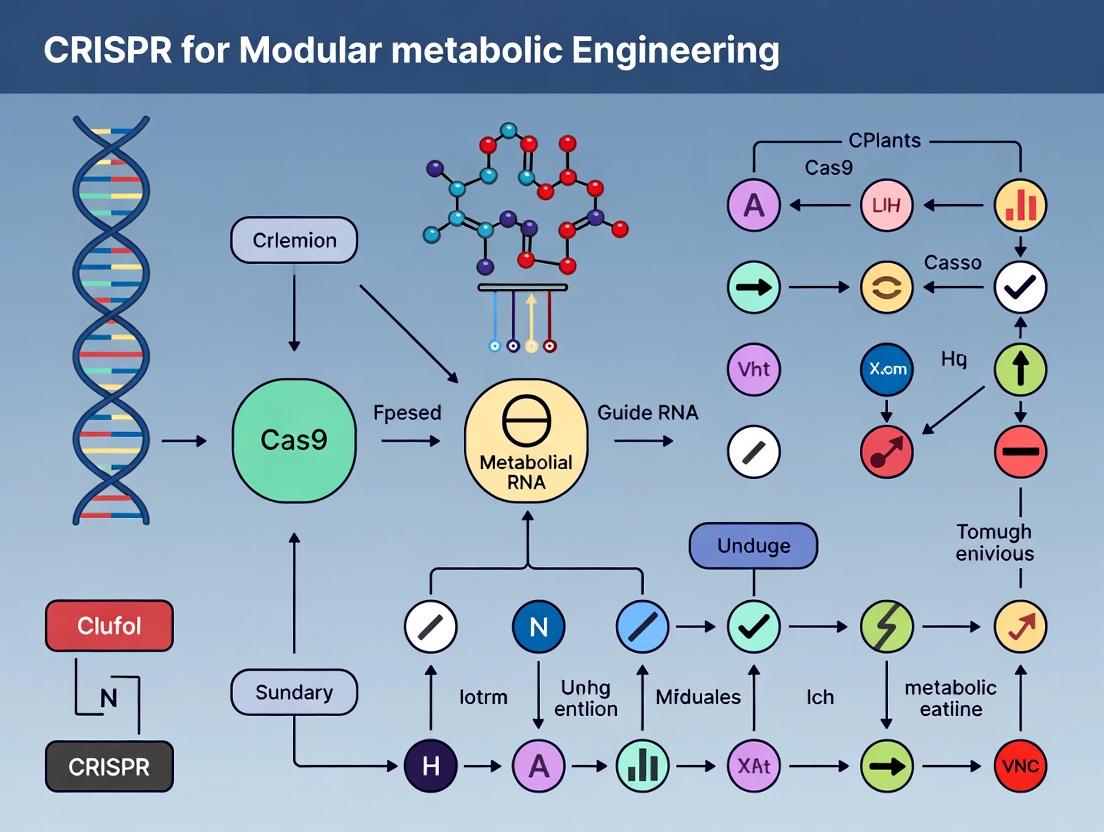
This article provides a comprehensive guide for researchers and industry professionals on implementing CRISPR-Cas systems for modular metabolic engineering (MME).
CRISPR-Driven Modular Metabolic Engineering: Designing Cellular Factories for Precision Therapeutics and Biomanufacturing
Abstract
This article provides a comprehensive guide for researchers and industry professionals on implementing CRISPR-Cas systems for modular metabolic engineering (MME). It covers foundational principles, from core CRISPR toolkits to the design of synthetic metabolic modules. It details practical methodologies for multiplexed genome editing, pathway assembly, and dynamic regulation in microbial and mammalian hosts. The guide addresses common troubleshooting challenges, optimization strategies for efficiency and specificity, and comparative analyses of CRISPR systems (Cas9, Cas12, base editors) for metabolic applications. Finally, it explores validation frameworks and benchmarks MME against traditional methods, concluding with future directions for creating next-generation cell therapies and sustainable bioproduction platforms.
From Scissors to Choreographers: Understanding CRISPR as the Foundational Tool for Modular Metabolic Design
Modular Metabolic Engineering (MME) is a systematic framework for engineering complex biochemical pathways by assembling standardized, well-characterized genetic parts. Within the broader thesis on CRISPR-based metabolic engineering, MME represents the conceptual and practical implementation layer. CRISPR technologies (CRISPRi, CRISPRa, base editing) provide the precision tools for constructing and tuning these modules, enabling a true 'plug-and-play' approach. This paradigm shifts metabolic engineering from ad-hoc, iterative strain manipulation to the predictable assembly of microbial cell factories.
Core Principles and Quantitative Comparison of MME Strategies
MME relies on decoupling pathway optimization into discrete, manageable modules (e.g., upstream precursor supply, core pathway enzymes, cofactor balancing, product transport). These modules are standardized with compatible genetic interfaces (e.g., serine integrase sites, CRISPR arrays, standardized promoters/RBSs) for rapid assembly and swapping.
Table 1: Comparison of Major MME Assembly Standards and Their Performance Metrics
| Standard/System | Key Components | Typical Assembly Efficiency (%) | Pathway Tuning Method | Max Module Complexity (Genes) | Primary Application |
|---|---|---|---|---|---|
| Golden Gate (MoClo) | Type IIS restriction enzymes, standardized prefixes/suffixes | 85-95 | Promoter/RBS libraries | 8-12 | Plant & microbial natural products |
| CRISPR-Barcoded Assembly | CRISPR-Cas9, homologous repair, unique barcodes | 70-85 | gRNA libraries for repression/activation | 10+ | Pharmaceutical intermediates |
| SERIAL (Site-Specific Recombination) | Bxb1 serine integrase, attP/attB sites | >90 | Pre-defined genomic landing pads | 5-7 | Biofuel & bulk chemical production |
| RNA-based Assembly | Ribozymes, RNA aptamers, toehold switches | 60-75 | Self-regulating metabolic circuits | 4-6 | Diagnostics & fine chemicals |
Data synthesized from recent literature (2023-2024) on modular pathway engineering platforms.
Application Notes: Implementing a CRISPR-Enhanced MME Workflow
Application Note AN-MME-101: Rapid Prototyping of a Terpenoid Biosynthetic Pathway in S. cerevisiae.
Objective: Assemble a 6-gene pathway for amorphadiene production using CRISPR-Cas12a for both module integration and subsequent balancing.
Key Findings:
- Module Swapping: The upstream mevalonate (MVA) module was swapped with three alternative enzyme variants. The high-activity Enterococcus faecalis MVA kinase module increased titers by 220% compared to the native S. cerevisiae module.
- CRISPR-Mediated Tuning: A multiplexed gRNA array targeting the native ERG9 promoter (squalene synthase) and the integrated pathway's GPPS gene was used for dynamic repression. Fine-tuning this repression increased carbon flux toward amorphadiene, reducing squalene byproduct accumulation by ~75%.
- Quantitative Output: The final engineered strain produced 25.8 g/L amorphadiene in a fed-batch bioreactor, demonstrating the efficacy of the MME approach.
Detailed Experimental Protocols
Protocol P-1: CRISPR-Assisted Module Integration into Genomic Landing Pads
Objective: Integrate a standardized biosynthetic module (Gene A-B-C) into a pre-engineered attB site in E. coli MG1655(DE3) using Cas9-assisted homologous recombination.
Materials: See "The Scientist's Toolkit" below. Procedure:
- Design & Cloning: Clone the Gene A-B-C expression cassette (on a pUC57 backbone) flanked by 500 bp homology arms (HAs) matching sequences upstream and downstream of the genomic attB site. Include a CRISPR gRNA target sequence specific to a neutral site within the attB region on the backbone.
- Transformation: Co-transform the recipient strain (harboring a chromosomal Cas9 gene under arabinose control) with:
- The donor plasmid (50 ng)
- A pTarget plasmid (100 ng) expressing the designed gRNA and a selectable marker (e.g., spectinomycin resistance).
- Selection & Screening: Plate transformations on LB agar containing appropriate antibiotics (for the integrated module and the pTarget plasmid) and 0.2% L-arabinose to induce Cas9. Incubate at 30°C for 36h.
- Counter-Selection & Verification: Streak colonies onto LB plates with 1 mM IPTG (to induce the ccdB negative selection gene on the donor plasmid backbone) and without arabinose. Surviving colonies have lost the donor backbone via CRISPR-cleavage and repair. Verify module integration via colony PCR across the two junctions.
Protocol P-2: Multiplexed CRISPRi for Module Balancing
Objective: Simultaneously titrate expression of two genes (from different modules) using a derepressible CRISPRi system.
Procedure:
- gRNA Array Cloning: Synthesize and clone two gRNA sequences targeting the promoter regions of the genes of interest into a single expression plasmid (pCRISPRi) using a Golden Gate assembly method. Use tRNA spacers between gRNAs for efficient processing.
- Strain Transformation: Transform the strain harboring the integrated pathway with the pCRISPRi plasmid and a second plasmid expressing a reverse tetracycline-controlled transactivator (rtTA) and a dCas9 protein.
- Induction & Screening: Inoculate transformants into deep-well plates with media containing varying concentrations of anhydrotetracycline (aTc, 0-1000 ng/mL). The aTc concentration linearly controls dCas9 expression. Incubate for 48h.
- Analysis: Measure product titer (e.g., via HPLC) and cell density (OD600). Plot titer/OD600 vs. aTc concentration to identify the optimal repression level for the targeted gene combination.
Visualizations
Diagram 1: Modular Metabolic Engineering (MME) Implementation Workflow
Diagram 2: The Synergy Between CRISPR Tools and the MME Philosophy
The Scientist's Toolkit: Key Research Reagent Solutions
Table 2: Essential Reagents for CRISPR-Enhanced Modular Metabolic Engineering
| Reagent / Material | Supplier Examples (for reference) | Function in MME |
|---|---|---|
| Type IIS Restriction Enzymes (BsaI, Esp3I) | NEB, Thermo Fisher | Core enzymes for Golden Gate assembly of standard biological parts. |
| Modular Cloning Toolkit (e.g., Yeast Toolkit YTK) | Addgene, in-house assembly | Pre-assembled libraries of promoters, ORFs, and terminators with standard overhangs. |
| dCas9/dCas12 Variant Plasmids | Addgene (e.g., pCRISPRi, pCRISPRa) | Enables CRISPR interference (CRISPRi) or activation (CRISPRa) for pathway tuning without editing DNA sequence. |
| Genomic Landing Pad Strains | CGSC, specialized labs | Engineered host strains with pre-defined, neutral attB sites for reliable, single-copy module integration. |
| Synthetic gRNA Array Libraries | Integrated DNA Technologies (IDT), Twist Bioscience | Custom pools of gRNAs for multiplexed repression/activation of multiple module genes simultaneously. |
| Metabolite Biosensors (Transcription Factor-based) | Literature, in-house engineering | Reporters (e.g., GFP) linked to product-responsive promoters for high-throughput screening of module performance. |
| Microfluidic Droplet Screening Systems | Berkeley Lights, Cytena | Platforms for encapsulating single engineered cells and screening for product titer at ultra-high throughput. |
This application note details the core CRISPR-Cas tools central to a broader thesis on Modular Metabolic Engineering (MME). MME aims to construct complex biosynthetic pathways by assembling standardized genetic parts. CRISPR technologies enable precise, multiplexed genome editing to install, fine-tune, and optimize these modules in microbial and mammalian hosts, accelerating the engineering of organisms for therapeutic compound production.
The CRISPR-Cas Nucleases: Cas9 and Cas12
These RNA-guided nucleases create targeted double-strand breaks (DSBs), which are repaired by host cells via Non-Homologous End Joining (NHEJ) or Homology-Directed Repair (HDR). They are used in MME for gene knock-outs, large deletions, and integrating pathway modules.
Table 1: Comparison of Cas9 and Cas12a Nucleases
| Feature | Cas9 (SpCas9) | Cas12a (AsCas12a) |
|---|---|---|
| Guide RNA | Two-part: crRNA + tracrRNA | Single crRNA |
| PAM Sequence | 5'-NGG-3' (canonical) | 5'-TTTV-3' (rich) |
| Cleavage Pattern | Blunt-ended DSB | Staggered DSB (5' overhang) |
| Catalytic Sites | RuvC & HNH (dual nuclease) | Single RuvC domain |
| Primary MME Use | Gene knockouts, HDR integration | Multiplexed gene disruptions |
Protocol 1.1: Multiplexed Gene Knockout Using Cas12a for Pathway De-bottlenecking Objective: Disrupt three competing endogenous genes in E. coli to redirect metabolic flux. Materials:
- AsCas12a nuclease
- Array of three crRNAs targeting geneA, geneB, geneC
- Electrocompetent E. coli strain
- Recovery media (SOC)
- Selection agar plates Procedure:
- Design crRNAs with 20-nt spacers complementary to targets immediately downstream of TTTV PAMs.
- Assemble the ribonucleoprotein (RNP) complex by incubating 50 pmol AsCas12a with 150 pmol total crRNA (50 pmol each) at 25°C for 10 min.
- Electroporate 2 µL of the RNP complex into 50 µL of electrocompetent cells (2.5 kV, 200Ω, 25 µF).
- Recover cells in 1 mL SOC at 37°C for 1 hour.
- Plate serial dilutions on non-selective agar. Screen individual colonies via colony PCR and Sanger sequencing to identify multiplexed knockout mutants.
Base Editors (BEs)
BEs catalyze direct, irreversible conversion of one DNA base pair to another without requiring DSBs or donor templates. They are ideal for creating precise point mutations in MME, such as activating silent enzymes or tuning catalytic activity.
Table 2: Characteristics of Common Base Editor Systems
| Editor | Cas Domain | Deaminase | Conversion | Window (Position from PAM) | Typical MME Application |
|---|---|---|---|---|---|
| Cytosine BE (CBE) | Cas9 nickase | rAPOBEC1 | C•G to T•A | ~Edits 4-8 (PAM dist.) | Introduce premature stop codons, alter substrate specificity. |
| Adenine BE (ABE) | Cas9 nickase | TadA* | A•T to G•C | ~Edits 4-8 (PAM dist.) | Correct pathogenic SNVs, create gain-of-function mutations. |
| Dual BE (ACBE) | Cas9 nickase | rAPOBEC1 + TadA* | C•G to T•A & A•T to G•C | Target dependent | Simultaneous A-to-G and C-to-T editing for combinatorial screening. |
Protocol 2.1: Tuning Promoter Strength with Adenine Base Editors Objective: Convert a specific A•T base pair to G•C within the -35 or -10 region of a bacterial promoter to modulate its transcription strength. Materials:
- ABE8e plasmid (or RNP)
- sgRNA expression plasmid (or synthetic sgRNA)
- Chemically competent E. coli with reporter construct
- LB broth and agar with appropriate antibiotics
- Fluorometer or spectrophotometer for reporter assay Procedure:
- Design sgRNA to position target adenine (A) within the editing window (typically positions 4-8) of the ABE8e complex relative to the PAM.
- Co-transform the ABE8e plasmid and the sgRNA plasmid into the E. coli reporter strain.
- Plate on double-selection agar and incubate overnight at 37°C.
- Pick 10-20 colonies, inoculate in liquid culture, and measure reporter (e.g., GFP) fluorescence.
- Isolate genomic DNA from high- and low-fluorescence variants. Amplify the promoter region and sequence to confirm the A-to-G edit.
Prime Editors (PEs)
PEs are "search-and-replace" tools that can install all 12 possible base-to-base conversions, as well as small insertions and deletions, without DSBs. They are the most versatile for precise MME, allowing installation of exact single-nucleotide variants (SNVs) in pathway genes.
Table 3: Prime Editor System Components and Editing Outcomes
| Component | Function | Key Design Consideration |
|---|---|---|
| Cas9 Nickase (H840A) | Binds pegRNA and nicks target strand. | Defines target locus via PBS binding. |
| Engineered Reverse Transcriptase (RT) | Uses pegRNA's RT template to synthesize edited DNA. | Processivity limits maximal insertion size (~40-80 bp). |
| Prime Editing Guide RNA (pegRNA) | Contains sgRNA spacer, Primer Binding Site (PBS), and RT template with edit. | PBS length (8-15 nt) and RT template design are critical for efficiency. |
Protocol 3.1: Installing a Precise Missense Mutation for Enzyme Engineering Objective: Introduce a specific amino acid change (e.g., Q125L) in a key biosynthetic enzyme. Materials:
- PE2 expression plasmid
- pegRNA expression plasmid
- HEK293T cells (or relevant host)
- Lipofectamine 3000 transfection reagent
- Genomic DNA extraction kit
- Next-generation sequencing (NGS) library prep kit Procedure:
- Design pegRNA: The 3' extension contains a 13-nt PBS and a ~30-nt RT template encoding the desired Q125L (CAA->CTA) mutation and any silent mutations to prevent re-editing.
- Seed HEK293T cells in a 24-well plate to reach 70-80% confluency at transfection.
- Co-transfect 500 ng PE2 plasmid and 250 ng pegRNA plasmid using Lipofectamine 3000 per manufacturer's protocol.
- Harvest cells 72 hours post-transfection. Extract genomic DNA.
- Amplify the target locus by PCR and prepare an NGS library. Sequence to quantify prime editing efficiency and specificity.
The Scientist's Toolkit: Key Research Reagent Solutions
| Item | Function in CRISPR for MME |
|---|---|
| High-Fidelity Cas9 Variant | Reduces off-target editing, crucial for engineering production strains requiring genomic stability. |
| Chemically Modified sgRNA | Enhances nuclease stability and editing efficiency, especially in primary cells or RNP delivery. |
| HDR Enhancer (e.g., RS-1) | Small molecule that inhibits NHEJ and promotes HDR, boosting precise integration of large DNA modules. |
| Next-Generation Sequencing (NGS) Kit | For unbiased, deep sequencing of target loci to assess editing efficiency, purity, and off-target effects. |
| Electroporation Cuvettes (1 mm) | For efficient RNP or plasmid delivery into challenging bacterial and fungal hosts used in metabolic engineering. |
| Lipid Nanoparticle (LNP) Formulation Kit | For transient, efficient delivery of CRISPR reagents to mammalian cells for pathway assembly and testing. |
Visualizations
CRISPR Tool Selection for MME
Base Editor Mechanism (A-to-G)
Prime Editing Experimental Workflow
Application Notes
In the context of CRISPR-based modular metabolic engineering, the integration of standardized biological parts—Modules, strategic Metabolic Nodes, and dynamic Regulatory Circuits—enables the rational design and optimization of microbial cell factories. These components allow for the predictable rerouting of metabolic flux toward high-value compounds, including pharmaceuticals and biofuels. CRISPR-Cas systems, particularly CRISPRi/a, provide precise, multiplexable tools for implementing these concepts by simultaneously tuning multiple regulatory circuits and metabolic nodes.
Synthetic Biology Modules
These are self-contained, functionally defined DNA sequences encoding standardized operations (e.g., a promoter-gene-terminator cassette for a biosynthetic enzyme). In CRISPR-driven engineering, modules can be rapidly assembled and integrated into genomic loci using Cas9-facilitated homologous recombination. Current applications leverage Golden Gate and Gibson assembly with CRISPR selection to build multi-gene pathways with >90% assembly efficiency.
Metabolic Nodes
These are key junction metabolites within a host's metabolic network where flux significantly influences yield (e.g., acetyl-CoA, malonyl-CoA, pyruvate). CRISPRi is used to downregulate competing pathways at these nodes, while CRISPRa can upregulate bottleneck enzymes. Recent studies demonstrate that multiplexed repression of three competing nodes in E. coli increased titers of target flavonoid by 150%.
Regulatory Circuits
These are genetic networks that provide dynamic control, often feedback/feedforward loops, to balance metabolic load and product synthesis. CRISPR-based transcription factors (e.g., dCas9-VPR, dCas9-KRAB) are deployed to build synthetic circuits. A notable example is a quorum-sensing-coupled CRISPRi circuit that autonomously downregulates growth genes and upregulates production genes at high cell density, improving product yield by 200% without manual intervention.
Table 1: Quantitative Outcomes of CRISPR-Enhanced Metabolic Engineering Strategies
| Strategy | Host Organism | Target Molecule | Fold Improvement | Key Concept Applied |
|---|---|---|---|---|
| Multiplexed CRISPRi | E. coli | Naringenin | 2.5x | Metabolic Node (downregulation of sdhA, ldhA, poxB) |
| dCas9-VPR Activation | S. cerevisiae | Amorpha-4,11-diene | 3.0x | Regulatory Circuit (transcriptional activation of pathway genes) |
| CRISPR-Mediated Module Integration | Y. lipolytica | Triacetic Acid Lactone | 4.1x | Synthetic Biology Module (site-specific pathway integration) |
| Dynamic CRISPRi Circuit | B. subtilis | Nisin | 3.0x | Regulatory Circuit (quorum-sensing feedback) |
Experimental Protocols
Protocol 1: Multiplexed CRISPRi for Metabolic Node Repression inE. coli
Objective: To repress multiple competing metabolic nodes to redirect flux toward a target compound. Materials: See "The Scientist's Toolkit" below. Procedure:
- Design and clone sgRNA array: Design three sgRNAs targeting genes at undesired metabolic nodes (e.g., sdhA, ldhA, poxB). Clone them into a single transcriptional unit under control of a J23119 promoter in plasmid pCRISPRi.
- Transform and express: Co-transform pCRISPRi and the compatible production pathway plasmid into E. coli BL21(DE3). Induce dCas9 expression with 0.5 mM IPTG at OD600 ~0.3.
- Culture and measure: Grow cells in M9 minimal media with appropriate carbon source for 48h at 30°C. Measure target compound titer via HPLC and cell density via OD600.
- Flux analysis: Validate node repression via qRT-PCR of target genes and/or metabolomics (GC-MS) of node metabolites.
Protocol 2: Construction of a CRISPR-dCas9 Synthetic Regulatory Circuit
Objective: To implement a feedback loop where product sensing activates pathway expression. Materials: See toolkit. Procedure:
- Circuit assembly: Assemble a plasmid containing: a) a promoter responsive to a biosensor for your product (e.g., pCaiF for fatty acids), b) the dCas9-VPR gene, and c) an sgRNA targeting a minimal promoter driving your biosynthetic pathway genes.
- Integration: Integrate the circuit plasmid and the sgRNA-responsive production module into the host genome using CRISPR-Cas9 mediated homologous recombination.
- Characterization: Inoculate colonies and grow in shake flasks. Sample periodically to measure circuit activation (via GFP reporter) and product titer. Compare to a constitutive promoter control strain.
Visualizations
Diagram 1: Core Concepts Integration Logic
Diagram 2: Multiplexed Node Engineering Workflow
The Scientist's Toolkit
Table 2: Essential Research Reagent Solutions
| Item | Function in Experiment | Example/Supplier |
|---|---|---|
| dCas9 Expression Plasmid | Provides inducible expression of catalytically dead Cas9 for CRISPRi/a. | Addgene #47108 (pDG-dCas9) |
| sgRNA Cloning Vector | Backbone for synthesizing and expressing single or arrays of sgRNAs. | Addgene #44251 (pCRISPomyces-2) |
| Golden Gate Assembly Mix | Enzymatic mix for seamless, modular assembly of multiple DNA parts. | NEB Golden Gate Assembly Kit (BsaI-HFv2) |
| HPLC-MS System | Quantifies target metabolite titers and identifies pathway intermediates. | Agilent 1260 Infinity II/6470 Triple Quad |
| qRT-PCR Master Mix | Validates transcriptional changes at metabolic nodes and pathways. | Bio-Rad iTaq Universal SYBR Green Supermix |
| Genome-Scale Model | In silico tool to predict key metabolic nodes and flux distributions. | ModelSEED, COBRApy |
| Biosensor Strain | Provides chassis with built-in regulatory circuit for dynamic control. | E. coli Nissle with pDawn sensor system |
Application Notes
The selection of a host organism is a foundational decision in CRISPR-based modular metabolic engineering, influencing pathway complexity, yield, and end-product application. The integration of CRISPR tools has accelerated the engineering of diverse chassis, each offering unique advantages.
Escherichia coli: A prokaryotic workhorse valued for rapid growth, well-characterized genetics, and high-density fermentation. CRISPRi/a (interference/activation) systems enable precise, multiplexed repression or activation of endogenous genes, streamlining the construction of complex metabolic pathways for commodity chemicals and recombinant proteins.
Saccharomyces cerevisiae: A eukaryotic model with robust protein secretion, post-translational modifications, and innate resilience in industrial bioreactors. CRISPR-Cas9 facilitates efficient gene knock-outs, integrations, and multiplexed editing, enabling advanced bio-production of fuels, pharmaceuticals, and platform chemicals.
Chinese Hamster Ovary (CHO) Cells: The dominant mammalian cell line for therapeutic protein production, capable of human-like glycosylation. CRISPR is used to knock out undesirable genes (e.g., FUT8 for afucosylation enhancement) and knock in transgenes at genomic safe harbors, boosting titers and modulating product quality attributes.
Human Pluripotent Stem Cells (hPSCs): A chassis for cell therapies and disease modeling. CRISPR-mediated precise editing (e.g., base editing, prime editing) allows for the correction of disease-causing mutations, insertion of reporter genes, and the creation of synthetic gene circuits to control differentiation pathways.
Quantitative Comparison of Key Chassis Organisms
| Organism | Generation Time | Typical Editing Efficiency (CRISPR) | Key Engineering Advantage | Primary Application |
|---|---|---|---|---|
| E. coli | 20-30 min | 90-100% (knockout) | High transformation efficiency, simple genetics | Metabolites, enzymes, simple proteins |
| S. cerevisiae | ~90 min | 70-90% (knockout) | Eukaryotic secretion, GRAS status, robust fermentation | Ethanol, pharmaceuticals, complex metabolites |
| CHO Cells | 12-24 hours | 10-80% (varies by locus) | Human-like PTMs, scalable suspension culture | Monoclonal antibodies, therapeutic proteins |
| hPSCs | ~24 hours | 1-40% (precise edits) | Pluripotency, differentiation into any cell type | Cell therapies, regenerative medicine, disease models |
Detailed Protocols
Protocol 1: CRISPR-Cas9 Mediated Multiplex Gene Knockout inS. cerevisiae
Objective: Simultaneously disrupt multiple genes in the yeast genome to eliminate competing metabolic pathways.
Materials & Reagents:
- Yeast strain (e.g., BY4741)
- pCAS-UTR2 plasmid (expresses Cas9 and sgRNA)
- sgRNA expression cassettes (targeting genes XYZ1, XYZ2)
- Homology-directed repair (HDR) donor DNA (short, ~80bp oligonucleotides with STOP codons)
- LiAc/SS Carrier DNA/PEG transformation mix
- Synthetic Drop-out medium lacking uracil
Procedure:
- Design & Cloning: Design 20bp target sequences for XYZ1 and XYZ2 using CHOPCHOP. Clone sgRNA sequences into the pCAS-UTR2 plasmid under RNA polymerase III promoters.
- Transformation: Prepare competent yeast cells using the LiAc method. Co-transform 100ng of the pCAS-UTR2 plasmid, 10pmol of each HDR donor oligo, and carrier DNA.
- Selection & Screening: Plate transformation on SD -Ura plates. Incubate at 30°C for 48-72 hours.
- Validation: Pick colonies, perform colony PCR across target loci, and sequence amplicons to confirm insertion of STOP codons and indels.
Protocol 2: CRISPR-Cas9 MediatedFUT8Knockout in CHO Cells for Afucosylated Antibody Production
Objective: Generate a stable FUT8 knockout CHO cell line to produce antibodies with enhanced Antibody-Dependent Cellular Cytotoxicity (ADCC).
Materials & Reagents:
- CHO-S or CHO-K1 cells
- Lipofectamine CRISPRMAX Transfection Reagent
- FUT8-targeting sgRNA (complexed with Alt-R S.p. HiFi Cas9 Nuclease)
- Flow cytometry antibodies (anti-human Fc, lectin)
- Cloning by limiting dilution plates
Procedure:
- sgRNA Complex Formation: Complex 30pmol of sgRNA with 1μg of HiFi Cas9 protein in Opti-MEM medium. Incubate 10-20 min at room temperature.
- Cell Transfection: Seed 2e5 cells/well in a 24-well plate. Add ribonucleoprotein (RNP) complexes to cells using CRISPRMAX according to manufacturer's protocol.
- Enrichment & Cloning: At 48-72 hours post-transfection, analyze a sample via flow cytometry using Lens culinaris lectin staining to identify FUT8-negative population. Single-cell sort FUT8-negative cells into 96-well plates.
- Screening & Validation: Expand clonal lines. Validate biallelic knockout via Sanger sequencing of the FUT8 locus and confirm phenotype by lectin staining.
Protocol 3: CRISPR Base Editing in Human Induced Pluripotent Stem Cells (hiPSCs)
Objective: Introduce a precise C•G to T•A point mutation in a disease-relevant gene in hiPSCs without generating double-strand breaks.
Materials & Reagents:
- hiPSCs cultured feeder-free
- mCherry-T2A-BE4max plasmid (expresses cytosine base editor and sgRNA)
- Stem cell-qualified Transfection Reagent (e.g., Lipofectamine Stem)
- RevitaCell Supplement
- Fluorescence-activated cell sorting (FACS) capability
Procedure:
- Design & Prep: Design a sgRNA to target the cytidine within the editing window (positions 4-8) of the protospacer. Prepare plasmid DNA.
- Transfection: Dissociate hiPSCs to single cells. Transfect 2e5 cells with 1.5μg plasmid DNA using stem cell-qualified transfection reagent.
- Recovery & Sorting: 24h post-transfection, replace medium with fresh medium containing RevitaCell. At 48-72 hours, harvest cells and FACS-sort the top 5-10% mCherry-positive cells.
- Clonal Expansion & Genotyping: Plate sorted cells at clonal density. Pick individual colonies, expand, and extract genomic DNA. Screen by Sanger sequencing and confirm via targeted deep sequencing.
Diagrams
The Scientist's Toolkit: Key Research Reagent Solutions
| Reagent / Material | Supplier Examples | Function in CRISPR Metabolic Engineering |
|---|---|---|
| Alt-R S.p. HiFi Cas9 Nuclease | Integrated DNA Technologies (IDT) | High-fidelity Cas9 enzyme for clean editing with reduced off-target effects in mammalian cells. |
| Lipofectamine CRISPRMAX | Thermo Fisher Scientific | A lipid-based transfection reagent optimized for delivery of CRISPR RNP complexes into hard-to-transfect cells. |
| CHOPCHOP Online Tool | chopchop.cbu.uib.no | Web-based platform for designing and evaluating sgRNA target sequences across multiple organism genomes. |
| Gibson Assembly Master Mix | New England Biolabs (NEB) | Enzymatic method for seamless assembly of multiple DNA fragments (e.g., sgRNA arrays, donor vectors). |
| CloneAmp HiFi PCR Premix | Takara Bio | High-fidelity PCR enzyme for accurate amplification of homology arms and verification amplicons. |
| Lectin from Lens culinaris (FITC) | Vector Labs / Sigma-Aldrich | Binds to core fucose; used in flow cytometry to screen for FUT8 knockout CHO cell clones. |
| RevitaCell Supplement | Thermo Fisher Scientific | A supplement used to improve viability and recovery of sensitive cells (e.g., stem cells) post-transfection. |
| NucleoBond Xtra Midi Kit | Macherey-Nagel | For purification of high-quality, transfection-grade plasmid DNA for mammalian cell work. |
| Drop-out Synthetic Media Mix | Sunrise Science Products | Defined yeast growth medium lacking specific amino acids for selection of plasmids and edited strains. |
Application Notes
The field of metabolic engineering has undergone a paradigm shift, moving from broad, untargeted genetic perturbation to precise, multiplexed genome editing. This evolution is critical for constructing robust microbial cell factories within modular metabolic engineering (MME) frameworks, where orthogonal, predictable genetic modules are assembled for complex biochemical production.
Random Mutagenesis & Classical Strain Engineering: Early efforts relied on chemical or UV-induced random mutagenesis followed by high-throughput screening. While successful for simple phenotypes (e.g., antibiotic resistance), this approach is blind, labor-intensive, and leads to accumulation of deleterious secondary mutations, complicating metabolic analysis.
Rational Design & Targeted Editing: The advent of homologous recombination and later, zinc-finger nucleases (ZFNs) and transcription activator-like effector nucleases (TALENs), introduced targeting. However, these systems are protein-based, requiring re-engineering for each new target, making multiplexed metabolic engineering cumbersome and costly.
CRISPR-Cas for MME: The CRISPR-Cas system, particularly CRISPR-Cas9 and CRISPR-Cas12a, represents a transformative leap. Its programmability via simple RNA guides enables precise, simultaneous multiplex genome editing (MME = Multiplexed, Modular Engineering). This allows for the coordinated knock-out, knock-in, and fine-tuning of multiple metabolic pathway genes in a single step, aligning perfectly with the modular design principles of modern metabolic engineering.
Current State: CRISPR Toolkits for Metabolism: Advanced derivatives like base editing, prime editing, and CRISPRi/a (interference/activation) enable single-nucleotide resolution and tunable transcriptional control without double-strand breaks. This is essential for balancing flux in complex, multi-gene pathways and for creating dynamic regulatory circuits.
Quantitative Comparison of Key Technologies
Table 1: Comparative Analysis of Genome Editing Technologies in Metabolic Engineering
| Technology | Targeting Mechanism | Multiplexing Capacity | Precision | Primary Use in MME | Typical Efficiency in Microbes |
|---|---|---|---|---|---|
| Random Mutagenesis | Non-specific chemical/UV | N/A | Very Low | Phenotypic screening, trait discovery | N/A (Random) |
| Homologous Recombination | DNA sequence homology | Low (1-2 loci) | High, but laborious | Targeted gene deletion/insertion | 10⁻⁶ to 10⁻⁴ (without selection) |
| ZFNs/TALENs | Protein-DNA recognition | Low (1-3 loci) | High | Targeted gene knockout | 1-50% (varies widely) |
| CRISPR-Cas9 (Nuclease) | RNA-DNA complementarity | High (5-10+ loci) | High (with off-target risks) | Multiplex knockouts, pathway disruption | 80-100% (in model microbes) |
| CRISPRi/a | dCas9 + effector domains | High (10+ loci) | High (transcriptional) | Tunable gene repression/activation, flux balancing | 70-95% repression (CRISPRi) |
| Base Editing | Cas9 nickase + deaminase | Moderate (3-5 loci) | Single-nucleotide | Point mutations for enzyme optimization | 10-50% (bacterial systems) |
Experimental Protocols
Protocol 1: Multiplex CRISPR-Cas9 Knockout for Pathway Deletion in E. coli
Objective: Simultaneously delete three genes (geneA, geneB, geneC) encoding competing metabolic enzymes to channel flux toward a desired product.
Materials:
- E. coli strain harboring a Cas9 expression plasmid (e.g., pCas9).
- Plasmid expressing a sgRNA array (e.g., pTarget, using tRNA-processing system).
- Donor DNA fragments (if knock-in is required).
- Electrocompetent cell preparation reagents.
- LB medium and appropriate antibiotics.
Procedure:
- Design & Cloning: Design three sgRNAs targeting geneA, geneB, geneC. Clone them as an array separated by tRNA spacers into the pTarget plasmid.
- Transformation: Co-electroporate the pTarget plasmid (or donor DNA) into electrocompetent E. coli cells already containing the pCas9 plasmid.
- Recovery & Selection: Recover cells in SOC medium for 2 hours, then plate on LB agar with antibiotics maintaining both plasmids.
- Screening: Pick colonies and screen by colony PCR across the target loci using flanking primers. Deletions cause a size shift.
- Curing Plasmids: Grow positive clones at 37°C without antibiotics to lose the temperature-sensitive pCas9 and pTarget plasmids.
- Validation: Sequence the edited genomic loci to confirm deletions.
Protocol 2: CRISPRi for Tunable Transcriptional Repression in S. cerevisiae
Objective: Dynamically repress a key glycolytic gene (PFK1) to reduce metabolic burden and redirect resources.
Materials:
- S. cerevisiae strain with genomically integrated dCas9-Mxi1 repressor.
- Guide RNA expression plasmid (e.g., pRS413-gRNA) with GAL1 inducible promoter.
- Synthetic complete dropout medium (-His).
- 2% Galactose/2% Raffinose induction medium.
Procedure:
- Guide Design & Cloning: Design a sgRNA targeting the promoter or early coding region of PFK1. Clone into the pRS413-gRNA plasmid.
- Transformation: Transform the plasmid into the dCas9-expressing yeast strain using the LiAc/SS carrier DNA/PEG method.
- Induction of Repression: Grow transformants in selective dropout medium with raffinose. Dilute and add galactose to a final 2% to induce sgRNA expression.
- Phenotypic Analysis: Measure growth (OD600) and metabolite profiles (e.g., via HPLC) at 0, 6, 12, and 24 hours post-induction.
- Validation: Quantify repression efficiency by RT-qPCR using primers for PFK1 and a housekeeping gene (e.g., ACT1).
Visualizations
Title: Evolution of Genetic Editing Technologies
Title: CRISPR-MME Workflow for Strain Development
The Scientist's Toolkit: Research Reagent Solutions
Table 2: Essential Reagents for CRISPR-based Modular Metabolic Engineering
| Reagent/Material | Function in CRISPR-MME | Example Product/Catalog |
|---|---|---|
| Broad-Host-Range Cas9 Expression Vector | Provides the Cas9 nuclease in diverse microbial hosts. | pCas9 (for E. coli), pMEL-10 (for yeast). |
| Modular sgRNA Cloning Kit | Enables rapid assembly of multiplex sgRNA arrays (e.g., using Golden Gate or tRNA scaffolds). | Addgene Kit #1000000059 (MoClo Toolkit). |
| dCas9-VPR/dCas9-Mxi1 Plasmids | Enables transcriptional activation (VPR) or repression (Mxi1) for fine-tuning gene expression. | pCRISPR-dCas9-VPR (Addgene #110815). |
| Base Editor Plasmid | Facilitates C•G to T•A or A•T to G•C conversions without double-strand breaks. | pCMV-BE3 (for mammalian) or pnCasSA-BEC (for bacteria). |
| Synthetic Donor DNA Fragments | Serves as repair templates for precise gene insertions or point mutations. | Ultramer DNA Oligos (IDT). |
| High-Efficiency Competent Cells | Essential for delivering CRISPR constructs into the target microbial chassis. | NEB 10-beta E. coli, S. cerevisiae YPH499. |
| Next-Gen Sequencing Verification Kit | Validates on-target edits and screens for potential off-target effects. | Illumina CRISPR Amplicon Sequencing assay. |
| Metabolomic Analysis Service/Kit | Quantifies metabolic flux and product titers to assess MME outcome. | Agilent GC/MS Metabolomics Kit. |
Building the Cellular Factory: A Step-by-Step Guide to CRISPR-ME Implementation
Within the broader thesis on CRISPR-based modular metabolic engineering, precise target identification is the foundational step. This protocol details the systematic selection of promoters, genes, and regulatory elements to construct orthogonal, tunable, and predictable genetic circuits for metabolic pathway optimization and therapeutic molecule production.
Application Notes: Principles for Modular Target Selection
Promoter Selection Criteria
Promoters are selected based on key quantitative parameters to ensure predictable expression levels and orthogonality. The following table summarizes critical metrics for evaluation:
Table 1: Quantitative Metrics for Synthetic Promoter Selection
| Metric | Description | Target Range/Value | Measurement Method |
|---|---|---|---|
| Strength (Transcripts/sec) | Transcriptional output rate. | 1 - 100 (relative units) | RNA-seq, qRT-PCR, Fluorescent Reporter Assay. |
| Leakiness | Basal expression in "OFF" state. | < 1% of maximal expression. | Reporter assay under repressive conditions. |
| Dynamic Range | Ratio of max (ON) to min (OFF) expression. | > 100-fold. | Reporter assay under inducing vs. repressive conditions. |
| Orthogonality | Lack of cross-talk with host regulators. | > 95% specificity. | ChIP-seq, RNA-seq in presence of non-cognate inducers/repressors. |
| Induction Kinetics | Time to reach 50% max output (T50). | < 60 minutes for inducible systems. | Time-course reporter assay post-induction. |
Gene Target Identification for Pathway Engineering
Genes are selected based on their role in the metabolic network and their suitability for CRISPR-mediated control.
Table 2: Gene Ranking Metrics for Metabolic Engineering
| Ranking Factor | Scoring (1-5) | Data Source | Tool/Protocol |
|---|---|---|---|
| Flux Control Coefficient | High (4-5) = High control over pathway flux. | Metabolic modeling (e.g., FBA). | In silico modeling with COBRApy. |
| Toxicity of Knockdown/KO | Low score (1-2) = Minimal growth defect. | Essentiality screens (CRISPRi/a). | Genome-wide CRISPRi growth fitness assay. |
| Enzyme Kinetics (kcat/Km) | High score = High catalytic efficiency. | BRENDA database, literature. | In vitro enzyme activity assay. |
| Native Expression Level | Moderate (3) = Easier to tune up or down. | RNA-seq data of host. | RNA extraction & sequencing. |
Regulatory Element Characterization
CRISPR-compatible regulatory elements (e.g., sgRNA scaffolds, effector binding sites) must be characterized for modularity.
Table 3: Performance of Modular Regulatory Elements
| Element Type | Variant | On-Target Efficacy (%) | Off-Target Score (Predicted) | Reference |
|---|---|---|---|---|
| sgRNA Scaffold | WT (S. pyogenes) | 100 (ref) | 1.0 (ref) | Doench et al., 2014 |
| sgRNA Scaffold | F+E (modified) | 145 ± 12 | 0.8 | Chen et al., 2013 |
| CRISPRa VP64 Linker | Short (GGGGS)x2 | 120 ± 15 | N/A | Tanenbaum et al., 2014 |
| CRISPRi Scaffold | MCP-SID4x fusion | 92 ± 8 | N/A | Gilbert et al., 2013 |
Experimental Protocols
Protocol 1: High-Throughput Promoter Characterization using Flow Cytometry
Objective: Quantify strength, leakiness, and dynamic range of promoter libraries. Reagents: Yeast/E. coli strain with chromosomal landing pad, promoter-GFP library plasmid pool, appropriate induction/repression chemicals. Steps:
- Transformation: Electroporate or chemically transform the promoter-GFP library pool into the host strain. Plate on selective agar for single colonies.
- Culture & Induction: Pick ≥ 500 colonies into 96-well deep plates with liquid media. Grow to mid-log phase. For inducible promoters, split culture and add inducer to one set.
- Flow Cytometry: Dilute cultures to an OD600 of ~0.2 in PBS or media. Analyze GFP fluorescence (FITC channel, 488 nm ex) for ≥ 10,000 events per sample using a high-throughput sampler.
- Data Analysis: Calculate median fluorescence for each clone. Strength = median fluorescence (induced). Leakiness = median fluorescence (uninduced). Dynamic Range = Strength / Leakiness.
Protocol 2: CRISPRi/a Screening for Essential Gene and Bottleneck Identification
Objective: Identify genes whose knockdown (CRISPRi) or activation (CRISPRa) most impacts pathway yield. Reagents: dCas9-expressing host strain, genome-wide sgRNA library (targeting promoters for CRISPRa or ORFs for CRISPRi), next-generation sequencing (NGS) reagents. Steps:
- Library Transformation: Transform the sgRNA library into the dCas9 strain at high coverage (≥ 500x per guide).
- Selection & Growth: Plate transformation on selective agar. Scrape all colonies to create the "T0" population. Inoculate the remainder into pathway-permissive conditions (e.g., with precursor) and grow for ~10 generations.
- Sample Harvesting: Harvest genomic DNA from T0 and final (Tend) populations using a kit (e.g., Qiagen DNeasy).
- sgRNA Amplification & Sequencing: Amplify the sgRNA cassette from gDNA with barcoded primers for multiplexing. Pool and purify PCR products. Sequence on an Illumina MiSeq (≥ 100,000 reads per sample).
- Analysis: Align reads to the sgRNA library index. Use MAGeCK or PinAPL-Py to identify sgRNAs significantly enriched/depleted in Tend vs. T0. Depleted sgRNAs in CRISPRi screen indicate essential genes for growth under condition. Enriched sgRNAs in CRISPRa screen indicate gene activations that confer a growth/yield advantage.
Protocol 3: Orthogonality Testing of Inducible Systems
Objective: Verify lack of cross-talk between multiple inducible CRISPR systems (e.g., aTc-, ABA-, GA-inducible). Reagents: Strains harboring all effector genes (e.g., dCas9-VP64 fusions with different inducible domains), reporter plasmids with corresponding sgRNAs and output (e.g., mCherry, BFP, GFP). Steps:
- Strain Construction: Assemble reporter plasmids where each unique fluorescent protein is controlled by a different inducible sgRNA. Transform into master strain.
- Cross-Induction Experiment: In a 96-well plate, prepare cultures with every single inducer and all pairwise combinations of inducers.
- Measurement: After 6-8 hours of induction, measure fluorescence for all channels (e.g., Texas Red for mCherry, Pacific Blue for BFP) via flow cytometry.
- Calculation: For each reporter, calculate % activation: (Fluor with non-cognate inducer - Fluor with no inducer) / (Fluor with cognate inducer - Fluor with no inducer) * 100. Orthogonality is confirmed if non-cognate induction is <5%.
Visualizations
Title: Strategic Target Identification Workflow
Title: Modular CRISPR Control System Components
The Scientist's Toolkit: Research Reagent Solutions
Table 4: Essential Materials for Target Identification & Modular Control
| Item | Supplier Examples | Function in Protocol |
|---|---|---|
| dCas9-VP64/KRAB Expression Plasmids | Addgene (#61422, #47107) | Source of CRISPRa/i effector proteins for transcriptional control. |
| MoClo/YTK Golden Gate Assembly Kits | Addgene (Kit #1000000059) | Modular assembly of promoters, genes, and sgRNAs into single constructs. |
| Genome-Wide Human/Yeast CRISPRi/a sgRNA Libraries | Addgene (Brunello, Dolcetto) | Pooled libraries for high-throughput essentiality and bottleneck screens. |
| Fluorescent Protein Reporter Plasmids (GFP, mCherry, BFP) | Addgene, ATCC | Quantitative reporters for promoter characterization and orthogonality tests. |
| High-Efficiency Electrocompetent Cells (NEB 10-beta, MegaX DH10B T1R) | New England Biolabs, Thermo Fisher | Essential for efficient transformation of large plasmid or library DNA. |
| Flow Cytometer with HTS (e.g., BD Fortessa, CytoFLEX S) | BD Biosciences, Beckman Coulter | High-throughput single-cell fluorescence measurement for promoter assays. |
| Next-Generation Sequencing Kit (MiSeq Reagent Kit v3) | Illumina | Sequencing for CRISPR screen deconvolution and identifying enriched/depleted sgRNAs. |
| qRT-PCR Master Mix (e.g., Power SYBR Green) | Thermo Fisher, Bio-Rad | Accurate quantification of transcript levels for validation of CRISPRa/i effects. |
Application Notes
Within modular metabolic engineering, the coordinated manipulation of multiple genetic targets is essential for rerouting metabolic fluxes and optimizing pathways. Multiplexed CRISPR-Cas delivery enables simultaneous knockouts, knockdowns, and activation/repression of several genes in a single experiment, dramatically accelerating strain development. This document outlines key strategies for designing gRNA arrays and optimizing their delivery in microbial and mammalian systems, contextualized for metabolic engineering workflows.
The core challenge lies in the efficient co-delivery of multiple guide RNAs (gRNAs) with the Cas nuclease or transcriptional effector. Two primary design paradigms exist: polycistronic gRNA arrays expressed from a single promoter and multiple independent expression cassettes. Polycistronic arrays, utilizing tRNA or crRNA-processing systems, offer compact size advantageous for viral packaging or transformation, while multiple independent promoters can provide more uniform expression but with increased genetic footprint.
Recent data (2023-2024) highlights optimized systems for high-level multiplexing. A comparative analysis of array processing systems is summarized below:
Table 1: Comparison of Polycistronic gRNA Array Processing Systems
| System | Processing Element | Avg. Cleavage Efficiency per gRNA* | Optimal # of Guides | Primary Application |
|---|---|---|---|---|
| tRNA-Gly | Endogenous RNase P and Z | 78-92% | 3-10 | Mammalian cells, Yeast, Plants |
| csy4 | CRISPR bacterial endoribonuclease | 85-95% | 2-7 | Mammalian cells, E. coli |
| crRNA | Native Cas12a/Cas13 processing | 80-90% (Cas12a) | 4-15 | Prokaryotes, Mammalian cells |
| HDV Ribozyme | Self-cleaving ribozyme | 70-85% | 2-5 | Mammalian cells, High-titer viral production |
*Efficiencies are system- and target-dependent; values aggregated from recent primary literature.
Successful metabolic pathway engineering often requires a combination of gene knockouts and transcriptional tuning. A multiplexed strategy can target GENE_1 and GENE_2 for knockout while simultaneously activating GENE_3 and repressing GENE_4, all within a single transformation event. This integrated approach is far more efficient than sequential modifications.
Experimental Protocols
Protocol 1: Designing and Cloning a tRNA-gRNA Array for Yeast Metabolic Engineering
Objective: Assemble a plasmid expressing S. pyogenes Cas9 and a tRNA-processed array of four gRNAs targeting genes in a competitive pathway.
Materials:
- pCAS-酵母整合载体 (with Cas9 and selection marker)
- Oligonucleotides for gRNA scaffold and target sequences (20nt)
- High-fidelity DNA polymerase (e.g., Q5)
- Golden Gate Assembly mix (BsaI-HFv2, T4 DNA Ligase)
- Chemically competent E. coli (Stbl3)
Method:
- Design: Select four 20-nt target sequences with high on-target/off-target scores using CRISPR design tools (e.g., CHOPCHOP, Benchling). Ensure 5'-NGG PAM.
- Oligo Annealing: Synthesize oligo pairs for each gRNA. Anneal by mixing equimolar amounts in 1x NEBuffer 2, heating to 95°C for 5 min, and cooling slowly to 25°C.
- Golden Gate Assembly: a. Use a BsaI-compatible destination vector with a tRNA(^{Gly}) promoter. b. Perform a one-pot reaction: 50 ng vector, 2 µL of each annealed gRNA duplex (diluted 1:50), 1 µL BsaI-HFv2, 1 µL T4 DNA Ligase, 1x T4 Ligase Buffer, in 20 µL total. Cycle: 37°C (5 min) + 20°C (5 min) for 30 cycles, then 50°C (5 min), 80°C (5 min).
- Transformation: Transform 2 µL reaction into Stbl3 cells, plate on selective agar, and incubate overnight.
- Validation: Screen colonies by colony PCR and Sanger sequencing using array-flanking primers.
Protocol 2: Lentiviral Delivery of a Multiplexed CRISPRa Array to Human HEK293T Cells for Pathway Activation
Objective: Produce lentivirus encoding dCas9-VPR and a 3-gRNA array (csy4-processed) for activating three metabolic enzyme genes.
Materials:
- Lenti-dCas9-VPR backbone (Addgene #63798)
- LentiGuide-Puro csy4 array backbone (Addgene #99373)
- psPAX2, pMD2.G packaging plasmids
- PEI MAX 40k transfection reagent
- HEK293T cells, DMEM + 10% FBS
- Polybrene (8 µg/mL)
Method:
- Array Cloning: Clone designed gRNAs into the BsmBI sites of the LentiGuide-csy4 vector per Protocol 1, using BsmBI instead of BsaI.
- Lentivirus Production: a. Seed HEK293T cells at 70% confluency in a 6-well plate. b. Co-transfect with 1 µg transfer plasmid (LentiGuide-gRNA array), 0.75 µg psPAX2, and 0.25 µg pMD2.G using 6 µL PEI MAX in serum-free medium. c. Replace medium after 6-8 hours. d. Harvest virus-containing supernatant at 48 and 72 hours post-transfection, filter through a 0.45 µm PES filter.
- Transduction: a. Seed target cells (e.g., HEK293T) in 24-well plates. b. Add filtered supernatant with 8 µg/mL Polybrene. c. Spinfect at 800 x g for 30 min at 32°C (optional). d. Replace with fresh medium after 24 hours. e. Apply puromycin (1-2 µg/mL) selection 48 hours post-transduction.
- Validation: After 7 days, assay activation via qRT-PCR for target gene mRNA and LC-MS for associated metabolic products.
Diagrams
Title: Multiplexed CRISPR Workflow Decision Tree
Title: Multiplexed CRISPR Metabolic Engineering Strategy
The Scientist's Toolkit
Table 2: Key Research Reagent Solutions for Multiplexed CRISPR Delivery
| Reagent / Material | Function & Application | Example Product/Cat. No. |
|---|---|---|
| BsaI-HFv2 & BsmBI-v2 | Type IIS restriction enzymes for Golden Gate assembly of gRNA arrays into vectors. | NEB #R3733 & #R0739 |
| tRNA-gRNA Cloning Backbone | Vector with tRNA promoter for efficient polycistronic array expression. | Addgene #63576 (pRG2) |
| LentiGuide-Puro csy4 | Lentiviral gRNA expression vector with csy4 processing sites for arrays. | Addgene #99373 |
| dCas9-VPR Transcriptional Activator | Fusion protein for CRISPR activation (up to 300x). Essential for pathway upregulation. | Addgene #63798 |
| PEI MAX 40k | High-efficiency, low-cost transfection reagent for plasmid and lentiviral packaging. | Polysciences #24765 |
| Gibson Assembly Master Mix | For seamless assembly of multiple expression cassettes (e.g., Cas9 + gRNA array). | NEB #E2611 |
| Cas9 Electroporation Enhancer | Short, Cas9-specific ssDNA to improve HDR and delivery efficiency in hard-to-transfect cells. | IDT #1074316 |
| High-Sensitivity gRNA QC Kit | Capillary electrophoresis for verifying in vitro transcribed or purified gRNA integrity. | Agilent #DNF-472 |
Within a broader thesis focused on CRISPR-enabled modular metabolic engineering, this article details the synergistic application of in vitro DNA assembly methods with in vivo CRISPR-HDR for the rapid construction and integration of complex metabolic pathways. The paradigm shifts from constructing static, plasmid-based pathways to creating dynamically editable, genomically integrated multi-gene modules. Golden Gate/Modular Cloning (MoClo) and Gibson Assembly enable the precise, scarless assembly of pathway fragments in vitro, while CRISPR-HDR serves as the enabling technology for their precise, marker-less integration into designated genomic loci. This combined approach accelerates the Design-Build-Test-Learn (DBTL) cycle for metabolic engineering.
Table 1: Comparison of DNA Assembly and Integration Methods
| Feature | Golden Gate / MoClo | Gibson Assembly | CRISPR-HDR Integration |
|---|---|---|---|
| Principle | Type IIS restriction-ligation | Exonuclease, polymerase, ligase | Homology-Directed Repair |
| Key Enzymes | BsaI, Esp3I, Ligase | T5 Exonuclease, Phusion Polymerase, Taq Ligase | Cas Nuclease, Host Repair Machinery |
| Assembly Type | In vitro, multi-part, scarless | In vitro, isothermal, overlapping ends | In vivo, targeted genomic insertion |
| Typical Throughput | High (10+ parts) | Medium (4-6 parts) | Low-Medium (1-2 loci) |
| Fidelity | Very High (sequence-defined) | High (dependent on homology arm design) | Variable (depends on HDR efficiency vs. NHEJ) |
| Primary Role in Workflow | Module Construction | Large Fragment Assembly | Genomic Integration |
| Typical Integration Efficiency | N/A (cloning) | N/A (cloning) | 0.1% - 30% (organism-dependent) |
Application Notes & Protocols
Golden Gate/MoClo for Standardized Part Assembly
Application Note: Golden Gate Assembly using Type IIS restriction enzymes (e.g., BsaI-HFv2) allows the hierarchical, scarless assembly of standardized genetic parts (promoters, CDS, terminators) into transcriptional units (TUs), which are then assembled into multi-gene modules. This is foundational for creating reusable, well-characterized metabolic parts libraries.
Protocol 1: Level 0 (Basic Part) to Level 1 (Transcriptional Unit) Assembly
- Reagents: BsaI-HFv2 restriction enzyme, T4 DNA Ligase, 10x T4 Ligase Buffer, ATP (10 mM), purified DNA parts (Level 0 plasmids in MoClo format), PCR purification kit.
- Procedure:
- Set up a 20 µL reaction: 50 ng each Level 0 plasmid (e.g., Promoter, CDS, Terminator), 1 µL BsaI-HFv2, 1 µL T4 DNA Ligase, 2 µL 10x T4 Ligase Buffer, 1 µL 10 mM ATP, ddH₂O to volume.
- Run thermocycler protocol: 30 cycles of (37°C for 3 min, 16°C for 4 min), then 50°C for 5 min, 80°C for 10 min.
- Transform 2-5 µL into competent E. coli (DH5α). Select on appropriate antibiotic.
- Validate assembly by colony PCR and diagnostic restriction digest.
Gibson Assembly for Large Fragment/Module Assembly
Application Note: Gibson Assembly is ideal for combining large, pre-assembled modules (e.g., from Golden Gate) or PCR-amplified pathway fragments with long homology arms (for subsequent HDR) into a single linear dsDNA product. This product serves as the donor template for CRISPR-HDR.
Protocol 2: Assembly of a Linear Donor Template for HDR
- Reagents: Gibson Assembly Master Mix (commercial or homemade: T5 exonuclease, Phusion polymerase, Taq ligase), PCR-amplified modules with 20-40 bp overlaps, linearized backbone vector (if creating circular donor).
- Procedure:
- Gel-purify all DNA fragments.
- Set up 10-20 µL Gibson reaction: 0.02-0.5 pmol of each fragment, equal volume of 2x Gibson Master Mix.
- Incubate at 50°C for 15-60 minutes.
- For circular donors: Transform 2 µL into E. coli. For linear donors (preferred for yeast/fungi HDR): Purify the reaction using a PCR cleanup kit and elute in nuclease-free water. Validate by analytical gel electrophoresis and PCR across junctions.
CRISPR-HDR for Genomic Integration of Metabolic Modules
Application Note: This protocol uses a Cas9-mediated double-strand break (DSB) at a pre-determined genomic "landing pad" to stimulate integration of a linear donor DNA containing the metabolic module flanked by homology arms (500-1000 bp). This enables copy-number-controlled, stable pathway expression.
Protocol 3: Yeast (S. cerevisiae) CRISPR-HDR Integration
- Reagents:
- Donor DNA: Linear dsDNA fragment containing metabolic module with 5' and 3' homology arms.
- gRNA Expression Plasmid: High-copy yeast plasmid with SNR52 promoter-driven gRNA targeting the genomic integration locus.
- Cas9 Expression Plasmid: Plasmid expressing codon-optimized SpCas9.
- Transformation Mix: 1.1x TE/LiOAc, 50% PEG-3350, single-stranded carrier DNA (salmon sperm).
- Procedure:
- Design gRNA targeting a neutral, intergenic "landing pad" (e.g., ho locus) using established tools (e.g., Benchling).
- Co-transform 100-200 ng donor DNA, 100 ng gRNA plasmid, and 100 ng Cas9 plasmid into competent yeast cells using the LiOAc/SS Carrier DNA/PEG method.
- Plate on appropriate selective medium (lacking amino acids to select for plasmids and/or integrated marker if used).
- Screen colonies by colony PCR using one primer outside the homology region and one inside the integrated module. Confirm via diagnostic PCR and phenotypic assay (e.g., production assay).
Integrated Workflow Visualization
Diagram Title: Integrated Workflow for Module Assembly and Integration
The Scientist's Toolkit: Key Research Reagent Solutions
Table 2: Essential Reagents for Metabolic Module Assembly and Integration
| Reagent / Solution | Function & Application Note |
|---|---|
| BsaI-HFv2 (NEB) | High-fidelity Type IIS restriction enzyme for Golden Gate assembly. Reduces star activity critical for multi-part assemblies. |
| T4 DNA Ligase (HC) | High-concentration ligase for efficient ligation in Golden Gate reactions alongside restriction enzymes. |
| 2x Gibson Assembly Master Mix (NEB) | Pre-mixed isothermal assembly enzymes. Simplifies and standardizes assembly of overlapping DNA fragments. |
| SpCas9 Nuclease (IDT, NEB) | Purified Cas9 protein for forming Ribonucleoprotein (RNP) complexes with gRNA. Enables rapid, plasmid-free delivery in many systems. |
| Alt-R HDR Enhancer (IDT) | Small molecule additive shown to improve HDR efficiency in mammalian cells by transiently inhibiting NHEJ. |
| Zymoprep Yeast Plasmid Miniprep (Zymo Research) | Efficiently recovers plasmids from yeast for downstream validation of gRNA/Cas9 constructs. |
| KAPA HiFi HotStart ReadyMix (Roche) | High-fidelity PCR enzyme for amplifying assembly fragments and homology arms with low error rates. |
| NovaBlue Singles Competent Cells (Novagen) | Chemically competent E. coli with high transformation efficiency, ideal for cloning assemblies post-Golden Gate/Gibson. |
| Synthetic gRNA (crRNA+tracrRNA) (IDT) | Chemically synthesized, high-purity gRNA components for RNP complex formation. Increases speed and reduces cloning steps. |
| Zero Blunt TOPO Cloning Kit (Thermo Fisher) | For rapid cloning and amplification of Gibson-assembled linear donors or PCR products prior to sequencing validation. |
1. Introduction Within modular metabolic engineering, static pathway control often leads to imbalances, metabolic burden, and suboptimal product titers. This application note details the integration of CRISPR interference (CRISPRi), CRISPR activation (CRISPRa), and synthetic feedback loops (FBLs) to implement dynamic, self-regulating control for pathway balancing. This approach is central to a broader thesis on CRISPR-based toolkits for predictable metabolic re-routing.
2. Technology Overview & Data Comparison
Table 1: Comparison of Dynamic CRISPR Control Modalities
| Feature | CRISPRi (Interference) | CRISPRa (Activation) | Synthetic Feedback Loop |
|---|---|---|---|
| Core Component | dCas9 fused to repressor domain (e.g., KRAB, Mxi1). | dCas9 fused to activator domain (e.g., VPR, SAM). | dCas9 or dCas12a fused to a controller protein (e.g., transcription factor). |
| Primary Function | Reversibly represses target gene transcription. | Upregulates target gene transcription. | Automatically adjusts gene expression in response to a sensed metabolite. |
| Typical Fold-Change | 5x to 100x repression. | 2x to 50x activation. | Dynamically varies; can achieve 10-1000x sensor output range. |
| Key Application in Balancing | Downregulating competing or overactive pathway nodes. | Upregulating rate-limiting or underperforming enzymes. | Maintaining homeostasis of a critical pathway intermediate. |
| Response Time | Minutes to hours post-induction. | Minutes to hours post-induction. | Continuous, real-time (minutes scale). |
| Best Suited For | Fine-tuning reduction of flux. | Boosting weak pathway links. | Stabilizing toxic or unstable metabolites. |
Table 2: Exemplar Performance Data from Recent Studies
| System | Control Strategy | Target Pathway | Outcome vs. Static Control | Reference* |
|---|---|---|---|---|
| E. coli | CRISPRi + miRNA-based FBL | Mevalonate (MVA) | 4.5-fold increase in titer; reduced metabolic burden. | Zhang et al., 2023 |
| S. cerevisiae | dCas12a-VPR (CRISPRa) | β-Carotene | 2.8-fold increase by activating rate-limiting crtE. | Lee et al., 2022 |
| B. subtilis | Metabolite-responsive dCas9 FBL | N-acetylglucosamine | Maintained precursor pool; 40% yield improvement. | Gupta et al., 2024 |
References are representative. Consult primary literature for full protocols.
3. Research Reagent Solutions Toolkit
Table 3: Essential Reagents for Implementation
| Reagent / Material | Function / Description |
|---|---|
| dCas9 (E. coli, yeast, mammalian codon-optimized) | Catalytically dead Cas9 protein scaffold for programmable DNA binding. |
| Effector Domains (KRAB, Mxi1, VPR, p65AD) | Fused to dCas9 to confer repression (KRAB, Mxi1) or activation (VPR) functions. |
| Metabolite-Responsive Transcription Factors (e.g., FapR, TtgR, Lrp) | Engineered as sensor domains for feedback loops, linking metabolite concentration to gRNA expression. |
| sgRNA Expression Backbones | Vectors for high-efficiency expression of single guide RNAs (sgRNAs) targeting specific genomic loci. |
| Inducible Promoters (aTc, ATc, Dox) | For precise, temporal control over dCas9-effector expression during experiments. |
| Fluorescent Reporters (YFP, mCherry) | For rapid, quantitative assessment of CRISPRi/a efficiency and feedback loop dynamics. |
| Next-Gen Sequencing Kits | For verifying CRISPR tool specificity (ChIP-seq, RNA-seq) and absence of off-target effects. |
4. Detailed Experimental Protocols
Protocol 4.1: Initial Setup & Validation of CRISPRi/a Tools Objective: Construct and validate dCas9-effector strains for robust interference or activation.
- Strain Engineering: Clone appropriate dCas9-effector (e.g., dCas9-KRAB, dCas9-VPR) into your host chassis under an inducible promoter (e.g., Ptet). Integrate genomically or maintain on a plasmid.
- Guide RNA Design & Cloning: Design 3 sgRNAs per target gene, focusing the -35 to +10 region relative to TSS for CRISPRi, and -400 to -50 for CRISPRa. Clone into a high-copy expression plasmid with a strong, constitutive promoter.
- Validation Assay: Co-transform dCas9-effector strain with a plasmid expressing a target sgRNA and a fluorescent reporter gene (e.g., YFP) driven by the native target promoter. Include non-targeting sgRNA control.
- Quantitative Measurement: After 16-24 hours of dCas9-effector induction, measure fluorescence (Flow Cytometry) and transcript levels (RT-qPCR) for the target. Select the most effective sgRNA.
Protocol 4.2: Implementing a Metabolite-Responsive Synthetic Feedback Loop Objective: Dynamically regulate a pathway gene using a dCas9-based controller.
- Sensor-Controller Construction: Fuse a metabolite-sensing transcription factor (TF) domain (e.g., a fatty acid-responsive FapR) directly to dCas9-VPR or dCas9-KRAB. The TF must undergo a conformational change upon metabolite binding.
- Output Promoter Engineering: Engineer the promoter driving your pathway gene of interest (GOI) to contain the DNA binding site for the sensor-TF. Ensure the TF's binding affinity is modulated by the target metabolite.
- Circuit Integration: Introduce the sensor-dCas9-effector construct and the engineered GOI into your production host. The system logic: High metabolite → TF binds metabolite → altered dCas9 binding/effector activity → adjusted GOI expression.
- Characterization: Perturb the pathway (e.g., feed precursor pulses) and measure metabolite concentration (LC-MS) and GOI mRNA levels over time to map the input-output relationship and closed-loop performance.
5. Visualizations
Dynamic vs Static Pathway Control Logic
Synthetic Feedback Loop Mechanism
Application Note 1: High-Yield Synthesis of the Paclitaxel Precursor Taxadiene
Thesis Context: This case demonstrates the use of CRISPR-Cas9 for combinatorial knockouts to eliminate metabolic bottlenecks and competing pathways, a core modular strategy for enhancing precursor flux in terpenoid pathways.
Key Findings (Summarized from Recent Literature):
- CRISPRi-mediated knockdown of ERG9 (squalene synthase) in S. cerevisiae increased taxadiene titers by ~45%.
- Multiplexed knockouts of ROX1 and UTR1 improved oxygen availability and redox balance, yielding a 2.3-fold increase.
- Integration of a Cas12a-based ERG20 (FPP synthase) mutant library generated a variant that improved flux by 60%.
Table 1: Quantitative Impact of CRISPR Modifications on Taxadiene Yield in S. cerevisiae
| Target Gene | CRISPR Tool | Modification Type | Reported Titer (mg/L) | Fold Increase vs. Base Strain |
|---|---|---|---|---|
| ERG9 | CRISPRi | Knockdown | 155 ± 12 | 1.45 |
| ROX1, UTR1 | CRISPR-Cas9 | Double Knockout | 245 ± 18 | 2.30 |
| ERG20 | CRISPR-Cas12a | Mutagenesis (Library) | 171 ± 9 | 1.60 |
| Base Strain | N/A | N/A | 106 ± 8 | 1.00 |
Detailed Protocol: CRISPR-Cas9 Mediated Dual Knockout of ROX1 and UTR1 in Yeast
- gRNA Design & Cloning: Design two 20-nt guide RNAs targeting the ROX1 and UTR1 open reading frames. Clone expression cassettes for both gRNAs into the pCAS plasmid (containing S. pyogenes Cas9 and a selection marker) using Golden Gate assembly.
- Transformation: Transform the assembled plasmid into the S. cerevisiae host strain (already engineered with the taxadiene synthase pathway) using standard lithium acetate/PEG method.
- Selection & Screening: Plate on appropriate selective media. Screen colonies via colony PCR using primers flanking each target locus. Successful knockouts will yield a smaller PCR product (deletion of the ORF) compared to the wild-type.
- Fermentation & Analysis: Inoculate positive clones in 50 mL of defined synthetic complete medium in a 250 mL baffled flask. Culture at 30°C, 250 RPM for 96 hours. Extract metabolites with ethyl acetate and analyze taxadiene concentration via GC-MS using dodecane as an internal standard.
Application Note 2: Production of the Rare Cannabinoid Δ4-Tetrahydrocannabivarin (THCV)
Thesis Context: This case illustrates modular assembly of heterologous pathways using CRISPR-mediated targeted integration (TI) and in vivo assembly of multi-gene constructs, enabling rapid prototyping of novel metabolite pathways.
Key Findings (Summarized from Recent Literature):
- CRISPR-Cas9 TI of a three-gene cassette (olivetolic acid cyclase, THCV synthase, etc.) into the Y. lipolytica genomic POX locus achieved a titer of 1.8 g/L in fed-batch fermentation.
- Integration stability was >95% over 50 generations.
- Use of Cas12a for multi-locus integration of pathway variants allowed parallel testing, identifying an optimal combination that improved yield by 35%.
Table 2: Performance Metrics for Rare Cannabinoid Production in Y. lipolytica
| Parameter | CRISPR-Cas9 TI | Multi-Locus Cas12a Integration |
|---|---|---|
| Target Locus | POX2 (peroxisomal) | MFE1, FAA1, Lip1 (neutral) |
| Integration Efficiency | 78% | 62% (per locus) |
| Final THCV Titer (Fed-Batch) | 1.8 ± 0.15 g/L | 2.4 ± 0.2 g/L |
| Pathway Stability | >95% (50 gen) | >90% (50 gen) |
Detailed Protocol: CRISPR-Cas9 Mediated Pathway Integration at the Y. lipolytica POX2 Locus
- Donor & gRNA Construction: Amplify the ~8 kb THCV biosynthetic gene cluster (BGC) donor DNA with 500 bp homology arms flanking the POX2 locus. Clone a gRNA targeting the POX2 start codon into a Y. lipolytica-specific Cas9 expression vector (e.g., pCRISPRyl).
- Co-transformation: Co-transform 1 µg of linear donor DNA and 1 µg of the pCRISPRyl-gRNA plasmid into mid-log phase Y. lipolytica cells via electroporation (1.5 kV, 25 µF, 200 Ω).
- Verification: Recover cells for 48 hours and plate on selective medium. Validate correct integration via junction PCR (using one primer in the genome outside the homology arm and one inside the BGC) and Sanger sequencing.
- Fermentation: Perform a 1 L fed-batch fermentation in a bioreactor with defined media, maintaining dissolved oxygen at 30% and feeding glucose intermittently. Quantify THCV in culture supernatant via HPLC-DAD at 228 nm.
Application Note 3: Optimization of Glycosylation in a Therapeutic Monoclonal Antibody
Thesis Context: This case highlights the application of CRISPR base editing and activation (CRISPRa) for precise, multiplexed tuning of host cell factors (HCFs) to optimize post-translational modifications, a critical aspect of therapeutic protein quality.
Key Findings (Summarized from Recent Literature):
- CRISPR-mediated base editing of the FUT8 gene in CHO cells achieved 99% knockout efficiency, producing completely afucosylated antibodies with enhanced ADCC activity.
- CRISPRa activation of MGAT3 increased bisecting GlcNAc levels by 70%, improving antibody-dependent cellular cytotoxicity (ADCC).
- Multiplexed repression of B4GALT1 and activation of GMD shifted glycan profiles towards a desired sialylated species.
Table 3: Glycoengineering Outcomes in CHO Cells via CRISPR Tools
| Target Gene(s) | CRISPR Tool | Goal | Key Outcome |
|---|---|---|---|
| FUT8 | Base Editor (BE4max) | Knockout for afucosylation | >99% afucosylation; 100x increase in ADCC potency |
| MGAT3 | CRISPRa (dCas9-VPR) | Activation for bisecting GlcNAc | 70% increase in bisecting GlcNAc species |
| B4GALT1, GMD | Multiplexed Interference/Activation | Shift to sialylation | Sialylation increased from 5% to 22% |
Detailed Protocol: Generating Afucosylated mAb-Producing CHO Cells via FUT8 Base Editing
- gRNA and Base Editor Delivery: Design a gRNA to target the protospacer adjacent to a catalytically essential codon in the FUT8 gene. Co-transfect a stable mAb-producing CHO-S cell line with plasmids expressing the BE4max base editor and the FUT8-targeting gRNA using a PEI-based method.
- Sorting & Single-Cell Cloning: 72 hours post-transfection, sort single cells expressing a fluorescent reporter (co-transfected with the BE4max plasmid) into 96-well plates using FACS.
- Screening: Expand clones and screen for FUT8 edits by extracting genomic DNA and performing PCR on the target region, followed by Sanger sequencing and TIDE analysis.
- Validation: For edited clones, validate the glycan profile of the produced mAb by releasing N-glycans with PNGase F, labeling with 2-AB, and analyzing by HILIC-UPLC. Confirm enhanced ADCC activity via a cell-based cytotoxicity assay using effector NK cells and target cells expressing the antigen.
Visualizations
Diagram 1: Workflow for CRISPR-Enhanced Taxadiene Synthesis.
Diagram 2: Key Enzymatic Steps in Rare Cannabinoid THCV Biosynthesis.
Diagram 3: CRISPR Strategies for mAb Glycoengineering in CHO Cells.
The Scientist's Toolkit: Key Research Reagent Solutions
| Reagent / Material | Function in CRISPR Metabolic Engineering |
|---|---|
| CRISPR-Cas9/-Cas12a Vectors | Delivery system for the nuclease and guide RNA(s); often contain host-specific selection markers. |
| Homology-Directed Repair (HDR) Donor | DNA template for precise gene insertion or replacement, containing homology arms and the payload (e.g., BGC). |
| Base Editor Plasmids (e.g., BE4max) | Enable precise point mutations (C-to-T or A-to-G) without double-strand breaks or donor templates. |
| CRISPRa/i Fusion Protein Plasmids | Contain dCas9 fused to transcriptional activators (VPR) or repressors (KRAB) for tunable gene expression. |
| Gibson or Golden Gate Assembly Mix | Enzymatic kits for seamless assembly of multiple DNA fragments (gRNAs, donors, cassettes) into vectors. |
| Host-Specific Electrocompetent Cells | Genetically engineered microbial (yeast, Yarrowia) or mammalian (CHO) cells optimized for DNA uptake. |
| GC-MS / HPLC-DAD / HILIC-UPLC | Analytical instruments for quantifying small molecule metabolites (taxadiene, cannabinoids) or glycan profiles. |
| Cell-based ADCC Assay Kit | Functional assay to measure the potency of engineered therapeutic antibodies via effector cell cytotoxicity. |
Overcoming Hurdles in CRISPR-ME: Optimizing Efficiency, Specificity, and Cellular Fitness
Diagnosing and Mitigating Off-Target Effects in Complex Metabolic Genomes
Application Notes
Within CRISPR-based modular metabolic engineering, the precision of genetic interventions is paramount. Complex metabolic genomes, such as those of industrially relevant yeast, fungi, or plant chassis, present unique challenges. Their polyploidy, repetitive elements, and extensive paralogous gene families create a landscape rife with potential for CRISPR-Cas off-target effects. These unintended edits can disrupt native metabolic networks, introduce confounding phenotypic noise, and compromise the stability and yield of engineered pathways. This document outlines a comprehensive, multi-layered strategy for the diagnosis and mitigation of off-target effects, ensuring the fidelity of metabolic reconstructions.
The core thesis is that robust metabolic engineering requires moving beyond single-guide RNA (sgRNA) design predictions to empirical, genome-wide verification. This integrated approach combines in silico design, in vitro pre-validation, and in vivo deep-sequencing techniques.
Key Quantitative Data Summary
Table 1: Comparison of Off-Target Detection Methods
| Method | Principle | Sensitivity | Time/Cost | Key Metric Typically Reported |
|---|---|---|---|---|
| CIRCLE-Seq | In vitro circularized genome sequencing + Cas9 cleavage | Very High (theoretical) | Moderate/High | Off-target cleavage score; Read counts per site |
| GUIDE-Seq | In vivo integration of double-stranded oligodeoxynucleotide tags | High | High | Tag integration frequency; Number of unique off-target sites |
| Digenome-Seq | In vitro Cas9 cleavage of genomic DNA + whole-genome sequencing | High | High/High | Digenome peak score; Read-depth discontinuities |
| Targeted Amplicon-Seq | Deep sequencing of PCR amplicons for predicted off-target loci | Moderate (biased) | Low/Moderate | Variant allele frequency (%) at each locus |
Table 2: Efficacy of Off-Target Mitigation Strategies in Metabolic Organisms
| Mitigation Strategy | Mechanism | Typical Reduction in Off-Target Editing | Key Considerations for Metabolic Genomes |
|---|---|---|---|
| High-Fidelity Cas9 Variants (e.g., SpCas9-HF1, eSpCas9) | Weakened non-catalytic DNA interactions | 10- to 100-fold | Maintains high on-target activity in repetitive genomic regions common in plants/fungi. |
| Cas9 Nickase (D10A) Paired Guides | Requires two adjacent nickases to create DSB | Up to 1000-fold | Requires two suitable sgRNAs, challenging in AT-rich or compact non-coding regions. |
| Truncated sgRNAs (tru-gRNAs, 17-18nt) | Reduced seed region length decreases stability | 5- to 10-fold | Can lower on-target efficiency; requires empirical tuning for each host organism. |
| Anti-CRISPR Proteins (AcrIIA4) | Direct inhibition of Cas9-DNA binding | Up to 100-fold | Useful for transiently controlling editing windows; dosing critical. |
Protocols
Protocol 1: In Vitro Pre-validation using CIRCLE-Seq Objective: To identify potential off-target sites genome-wide in vitro prior to cellular experiments.
- Genomic DNA Isolation: Extract high-molecular-weight gDNA (≥40 kb) from your metabolic host (e.g., S. cerevisiae, Y. lipolytica) using a gentle lysis method (e.g., spheroplasting for yeast).
- DNA Circularization: Fragment 2 µg of gDNA (Covaris sheared to ~300 bp). Repair ends, add dA-tails, and ligate with T4 DNA ligase under highly dilute conditions (3 ng/µL) to promote self-circularization.
- In Vitro Cleavage: Incubate 500 ng of circularized DNA with 100 nM purified Cas9 protein and 200 nM sgRNA in NEBuffer 3.1 at 37°C for 16 hours.
- Library Prep & Sequencing: Heat-inactivate Cas9, linearize the DNA by re-cutting the on-target site, and prepare a sequencing library. The only DNA fragments that amplify are those linearized by Cas9 cleavage. Sequence on an Illumina platform (≥50 million paired-end reads).
- Analysis: Map reads to the reference genome. Sites of cleavage appear as reads with ends aligning precisely to the predicted cut site. Rank off-target sites by read abundance.
Protocol 2: In Vivo Validation via Targeted Amplicon Sequencing Objective: To empirically verify suspected off-target edits in engineered cell pools or clones.
- sgRNA Design & Transfection: Design sgRNAs targeting your metabolic gene of interest (e.g., ADH2 promoter). Co-deliver Cas9 and sgRNA expression plasmids into your host via electroporation or PEG-mediated transformation.
- Cell Pooling & gDNA Extraction: After sufficient time for editing (e.g., 72 hours), harvest and pool at least 10^5 transformed cells. Extract gDNA.
- Amplicon Library Construction: Design PCR primers (with overhangs for Illumina indexes) to amplify ~250-300 bp regions surrounding the top 10-20 in silico predicted off-target loci and the on-target locus. Perform multiplexed PCR.
- Sequencing & Analysis: Purify amplicons, quantify, pool equimolarly, and sequence deeply (≥100,000x read depth per amplicon). Use a variant-calling pipeline (e.g., CRISPResso2) to quantify insertion/deletion (indel) frequencies at each locus.
Protocol 3: Mitigation Using High-Fidelity Cas9 Variants Objective: To reduce off-target effects while maintaining on-target editing in a polyploid yeast strain.
- Vector Assembly: Clone your sgRNA expression cassette into a plasmid backbone encoding SpCas9-HF1 under a constitutive promoter (e.g., TEF1 for yeast). Include a marker for selection in your host.
- Strain Transformation: Co-transform the plasmid along with a donor DNA template for your desired metabolic pathway module (e.g., a biosynthetic gene cluster) into a polyploid industrial yeast strain.
- Screening & Validation: Select transformants on appropriate media. Screen for the desired metabolic phenotype (e.g., pigment production). Genotypically validate the on-target locus in positive clones by Sanger sequencing.
- Off-Target Assessment: Perform Targeted Amplicon Sequencing (Protocol 2) on the edited clone and compare indel frequencies at off-target loci to those generated by wild-type SpCas9.
Visualizations
Integrated Off-Target Diagnosis & Mitigation Workflow
Mechanism of High-Fidelity Cas9 Variants
The Scientist's Toolkit
Table 3: Essential Research Reagents & Materials
| Item | Function & Relevance |
|---|---|
| High-Fidelity Cas9 Expression Plasmid | Vector encoding SpCas9-HF1 or eSpCas9 for reduced off-target cleavage in host cells. |
| In Vitro Transcribed sgRNA or Synthesis Kit | For in vitro validation assays (CIRCLE-Seq) or rapid in vivo testing. |
| CIRCLE-Seq Kit (Commercial) | Standardized reagents for the in vitro circularization and cleavage steps. |
| Next-Generation Sequencing Library Prep Kit | For preparing amplicon or whole-genome libraries from engineered metabolic strains. |
| CRISPResso2 or Cas-Offinder Software | Bioinformatics tools for in silico prediction and deep sequencing analysis of editing outcomes. |
| Host-Specific Transformation Reagents | e.g., PEG/LiAc for yeast, protoplasting enzymes for fungi/plants - critical for delivery. |
| Metabolite Detection Assay (e.g., LC-MS Kit) | To correlate genetic editing fidelity with intended metabolic output (product titer, flux). |
Within the broader thesis of CRISPR for modular metabolic engineering, a primary challenge is the cytotoxicity and fitness burden imposed by heterologous pathway expression. These burdens, arising from resource competition, metabolite toxicity, or protein misfolding, drastically reduce host viability and titer. This application note details integrated strategies employing combinatorial tuning of gene expression and CRISPR-based functional genomics to identify and resolve these bottlenecks, enabling robust microbial cell factories.
Application Notes & Core Strategies
Expression Tuning to Mitigate Burden
Static, high-level expression of pathway enzymes is a major source of burden. Solutions involve:
- Promoter & RBS Libraries: Generating graded expression levels for each pathway gene.
- CRISPR-Mediated Multiplex Integration: For stable, copy-number controlled pathway assembly.
- Dynamic Regulation: Using metabolite-responsive biosensors to decouple growth from production phases.
CRISPR interference (CRISPRi) or knockout (CRISPRko) screens are deployed to systematically identify genetic interactions and toxicity hotspots.
- Fitness-Based Screening: Genes whose knockdown improve growth under production conditions indicate burden sources.
- Fluorescence-Activated Cell Sorting (FACS) Screens: Coupling production to a fluorescent output (e.g., via a biosensor) to sort for high-performing variants.
Table 1: Common Expression Tuning Elements and Their Dynamic Range
| Tuning Element | Typical Range (Fold Change) | Key Application | Reference Strain |
|---|---|---|---|
| Constitutive Promoters (Pro) | 10^3 - 10^4 | Baseline pathway balancing | E. coli, S. cerevisiae |
| Inducible Promoters (e.g., PTet, PAra) | 10^2 - 10^3 | Dynamic pathway control | E. coli |
| Synthetic RBS Libraries | 10^2 - 10^3 | Fine-tuning translation initiation | E. coli |
| CRISPRa/i Tuning | 10^2 - 10^3 | In situ gene modulation without editing | Mammalian cells, Yeast |
| Plasmid Copy Number | 10^1 - 10^2 | Coarse-grain control | Multiple |
Table 2: Example CRISPR Screening Outcomes for a Model Terpenoid Pathway
| Target Gene (CRISPRi) | Fitness Change (ΔGrowth Rate) | Metabolite Titer Change | Identified Role/Burden |
|---|---|---|---|
| ERG9 (Squalene Synthase) | +0.12 h⁻¹ | -85% | Diverts flux from native ergosterol pathway |
| HMG1 (HMG-CoA Reductase) | -0.08 h⁻¹ | -95% | Essential upstream pathway node |
| Unknown YDL | +0.09 h⁻¹ | +22% | Putative toxicity from intermediate accumulation |
| ATF1 (Alcohol Acetyltransferase) | +0.05 h⁻¹ | +15% | Relieves acyl-CoA resource competition |
Detailed Experimental Protocols
Protocol 4.1: Construction of a CRISPRi Library for Fitness Screening
Objective: Create a pooled guide RNA (gRNA) library targeting all pathway and essential host genes to identify knockdowns that relieve fitness burden. Materials: Oligo pool library, plasmid backbone (e.g., dCas9-expressing), high-efficiency competent cells (NEB 10-beta), Q5 Hot Start High-Fidelity DNA Polymerase. Procedure:
- Library Design: Design 5 gRNAs per gene target (including non-targeting controls). Order as an oligo pool.
- PCR Amplification: Amplify the oligo pool using primers adding flanking homology to the plasmid backbone.
- Golden Gate Assembly: Digest the CRISPRi plasmid backbone (containing dCas9) with BsaI. Perform a Golden Gate assembly with the PCR-amplified gRNA pool using T7 DNA Ligase. Incubate: 30 cycles of (37°C for 5 min, 16°C for 5 min), then 50°C for 5 min, 80°C for 5 min.
- Transformation & Library Recovery: Transform 2 µL of the assembly reaction into 50 µL of electrocompetent E. coli via electroporation (2.5 kV). Immediately recover in 1 mL SOC medium at 37°C for 1 hour. Plate the entire culture on large LB+Agar+Spec plates. Incubate overnight.
- Plasmid Harvest: Scrape all colonies, maxiprep the pooled plasmid library. Verify complexity by deep sequencing of the gRNA region.
Protocol 4.2: Pooled CRISPRi Screening for Fitness Variants
Objective: Identify gRNAs that confer a growth advantage under metabolic burden conditions. Materials: CRISPRi library plasmid, production host strain, selective medium, deep sequencing platform. Procedure:
- Library Delivery: Transform the plasmid library into your production host strain. Aim for >200x coverage of the gRNA library.
- Passaging Under Selection: Inoculate transformed library into primary culture with appropriate antibiotics. At mid-log phase, split into two conditions: Control (minimal medium) and Burden (minimal medium + induced pathway expression). Passage cultures for ~10-15 generations, maintaining >500x library coverage.
- Sample Preparation & Sequencing: Harvest genomic DNA from the initial pool (T0) and each condition at endpoint. PCR amplify the gRNA region with barcoded primers for multiplex sequencing.
- Data Analysis: Map sequencing reads to the gRNA library. Calculate the enrichment/depletion of each gRNA using a tool like MAGeCK. gRNAs significantly enriched in the Burden condition versus T0 or Control indicate knockdowns that relieve fitness burden.
Signaling Pathways & Workflow Diagrams
Diagram Title: Integrated Burden Mitigation Strategy
Diagram Title: CRISPRi Fitness Screen Workflow
The Scientist's Toolkit
Table 3: Essential Research Reagent Solutions for Burden Mitigation
| Item | Function & Application | Example Vendor/Product |
|---|---|---|
| dCas9 Expression Vector | Provides tunable, catalytically dead Cas9 for CRISPRi repression. | Addgene #47108 (pLentidCas9-VP64_Blast) |
| gRNA Library Cloning Backbone | Plasmid with scaffold for high-efficiency gRNA cloning (e.g., via Golden Gate). | Addgene #52963 (pCRISPRia-v2) |
| Promoter/RBS Library Kit | Pre-built modular parts for transcriptional/translational tuning in common hosts. | NEB Golden Gate MoClo Toolkit, Twist Bioscience synthetic libraries |
| High-Fidelity DNA Assembly Mix | For error-free assembly of pathway constructs and library parts. | NEB Gibson Assembly Master Mix, Thermo Fisher GeneArt Gibson Assembly |
| Metabolite Biosensor Plasmid | Enables FACS-based screening by linking product concentration to fluorescence. | Custom-built (e.g., pSen for fatty acids, plant hormone sensors) |
| Next-Gen Sequencing Kit | For quantifying gRNA abundance before/after screening. | Illumina Nextera XT, Novogene service |
| Analysis Software | For statistical analysis of enrichment in CRISPR screen data. | MAGeCK, CRISPResso2, custom R/Python pipelines |
Optimizing HDR Efficiency for Large Pathway Insertions in Non-Model Organisms
Within the broader thesis on CRISPR for modular metabolic engineering, the precise integration of large, multi-gene biosynthetic pathways into the genomes of non-model organisms presents a critical challenge. Homology-Directed Repair (HDR), when successfully coupled with CRISPR-Cas-induced double-strand breaks, offers a route for such targeted insertions. However, HDR efficiency is notoriously low in many industrially relevant, non-model hosts (e.g., non-conventional yeasts, cyanobacteria, filamentous fungi), especially for insertions exceeding 5 kb. This application note details strategies and protocols to optimize HDR efficiency for kilobase-scale pathway integrations, enabling the systematic construction of complex metabolic modules.
Key Optimization Strategies & Quantitative Data
Recent research identifies multiple synergistic factors influencing HDR outcomes for large insertions. The following table summarizes optimization levers and their quantitative impacts as reported in recent literature.
Table 1: Strategies for Optimizing HDR Efficiency for Large Insertions
| Optimization Lever | Mechanism of Action | Typical Efficiency Gain (vs. Baseline) | Key Considerations for Non-Model Hosts |
|---|---|---|---|
| Donor DNA Form | Influences stability and nuclear availability. | Linear dsDNA: 2-5x (vs. circular) | PCR-generated, blunt-end fragments often optimal. Include long homology arms (≥500 bp). |
| Homology Arm Length | Increases recombination frequency. | 500-1000 bp arms: 3-10x (vs. 50 bp arms) | Arm length is critical. Symmetry may not be required; one long arm can suffice. |
| Cas9 Delivery & Timing | Separates nuclease activity from donor delivery. | Transient Cas9 expression + pre-digested donor: ~4x | Use pre-assembled Cas9-gRNA RNP complexes for rapid, transient activity. |
| HDR Pathway Stimulation | Overexpression of key recombination proteins. | Rad51/Rad52 overexpression: 2-8x | Heterologous expression of yeast RAD54 can be beneficial in some hosts. |
| NHEJ Inhibition | Suppresses competing repair pathway. | Ku70/Ku80 knockout or chemical inhibition (e.g., SCR7): 1.5-4x | Chemical inhibitors (SCR7, Nu7026) offer a transient, genetic modification-free approach. |
| Cell Cycle Synchronization | Enriches for HDR-competent (S/G2 phase) cells. | Hydroxyurea arrest: ~3x | Often low-throughput but effective for hard-to-transform organisms. |
| Promoter Choice for Selection | Ensures strong, early expression post-integration. | Strong constitutive promoter (e.g., TEF1): 2-6x (vs. weak promoter) | Essential for large inserts where promoter proximity effects are diluted. |
Experimental Protocols
Protocol 3.1: Design and Assembly of Large Donor Constructs
Objective: Generate a linear double-stranded DNA donor with long homology arms and a large cargo (5-20 kb). Materials: High-fidelity DNA polymerase, PCR reagents, gel extraction kit, DNA assembly master mix (e.g., Gibson Assembly, HiFi DNA Assembly). Procedure:
- Design: Flank your pathway cargo (with its own promoters/terminators) with ≥500 bp homology arms identical to the genomic target locus. Add 20-30 bp overlaps for assembly if needed.
- Amplify Components: PCR-amplify (i) the 5' homology arm, (ii) the pathway cargo (from a plasmid or synthesized fragments), and (iii) the 3' homology arm.
- Assemble: Use a single-tube, multi-fragment DNA assembly master mix to combine the three fragments into a circular plasmid in E. coli.
- Linearize: Amplify the full donor construct (arms + cargo) from the assembled plasmid via PCR using primers annealing to the distal ends of the homology arms. Verify size and purity by gel electrophoresis.
- Purify: Gel-extract the correct, full-length linear donor fragment. Elute in nuclease-free water. Quantify via fluorometry.
Protocol 3.2: Co-delivery of Cas9 RNP and Linear Donor DNA
Objective: Maximize HDR by delivering a pre-formed Cas9 ribonucleoprotein (RNP) complex alongside the purified linear donor. Materials: Purified Cas9 nuclease (or recombinant protein for your system), sgRNA (chemically synthesized or in vitro transcribed), donor DNA from Protocol 3.1, electroporator or transfection reagent. Procedure:
- RNP Complex Formation: Mix 5 µg of purified Cas9 protein with a 1.2x molar excess of sgRNA in nuclease-free buffer. Incubate at 25°C for 10 minutes.
- Delivery Mixture Preparation: For electroporation, mix 10-50 µL of competent cells with 5 µL of RNP complex (from step 1) and 1-2 µg of linear donor DNA. Keep on ice.
- Alternative for transfection: Use a lipid-based transfection reagent per manufacturer's instructions, combining RNP and donor DNA.
- Transformation: Perform electroporation or transfection. For electroporation, use organism-specific voltage and recovery protocols.
- Recovery & Plating: Transfer cells to rich recovery medium and incubate (e.g., 3-6 hours) to allow for repair and gene expression. Plate on selective medium.
Protocol 3.3: Transient Chemical Inhibition of NHEJ
Objective: Temporarily suppress the Non-Homologous End Joining (NHEJ) pathway to favor HDR. Materials: NHEJ inhibitor (e.g., SCR7 pyrazine, 5 mM stock in DMSO), growth medium, DMSO control. Procedure:
- Inhibitor Addition: Immediately after transformation (Protocol 3.2, Step 4), add SCR7 to the recovery medium at a final concentration of 5-10 µM. A DMSO-only control is essential.
- Extended Recovery: Incubate cells in the inhibitor-containing medium for 12-24 hours under normal growth conditions.
- Washout: Pellet cells, wash 1x with fresh medium without inhibitor, and then plate on selective medium.
Diagrams
Diagram Title: Workflow for Large Pathway Insertion via HDR
Diagram Title: CRISPR Repair Pathway Competition & Modulation
The Scientist's Toolkit
Table 2: Essential Research Reagent Solutions
| Reagent / Material | Function in HDR Optimization | Example Product / Note |
|---|---|---|
| High-Fidelity DNA Assembly Mix | Seamless assembly of large donor constructs from multiple fragments (homology arms + cargo). | NEBuilder HiFi DNA Assembly Master Mix, Gibson Assembly. |
| Pure, Linear Donor DNA | The repair template. PCR-generated, gel-purified linear dsDNA with long homology arms is superior for integration. | Prepared in-house via Protocol 3.1. Verify absence of supercoiled plasmid. |
| Recombinant Cas9 Protein | For forming transient, pre-complexed Ribonucleoprotein (RNP) particles. Reduces cytotoxicity and off-target effects. | Alt-R S.p. Cas9 Nuclease V3, or host-specific recombinant protein. |
| Chemically Modified sgRNA | Increases stability and RNP complex formation efficiency. Critical for high activity in non-model systems. | Alt-R CRISPR-Cas9 sgRNA, or in vitro transcription with cleanup. |
| NHEJ Pathway Inhibitors | Small molecules that transiently inhibit the Ku complex or DNA ligase IV, tilting balance toward HDR. | SCR7 pyrazine (active form), Nu7026. Use during recovery phase. |
| Organism-Specific Electroporation Kit | Optimized buffers and protocols for efficient delivery of RNP and donor DNA into difficult-to-transform cells. | Often prepared in-house, but commercial kits exist for common non-model hosts (e.g., Yarrowia, Aspergillus). |
| Strong Constitutive Promoter Cassettes | For driving selection marker expression immediately after integration to avoid false negatives. | Host-optimized promoters (e.g., TEF1p for yeasts, gpdAp for fungi). |
Within the context of CRISPR-based modular metabolic engineering, phenotypic heterogeneity poses a significant challenge, impacting yield, titer, and productivity in engineered microbial or mammalian cell populations. This application note details strategies and protocols to address this heterogeneity, enabling precise clonal selection and population-level control to optimize metabolic pathway performance.
Quantitative Analysis of Population Heterogeneity
To effectively address heterogeneity, its extent must first be quantified. Common metrics are summarized below.
Table 1: Key Metrics for Quantifying Population Heterogeneity
| Metric | Measurement Technique | Typical Range in Engineered Populations | Implication for Metabolic Output |
|---|---|---|---|
| Fluorescence Variance (CV%) | Flow Cytometry (e.g., GFP reporter) | 15% - 60% CV | High CV correlates with unstable product formation. |
| Product Titer Spread | HPLC/MS of single-clone supernatants | ± 25-40% from mean | Direct measure of biocatalyst performance heterogeneity. |
| CRISPR Edit Efficiency | NGS of target locus (TIDE, ICE analysis) | 40% - 95% indels | Incomplete editing leads to mixed genotypes. |
| Growth Rate Heterogeneity | Time-lapse microscopy / Microfluidics | Generation time ± 10-30% | Correlates with metabolic burden distribution. |
| Single-Cell RNA-seq Diversity | scRNA-seq (UMI counts) | 1000-5000 variable genes | Reveals divergent metabolic states. |
Protocols for Clonal Selection and Screening
Protocol 2.1: High-Throughput FACS Enrichment for Pathway Activity
Objective: Isolate top-performing clones based on a fluorescent biosensor linked to product concentration or metabolic flux.
- Construct Design: Clone a biosensor (e.g., transcription factor-based responsive to target metabolite) driving GFP expression into the host genome alongside the metabolic pathway.
- Transformation & Recovery: Introduce the CRISPR-engineered pathway library via electroporation/transfection. Recover cells in rich medium for 1 hour, then in selective medium for 48 hours.
- Preparation for FACS: Harvest cells, wash 2x with PBS + 1% BSA, and resuspend at ~1x10^7 cells/mL in sorting buffer.
- Gating Strategy: Use a non-fluorescent control to set a negative gate. Sort the top 1-5% of GFP-high cells. Perform a second "bulk" sort for the top 20% to maintain diversity if needed.
- Recovery & Expansion: Collect sorted cells in recovery medium. Plate via limiting dilution or directly into 96-well plates for expansion.
- Validation: After 5-7 days, re-assay fluorescence and product titer from expanded clones via HPLC/MS.
Protocol 2.2: Single-Cell Droplet Digital PCR (ddPCR) for Genotype Screening
Objective: Link genotype (CRISPR edit) to phenotype at the single-cell level prior to expansion.
- Cell Encapsulation: Dilute the heterogeneous population to ~100,000 cells/mL. Use a droplet generator (e.g., Bio-Rad QX200) to encapsulate single cells with lysis reagents and ddPCR assay mix.
- Assay Design: Design two TaqMan probe assays: (i) Edit-Specific: Probe spanning the CRISPR-cut site, losing signal upon indel formation. (ii) Reference Gene: Control for cell presence.
- Droplet PCR: Run thermocycling: 95°C/10min; 40 cycles of 94°C/30s, 60°C/1min; 98°C/10min (ramp rate 2°C/s).
- Droplet Reading & Sorting: Read droplets in a droplet reader. Set gates for droplets positive for reference gene but negative for edit-specific probe (successfully edited cells). Use a droplet sorter to recover these genotype-verified single cells.
- Export & Culture: Break sorted droplets, recover cells, and transfer to conditioned medium for outgrowth.
Strategies for Population-Level Control
For applications where clonal isolation is impractical, population-level control strategies are essential.
Protocol 3.1: Implementing a CRISPR-Mediated Synthetic Metabolic Circuit for Auto-Selection
Objective: Use CRISPR interference (CRISPRi) to couple cell growth to high pathway activity, dynamically suppressing low performers.
- Circuit Design:
- Pathway Output Sensor: Express a transcription factor (TF) activated by the target metabolite.
- CRISPRi Effector: The active TF drives expression of dCas9.
- Growth-Essential Gene Targeting: Co-express a gRNA targeting an essential gene (e.g., glmS in E. coli). Design its promoter to be constitutively active.
- Mechanism: In low-performing cells (low metabolite), dCas9 is low, allowing essential gene expression and survival. In high-performing cells (high metabolite), high dCas9 levels repress the essential gene, creating a negative selection pressure. To stabilize the population, integrate a positive selection element: express an antibiotic resistance gene (e.g., cat) from the same TF-responsive promoter as dCas9. This creates a balanced circuit where optimal performers survive antibiotic selection.
- Implementation: Assemble the genetic circuit on a plasmid or genomic locus. Transform into the production host with the metabolic pathway. Culture in the presence of sub-inhibitory antibiotic levels (e.g., 10 µg/mL chloramphenicol). Monitor population output stability over 50+ generations.
Protocol 3.2: Metabolite-Based Feedback Using CRISPR-Activation (CRISPRa)
Objective: Dynamically upregulate pathway genes in response to a key intermediate depletion, homogenizing flux.
- Biosensor Integration: Engineer a promoter responsive to a pathway intermediate (I) to express a transcriptional activator (e.g., MphR for erythromycin-derived molecules, or custom engineered TF).
- CRISPRa System: The activator drives expression of a CRISPRa system (e.g., dCas9-VPR) and a gRNA array targeting late pathway genes.
- Workflow: When intermediate I is low (indicating bottleneck), the activator turns on, producing dCas9-VPR and gRNAs, which then bind and upregulate the promoters of late-stage enzymes. This pushes flux through the bottleneck, raising I levels and closing the feedback loop.
- Validation: Use metabolomics (LC-MS) to measure intermediate pool sizes across the population and compare variance between feedback-enabled and control strains.
The Scientist's Toolkit
Table 2: Essential Research Reagent Solutions
| Item | Function | Example Product/Catalog |
|---|---|---|
| dCas9-VPR Expression Plasmid | Enables CRISPR activation for feedback loops. | Addgene #63798 |
| Metabolite-Responsive Biosensor Kit | Provides TF/promoter pairs for key metabolites (malonyl-CoA, tyrosine, etc.). | DOI: 10.1038/nbt.4179 |
| Lentiviral sgRNA Library | For pooled CRISPRi screens in mammalian cells to identify heterogeneity genes. | Addgene #1000000099 |
| Microfluidic Single-Cell Culture Chip | For long-term tracking of lineage and phenotype heterogeneity. | CellASIC ONIX2 |
| Droplet Digital PCR Supermix | Enables absolute quantification of edit efficiency at single-cell resolution. | Bio-Rad ddPCR Supermix for Probes (186-3026) |
| Fluorescent Protein Reporters (GFP/mCherry) | For tagging and visualizing pathway expression dynamics. | Chromoprotein plasmids (FsRed, AmilCP). |
| Next-Gen Sequencing Kit for Edit Efficiency | Quantifies CRISPR-induced indels and genotype heterogeneity. | Illumina CRISPR Sequencing Kit. |
| Cell Viability Stain for FACS | Distinguish live/dead cells during sorting for clonal selection. | Propidium Iodide (PI) or DAPI. |
Visualizations
Diagram 1: Strategies for Addressing Heterogeneity in Metabolic Engineering.
Diagram 2: Workflow for Single-Cell Genotype Screening via ddPCR.
Diagram 3: CRISPRa Feedback Circuit for Population-Level Control.
Application Notes
Within modular metabolic engineering, CRISPR tools enable precise genomic edits to rewire cellular metabolism. However, challenges persist in control, safety, and efficiency. Anti-CRISPR (Acr) proteins provide an off-switch for CRISPR-Cas systems, allowing temporal control to prevent off-target effects or tune metabolic flux. Kill-switches are genetically encoded circuits that induce cell death under predefined conditions, acting as a biocontainment strategy for engineered organisms in industrial fermentation. Model-Guided Optimization (MGO) uses computational models of cellular metabolism to predict optimal genetic intervention points, significantly reducing the experimental burden of strain development.
The integration of these tools creates a robust framework: MGO identifies targets, CRISPR executes edits, Acr proteins offer control, and kill-switches ensure biocontainment, accelerating the development of high-yield, safe microbial cell factories.
Key Experimental Protocols
Protocol 1: Testing Anti-CRISPR Protein Efficacy for Cas9 Inhibition
Objective: To quantify the inhibition efficiency of an Acr protein (e.g., AcrIIA4) on SpCas9-mediated gene editing in E. coli.
- Construct Preparation: Clone the gene encoding SpCas9, a sgRNA targeting a reporter gene (e.g., lacZ), and the gene for AcrIIA4 into separate inducible expression plasmids with compatible origins and resistance markers.
- Transformation: Co-transform the three plasmids into an E. coli strain containing a functional lacZ gene. Include control groups without the Acr plasmid.
- Induction and Editing: Grow cultures to mid-log phase and induce Cas9, sgRNA, and AcrIIA4 expression with appropriate inducers (e.g., arabinose, aTc).
- Assessment: Plate serial dilutions on media with X-gal. Blue/white screening allows quantification of editing efficiency. White colonies (successful lacZ knockout) indicate Cas9 activity; blue colonies indicate inhibition by Acr.
- Quantification: Calculate editing efficiency as (white colonies / total colonies) for both Acr(+) and Acr(-) conditions. Inhibition % = [1 - (EfficiencyAcr+ / EfficiencyAcr-)] * 100.
Protocol 2: Implementing a Temperature-Sensitive Kill-Switch
Objective: To construct and validate a kill-switch that lyses engineered E. coli upon escape from a 30°C production environment.
- Circuit Cloning: Clone a temperature-sensitive repressor (e.g., cI857 from λ phage) to control the expression of a lethal protein (e.g., endolysin from phage ΦX174). At 30°C, cI857 represses the lethal gene. At 37°C+, it denatures, allowing expression.
- Integration: Integrate the circuit into the host genome using CRISPR-Cas9 and homology-directed repair.
- Validation in Bioreactor: Grow the engineered strain in a bioreactor at 30°C to high density. Shift a sample aliquot to 37°C for 6 hours.
- Viability Assay: Perform serial dilution and plating from both temperature conditions on non-selective media. Calculate the reduction in viable CFU/mL at 37°C compared to 30°C.
- Containment Test: Monitor cell density (OD600) and culture viability over 24-48 hours at the restrictive temperature.
Protocol 3: Model-Guided Optimization of a Precursor Pathway
Objective: To use FBA (Flux Balance Analysis) to identify gene knockout targets for enhancing succinate production in E. coli.
- Model Selection: Use a genome-scale metabolic model (e.g., iML1515 for E. coli).
- Simulation: Constrain the model to aerobic conditions with glucose uptake. Set the objective function to maximize succinate export flux.
- Knockout Prediction: Use an in silico gene deletion algorithm (e.g., OptKnock) to predict gene knockouts that couple growth with succinate production.
- Experimental Implementation: Use CRISPR-Cas9 to create the top-predicted knockouts (e.g., pta, ackA, ldhA).
- Fermentation & Validation: Cultivate knockout strains in controlled bioreactors. Measure succinate titer, yield, and growth rate. Compare to model predictions and wild-type.
Data Tables
Table 1: Efficacy of Common Anti-CRISPR Proteins Against Common Cas Effectors
| Anti-CRISPR Protein | Target Cas Effector | Reported Inhibition Efficiency (%) | Key Application in Metabolic Engineering |
|---|---|---|---|
| AcrIIA4 | SpCas9 | 95-99 | Fine-tuning multiplexed knockouts |
| AcrVA1 | Cas12a (Cpfl) | >90 | Controlling base editing circuits |
| AcrIIIB1 | Cas12b | ~85 | Regulating CRISPRi in thermophiles |
Table 2: Performance of Kill-Switch Circuits in Biocontainment
| Kill-Switch Inducer | Lethal Mechanism | Escape Frequency (Cells per 10^8) | Activation Time (Hours) |
|---|---|---|---|
| Temperature (37°C+) | Membrane pore formation | < 1.0 x 10^-7 | 4-6 |
| Arabinose (Absent) | Transcriptional toxin | ~ 2.0 x 10^-6 | 8-12 |
| Theophylline | CRISPR-based self-targeting | < 1.0 x 10^-8 | 2-3 |
Table 3: MGO-Predicted vs. Experimental Yield Improvements for Succinate
| Strain (Knockouts) | Predicted Yield (g/g Glucose) | Experimental Yield (g/g Glucose) | Growth Rate (1/h) |
|---|---|---|---|
| Wild-type E. coli MG1655 | 0.09 (Baseline) | 0.10 ± 0.02 | 0.41 ± 0.03 |
| MGO Design 1 (ΔldhA, Δpta) | 0.65 | 0.58 ± 0.05 | 0.32 ± 0.02 |
| MGO Design 2 (ΔldhA, ΔackA) | 0.71 | 0.62 ± 0.04 | 0.29 ± 0.03 |
Visualizations
Title: MGO Cycle for Strain Design
Title: Genetic Kill-Switch Activation Pathway
The Scientist's Toolkit: Research Reagent Solutions
| Item | Function in Experiments | Example/Catalog Consideration |
|---|---|---|
| Anti-CRISPR Expression Plasmid | Provides inducible expression of Acr protein for controlled inhibition of Cas effector. | Addgene #xxx (AcrIIA4 in pBAD33). |
| Temperature-Sensitive Repressor Kit | Pre-characterized genetic parts for building thermal kill-switches. | Kit containing cI857 repressor and cognate promoters. |
| Genome-Scale Metabolic Model | In silico model for predicting metabolic flux and identifying knockout targets. | BiGG Models (e.g., iML1515). |
| CRISPR-Cas9 Genome Editing Kit | All-in-one kit for efficient genomic integration/deletion in common chassis organisms. | Commercial kits for E. coli or yeast with designed sgRNA scaffolds and repair templates. |
| Microbial Bioreactor System | For controlled, scalable cultivation of engineered strains for yield validation. | Systems with precise control over temperature, pH, and feed rates. |
| Fluorophore-Linked Lethal Reporter | Fluorescent protein fused to a mild toxin to visually monitor kill-switch activation in single cells. | e.g., mCherry-Barnase construct. |
Benchmarking Success: Validating CRISPR-ME Strains and Comparing Platform Efficacy
Within the broader thesis on CRISPR-based modular metabolic engineering, validating the function of engineered genetic modules is paramount. A module—a co-regulated set of genes for a specific metabolic task—must be characterized beyond final product titer. Integrated omics analytics (Transcriptomics, Metabolomics, Fluxomics) provide a multi-layered validation pipeline, moving from gene expression (potential) through metabolite accumulation (static snapshot) to reaction rates (dynamic function). This application note details protocols and data integration strategies for module validation post-CRISPR editing, crucial for iterative design-build-test-learn (DBTL) cycles in metabolic engineering and drug precursor synthesis.
The Scientist's Toolkit: Research Reagent Solutions
Table 1: Essential Reagents and Kits for Omics Validation Pipelines
| Item Name | Function in Validation Pipeline | Example Vendor/Product |
|---|---|---|
| CRISPR gRNA Synthesis Kit | For precise knock-in/knock-out of regulatory elements or module genes. | Synthego CRISPR Knockout Kit |
| Total RNA Isolation Kit | High-quality, DNase-treated RNA extraction for transcriptomics. | Zymo Quick-RNA Miniprep Kit |
| mRNA-Seq Library Prep Kit | Preparation of stranded, rRNA-depleted cDNA libraries for RNA-seq. | Illumina Stranded Total RNA Prep |
| Metabolite Quenching Solution | Instant cessation of metabolism (e.g., cold methanol/saline) for metabolomics. | 60% Methanol, -40°C |
| Polar Metabolite Extraction Solvent | Extraction of intracellular metabolites for LC-MS analysis. | 40:40:20 Acetonitrile/Methanol/Water |
| Stable Isotope Labeled Substrate (e.g., U-13C Glucose) | Tracer for fluxomic analysis to quantify metabolic pathway activity. | Cambridge Isotope CLM-1396 |
| Derivatization Reagent (for GC-MS) | Chemical modification of metabolites for volatile compound analysis. | MilliporeSigma MOX reagent |
| LC-MS/MS Column | High-resolution separation of complex metabolite mixtures. | Waters ACQUITY UPLC BEH C18 |
| Flux Analysis Software | Computational modeling of metabolic fluxes from isotopic labeling data. | INCA (Isotopomer Network Comp. Analysis) |
Experimental Protocols
Protocol 3.1: CRISPR Module Integration & Cell Processing
Objective: Integrate a target metabolic module (e.g., heterologous flavonoid pathway) into a microbial host (e.g., S. cerevisiae) using CRISPR-Cas9 and prepare samples for multi-omics.
- Design & Assembly: Design gRNAs targeting a genomic "safe harbor" locus. Assemble a donor DNA containing the module genes (with promoters/terminators) and a selectable marker flanked by homology arms.
- Transformation: Co-transform the host with Cas9 expression plasmid, gRNA plasmid, and linear donor DNA via electroporation or LiAc protocol.
- Screening & Cultivation: Screen for correct integrants via colony PCR. Inoculate validated strain and a wild-type control in defined minimal medium in bioreactors (biological triplicates). Grow to mid-exponential phase (OD600 ~0.6-0.8).
- Rapid Sampling & Quenching: For each bioreactor, rapidly extract 3 aliquots:
- For Transcriptomics: 1-5 mL culture → centrifuge (30s, 4°C), snap-freeze pellet in liquid N2. Store at -80°C.
- For Metabolomics: 1 mL culture → inject into 4 mL of -40°C 60% methanol quenching solution. Centrifuge (5 min, -9°C). Store pellet at -80°C.
- For Fluxomics: Initiate a parallel cultivation with U-13C glucose as the sole carbon source. At steady-state (or during a pulse), sample and quench as for metabolomics.
Protocol 3.2: Transcriptomics via RNA-seq
Objective: Quantify differential gene expression of the module and host genome.
- RNA Extraction: Thaw cell pellets. Extract total RNA using a commercial kit (e.g., Zymo Quick-RNA). Include on-column DNase I treatment. Assess quality (RIN >8.5) via Bioanalyzer.
- Library Prep & Sequencing: Deplete ribosomal RNA. Prepare stranded cDNA libraries (Illumina Stranded Total RNA Prep). Sequence on an Illumina NextSeq 2000 platform for >20 million 150bp paired-end reads per sample.
- Data Analysis: Map reads to the reference genome + module sequence using STAR aligner. Quantify gene counts with featureCounts. Perform differential expression analysis (Module strain vs. WT) using DESeq2. Identify significantly upregulated/downregulated genes (adjusted p-value < 0.05, |log2 fold change| > 1).
Protocol 3.3: Targeted Metabolomics via LC-MS/MS
Objective: Quantify intracellular concentrations of pathway intermediates and final products.
- Metabolite Extraction: Thaw quenched pellets on ice. Add 1 mL of -20°C extraction solvent (40:40:20 ACN/MeOH/H2O). Vortex vigorously for 30s, incubate at -20°C for 1h, centrifuge (10 min, 4°C, 15,000 x g). Transfer supernatant, dry in a vacuum concentrator. Resuspend in 100 µL MS-grade water for LC-MS.
- LC-MS/MS Analysis: Use a UPLC system coupled to a triple quadrupole mass spectrometer (e.g., Agilent 6470). Separate metabolites on a C18 column (e.g., Waters BEH C18) with a water/acetonitrile gradient (+0.1% formic acid). Operate MS in dynamic MRM mode.
- Quantification: Generate standard curves for each target metabolite (pathway intermediates, products, key co-factors). Use stable isotope-labeled internal standards (e.g., 13C-amino acids) for absolute quantification where possible. Process with vendor or open-source software (e.g., Skyline, XCMS).
Protocol 3.4: 13C-Based Metabolic Flux Analysis (MFA)
Objective: Determine in vivo reaction rates (fluxes) through central metabolism and the engineered module.
- Tracer Experiment & Sampling: Grow the engineered strain in a controlled bioreactor with U-13C glucose as the sole carbon source. Harvest cells at metabolic steady-state (constant OD600 and metabolite levels) via rapid quenching (as in 3.1). Extract metabolites (as in 3.3).
- Mass Spectrometry for Labeling: Analyze proteinogenic amino acids (via GC-MS after hydrolysis/derivatization) and/or intracellular metabolites (via LC-HRMS) to measure 13C isotopic labeling patterns (mass isotopomer distributions, MIDs).
- Flux Calculation: Construct a stoichiometric metabolic network model including central carbon metabolism and the engineered module. Input: Measured MIDs, extracellular uptake/secretion rates, and growth rate. Use simulation software (e.g., INCA) to iteratively fit the network fluxes to the experimental MIDs via least-squares regression. Report fluxes in mmol/gDW/h.
Data Presentation & Integration
Table 2: Exemplary Multi-Omics Data from a CRISPR-Integrated Flavonoid Module in Yeast
| Omics Layer | Target/Analyte | Wild-Type | Module Strain | Fold Change | Key Insight |
|---|---|---|---|---|---|
| Transcriptomics | Module Gene 1 (CHS) | 0.1 FPKM | 152.3 FPKM | 1523x | Successful transcriptional activation |
| Host Gene (Aro10) | 45.2 FPKM | 8.7 FPKM | -5.2x | Host pathway competition downregulated | |
| Metabolomics | Phenylalanine (precursor) | 1.5 µmol/gDW | 0.3 µmol/gDW | -5.0x | Depletion indicates precursor consumption |
| Naringenin (product) | ND | 0.85 µmol/gDW | N/A | Module is functionally producing | |
| ATP/ADP Ratio | 8.2 | 5.1 | -1.6x | Potential metabolic burden | |
| Fluxomics | Glycolytic Flux | 3.1 mmol/gDW/h | 2.8 mmol/gDW/h | -0.9x | Minor rerouting of central carbon |
| Pentose Phosphate Pathway Flux | 0.65 mmol/gDW/h | 0.95 mmol/gDW/h | +1.5x | Increased demand for NADPH/E4P | |
| Module Flux (PAL -> Naringenin) | 0.0 mmol/gDW/h | 0.18 mmol/gDW/h | N/A | Quantitative module activity |
Visualization of Workflows and Pathways
Title: Omics Validation Pipeline for CRISPR Modules
Title: Flavonoid Module & Central Carbon Metabolic Map
In modular metabolic engineering research, particularly when utilizing CRISPR-based toolkits for genome editing and regulation, the quantitative assessment of strain performance is paramount. The transition from genetic construction to a viable production host is governed by three core metrics: Titer (T), the final concentration of the target product; Rate (R), the volumetric or specific productivity; and Yield (Y), the conversion efficiency of substrate to product. Collectively known as TRY, these metrics form the basis for evaluating the success of a metabolic intervention, such as the CRISPRi-mediated repression of a competing pathway or CRISPRa activation of a biosynthetic gene cluster.
The ultimate translational goal is to move from small-scale screening in multi-well plates or shake flasks to controlled, scalable bioreactor processes. This scaling introduces critical additional metrics, including oxygen transfer rate (OTR), mixing time, and power input per volume (P/V), which must be understood to maintain or improve TRY performance. This application note provides detailed protocols and frameworks for quantifying TRY at benchtop scale and for planning a scale-up strategy.
Core Definitions and Scaling Metrics: A Quantitative Framework
Defining TRY Metrics
| Metric | Formula | Typical Units | Significance in Metabolic Engineering |
|---|---|---|---|
| Titer (T) | ( C_p = \text{Measured product concentration} ) | g·L⁻¹, mg·L⁻¹ | Indicates process productivity and downstream cost. Primary goal of pathway engineering. |
| Volumetric Productivity / Rate (R) | ( Qp = \frac{\Delta Cp}{\Delta t} ) or ( \frac{Cp}{t{\text{total}}} ) | g·L⁻¹·h⁻¹ | Reflects the speed of production. Critical for determining bioreactor throughput. |
| Specific Productivity / Rate | ( qp = \frac{Qp}{Cx} ) (where ( Cx ) is cell density) | g·gDCW⁻¹·h⁻¹ | Intrinsic cellular performance, independent of culture density. |
| Yield (Y) | ( Y{p/s} = \frac{Cp}{C{s,0} - C{s,t}} ) | g·g⁻¹, mol·mol⁻¹ | Metabolic efficiency. Key for cost-effective use of feedstock, especially in CRISPR-optimized strains. |
Key Scaling Parameters from Flask to Bioreactor
| Parameter | Shake Flask (Control Limitation) | Stirred-Tank Bioreactor (Controlled Parameter) | Scaling Consideration |
|---|---|---|---|
| Oxygen Transfer | Limited by shake speed, flask geometry, and fill volume. OTR is low and variable. | Controlled via agitation, aeration, and gas blending. OTR can be measured and maintained. | Scale-up to maintain constant ( k_La ) (volumetric mass transfer coefficient). |
| Mixing Time | High and unpredictable. Leads to gradients in nutrients, pH, and dissolved oxygen. | Lower and can be estimated. Homogeneous conditions are maintained. | Increased reactor size increases mixing time; can impact yield in sensitive cultures. |
| Power Input (P/V) | Not directly controlled; derived from shaking. | Precisely controlled via impeller speed. | Constant P/V is a common scaling rule for shear-sensitive cultures. |
| Heat Transfer | Passive dissipation to environment. | Controlled via heating/cooling jacket. | Surface area-to-volume ratio decreases at scale, requiring active cooling. |
| pH | Uncontrolled; typically buffered. | Precisely controlled via acid/base addition. | Critical for maintaining enzyme activity in engineered pathways. |
| Feed Strategy | Batch only. | Fed-batch, continuous, or perfusion possible. | Enables high-cell-density cultivation to boost titer and rate. |
Experimental Protocols
Protocol 1: Determining TRY Metrics in Shake Flask Cultures
Purpose: To establish baseline performance of a CRISPR-engineered microbial strain (e.g., E. coli, S. cerevisiae) for a target metabolite (e.g., an organic acid, flavonoid).
Materials: See "The Scientist's Toolkit" below. Procedure:
- Inoculum Preparation: From a fresh colony of the engineered strain, inoculate 5 mL of seed medium in a 14 mL culture tube. Incubate overnight (12-16h) at appropriate conditions (e.g., 37°C, 250 rpm for E. coli).
- Main Culture Setup: In a 250 mL baffled shake flask, prepare 50 mL of production medium. Inoculate with seed culture to a starting OD600 of 0.05-0.1. Use n ≥ 3 biological replicates.
- Sampling: At defined intervals (e.g., 0, 2, 4, 6, 8, 12, 24, 48h), aseptically remove 1-2 mL samples.
- Cell Density: Measure OD600. For dry cell weight (DCW), filter a known volume (e.g., 5 mL) through a pre-weighed 0.2 μm membrane, wash with saline, and dry to constant weight.
- Substrate Analysis: Centrifuge sample (e.g., 13,000 x g, 5 min). Analyze supernatant for carbon source (e.g., glucose via HPLC-RI or enzymatic assay).
- Product Analysis: Centrifuge sample. Analyze supernatant for target product using appropriate method (HPLC, GC-MS, LC-MS).
- Data Calculation: Plot growth (OD600/DCW), substrate consumption, and product formation over time. Calculate maximum titer ((T{max})), average volumetric productivity over the fermentation ((R{avg})), and yield on substrate ((Y_{p/s})) at the point of maximal yield (often at substrate depletion).
Protocol 2: Measuring Oxygen Transfer Rate ((k_La)) via Gassing-Out Method
Purpose: To characterize the oxygen transfer capacity of a bioreactor before inoculation with a CRISPR-engineed strain.
Materials: Bioreactor, polarographic dissolved oxygen (DO) probe, nitrogen gas source, data acquisition system. Procedure:
- Calibration: Calibrate the DO probe to 0% in a sodium sulfite solution and to 100% with air-saturated water at the process temperature.
- Deoxygenation: Fill the bioreactor with water or medium at the intended working volume. Start agitation and aeration at the desired test conditions (e.g., 500 rpm, 1 vvm air). Allow DO to reach a steady state (~100%). Switch off air supply and sparge with nitrogen until DO drops to 0-5%.
- Re-aeration: Immediately switch the gas supply back to air at the same flow rate. Record the increase in DO (%) over time until it stabilizes near 100%.
- Calculation: Plot ( ln(1 - DO) ) vs. time during the re-aeration phase. The slope of the linear region is ( -k_La ). Perform at different agitation/aeration rates to generate a correlation for scaling.
The Scientist's Toolkit: Research Reagent Solutions
| Item | Function & Relevance to CRISPR Metabolic Engineering |
|---|---|
| CRISPR Nucleases & Guide RNA Tools | Cas9 for knockouts, dCas9-based transcriptional regulators (CRISPRi/a) for fine-tuning pathway flux without editing the genome. Essential for modular engineering. |
| Chemically Defined Medium Components | Allows precise calculation of substrate yield (Yp/s). Avoids variability from complex ingredients like yeast extract. |
| HPLC/UPLC System with PDA/RI/MS Detectors | For accurate, simultaneous quantification of substrates (e.g., sugars), products (e.g., organic acids, pigments), and potential by-products. Critical for TRY. |
| Enzymatic Assay Kits (e.g., Glucose, Acetate) | Rapid, specific quantification of key metabolites for frequent process monitoring. |
| Baffled Erlenmeyer Flasks | Improves oxygen transfer in shake flask cultures, providing a more reproducible pre-scale-up environment. |
| Benchtop Bioreactor (e.g., 1-5 L) | Enables controlled study of scaling parameters (pH, DO, feeding) on TRY metrics before pilot-scale investment. |
| DO and pH Probes | For real-time monitoring of critical process parameters (CPPs) that directly impact cellular metabolism and TRY. |
| Sterile, Single-Use Sampling Systems | Allows aseptic removal of culture samples for offline TRY analysis without risking contamination. |
Visualizing the Workflow and Metabolic Relationships
Within the context of modular metabolic engineering, the selection of a genetic perturbation tool is critical. CRISPR systems, homologous recombination (HR), and RNA interference (RNAi) represent distinct technological generations, each with unique mechanisms and applications. This application note provides a direct, data-driven comparison to inform experimental design for metabolic pathway optimization and functional genomics in therapeutic development.
Mechanism and Target Comparison
Table 1: Core Mechanistic and Targeting Characteristics
| Feature | CRISPR-Cas9 (Classic Nuclease) | Homologous Recombination | RNAi (siRNA/shRNA) |
|---|---|---|---|
| Primary Mechanism | Creates DNA double-strand breaks (DSBs) repaired by NHEJ or HDR. | Requires exogenous DNA template with homology arms for precise allele replacement. | RNA-induced silencing complex (RISC) degrades or translationally represses target mRNA. |
| Molecular Target | Genomic DNA (any locus with PAM sequence). | Genomic DNA (specific allele). | Messenger RNA (mRNA) in the cytoplasm. |
| Perturbation Type | Knockout, knock-in, repression/activation (via dCas9). | Precise nucleotide substitution, gene insertion, or deletion. | Transient (siRNA) or stable (shRNA) knockdown. |
| Key Specificity Factor | 20-nt guide RNA sequence + NGG PAM (SpCas9). | Length and homology of flanking arms (typically >500 bp each). | 19-22 nt siRNA sequence; seed region (nt 2-8) critical. |
| Typical Editing/Knockdown Efficiency | 40-80% indels (NHEJ); 1-20% HDR (varies widely). | Extremely low in eukaryotes (<0.1%) unless coupled with nucleases (e.g., CRISPR). | 70-90% protein knockdown at mRNA level. |
| Persistence of Effect | Permanent genomic change in replicating cells. | Permanent genomic change. | Transient (days to weeks); stable with viral shRNA integration. |
| Major Off-Target Risk | DNA cleavage at sites with seed region mismatch. | Random integration of the targeting construct. | mRNA silencing via seed-region homology (miRNA-like effects). |
Title: Tool Mechanism and Outcome Decision Tree
Quantitative Performance Metrics in Metabolic Engineering
Table 2: Performance in Model Systems (Mammalian Cells & Yeast)
| Metric | CRISPR-Cas9 | HR (without nuclease) | RNAi |
|---|---|---|---|
| Time to Clonal Selection | 2-4 weeks (for HDR edits). | 4-12 weeks (extensive screening). | 1-2 weeks (for stable lines). |
| Multiplexing Capacity | High (delivery of multiple gRNAs). | Very Low (sequential targeting). | Moderate (multiple shRNA constructs). |
| Precision (Single-Nucleotide) | High when using HDR donors. | Very High (gold standard). | Not Applicable. |
| Gene Knockout Efficacy | High (≥80% in polyclonal pools). | Very Low (inefficient in eukaryotes). | Incomplete (knockdown only). |
| Titratable Knockdown | Possible with dCas9-KRAB/repressors. | Not applicable (all-or-nothing). | Yes (dose/concentration dependent). |
| Primary Use in Metabolic Engineering | Multiplexed pathway gene knockouts, activation/repression, integration of large cassettes. | Precise promoter swaps, tag insertion, codon changes in microbes. | Rapid assessment of gene knockdown effects on flux. |
Detailed Protocols
Protocol 1: CRISPR-Cas9 Mediated Knock-in for Pathway Enzyme Optimization
Application: Swapping native promoter/terminator sequences for a metabolic enzyme gene in S. cerevisiae.
- gRNA Design: Design two gRNAs targeting sequences immediately upstream of the native start codon and downstream of the stop codon using a tool like CHOPCHOP. Cloning into plasmid pML104 (Addgene #116298).
- Donor Construction: Synthesize a double-stranded DNA fragment containing: 500 bp 5' homology arm - strong constitutive promoter (e.g., TEF1) - enzyme ORF - strong terminator (e.g., CYC1) - 500 bp 3' homology arm. The fragment must lack the gRNA target sequences.
- Transformation: Co-transform 1 µg of donor DNA, 500 ng of gRNA expression plasmid, and 500 ng of Cas9 expression plasmid (pCAS, Addgene #60847) into competent yeast cells via lithium acetate method.
- Screening & Validation: Plate on selective media. Screen 10-20 colonies by colony PCR using one primer outside the homology arm and one inside the new promoter/cassette. Confirm via Sanger sequencing and measure enzyme activity and metabolite titers.
Protocol 2: Traditional HR for Allelic Replacement inE. coli
Application: Precise point mutation in a biosynthetic gene.
- Targeting Construct: PCR-amplify a linear DNA fragment containing a selectable marker (e.g., kanamycin resistance) flanked by 500-1000 bp of homology arms identical to the target locus, including the desired point mutation in one arm.
- Recombineering: Electroporate 100-200 ng of the linear fragment into recombinase-expressing E. coli strains (e.g., DY380 or SW102 expressing lambda Red genes).
- Selection & Marker Removal: Plate on kanamycin. Verify integration via PCR. Use FLP recombinase (from pCP20 plasmid) to excise the marker, leaving behind an FRT scar and the incorporated point mutation.
- Sequencing: Sequence the entire modified locus to confirm the intended edit and absence of secondary mutations.
Protocol 3: RNAi Knockdown for Mammalian Metabolic Flux Analysis
Application: Transient knockdown of a regulatory kinase in HEK293 cells to assess impact on product yield.
- siRNA Design: Select 3-4 validated siRNA duplexes targeting the human gene of interest from a public database (e.g., Dharmacon siDESIGN).
- Reverse Transfection: In a 24-well plate, mix 25 nM final siRNA with 1 µL of Lipofectamine RNAiMAX in Opti-MEM. Seed 100,000 cells/well in complete medium. Include non-targeting siRNA and untreated controls.
- Harvest & Analysis:
- 48h post-transfection: Harvest cells for RNA extraction and qRT-PCR to verify mRNA knockdown (≥70% target).
- 72h post-transfection: Harvest conditioned medium for LC-MS analysis of target metabolite concentrations. Perform western blot if antibody is available.
- Data Correlation: Correlate residual target mRNA/protein levels with changes in metabolic output.
Title: Experimental Design Decision Flowchart
The Scientist's Toolkit: Essential Research Reagents
Table 3: Key Reagent Solutions for Genetic Perturbation Experiments
| Reagent / Solution | Primary Function | Example Product / Kit |
|---|---|---|
| High-Fidelity DNA Polymerase | Error-free amplification of homology arms and donor constructs for HR/CRISPR-HDR. | Q5 High-Fidelity (NEB), KAPA HiFi. |
| T7 Endonuclease I or Surveyor Nuclease | Detection of CRISPR-induced indels via mismatch cleavage assay. | T7E1 (NEB #M0302), Surveyor Mutation Detect Kit (IDT). |
| Lipofectamine-based Transfection Reagents | Delivery of CRISPR RNP, plasmid DNA, or siRNA into mammalian cells. | Lipofectamine CRISPRMAX Cas9 (Thermo), Lipofectamine RNAiMAX (Thermo). |
| Lambda Red Recombinase System | Enables efficient HR in E. coli using linear DNA fragments. | DY380 strain, pKD46 plasmid. |
| Next-Generation Sequencing Library Prep Kit | Comprehensive off-target analysis and multiplexed editing efficiency quantification. | Illumina TruSeq, xGen Amplicon (IDT). |
| dCas9-VPR/dCas9-KRAB Expression Plasmids | For CRISPRa/i (activation/interference) studies without DNA cleavage. | Addgene #63798 (VPR), #71237 (KRAB). |
| Validated siRNA Libraries | Pre-designed, high-confidence siRNA pools for genome-scale RNAi screens. | Dharmacon siGENOME, Ambion Silencer Select. |
| Homology-Directed Repair (HDR) Enhancers | Small molecules to boost HDR efficiency relative to NHEJ in CRISPR experiments. | Alt-R HDR Enhancer (IDT), NU7441 (DNA-PK inhibitor). |
Application Notes
Within the context of a broader thesis on CRISPR for modular metabolic engineering, selecting the appropriate nuclease variant is critical for balancing efficiency, specificity, and desired genomic outcome. This document compares three primary systems: SpCas9, Cas12a (Cpf1), and Cas9 Nickase (nCas9), for typical metabolic engineering tasks such as gene knock-outs (KOs), knock-ins (KIs), and multiplexed pathway modulation.
Cas9 (SpCas9): The standard workhorse, creating blunt-ended double-strand breaks (DSBs) 3-4 nucleotides upstream of the PAM (5'-NGG-3'). Ideal for complete gene knock-outs via error-prone non-homologous end joining (NHEJ). Its requirement for two separate guide RNAs (crRNA and tracrRNA, often fused as a single guide RNA, sgRNA) and blunt ends can complicate precise multiplexing and large insertions.
Cas12a (e.g., LbCas12a, AsCas12a): Recognizes T-rich PAMs (5'-TTTV-3') and creates staggered, 5' overhang ends. Its inherent RNase activity allows processing of a single CRISPR RNA (crRNA) array, enabling multiplexed gene targeting from a single transcript. The sticky ends can enhance homology-directed repair (HDR) efficiency for knock-ins by providing a favored substrate for single-strand annealing.
Cas9 Nickase (nCas9): A Cas9 variant (D10A mutation) that creates a single-strand break (nick) in the target DNA. Used in pairs (dual nickases) to generate a DSB with overhangs, improving specificity by requiring two proximal, offset sgRNAs. Also a key component of base editors (BEs), enabling precise point mutations without a DSB, crucial for creating or silencing catalytic sites in enzymes.
Key Considerations for Metabolic Engineering:
- Multiplexing: Cas12a excels due to crRNA self-processing.
- Precision: nCas9-based base editors offer the highest precision for single-nucleotide variants (SNVs).
- Knock-in Efficiency: Cas12a's staggered cuts may offer an advantage for HDR, but strategies using nCas9-fused reverse transcriptase (Prime Editing) are emerging for versatile, precise integration.
- PAM Flexibility: Cas9 variants (e.g., SpCas9-NG) and Cas12a orthologs expand targeting range, essential for targeting specific genomic loci in industrial microbial strains.
Quantitative Comparison Table
Table 1: Comparative Characteristics of CRISPR Systems for Metabolic Engineering
| Feature | SpCas9 (Streptococcus pyogenes) | Cas12a (Lachnospiraceae bacterium) | Cas9 Nickase (D10A, paired) |
|---|---|---|---|
| Catalytic Activity | Double-strand endonuclease (blunt ends) | Double-strand endonuclease (staggered, 5' overhangs) | Single-strand endonuclease ("nickase") |
| PAM Sequence | 5'-NGG-3' (canonical) | 5'-TTTV-3' (for LbCas12a) | 5'-NGG-3' (per nickase domain) |
| Guide RNA | Dual (crRNA+tracrRNA) or chimeric sgRNA | Single crRNA | Requires two offset sgRNAs for DSB |
| Multiplexing (Native) | Requires multiple sgRNA constructs | Single crRNA array processed by RNase activity | Requires multiple sgRNA constructs |
| DSB Formation | Single sgRNA | Single crRNA | Requires two proximal, offset nicks |
| Primary Repair Pathway | NHEJ (indels) | NHEJ or HDR (staggered cut may favor HDR) | High-fidelity HDR or BER (for base editing) |
| Typical Metabolic Engineering Application | Gene knock-outs, large deletions | Multiplex gene knock-outs, gene knock-ins | High-fidelity gene editing, base editing (when fused to deaminase) |
| Relative Specificity | Moderate (off-target DSBs possible) | High (shorter seed region, staggered cut) | Very High (DSB requires two proximal bindings) |
Experimental Protocols
Protocol 1: Multiplex Gene Knock-out in S. cerevisiae using a Cas12a crRNA Array Objective: Simultaneously disrupt three genes (ERG9, ALD6, PDC5) to redirect metabolic flux toward sesquiterpene production.
- Design: Identify target sequences (20-24 nt) preceding a 5'-TTTV-3' PAM in each gene. Design a single crRNA array with direct repeats (DR) separating each spacer: DR-spacer1-DR-spacer2-DR-spacer3.
- Cloning: Synthesize the array fragment and clone it into a Cas12a expression plasmid (containing LbCas12a) under a Pol III promoter (e.g., SNR52) via Golden Gate assembly.
- Transformation: Introduce the plasmid into a laboratory S. cerevisiae strain (e.g., CEN.PK2) using the lithium acetate/single-stranded carrier DNA/PEG method.
- Screening: Plate cells on synthetic complete media lacking uracil (plasmid selection). Screen 10-20 colonies by colony PCR amplifying each target locus. Analyze PCR products by Sanger sequencing to confirm indel mutations.
- Validation: Measure ergosterol (ERG9 product) depletion via GC-MS and assess growth phenotypes on different carbon sources.
Protocol 2: Precise Point Mutation using a Cas9 Nickase Base Editor (BE) in E. coli Objective: Introduce a R158H mutation in the glnA gene to reduce feedback inhibition and increase glutamine synthesis.
- Design: Design a single sgRNA (protospacer) targeting the adenine (A) in the AGA (Arg158) codon within the nCas9 (D10A)-deaminase fusion protein's activity window (~protospacer positions 4-8). The PAM (NGG) must be adjacent.
- Plasmid Assembly: Clone the sgRNA expression cassette and the nCas9-cytidine deaminase (e.g., ABE7.10 for A•T to G•C conversion) fusion protein expression cassette onto a single, inducible plasmid (e.g., pTarget series).
- Editing: Co-transform the BE plasmid and a repair template (optional, can enhance efficiency) into the production E. coli strain. Induce BE expression with anhydrotetracycline (aTc) for 6-8 hours at 37°C.
- Screening: Isolate plasmid and cure it via serial passage. Screen colonies via allele-specific PCR or restriction fragment length polymorphism (RFLP) if the edit creates/disrupts a site. Confirm the exact nucleotide change by Sanger sequencing of the glnA locus.
- Functional Assay: Measure glutamine titers in shake-flask cultures and assay GlnA enzyme kinetics for feedback inhibition.
Protocol 3: Gene Knock-in via Cas9-mediated HDR in P. pastoris Objective: Integrate a GFP-TEF1 expression cassette at the AOX1 locus.
- Design: Design two sgRNAs cleaving upstream and downstream of the AOX1 stop codon. Design a linear dsDNA donor containing the GFP-TEF1 cassette flanked by 500-800 bp homology arms matching the sequences surrounding the two cut sites.
- Electroporation: Linearize the Cas9/sgRNA expression plasmid and mix it with the purified dsDNA donor fragment. Electroporate 40 µl of competent P. pastoris (strain X-33) cells at 1500 V.
- Recovery & Selection: Recover cells in YPD for 2 hours, then plate on YPD with zeocin (selecting for donor cassette). Screen zeocin-resistant colonies by colony PCR using one primer outside the homology arm and one inside the GFP gene.
- Validation: Confirm correct integration at both junctions by long-range PCR and Sanger sequencing. Induce with methanol and measure GFP fluorescence to confirm functional expression.
Visualizations
Diagram 1: CRISPR Systems DNA Cleavage Patterns
Diagram 2: Metabolic Engineering CRISPR Workflow
The Scientist's Toolkit
Table 2: Key Reagent Solutions for CRISPR Metabolic Engineering
| Reagent / Material | Function / Application |
|---|---|
| High-Efficiency Competent Cells (e.g., NEB Stable, MegaX, species-specific) | Essential for transformation of large RNP or plasmid assemblies, especially with industrially relevant, often hard-to-transform, microbial chassis. |
| Chemically Modified sgRNA (Synthetic crRNA) | Increases stability and editing efficiency, particularly for RNP delivery in microbes or eukaryotic cells with high nuclease activity. |
| HDR Enhancer Molecules (e.g., SCR7, RS-1) | Small molecule inhibitors of NHEJ key proteins (e.g., DNA Ligase IV). Used during Cas9-mediated transformation to boost HDR rates for precise knock-ins. |
| CRISPR-Cas Plasmid Kit (e.g., pCas, pTarget series) | Modular, ready-to-use plasmids with inducible Cas expression, sgRNA scaffolds, and selection markers, speeding up construct assembly for various host organisms. |
| Next-Generation Sequencing (NGS) Kit for Amplicon Sequencing | Enables unbiased, genome-wide off-target analysis and quantitative assessment of editing efficiency in pooled microbial populations. |
| Single-Stranded DNA (ssDNA) Donor Oligos | Short, single-stranded repair templates for introducing point mutations or small tags via HDR. More efficient than dsDNA donors in many microbial systems. |
| Cas9/Cas12a Recombinant Protein (Nuclease or Nickase) | For Ribonucleoprotein (RNP) complex delivery. Enables rapid, transient editing without plasmid integration, avoiding regulatory hurdles and off-target effects from persistent expression. |
| Base Editor Plasmid (e.g., pCMV-BE3, microbial variants) | All-in-one plasmids expressing nCas9 (D10A) fused to a deaminase enzyme (e.g., APOBEC1 for C>T, TadA for A>G) for precise point mutation without DSBs. |
Long-Term Stability and Evolutionary Robustness of CRISPR-Engineered Metabolic Modules
Within a thesis on CRISPR-enabled modular metabolic engineering, a central pillar is ensuring that engineered genetic modules remain stable and functional over industrial-scale fermentation timescales and in the face of evolutionary pressures. This document provides application notes and protocols for assessing and enhancing the long-term performance of CRISPR-installed metabolic pathways.
Application Notes: Key Challenges & Quantitative Insights
Table 1: Documented Instability Factors & Mitigation Strategies
| Instability Factor | Typical Impact (Fold-Change) | Proposed CRISPR-Mediated Mitigation | Reported Stability Improvement |
|---|---|---|---|
| Plasmid-Based Expression | >50% loss after 50 gen. | Genomic integration via Cas9/HDR | >95% retention after 100 gen. |
| Metabolic Burden | 40-70% growth rate reduction | Titrated expression using gRNA-tuned multiplex repression | Growth deficit <20% |
| Genetic Drift/ Mutation | Pathway inactivation in 30-60 gen. | Incorporation of essential genes within module (addiction) | Stability >99% over 120 gen. |
| Toxic Intermediate Accumulation | Variable; up to 80% yield loss | Dynamic regulation via CRISPRi biosensor feedback loops | Yield stabilization ±5% over time |
Table 2: Benchmarking Long-Term Pathway Performance
| Organism | Module (Product) | Culture Duration (Generations) | Initial Titer (g/L) | Final Titer (g/L) | % Retention | Key Stabilizing Method |
|---|---|---|---|---|---|---|
| E. coli | Naringenin | 100 | 0.85 | 0.81 | 95.3 | Genomic landing pads |
| S. cerevisiae | β-Carotene | 80 | 1.2 | 0.78 | 65.0 | Plasmid-based (control) |
| B. subtilis | Riboflavin | 120 | 4.5 | 4.4 | 97.8 CRISPR-encoded toxin-antitoxin | |
| E. coli | 1,4-BDO | 150 | 18 | 16.2 | 90.0 | Periodic selection (chemostat) |
Protocols
Protocol 1: Serial Passage Experiment for Stability Assessment
Objective: Quantify the functional persistence of a CRISPR-integrated metabolic module over long-term culture. Materials: See Scientist's Toolkit. Procedure:
- Strain Preparation: Inoculate your engineered strain and an isogenic control from single colonies into 5 mL of selective/maintenance medium. Grow to saturation (typically 16-24 hrs, 37°C).
- Daily Passage: Each day, dilute the saturated culture 1:1000 into 5 mL of fresh, selective medium. This represents ~10 generations per passage.
- Sampling: Every 3-4 passages (i.e., every ~30-40 generations), plate dilutions on non-selective agar to obtain single colonies. Replicate plate at least 30 colonies onto selective and non-selective agar to calculate the percentage of cells retaining the engineered module.
- Productivity Assay: In parallel, at each sampling point, inoculate a sample of the population into production medium (inducing if necessary). After standard production time, measure product titer via HPLC/GC-MS.
- Data Analysis: Plot % population retention and relative titer against elapsed generations. A stable module shows minimal decay in both curves.
Protocol 2: CRISPR-Mediated Stabilization via Essential Gene Coupling
Objective: Genetically link module retention to host fitness using CRISPR-Cas9. Procedure:
- Identify Essential Gene: Select a conditionally essential gene (e.g., glmS in minimal glucose medium).
- Design Repair Template: Create a donor DNA template containing: i) Your metabolic module, ii) A promoter driving the essential gene, iii) Homology arms (≥500 bp) targeting a safe-haven genomic locus.
- CRISPR-Cas9 Cleavage: Co-transform cells with: a) Plasmid expressing Cas9 and a gRNA targeting the safe-haven locus, b) The linear repair template from Step 2.
- Selection & Screening: Plate transformations on minimal medium (creating dependency on the engineered essential gene). Screen colonies via PCR for correct integration.
- Validation: Perform serial passage (Protocol 1) in minimal medium. The module is stabilized because its loss renders the essential gene non-functional, killing the cell.
Diagrams
Title: Serial Passage Stability Assessment Workflow
Title: CRISPR Stabilization by Essential Gene Coupling
The Scientist's Toolkit
Table 3: Key Research Reagent Solutions
| Reagent/Material | Function in Stability Studies | Example/Notes |
|---|---|---|
| CRISPR-Cas9 System | Genomic integration & editing. | E. coli: pCas9/pTargetF system; S. cerevisiae: pCAS series. |
| Long-Range PCR Kit | Amplify long homology arms for HDR. | Q5 High-Fidelity DNA Polymerase. |
| Chemically Defined Medium | For controlled serial passage & selection. | M9 minimal salts, MOPS medium. Avoids complex media drift. |
| Microplate Reader | High-throughput growth curve monitoring. | Essential for calculating evolutionary rates and fitness costs. |
| HPLC-MS/GC-MS | Quantification of metabolic product titer over time. | Gold standard for pathway performance tracking. |
| Next-Gen Sequencing Kit | Identify escape mutations or genetic drift in populations. | Illumina MiSeq for pooled population genomics. |
| Toxin-Antitoxin Plasmid System | Apply selective pressure to maintain modules. | hok/sok or ccdA/ccdB systems under inducible control. |
| Automated Continuous Culture (Chemostat) | Apply constant evolutionary pressure. | Enables precise control of dilution rate and selection. |
Conclusion
CRISPR has fundamentally transformed metabolic engineering from an artisanal craft into a modular, predictable design discipline. By mastering foundational tools, implementing robust methodologies, systematically troubleshooting challenges, and employing rigorous validation, researchers can now construct sophisticated cellular factories with unprecedented precision. The comparative advantage of CRISPR-ME lies in its speed, multiplexing capability, and ability to implement dynamic control. The future points towards fully automated genome-scale design, integration of AI for pathway prediction, and the application of these principles to engineer human cells for advanced cell and gene therapies. This convergence of CRISPR, systems biology, and bioprocessing is paving the way for a new era of sustainable biomanufacturing and personalized medicine.