CRISPR Knockout Screens in Antibiotic Resistance: A Comprehensive Guide from Design to Discovery
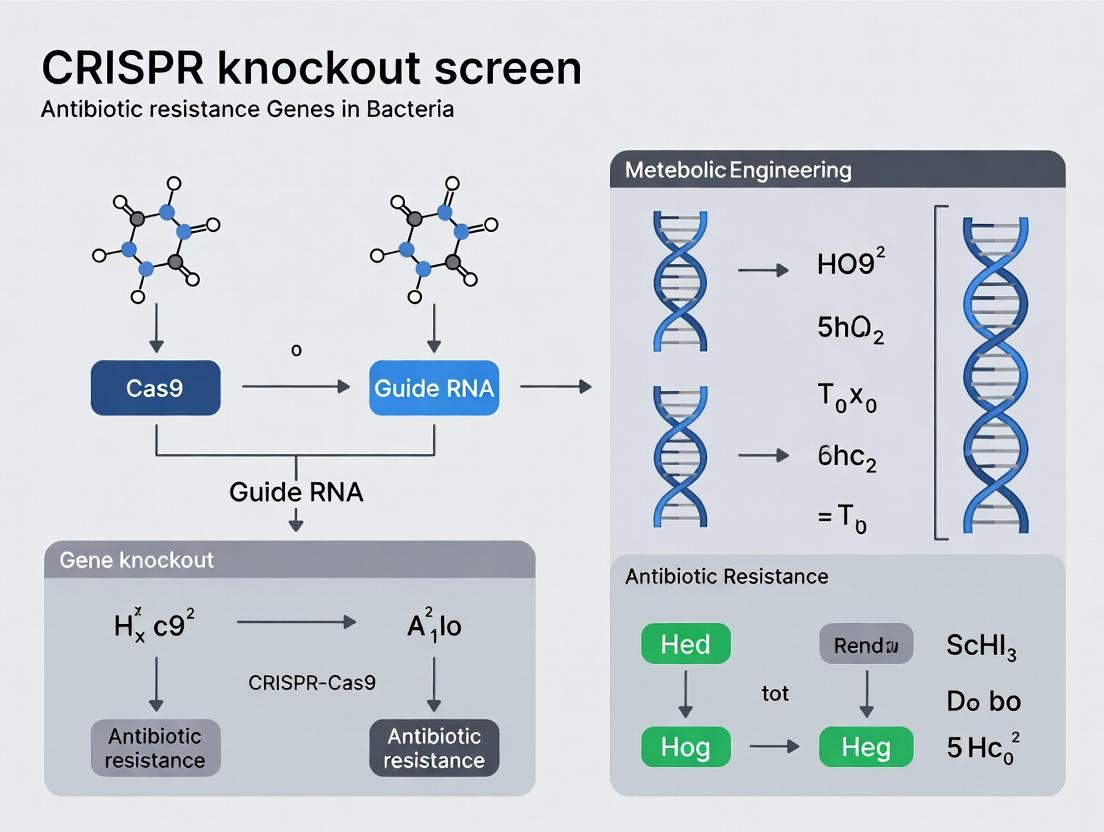
This article provides a detailed roadmap for employing CRISPR knockout screens to identify genes essential for antibiotic resistance.
CRISPR Knockout Screens in Antibiotic Resistance: A Comprehensive Guide from Design to Discovery
Abstract
This article provides a detailed roadmap for employing CRISPR knockout screens to identify genes essential for antibiotic resistance. We cover foundational principles, including the necessity of functional genomics in the AMR crisis and core CRISPR screening concepts. A step-by-step methodological guide details library design, bacterial delivery systems (e.g., plasmids, phages), antibiotic challenge strategies, and NGS data analysis. We address critical troubleshooting areas like library representation, delivery efficiency, and false positives. Finally, we explore validation techniques and compare CRISPR screening to traditional methods like transposon mutagenesis, highlighting its superior resolution and advantages. This guide is tailored for researchers and drug development professionals aiming to discover novel resistance mechanisms and therapeutic targets.
Decoding Resistance: Why CRISPR Screens Are Revolutionizing Antibiotic Discovery
The Antibiotic Resistance Crisis and the Need for Functional Genomics
The rapid emergence and global spread of antibiotic-resistant bacteria constitute a critical public health crisis. Traditional antimicrobial discovery pipelines have stagnated, failing to address the escalating threat of pan-resistant pathogens. This whitepaper frames the crisis within the context of modern functional genomics, specifically the application of CRISPR-Cas9 knockout screens, to systematically identify and validate genetic determinants of resistance. This approach moves beyond correlative studies to establish causality, offering a high-throughput pathway for uncovering novel drug targets and potentiators of existing antibiotics.
The Scale of the Crisis: Quantitative Data
The following tables summarize key quantitative data illustrating the severity of the antibiotic resistance crisis and the output of functional genomics studies.
Table 1: Global Burden of Antimicrobial Resistance (AMR)
| Metric | Value | Source/Note |
|---|---|---|
| Estimated deaths attributable to AMR in 2019 | 4.95 million | (Murray et al., The Lancet 2022) |
| Estimated deaths directly caused by AMR in 2019 | 1.27 million | (Murray et al., The Lancet 2022) |
| Projected annual deaths by 2050 under status quo | 10 million | (O'Neill Review on AMR, 2016) |
| Increase in mortality risk for resistant infections | ~2x | Varies by pathogen-drug combination |
| Estimated global economic cost by 2050 | $100 trillion | (O'Neill Review on AMR, 2016) |
Table 2: Output from a Representative CRISPR Knockout Screen for Resistance Genes
| Parameter | Result | Experimental Context |
|---|---|---|
| Library size | ~100,000 sgRNAs | Genome-wide E. coli Keio library adaptation |
| Genes identified as conferring resistance (hits) | 57 | Screen against sub-MIC ciprofloxacin |
| Essential genes whose knockdown increases sensitivity (collateral vulnerabilities) | 32 | Screen against sub-MIC colistin |
| Novel genetic contributors to resistance | ~30% of hits | Previously unlinked to antibiotic response |
| Validation rate (hit confirmation via individual knockout) | >85% | Secondary assays |
Core Experimental Protocol: Genome-wide CRISPR Knockout Screen for Antibiotic Resistance Genes
This protocol details a pooled screening approach in a model bacterium (e.g., E. coli) to identify genes whose loss confers resistance or hypersensitivity.
Materials and Reagents
- Bacterial Strain: E. coli BW25113 or similar with functional non-homologous end joining (NHEJ) or recombineering system for CRISPR-Cas9.
- CRISPR-Cas9 System: Plasmid expressing a codon-optimized Cas9 nuclease and a scaffold for sgRNA expression. System must be compatible with the bacterial host.
- sgRNA Library: A pooled, cloned library targeting all non-essential genes in the genome. Each gene is targeted by 4-10 distinct sgRNAs. The library includes non-targeting control sgRNAs.
- Antibiotic: The antibiotic of interest (e.g., ciprofloxacin, colistin), prepared at a precise sub-lethal concentration (e.g., 0.5x MIC).
- Growth Media: Lysogeny broth (LB) or defined medium appropriate for the strain.
- Molecular Biology Reagents: Kits for genomic DNA extraction, PCR amplification, and next-generation sequencing (NGS) library preparation.
- Equipment: Next-generation sequencer, spectrophotometer, microplate reader, centrifuges, and controlled environment incubators.
Procedure
Day 1: Library Transformation and Expansion
- Electroporate or chemically transform the pooled sgRNA library plasmid pool into the Cas9-expressing E. coli strain.
- Allow recovery in non-selective medium for 1 hour, then plate the entire transformation on large, selective agar plates (e.g., chloramphenicol) to maintain the plasmid. Incubate overnight (~16 hours) at 37°C.
Day 2: Harvest Initial Population (T0)
- Harvest all bacterial colonies from the plates by scraping into liquid medium. Isolate genomic DNA from an aliquot representing at least 500x coverage of the library (e.g., for a 100,000-guide library, harvest >50 million cells). This is the T0 reference sample.
- Dilute the remainder of the harvested cells to a precise density (OD600 ~0.05) in fresh, selective medium containing the sub-lethal concentration of the target antibiotic.
Day 3-5: Selection Passaging
- Grow the culture under antibiotic selection. Monitor growth until it reaches mid-log phase (OD600 ~0.6-0.8).
- Dilute the culture back to OD600 ~0.05 in fresh medium containing the same concentration of antibiotic. Repeat this passaging for 3-5 bacterial generations to allow for significant enrichment or depletion of sgRNA guides.
- Harvest an aliquot at each passage point for genomic DNA extraction (e.g., T3, T5).
Day 6: Sequencing Library Preparation and Analysis
- From each genomic DNA sample (T0, T3, T5), PCR amplify the sgRNA cassette using barcoded primers compatible with your NGS platform.
- Purify the PCR products, quantify, pool equimolarly, and sequence on an Illumina MiSeq or HiSeq platform to obtain at least 500 reads per sgRNA.
- Bioinformatic Analysis: For each sgRNA, calculate its abundance fold-change (T5/T0) using a pipeline (e.g., MAGeCK). Statistically rank genes based on the collective behavior of all targeting sgRNAs. Genes with significantly enriched sgRNAs indicate knockouts that confer resistance; genes with depleted sgRNAs indicate essential genes or those whose loss increases sensitivity.
Visualizing the Workflow and Pathways
Diagram Title: CRISPR Screen Workflow for Antibiotic Resistance Genes
Diagram Title: Resistance Mechanisms & Genetic Determinants
The Scientist's Toolkit: Key Research Reagent Solutions
Table 3: Essential Reagents for CRISPR Functional Genomics in Antibiotic Resistance
| Item | Function/Description | Example/Supplier |
|---|---|---|
| Arrayed or Pooled sgRNA Libraries | Pre-designed, cloned sets of guide RNAs targeting the entire genome or specific gene families (e.g., kinases, transporters). Essential for loss-of-function screens. | E. coli Keio library (Horizon); Genome-wide human Brunello library (Addgene). |
| CRISPR-Cas9 Vector Systems | Plasmids or integrated systems expressing Cas9 and the sgRNA scaffold. Must be optimized for the host organism (bacterial, fungal, mammalian). | pCas9 (Addgene plasmid #42876) for E. coli; lentiCRISPRv2 for mammalian cells. |
| NGS Library Prep Kits | Kits optimized for amplifying and barcoding sgRNA sequences from genomic DNA for deep sequencing. Critical for screen deconvolution. | Illumina Nextera XT; NEBNext Ultra II DNA. |
| Bioinformatics Analysis Software | Specialized tools for quantifying sgRNA abundance, normalization, and statistical identification of significant hits from screen data. | MAGeCK, CRISPResso2, pinAPL-Py. |
| Validated Antibiotic Compounds | High-purity chemical agents for in vitro selection. Requires precise MIC determination for the model organism. | Sigma-Aldrich, Millipore. |
| Conditional Knockout/Rescue Systems | Tools for orthogonal validation, such as inducible CRISPRi or complementation vectors, to confirm phenotype-genotype causality. | CRISPRi systems (dCas9) with inducible promoters. |
This technical guide elucidates the molecular fundamentals of the CRISPR-Cas9 system, tracing its evolution from an adaptive bacterial immune mechanism to a premier tool for precision genome engineering. The content is framed within the critical context of employing CRISPR knockout (CRISPRko) screens to systematically identify and validate antibiotic resistance genes, a research thesis pivotal for combating the global antimicrobial resistance (AMR) crisis. For researchers and drug development professionals, mastery of these fundamentals is essential for designing robust, high-throughput screens to uncover novel genetic determinants of resistance and potential therapeutic targets.
Part 1: From Bacterial Immunity to a Programmable Nuclease
The Clustered Regularly Interspaced Short Palindromic Repeats (CRISPR) and CRISPR-associated (Cas) systems constitute an adaptive immune defense in bacteria and archaea. Upon viral (phage) invasion, fragments of foreign DNA are integrated as "spacers" into the host's CRISPR locus. This genomic record is transcribed and processed into short CRISPR RNA (crRNA) molecules, which guide Cas nucleases to cleave complementary invasive DNA upon re-infection.
The Type II CRISPR-Cas9 system from Streptococcus pyogenes was simplified into a two-component tool: the Cas9 endonuclease and a single-guide RNA (sgRNA). The sgRNA, a fusion of crRNA and trans-activating crRNA (tracrRNA), directs Cas9 to a specific genomic locus complementary to its 20-nucleotide spacer sequence, adjacent to a Protospacer Adjacent Motif (PAM, 5'-NGG-3' for SpCas9). Cas9 induces a double-strand break (DSB) at the target site.
Key Quantitative Parameters of Common Cas9 Orthologs
| Cas9 Variant | PAM Sequence | Size (aa) | Cleavage Domain | Common Application |
|---|---|---|---|---|
| S. pyogenes (SpCas9) | 5'-NGG-3' | 1368 | RuvC, HNH | Broad mammalian genome editing |
| S. aureus (SaCas9) | 5'-NNGRRT-3' | 1053 | RuvC, HNH | In vivo delivery (smaller size) |
| S. thermophilus (StCas9) | 5'-NNAGAAW-3' | 1121 | RuvC, HNH | Targeting AT-rich regions |
| Cas9 Nickase (D10A) | NGG | 1368 | HNH (active) | Paired nickases for reduced off-target |
| Dead Cas9 (dCas9) | NGG | 1368 | None | Transcriptional modulation, imaging |
CRISPR Evolution: Bacterial Defense to Gene Editing Tool
Part 2: Mechanism of Precision Gene Knockout
In eukaryotic cells, the CRISPR-Cas9-induced DSB is primarily repaired by the error-prone Non-Homologous End Joining (NHEJ) pathway. This often results in small insertions or deletions (indels) at the break site. When these indels occur within a protein-coding exon, they can cause a frameshift mutation, leading to a premature stop codon and complete loss of function (knockout) of the target gene.
Quantitative Outcomes of NHEJ Repair After Cas9 Cleavage
| Outcome Type | Frequency Range | Result for Protein-Coding Gene |
|---|---|---|
| Precise Repair | ~10-30% | No knockout (functional protein) |
| Small Indel (1-10 bp) | ~50-70% | High probability of frameshift knockout |
| Large Deletion (>10 bp) | ~5-20% | High probability of knockout |
| Microhomology-Mediated Deletion | Variable | Often leads to knockout |
Part 3: CRISPRko Screens for Antibiotic Resistance Genes
A pooled CRISPRko screen is a powerful forward-genetic approach to identify genes whose loss of function confers a phenotype, such as altered antibiotic sensitivity. The workflow involves: 1) Designing a library of sgRNAs targeting the genome; 2) Delivering the library to a population of cells; 3) Applying selective pressure (e.g., an antibiotic); 4) Sequencing to identify sgRNAs enriched or depleted in the surviving population.
Key Steps in a CRISPRko Screen for Antibiotic Resistance
| Step | Key Action | Objective in AMR Research |
|---|---|---|
| Library Design | Select 4-5 sgRNAs/gene + non-targeting controls | Target known/potential resistance genes |
| Library Delivery | Lentiviral transduction at low MOI | Ensure one sgRNA per cell, stable integration |
| Selection | Treat with sub-MIC or lethal antibiotic dose | Apply selective pressure for resistance genes |
| Harvest & Sequence | Extract genomic DNA, amplify sgRNA region, NGS | Quantify sgRNA abundance pre- and post-selection |
| Bioinformatics | MAGeCK, CRISPResso2, edgeR analysis | Identify significantly depleted (essential resistance) genes |
Workflow for a Pooled CRISPRko Antibiotic Screen
Experimental Protocol: Key Steps for a CRISPRko Screen
Protocol 1: Production of Lentiviral sgRNA Library
- Clone Library: Use a pooled, array-synthesized oligonucleotide library (e.g., Brunello or GeCKO v2) cloned into a lentiviral sgRNA expression vector (e.g., lentiCRISPRv2, Addgene #52961).
- Transform: Electroporate the ligation into Endura electrocompetent cells. Plate on large LB-ampicillin plates. Harvest all colonies for max diversity.
- Package Virus: Co-transfect HEK293T cells (in 10-cm dish) with 10 µg library plasmid, 7.5 µg psPAX2, and 2.5 µg pMD2.G using PEI transfection reagent.
- Harvest & Concentrate: Collect supernatant at 48h and 72h post-transfection. Concentrate via PEG-it virus precipitation solution. Titrate on target cells.
Protocol 2: Cell Selection and Genomic DNA Extraction
- Infect Target Cells: Infect cells (e.g., E. coli or mammalian cell line) at an MOI of ~0.3 to ensure most cells receive one sgRNA. Select with appropriate antibiotic (e.g., puromycin) for 5-7 days.
- Apply Selective Pressure: Split cells into treatment (antibiotic at predetermined MIC) and control arms. Passage cells for 10-14 population doublings.
- Harvest gDNA: Harvest at least 1e7 cells per arm. Extract gDNA using a column-based maxi-prep kit (e.g., Qiagen Blood & Cell Culture DNA Maxi Kit). Ensure DNA concentration >100 ng/µL.
- Amplify sgRNA Locus: Perform 2-step PCR to add Illumina adapters and sample indices. Use high-fidelity polymerase. Purify PCR products with AMPure XP beads. Quantify by qPCR before pooling for sequencing.
The Scientist's Toolkit: Research Reagent Solutions
| Item | Function in CRISPRko Screen | Example/Supplier |
|---|---|---|
| Pooled sgRNA Library | Targets thousands of genes simultaneously; provides phenotypic readout via sgRNA barcode. | Broad Institute Brunello Human Library (Addgene #73178) |
| Lentiviral Packaging Plasmids | Essential for producing replication-incompetent lentiviral particles to deliver sgRNA. | psPAX2 (Addgene #12260), pMD2.G (Addgene #12259) |
| Cas9-Expressing Cell Line | Stably expresses Cas9 nuclease, required for sgRNA-directed cleavage. | HEK293T-Cas9, U2OS-Cas9, or generate via stable transfection. |
| Selection Antibiotics | 1) Select for sgRNA integration. 2) Apply phenotypic pressure (e.g., antibiotic challenge). | Puromycin, Blasticidin; Experimental: Ciprofloxacin, Colistin |
| Next-Gen Sequencing Kit | For quantifying sgRNA abundance pre- and post-selection. | Illumina MiSeq Reagent Kit v3 (150-cycle) |
| Bioinformatics Software | Statistical analysis of screen data to identify hit genes. | MAGeCK (Model-based Analysis of Genome-wide CRISPR-Cas9 Knockout) |
DSB Repair Pathways Determine Knockout vs. Edit
This technical guide examines the core principles of pooled lentiviral versus arrayed CRISPR screening, framed within a broader thesis on the application of CRISPR knockout screens for identifying antibiotic resistance genes. As antimicrobial resistance (AMR) poses a critical global health threat, systematic genetic screening in bacterial models is essential for mapping genetic determinants of resistance and uncovering novel therapeutic targets. The choice between pooled and arrayed screening paradigms fundamentally shapes experimental design, scalability, data output, and biological interpretation in these efforts.
Core Principles and Comparative Analysis
CRISPR-Cas systems, particularly CRISPR-Cas9 from Streptococcus pyogenes and the smaller CRISPR-Cas12a, have been adapted for high-throughput functional genomics in bacteria. The central distinction lies in format:
- Pooled Lentiviral Screens: A heterogeneous population of cells is transduced with a complex lentiviral library where each virion delivers a single guide RNA (sgRNA). The entire population is cultured together under a selective pressure (e.g., an antibiotic), and sgRNA abundance before and after selection is quantified via next-generation sequencing (NGS).
- Arrayed CRISPR Screens: Each well of a multi-well plate contains a homogeneous population of cells, each transfected or transduced with a single, known sgRNA. Phenotypes (e.g., bacterial growth, viability) are measured individually for each well via high-content imaging or plate-based assays.
Quantitative Comparison
The following table summarizes the key technical and operational differences between the two approaches in the context of bacterial antibiotic resistance research.
Table 1: Comparison of Pooled Lentiviral vs. Arrayed CRISPR Screens
| Feature | Pooled Lentiviral Screen | Arrayed CRISPR Screen |
|---|---|---|
| Format | Mixed population; library in one vessel. | Separate wells for each sgRNA/bacterial clone. |
| Throughput | Extremely high (>100,000 sgRNAs). | Moderate to high (100s to 10,000s of targets). |
| Phenotype Readout | Bulk sequencing of sgRNA abundance. | Per-well measurement (e.g., growth kinetics, fluorescence, imaging). |
| Primary Data | Enrichment/depletion scores of sgRNAs. | Direct quantitative phenotype per target. |
| Complex Phenotypes | Limited to survival/death. | Compatible with high-content data (morphology, reporter expression). |
| Spatial/Temporal Data | No; endpoint bulk measurement. | Yes; time-course and single-well resolution possible. |
| Screen Cost | Lower per target. | Higher per target. |
| Hit Deconvolution | Requires sequencing and bioinformatics. | Directly known from well position. |
| Best Suited For | Genome-wide knockout screens under strong selective pressure. | Focused libraries, kinetic studies, complex morphology-based phenotypes. |
| Key Challenge | Off-target effects, screening dynamics, delivery efficiency in bacteria. | Scalability, assay robustness, automated handling. |
Detailed Experimental Protocols
Protocol 1: Pooled Lentiviral CRISPR Knockout Screen for Antibiotic Resistance Genes
Objective: To identify bacterial genes whose knockout alters susceptibility to a specific antibiotic.
Materials:
- Bacterial Strain: Competent E. coli or other suitable strain expressing Cas9 (or Cas12a) under inducible control.
- Lentiviral sgRNA Library: Designed for bacterial genomes (e.g., targeting all non-essential genes). Note: Lentiviral delivery is less common in bacteria due to host range; often phage-based (M13) or electroporation of plasmid libraries is used. The "lentiviral" principle is adapted from eukaryotic systems.
- Selection Antibiotic: For maintenance of the CRISPR plasmid.
- Test Antibiotic: The compound for resistance/sensitivity screening.
- Growth Medium: Appropriate liquid and solid media.
- Plasmid Extraction & NGS Kits.
Procedure:
- Library Delivery: Transform the pooled sgRNA plasmid library into the Cas9-expressing bacterial strain via high-efficiency electroporation. Achieve >1000x library coverage.
- Control Sample Harvest: Immediately after recovery, harvest a sample of cells ("T0"), extract plasmid DNA, and amplify the sgRNA region for NGS to define the initial library representation.
- Selection Phase: Divide the transformed pool. Culture one portion under the sub-inhibitory concentration of the test antibiotic, and another as an untreated control. Propagate for ~10-15 bacterial generations.
- Endpoint Sample Harvest: Harvest cells from both treated and control pools. Extract plasmid DNA.
- sgRNA Amplification & Sequencing: PCR-amplify the sgRNA cassette from all samples (T0, treated, control). Prepare NGS libraries and sequence on an Illumina platform.
- Bioinformatic Analysis: Align reads to the sgRNA library reference. Calculate the fold-change and statistical significance (e.g., using MAGeCK or edgeR) for each sgRNA between conditions. Genes targeted by significantly depleted sgRNAs in the treated pool are putative antibiotic resistance genes.
Protocol 2: Arrayed CRISPR Knockout Screen for Synergistic Lethality
Objective: To identify gene knockouts that synergize with a low dose of an antibiotic to cause bacterial death.
Materials:
- Arrayed sgRNA Library: Individual bacterial clones, each harboring a plasmid with a unique, known sgRNA.
- Automated Liquid Handler: For high-throughput plating.
- Multi-well Plates: 96-well or 384-well plates.
- Microplate Reader: For optical density (OD) and fluorescence measurements.
- Inducer: To induce Cas9 expression and sgRNA transcription.
- Test Antibiotic.
Procedure:
- Arrayed Culture Setup: Using an automated handler, inoculate each well of a 384-well plate with a single bacterial clone from the arrayed library. Include control wells (non-targeting sgRNA, essential gene sgRNA).
- Knockout Induction: Add inducer to trigger Cas9 and sgRNA expression, generating the knockout.
- Compound Treatment: Add a sub-inhibitory concentration of the test antibiotic to all wells.
- Phenotypic Measurement: Incubate the plate with continuous shaking in a microplate reader. Measure OD600 (for growth) every 30 minutes for 16-24 hours.
- Data Analysis: Calculate growth curves for each well. Derive parameters like area under the curve (AUC), maximum growth rate, or endpoint OD. Normalize to control wells. Identify sgRNAs causing significantly reduced growth only in the presence of the antibiotic as hits revealing synergistic lethal interactions.
Visualizing Screening Workflows
Diagram 1: Pooled CRISPR Screen Workflow
Diagram 2: Arrayed CRISPR Screen Workflow
The Scientist's Toolkit: Key Research Reagents & Materials
Table 2: Essential Toolkit for Bacterial CRISPR Screens
| Item | Function in Screen | Key Considerations |
|---|---|---|
| CRISPR-Cas Vector | Delivers Cas nuclease and sgRNA scaffold to bacterium. | Inducible Cas9/Cas12a; compatible origin of replication and antibiotic resistance for host. |
| sgRNA Library | Targets specific genomic loci for double-strand breaks. | Design for minimal off-targets in bacterial genome. Pooled (plasmid library) or arrayed (individual clones). |
| Electrocompetent Cells | For high-efficiency plasmid library transformation. | High transformation efficiency (>10^9 CFU/µg) is critical for pooled screen coverage. |
| Selective Antibiotics | Maintains plasmid and applies selective pressure. | Choose based on plasmid resistance marker and the antibiotic being studied. |
| Inducer Molecule | Tightly controls Cas9 and sgRNA expression. | Common: anhydrotetracycline (aTc) for Tet-inducible systems; IPTG for lac systems. |
| Next-Gen Sequencing Kit | Quantifies sgRNA abundance in pooled screens. | Must reliably amplify sgRNA region from genomic DNA with minimal bias. |
| Microplate Reader | Measures kinetic growth in arrayed screens. | Should have shaking, temperature control, and OD600/fluorescence capabilities. |
| Bioinformatics Software | Analyzes NGS data or plate reader data for hit identification. | MAGeCK, CRISPRcloud for pooled; custom R/Python scripts for arrayed dose-response. |
The choice between pooled lentiviral (or phage/plasmid-based) and arrayed CRISPR screens is foundational in bacterial antibiotic resistance research. Pooled screens offer unparalleled scale and are ideal for positive/negative selection paradigms to map essential and resistance genes genome-wide. Arrayed screens, while lower in ultimate throughput, provide richer, time-resolved phenotypic data essential for studying genetic interactions, such as synthetic lethality with existing antibiotics. Integrating findings from both approaches within a thesis framework provides a comprehensive genetic landscape of bacterial vulnerability, accelerating the discovery of novel drug targets and combination therapies to combat antimicrobial resistance.
Defining Essential Genes, Resistance Genes, and Synthetic Lethality in Bacteria
This whitepaper defines the core genetic concepts underpinning modern functional genomics approaches, specifically within the context of using CRISPR knockout screens to identify novel targets for combating antibiotic resistance.
Core Definitions
- Essential Genes: Genes indispensable for survival under a given condition (e.g., optimal growth in vitro). Their deletion results in loss of viability or reproductive failure. In antibiotic contexts, essential genes are often the targets of bactericidal drugs.
- Resistance Genes: Genes that, when acquired or mutated, enable a bacterium to survive exposure to an antibiotic. Mechanisms include drug inactivation, efflux pumps, target modification, and bypass pathways.
- Synthetic Lethality (SL): A genetic interaction where the simultaneous disruption of two non-essential genes results in cell death, whereas disruption of either gene alone is viable. In bacteria, targeting a resistance gene in combination with a non-essential SL partner is a promising therapeutic strategy to resensitize resistant strains.
Table 1: Prevalence of Gene Types in Model Bacterial Pathogens
| Bacterium | Approx. Total Genes | Estimated Essential Genes* | Known Resistance Genes (Plasmid/Chromosomal) | Reference |
|---|---|---|---|---|
| Escherichia coli (K-12) | ~4,500 | 300-500 (7-11%) | 50+ (e.g., blaTEM, aac(3)-IIa) | Price et al., 2018 |
| Staphylococcus aureus (USA300) | ~2,800 | 350-600 (12-21%) | 20+ (e.g., mecA, ermC) | Chaudhuri et al., 2009 |
| Pseudomonas aeruginosa (PAO1) | ~5,500 | 300-600 (5-11%) | 40+ (e.g., ampC, mex efflux genes) | Poulsen et al., 2019 |
| Mycobacterium tuberculosis (H37Rv) | ~4,000 | 600-800 (15-20%) | 20+ (e.g., rpoB (RIF), katG (INH)) | DeJesus et al., 2017 |
Note: Essential gene counts are condition-dependent (rich media).
Table 2: CRISPR Screen Output Metrics for Antibiotic Resistance Studies
| Screen Type | Typical Library Size (sgRNAs) | Key Output Measurement | Potential Hit Criteria | Example Application |
|---|---|---|---|---|
| Drop-out Screen (Essential Genes) | 50-100k (genome-wide) | Depletion (log2 fold-change) | Log2FC < -2, FDR < 5% | Identify core essentialome |
| Resistance Gene Screen (Positive Selection) | 10-50k (focused) | Enrichment (log2 fold-change) | Log2FC > 2, FDR < 5% | Find genes conferring resistance |
| SL Screen (Conditional Essentiality) | 50-100k (genome-wide) | Differential Depletion (ΔLog2FC) | (ΔLog2FC) < -3 in drug vs control | Find SL partners of resistance pathways |
Experimental Protocols
Protocol: Genome-wide CRISPRi Knockout Screen for Synthetic Lethal Partners of a Beta-lactam Resistance Gene
Objective: Identify genes whose knockdown is lethal in a β-lactam-resistant strain (blaTEM-1 positive) but not in an isogenic susceptible strain under sub-MIC ampicillin treatment.
Materials: See "Research Reagent Solutions" below.
Method:
- Library Delivery: Transform the target bacterial strain (harboring a dCas9-expression plasmid) with a genome-wide, pooled sgRNA library (e.g., ~100,000 sgRNAs) via electroporation. Include non-targeting control sgRNAs.
- Library Expansion & Baseline: Plate transformed cells on large square agar plates with appropriate antibiotics to select for both plasmids. Scrape, resuspend, and harvest a sample (T0) for genomic DNA extraction.
- Selection Arms: Inoculate the remaining pool into two parallel liquid cultures:
- Condition A: Growth medium + sub-MIC Ampicillin (e.g., 0.5x MIC).
- Condition B: Growth medium only (no drug control).
- Passaging: Grow cultures for ~12-16 generations, diluting into fresh medium/drug every 6-8 hours to maintain logarithmic growth. Harvest final pellets (Tend) for gDNA.
- Sequencing Library Prep:
- Extract gDNA from T0 and Tend samples.
- Amplify the sgRNA region via a two-step PCR. Use limited-cycle PCR1 with primers containing partial Illumina adapters and sample barcodes. Pool products, then run PCR2 to add full adapters.
- Purify, quantify, and sequence on an Illumina NextSeq (75bp single-end).
- Data Analysis:
- Align reads to the sgRNA library reference.
- Count reads per sgRNA for each sample (T0, TendConditionA, TendConditionB).
- Normalize counts (e.g., counts per million, CPM).
- Calculate log2 fold-change (Log2FC) for each sgRNA in Condition A vs T0 and Condition B vs T0.
- Compute the differential depletion score: ΔLog2FC = Log2FC(Condition A) - Log2FC(Condition B).
- Perform statistical testing (e.g., using MAGeCK or edgeR) to rank sgRNAs/genes by significant depletion in Condition A relative to Condition B (FDR < 5%). Top hits represent candidate synthetic lethal interactions with the β-lactam resistance state.
Diagrams
Diagram Title: CRISPRi Screen Workflow for Synthetic Lethality
Diagram Title: Synthetic Lethality with a Resistance Gene
Research Reagent Solutions
Table 3: Essential Toolkit for Bacterial CRISPR Knockout Screens
| Item | Function/Description | Example Product/Reference |
|---|---|---|
| dCas9 Expression Plasmid | Constitutively expresses catalytically dead Cas9 for CRISPR interference (CRISPRi) knockdown. | pdCas9-bacteria (Addgene #44249) |
| Genome-wide sgRNA Library | Pooled, cloned sgRNAs targeting all non-essential genes. Essential for unbiased discovery. | E. coli CRISPRi Keio library (Yao et al., Nat. Microbiol., 2020) |
| Next-Generation Sequencing (NGS) Platform | For high-throughput sequencing of sgRNA amplicons to quantify abundance. | Illumina NextSeq 500/550 |
| sgRNA Amplification Primers | PCR primers with overhangs for adding Illumina adapters and sample barcodes. | Custom-designed, index primers. |
| Analysis Software | For statistical analysis of screen data to identify essential/resistance/SL genes. | MAGeCK (Li et al., Genome Biol., 2014) |
| Electrocompetent Cells | High-efficiency bacterial cells for library-scale transformation. | Homemade or commercial (e.g., Lucigen) |
| Selection Antibiotics | For maintenance of plasmids and application of selective pressure during screen. | Kanamycin, Carbenicillin, etc. |
Within the broader thesis of utilizing CRISPR knockout screens to systematically dissect antibiotic resistance, a pivotal application is the identification of novel resistance mechanisms and vulnerable drug targets. This guide details the experimental and computational pipeline for transitioning from genome-wide screening to validated targets, a critical pathway for revitalizing the antimicrobial discovery pipeline.
Core Experimental Workflow
High-Throughput CRISPR-Cas9 Knockout Screen
Objective: To identify bacterial genes whose loss-of-function alters susceptibility to a specific antibiotic.
Protocol:
- Library Design & Cloning: Utilize a pooled, genome-wide sgRNA library (e.g., ~10 sgRNAs/gene, plus non-targeting controls). For bacteria, employ a dCas9 or CRISPRi knockdown library for essential genome interrogation, or a clean knockout library in non-essential regions. Clone library into an appropriate, chemically competent E. coli strain via electroporation.
- Transformation & Selection: Achieve >200x library coverage. Plate transformed cells on selective media (e.g., chloramphenicol) to maintain the plasmid. Harvest colonies to create the "Input Pool (T0)."
- Antibiotic Challenge: Dilute the T0 pool into fresh medium and split into two conditions:
- Experimental: Grown in sub-lethal concentration (e.g., 0.5x MIC) of the target antibiotic.
- Control: Grown in the absence of antibiotic.
- Culture for ~10-12 generations to allow for phenotype enrichment.
- Harvest & Sequencing: Harvest genomic DNA from the post-selection Experimental and Control populations. Amplify the integrated sgRNA region via PCR using barcoded primers. Sequence on an Illumina platform to obtain sgRNA counts.
Data Analysis & Hit Identification
Protocol:
- Read Alignment & Count: Map sequencing reads to the reference sgRNA library using tools like
Bowtie2orMAGeCK. - Statistical Enrichment/Depletion Analysis: Use Model-based Analysis of Genome-wide CRISPR-Cas9 Knockout (MAGeCK) or similar to compare sgRNA abundance between Experimental and Control conditions.
- Key output: Log2 Fold Change (LFC) and False Discovery Rate (FDR) for each gene.
- Hit Criteria: Genes are prioritized as "hits" if they meet:
- Resistance Genes (Sensitizers): sgRNAs are depleted in the antibiotic condition (LFC < 0, FDR < 0.05). Knockout increases antibiotic susceptibility.
- Drug Target Candidates (Resistance Mechanisms): sgRNAs are enriched in the antibiotic condition (LFC > 0, FDR < 0.05). Knockout confers a survival advantage, suggesting the gene product is the antibiotic's target or part of a redundant resistance pathway.
Table 1: Example Hit List from a β-lactam Screen in E. coli
| Gene Name | LFC (Antibiotic vs Control) | FDR (q-value) | Putative Function | Hit Classification |
|---|---|---|---|---|
| ampC | -4.21 | 2.5E-08 | β-lactamase | Known Resistance (Sensitizer) |
| mrdA | -3.85 | 5.1E-07 | Penicillin-binding protein 2 | Known Target (Sensitizer) |
| ycbB | +2.94 | 1.8E-05 | Uncharacterized permease | Novel Resistance Mechanism |
| folA | -2.56 | 3.2E-04 | Dihydrofolate reductase | Novel Sensitizer (Adjuvant Target) |
CRISPR Screen to Target ID Workflow
Validation & Mechanistic Elucidation
Validation of Candidate Genes
Protocol for Individual Knockout Validation:
- Strain Construction: Generate clean, markerless knockout of the candidate gene in the wild-type background using allelic exchange or a dedicated CRISPR-Cas9 plasmid.
- Phenotypic Confirmation: Perform Minimum Inhibitory Concentration (MIC) assays in triplicate according to CLSI guidelines. Compare MIC of the knockout strain to the wild-type parent against the screening antibiotic and other relevant agents.
- Complementation: Clone the wild-type allele into an inducible expression vector. Introduce into the knockout strain and demonstrate restoration of the wild-type MIC phenotype upon induction.
Table 2: MIC Validation of Candidate Hits
| Strain | MIC to Screening Antibiotic (μg/mL) | Fold Change vs WT | Interpretation |
|---|---|---|---|
| Wild-Type | 16 | 1.0 | Baseline |
| ΔycbB (Enriched Hit) | 2 | 0.125 | Confirmed: Knockout increases susceptibility |
| ΔfolA (Depleted Hit) | 64 | 4.0 | Confirmed: Knockout decreases susceptibility |
| ΔycbB + pycbB | 16 | 1.0 | Complementation successful |
Elucidating the Mechanism of Action
Protocol for Target Identification via Chemical-Genetic Profiling:
- Secondary Screening: Challenge the validated knockout strain with a diverse panel of antibiotics (e.g., 20-30 compounds with known mechanisms).
- Signature Analysis: Identify which antibiotics show altered MIC in the knockout strain. A unique hypersensitivity profile often points to the pathway or function the novel gene interacts with.
- Biochemical Assays: Based on the profile, perform downstream assays:
- Membrane Permeability: If hypersensitive to large antibiotics, measure uptake of fluorescent dyes (e.g., ethidium bromide).
- Efflux Inhibition: If hypersensitive to multiple classes, use carbonyl cyanide m-chlorophenyl hydrazone (CCCP) as an efflux pump inhibitor control.
- Enzymatic Activity: If the gene is putative enzyme, develop an in vitro assay with purified protein and suspected substrate.
Mechanism Elucidation Pathways
The Scientist's Toolkit: Research Reagent Solutions
Table 3: Essential Materials for CRISPR Knockout Resistance Screens
| Item | Function & Rationale | Example/Supplier |
|---|---|---|
| Genome-wide sgRNA Library | Pooled library targeting all non-essential genes; enables systematic, parallel interrogation of gene function. | E. coli Keio collection-based library (Addgene Kit #1000000055) or custom-designed CRISPRi libraries. |
| CRISPR-Cas9 Vector System | Delivers Cas9 and sgRNA expression cassettes; requires appropriate replicon and selection for host bacterium. | pCas9 (Addgene #42876) or pKDsgRNA-pCAS9 system for E. coli. |
| Electrocompetent Cells | High-efficiency bacterial cells for library transformation; critical for maintaining library diversity. | Commercial E. coli strains (e.g., MG1655) prepared in-house for optimal competency (>10⁹ CFU/μg). |
| Next-Generation Sequencer | Quantifies sgRNA abundance pre- and post-selection; essential for calculating enrichment scores. | Illumina MiSeq or NextSeq 500/550. |
| Bioinformatics Pipeline | Aligns reads, counts sgRNAs, and performs statistical analysis to rank significant hits. | MAGeCK (https://sourceforge.net/p/mageck), PinAPL-Py. |
| MIC Assay Plates | 96-well polypropylene plates for high-throughput minimum inhibitory concentration determination. | Corning #3357 or equivalent. |
| Inducible Complementation Vector | Allows controlled expression of wild-type gene for phenotypic rescue; confirms on-target effect. | pBAD/Myc-His series (araBAD promoter) or pTrc99A (trc promoter). |
| Fluorescent Membrane Dyes | Probes for assessing changes in membrane permeability as a resistance mechanism. | Ethidium bromide, SYTOX Green, N-phenyl-1-naphthylamine (Thermo Fisher). |
Blueprint for Success: A Step-by-Step Protocol for Your AMR CRISPR Screen
Within the framework of a CRISPR knockout (CRISPRko) screen for antibiotic resistance gene discovery, the initial and most critical step is the construction of a high-quality single guide RNA (sgRNA) library. The choice between a genome-wide and a focused library sets the strategic direction for the entire screen, balancing the depth of discovery against experimental tractability and cost. This guide details the technical considerations and protocols for designing and cloning both library types.
Library Strategy: Genome-Wide vs. Focused
The decision between library types hinges on the research hypothesis and available resources.
Table 1: Comparative Analysis of Genome-Wide vs. Focused sgRNA Libraries
| Feature | Genome-Wide Library | Focused Library |
|---|---|---|
| Target Scope | All annotated genes in a genome (e.g., ~20,000 human genes) | Pre-defined gene set (e.g., 500-2,000 genes of a specific pathway or phenotype) |
| Typical Size | 70,000 - 120,000 sgRNAs | 5,000 - 15,000 sgRNAs |
| Primary Goal | Unbiased discovery of novel resistance mechanisms | Deep interrogation of known pathways or gene families |
| Screen Cost | High (reagents, sequencing) | Moderate |
| Hit Validation Burden | High (many candidate genes) | Lower (targeted candidate list) |
| Optimal Use Case | Discovery of novel, unexpected resistance genes | Validating hypotheses linking specific pathways (e.g., efflux pumps, cell wall synthesis) to resistance |
| Design Complexity | High; requires complex bioinformatics to manage scale | Lower; allows for sophisticated tiling or saturation mutagenesis within targets |
sgRNA Design Principles
Core Design Rules
- Target Sequence: 20-nt guide sequence immediately 5' of the Protospacer Adjacent Motif (PAM). For Streptococcus pyogenes Cas9 (SpCas9), PAM is 5'-NGG-3'.
- On-Target Efficiency Prediction: Use algorithms (e.g., Doench-Root 2016, Rule Set 2, or more recent models) to score and select guides with high predicted activity. Target an average score > 0.6.
- Off-Target Minimization: Perform genome-wide alignment (e.g., using Bowtie or BWA) to identify potential off-target sites. Discard guides with >3 mismatches in the seed region (positions 1-12) or with perfect matches elsewhere in the genome.
- Genomic Context: Avoid regions with low complexity (e.g., homopolymer runs) or high GC content (aim for 40-60% GC).
Special Considerations for Antibiotic Resistance Screens
- Essential Gene Controls: Include sgRNAs targeting known essential genes (e.g., ribosomal proteins) as negative controls for cell viability.
- Positive Controls: Include sgRNAs targeting known antibiotic resistance genes (e.g., blaTEM-1, mecA) to validate screen performance.
- Non-Targeting Controls: 500-1000 sgRNAs with no genomic match to control for non-specific effects.
Quantitative Design Metrics
Table 2: Key Quantitative Benchmarks for Library Design
| Metric | Genome-Wide Library Recommendation | Focused Library Recommendation | Purpose |
|---|---|---|---|
| sgRNAs per Gene | 4 - 10 | 5 - 20 (or saturation tiling) | Ensure statistical robustness; mitigate sgRNA failure |
| Library Redundancy | ≥ 500 cells/sgRNA at infection | ≥ 1000 cells/sgRNA at infection | Ensure representation; prevent stochastic dropout |
| Cloning Efficiency | > 10⁸ CFU from ligation | > 10⁷ CFU from ligation | Ensure full library representation |
| Coverage at Screening | > 200x (reads per sgRNA) | > 500x (reads per sgRNA) | Ensure accurate quantification by NGS |
| Predicted On-Target Score | Mean > 0.6 | Mean > 0.7 | Maximize knockout efficiency |
| Off-Target Allowance | Zero perfect matches elsewhere | Zero perfect matches elsewhere | Minimize confounding phenotypes |
Protocol: Cloning the sgRNA Library into a Lentiviral Vector
This protocol describes the cloning of a pooled oligonucleotide library into the lentiCRISPRv2 or similar backbone via Golden Gate assembly.
Materials & Reagents
- Pooled Oligonucleotides: Synthesized ssDNA library containing variable 20-nt guide sequences flanked by constant cloning overhangs.
- Lentiviral Backbone: BsmBI-digested lentiCRISPRv2 plasmid (Addgene #52961).
- Enzymes: T4 Polynucleotide Kinase (PNK), T7 DNA Ligase, BsmBI-v2.
- Bacterial Strain: Endotoxin-free, electrocompetent E. coli (e.g., Stbl4, Endura ElectroCompetent Cells).
- Equipment: Electroporator, large-format agar plates (245 x 245 mm), plasmid maxi-prep kits.
Detailed Methodology
Step 1: Oligo Phosphorylation and Annealing
- Resusense pooled oligos in TE buffer.
- Phosphorylation/Annealing Reaction Mix:
- 1 µL Oligo pool (100 ng/µL)
- 1.25 µL 10x T4 Ligation Buffer
- 0.5 µL T4 PNK (10 U/µL)
- 11.25 µL Nuclease-free water
- Incubate in thermocycler: 37°C for 30 min; 95°C for 5 min; ramp down to 25°C at 5°C/min. Hold at 4°C.
Step 2: Golden Gate Cloning
- Assembly Reaction Mix:
- 12.5 µL Phosphorylated/Annealed oligo duplex (diluted 1:200)
- 50 ng BsmBI-digested lentiviral backbone
- 1.5 µL 10x T4 Ligase Buffer
- 0.5 µL BsmBI-v2 (10 U/µL)
- 1 µL T7 DNA Ligase (high-concentration)
- Nuclease-free water to 15 µL
- Incubate in thermocycler: 20 cycles of (37°C for 5 min, 20°C for 5 min); then 50°C for 5 min; 80°C for 5 min.
Step 3: Bacterial Transformation and Library Amplification
- Desalt the entire assembly reaction using a spin column.
- Electroporate 2 µL of product into 50 µL of Endura ElectroCompetent cells. Repeat to achieve >10⁸ total transformants.
- Recover cells in 1 mL SOC medium at 37°C for 1 hour.
- Plate the entire recovery onto five large-format LB agar plates with appropriate antibiotic (e.g., 100 µg/mL ampicillin). Incubate overnight at 32°C (reduces recombination).
- Scrape all colonies and perform a maxi-prep plasmid DNA extraction. This pooled plasmid is the cloned library ready for lentivirus production.
Step 4: Quality Control by Next-Generation Sequencing (NGS)
- Amplify the sgRNA cassette from the pooled plasmid using primers adding Illumina adapters.
- Sequence on an Illumina MiSeq (≥ 2 million reads).
- Analyze reads to confirm: >90% of designed sgRNAs are present, and no single sgRNA constitutes >0.1% of the total library.
Visualizations
Decision Flow for sgRNA Library Type Selection
sgRNA Library Cloning and QC Workflow
The Scientist's Toolkit: Research Reagent Solutions
Table 3: Essential Materials for sgRNA Library Construction
| Item | Function | Example Product/Catalog # |
|---|---|---|
| Pooled Oligonucleotide Library | Source of all sgRNA sequences for cloning. | Custom synthesis from Twist Bioscience, Agilent, or IDT. |
| Lentiviral Backbone Plasmid | Expresses Cas9, sgRNA, and allows viral packaging. | lentiCRISPRv2 (Addgene #52961). |
| High-Efficiency Cloning Kit | Optimized enzymes for Golden Gate assembly. | NEB Golden Gate Assembly Kit (BsmBI-v2) (E1602). |
| Electrocompetent E. coli | For high-efficiency transformation of large, repetitive libraries. | Endura ElectroCompetent Cells (Lucigen #60242-2). |
| Large-Format Agar Plates | Allows even growth of >10⁸ colonies to prevent overgrowth. | 245 x 245 mm Bioassay Dish (Corning #431111). |
| Maxi-Prep Kit | High-yield, high-purity plasmid prep from pooled colonies. | Qiagen Plasmid Plus Maxi Kit (12963). |
| NGS Library Prep Kit | To sequence and quantify the cloned sgRNA pool. | Illumina Nextera XT DNA Library Prep Kit (FC-131-1096). |
The efficacy of a genome-wide CRISPR knockout screen for identifying antibiotic resistance genes is fundamentally dependent on the delivery and expression of the CRISPR-Cas machinery within the target bacterial population. This step is not merely a technical prerequisite but a critical variable influencing screen coverage, uniformity, and the biological relevance of hits. The choice of delivery system—plasmid transformation, conjugation, or phage transduction—directly impacts transformation efficiency, cargo capacity, host range, and inducer compatibility. This guide provides an in-depth technical comparison of these systems and outlines optimized protocols for integrating them into a CRISPR knockout screen workflow targeting resistance determinants in clinically relevant bacterial strains.
Quantitative Comparison of Delivery Systems
The selection of a delivery system requires balancing multiple parameters. The table below summarizes key quantitative and qualitative metrics for the three primary systems.
Table 1: Comparative Analysis of Bacterial Delivery Systems for CRISPR Knockout Screens
| Parameter | Plasmid (Electroporation/Chemical) | Conjugation | Phage Transduction |
|---|---|---|---|
| Max Cargo Capacity | 10-20 kbp (standard plasmids) | > 50 kbp (BAC, genomic libraries) | ~40-50 kbp (Cosmid/phage genome) |
| Typical Efficiency | 10^6 – 10^9 CFU/µg DNA (highly strain-dependent) | 10^-1 – 10^-5 (transconjugants/donor) | 10^-6 – 10^-8 (transductants/PFU) |
| Primary Host Barrier | Restriction-Modification, Cell Envelope | Restriction, CRISPR-Cas of recipient | Receptor specificity, DNA injection |
| Requirement for Selectable Marker | Mandatory | Mandatory (for recipient selection) | Optional (can use phenotypic screening) |
| Best Suited For | High-efficiency, lab-adapted strains (e.g., E. coli K-12) | Broad-host-range, low-efficiency, or non-transformable strains (e.g., many clinical isolates) | Strain-specific, high-throughput delivery where natural phage exists |
| Key Advantage | High efficiency, controlled chemical induction. | Bypasses transformation barriers, delivers large DNA. | Highly efficient for specific hosts, minimal manipulation. |
| Key Disadvantage | Host-range limited, susceptible to restriction. | Requires donor cultivation, potential for donor DNA transfer. | Narrow host range, cargo capacity limited by phage head. |
Detailed Experimental Protocols
Protocol 3.1: Optimized Plasmid Delivery via Electroporation forE. coli
Objective: Introduce a CRISPR plasmid (containing Cas9 and sgRNA array) into a target E. coli strain for library construction.
- Growth: Inoculate 5 mL of target strain in rich broth (e.g., LB). Grow overnight at 37°C with shaking.
- Dilution: Subculture 1:100 into 50 mL of fresh, pre-warmed broth. Grow to an OD600 of 0.5-0.7.
- Chilling: Chill culture on ice for 15-30 minutes. Pellet cells at 4,000 x g for 10 min at 4°C.
- Washing: Wash pellet gently three times with 25 mL of ice-cold 10% glycerol (or electroporation buffer). Resuspend final pellet in 200 µL of ice-cold 10% glycerol.
- Electroporation: Mix 50 µL of competent cells with 1-10 ng of plasmid DNA. Transfer to a pre-chilled 1-mm electroporation cuvette. Pulse using standard E. coli settings (e.g., 1.8 kV, 200Ω, 25µF).
- Recovery: Immediately add 1 mL of SOC medium, transfer to a tube, and incubate at 37°C for 1 hour with shaking.
- Plating: Plate on selective agar to determine transformation efficiency (CFU/µg DNA).
Protocol 3.2: Triparental Conjugation for Delivery to Gram-Negative Clinical Isolates
Objective: Deliver a mobilizable CRISPR plasmid from an E. coli donor to a non-transformable clinical Pseudomonas aeruginosa recipient.
- Strain Preparation:
- Grow the donor (E. coli with mobilizable CRISPR plasmid and antibiotic resistance A), the helper (E. coli with pRK2013 or similar tra+ plasmid, resistance B), and the recipient (P. aeruginosa, resistance C) to mid-log phase.
- Mating:
- Mix 100 µL of each culture on a sterile 0.22 µm filter placed on a non-selective LB agar plate.
- Incubate face-up for 6-8 hours at 37°C.
- Selection:
- Resuspend the filter in 1 mL of saline.
- Plate serial dilutions on agar containing antibiotics A and C (to select for recipient cells that have received the CRISPR plasmid) and an antibiotic to counterselect against the E. coli donor and helper (e.g., nalidixic acid if the recipient is naturally resistant).
- Analysis: Screen transconjugant colonies by colony PCR for the presence of the CRISPR cassette.
Protocol 3.3: Phage λ Red Recombineering forE. coliLibrary Delivery
Objective: Integrate a CRISPR-Cas9 system and sgRNA library directly into the bacterial chromosome for stability.
- Induction:
- Grow an E. coli strain harboring a temperature-sensitive λ Red plasmid (pSIM5, pKD46) in LB with ampicillin at 30°C to OD600 ~0.3.
- Induce the Red genes (gam, bet, exo) by shifting to 42°C for 15 minutes.
- Preparation: Make cells electrocompetent as in Protocol 3.1.
- Electroporation:
- Electroporate with a linear dsDNA fragment containing: (i) the Cas9 gene and sgRNA array, (ii) a selectable marker, (iii) 50-bp homology arms targeting a specific genomic locus (e.g., attB site).
- Recovery & Selection:
- Recover in SOC at 30°C for 2-3 hours to allow expression of the selectable marker and repair.
- Plate on selective agar at 30°C (permissive temperature for plasmid).
- Curing: Screen colonies for successful integration and cure the temperature-sensitive Red plasmid by growing at 37°C.
Visualization of Workflows and Relationships
Title: Decision Workflow for Selecting a Bacterial Delivery System
Title: Triparental Conjugation Protocol for CRISPR Delivery
The Scientist's Toolkit: Essential Reagents and Materials
Table 2: Key Research Reagent Solutions for Delivery System Optimization
| Reagent/Material | Function/Description | Example Product/Catalog |
|---|---|---|
| Broad-Host-Range Cloning Vector | Plasmid backbone with origin of replication (oriV) functional in diverse Gram-negative bacteria (e.g., RK2, RSF1010). | pBBR1 series, pUCP series |
| Mobilizable Plasmid Backbone | Contains origin of transfer (oriT) for conjugation-mediated transfer by helper strains. | pSW-2 (oriT), pKNG101 |
| λ Red Recombineering Plasmid | Temperature-sensitive plasmid expressing Gam, Bet, Exo for homologous recombination in E. coli. | pSIM5, pKD46 |
| Helper Plasmid for Conjugation | Provides trans-acting transfer (tra) functions in trans to mobilize oriT-containing plasmids. | pRK2013, pUX-BF13 |
| High-Efficiency Electrocompetent Cells | Chemically or electrically prepared cells for plasmid transformation. | NEB 10-beta, homemade prep from target strain. |
| Phage Packaging Extracts | In vitro systems to package CRISPR library DNA into phage particles for transduction. | λ Phage Packaging Extracts |
| Counterselection Antibiotics | Antibiotics to which the recipient is naturally resistant, used to kill the donor E. coli after conjugation. | Nalidixic Acid, Streptomycin, Cycloserine |
| Homology Arm Oligos | Long single-stranded or double-stranded DNA with 40-50 bp homology for recombineering. | Custom synthesized gBlocks or primers. |
This guide details the critical step of functionally validating candidate antibiotic resistance genes identified through a genome-wide CRISPR knockout screen. Following the identification of sgRNAs enriched in antibiotic-treated pools, individual knockout clones must be subjected to rigorous pharmacological challenge. Determining the Minimum Inhibitory Concentration (MIC), establishing lethal dosage curves, and analyzing the time-course of killing are essential to confirm gene function, characterize resistance mechanisms, and inform potential drug target strategies.
Core Quantitative Metrics: Definitions and Standards
Minimum Inhibitory Concentration (MIC)
The MIC is the lowest concentration of an antibiotic that completely inhibits visible growth of a microorganism under standardized conditions. It serves as the foundational metric for susceptibility testing.
Key Pharmacodynamic/Pharmacokinetic Indices
For translating in vitro results to therapeutic predictions, the following indices are critical:
- %T>MIC: The percentage of a dosing interval that the free drug concentration remains above the MIC for time-dependent antibiotics (e.g., β-lactams).
- AUC/MIC: The ratio of the area under the free drug concentration-time curve to the MIC for concentration-dependent antibiotics (e.g., fluoroquinolones, aminoglycosides).
- Cmax/MIC: The ratio of the peak free drug concentration to the MIC for concentration-dependent antibiotics.
Experimental Protocols
Protocol 1: Broth Microdilution for MIC Determination (CLSI M07)
Objective: To determine the precise MIC for wild-type and CRISPR knockout mutant strains. Materials: Cation-adjusted Mueller-Hinton Broth (CAMHB), sterile 96-well polypropylene plates, logarithmic-phase bacterial inoculum (0.5 McFarland standard, diluted to ~5x10^5 CFU/mL), antibiotic stock solution. Procedure:
- Prepare a 2X serial dilution series of the antibiotic in CAMHB across a 96-well plate (e.g., 64 µg/mL to 0.0625 µg/mL). Use columns 1-11. Column 12 serves as a growth control (no antibiotic).
- Add an equal volume of the prepared bacterial inoculum to each well, achieving a final volume of 200 µL and a target inoculum of ~5x10^5 CFU/mL.
- Seal the plate and incubate statically at 35±2°C for 16-20 hours.
- Read the MIC visually as the lowest concentration with no visible turbidity. Confirm by measuring optical density at 600 nm (OD600).
Protocol 2: Time-Kill Kinetics Assay
Objective: To evaluate the rate and extent of bactericidal activity against mutant vs. wild-type strains over time. Materials: CAMHB, antibiotic at predetermined multiples of MIC (e.g., 1x, 4x, 16x MIC), shaking incubator. Procedure:
- Inoculate flasks containing CAMHB with antibiotic at desired concentrations to a starting density of ~5x10^5 CFU/mL. Include a drug-free growth control.
- Incubate flasks at 37°C with shaking.
- Sample aliquots at defined time points (e.g., 0, 1, 2, 4, 6, 8, 24 hours).
- Perform serial 10-fold dilutions of each sample in saline and plate onto non-selective agar plates for viable colony count determination.
- Incubate plates and count colonies after 18-24 hours. Plot Log10 CFU/mL versus time.
Data Presentation
Table 1: MIC Profile of CRISPR-Generated Knockout Mutants
| Bacterial Strain (Genotype) | Antibiotic (Class) | MIC (µg/mL) | Fold Change vs. WT | Interpretation |
|---|---|---|---|---|
| E. coli WT (Parental) | Ciprofloxacin (FQ) | 0.06 | 1x | Susceptible |
| E. coli ΔgyrA | Ciprofloxacin (FQ) | 8.0 | 133x | Resistant |
| E. coli ΔacrB | Erythromycin (MLS) | 2.0 | 4x | Reduced Efflux |
| E. coli WT (Parental) | Meropenem (β-lactam) | 0.125 | 1x | Susceptible |
| E. coli ΔompF | Meropenem (β-lactam) | 0.5 | 4x | Reduced Permeability |
| Strain | Log10 Reduction in CFU/mL at Key Time Points | Classification | ||
|---|---|---|---|---|
| 2h | 6h | 24h | ||
| WT | -0.5 | -2.1 | -3.8 | Bactericidal |
| ΔresistanceGeneX | -2.8 | -4.5 | >-6.0 | Enhanced Killing |
| ΔpersistenceGeneY | -0.2 | -0.8 | -3.0 | Tolerant |
Visualizations
Workflow for Validating CRISPR Screen Hits
Linking In Vitro MIC to In Vivo Efficacy
The Scientist's Toolkit: Essential Research Reagents & Materials
| Item | Function & Application |
|---|---|
| Cation-Adjusted Mueller Hinton Broth (CAMHB) | Standardized growth medium for MIC assays, ensuring consistent cation concentrations (Ca2+, Mg2+) that affect antibiotic activity. |
| 96-Well Microtiter Plates (Sterile, Polystyrene) | Platform for high-throughput broth microdilution MIC assays. |
| Automated Liquid Handling System | Ensures precision and reproducibility when performing serial antibiotic dilutions and inoculum dispensing. |
| Multichannel Pipettes & Sterile Tips | For manual transfer of cultures, antibiotics, and reagents in plate-based assays. |
| Plate Reader (with OD600 capability) | For spectrophotometric determination of bacterial growth, enabling objective, high-throughput MIC reading. |
| Colony Counting Software/Automated Colony Counter | For accurate and efficient enumeration of CFUs from time-kill assay plates. |
| Sterile Saline (0.85-0.9% NaCl) | Diluent for preparing accurate bacterial inocula and performing serial dilutions for CFU plating. |
| Clinical & Laboratory Standards Institute (CLSI) Documents (M07, M26) | Essential reference guides for standardized performance, interpretation, and quality control of susceptibility tests. |
Within a CRISPR-Cas9 knockout screen for antibiotic resistance genes, the post-selection harvesting and sequencing steps are critical for determining which genetic perturbations confer a survival advantage under antibiotic pressure. After applying selective pressure, the genomic DNA (gDNA) from the surviving cell population contains the integrated single guide RNA (sgRNA) sequences, which serve as molecular barcodes. Preparing high-quality NGS libraries from this gDNA is essential for accurately quantifying sgRNA abundance and identifying hits. This guide details the technical protocols and considerations for this pivotal phase.
Genomic DNA Harvesting and sgRNA Amplification
2.1 gDNA Extraction from Pooled Screen Cells Following the antibiotic selection period, cells are harvested, and high-molecular-weight gDNA is isolated.
- Protocol: Use a silica-membrane-based column kit (e.g., Qiagen DNeasy Blood & Tissue Kit) scaled for a large number of cells (typically >10^7). Ensure complete lysis and thorough RNase A treatment to remove cellular RNA that could interfere with downstream PCR. Elute in nuclease-free water or low-EDTA TE buffer. Quantify gDNA using a fluorescence-based assay (e.g., Qubit dsDNA HS Assay) for accuracy.
- Critical Parameter: Aim for a minimum of 1-3 µg of total gDNA per sample to ensure sufficient representation of the sgRNA library, even for low-complexity populations.
2.2 PCR Amplification of sgRNA Cassettes The sgRNA sequences are amplified from the integrated lentiviral vector backbone in the genomic DNA.
Primary PCR (1st PCR): This step amplifies the sgRNA region and adds partial adapter sequences compatible with the Illumina platform.
- Primer Design: Forward primers bind to a constant region upstream of the sgRNA scaffold. Reverse primers bind to a constant region downstream. These primers contain overhangs with Illumina adapter sequences (e.g., partial P5 and P7).
- Reaction Setup: Use a high-fidelity polymerase (e.g., KAPA HiFi HotStart ReadyMix) to minimize amplification errors. The cycle number must be optimized to stay in the exponential amplification phase to avoid skewing representation; typically 18-22 cycles.
- Protocol:
- Set up 50-100 µL reactions with ~1 µg of gDNA as template.
- Thermocycler conditions: 95°C for 3 min; [98°C for 20 sec, 60°C for 30 sec, 72°C for 30 sec] x N cycles; 72°C for 5 min.
- Purify PCR products using magnetic beads (e.g., SPRIselect beads) at a 0.8x ratio to remove primers and gDNA.
Indexing PCR (2nd PCR): Adds full-length Illumina adapters, including unique dual indices (i7 and i5) for sample multiplexing and the P5/P7 sequences required for cluster generation.
- Protocol:
- Use 5-20 ng of purified 1st PCR product as template.
- Use indexed primers from a kit (e.g., Illumina Nextera XT Index Kit v2) or custom-designed indices.
- Run for 8-12 cycles.
- Purify the final library using a double-sided SPRI bead cleanup (e.g., 0.6x to 1.2x ratio) to select a tight size range (~200-300 bp).
- Protocol:
Table 1: Key Quantitative Parameters for Library Preparation
| Parameter | Typical Value or Range | Purpose/Rationale |
|---|---|---|
| Input gDNA | 1-3 µg per sample | Ensures sufficient coverage of initial sgRNA library diversity. |
| 1st PCR Cycles | 18-22 cycles | Maintains exponential phase to prevent bias; must be optimized empirically. |
| 2nd PCR Cycles | 8-12 cycles | Minimizes PCR duplication artifacts while adding indices. |
| Final Library Size | 200-300 bp | Optimal for Illumina short-read sequencing (75-150 bp reads). |
| Sequencing Depth | 50-200 reads per sgRNA | Ensures statistical power for robust dropout/enrichment analysis. |
| SPRI Bead Ratio (Cleanup) | 0.6x - 1.2x | Size-selection to remove primer dimers and large non-specific products. |
Library Quality Control and Sequencing
- QC Step 1: Fragment Analysis: Assess library size distribution and concentration using a Bioanalyzer (Agilent) or TapeStation. A single, sharp peak at the expected size is critical.
- QC Step 2: Quantitative PCR: Use a library quantification kit (e.g., KAPA Library Quantification Kit for Illumina platforms) for accurate, sequence-specific concentration measurement. This is essential for pooling libraries at equimolar ratios.
- Sequencing: Pool indexed libraries and sequence on an Illumina platform (e.g., MiSeq, NextSeq 2000). A 75-150 bp single-end read is standard, as it is sufficient to cover the 20 bp sgRNA spacer sequence and a constant region for alignment.
The Scientist's Toolkit: Research Reagent Solutions
Table 2: Essential Materials for Harvesting and NGS Library Prep
| Item | Function & Rationale |
|---|---|
| DNeasy Blood & Tissue Kit (Qiagen) | Reliable, scalable silica-membrane-based gDNA extraction. Removes RNA and contaminants effectively. |
| Qubit dsDNA HS Assay Kit (Thermo Fisher) | Fluorometric quantification specific to double-stranded DNA. More accurate for PCR input than spectrophotometry (A260). |
| KAPA HiFi HotStart ReadyMix (Roche) | High-fidelity polymerase mix. Essential for low-error amplification to preserve sgRNA sequence identity. |
| Illumina-Compatible PCR Primers | Custom primers with overhangs designed for your specific sgRNA vector (e.g., lentiCRISPRv2, pLCKO). |
| Nextera XT Index Kit v2 (Illumina) | Provides a validated set of dual indices for multiplexing up to 384 samples with minimal index hopping risk. |
| SPRIselect Beads (Beckman Coulter) | Magnetic beads for size selection and purification of PCR products. Enables reproducible cleanups. |
| Agilent High Sensitivity DNA Kit | For chip-based fragment analysis on a Bioanalyzer. Confirms library size and detects adapter dimers. |
| KAPA Library Quantification Kit | qPCR-based assay using Illumina P5/P7 primer sequences. Provides the accurate concentration needed for pooling. |
Visualized Workflows
Title: NGS Library Prep Workflow for CRISPR Screens
Title: Two-Step PCR for sgRNA Library Construction
This guide details the critical data analysis phase for a CRISPR-Cas9 knockout screen focused on identifying antibiotic resistance genes. The pipeline transforms raw sequencing data into statistically robust gene hits, leveraging two complementary algorithms: MAGeCK for negative selection analysis and BAGEL for essential gene classification.
I. Experimental Protocols & Methodologies
1. Library Preparation & Sequencing A genome-wide CRISPR knockout library (e.g., Brunello, Toronto KnockOut) is transduced into the bacterial model organism at low MOI to ensure single-guide RNA (sgRNA) incorporation. Following antibiotic challenge (treatment) vs. no-challenge (control), genomic DNA is harvested, the sgRNA region is amplified via PCR, and samples are subjected to paired-end sequencing on platforms like Illumina NovaSeq to generate FASTQ files.
2. Core Computational Protocol
- Quality Control & Alignment: Use FASTQC and Cutadapt to trim adapters. Align reads to the sgRNA library reference using Bowtie2 with parameters
-N 1 -L 20for high-fidelity mapping. - Read Counting: Generate a count matrix (sgRNA × sample) from aligned BAM files using
mageck count. - Differential Analysis with MAGeCK: Run
mageck testusing the Negative Binomial model. Key parameters:--control-sgrna control_guides.txt --norm-method median. - Bayesian Analysis with BAGEL: Using the same count matrix, execute BAGEL (
python BAGEL.py crpr) with a reference set of known essential and non-essential genes. - Hit Calling: Integrate results. Primary hits are genes with MAGeCK FDR < 0.05 (negative selection) and BAGEL Bayes Factor > 10.
II. The Scientist's Toolkit: Research Reagent Solutions
| Item | Function |
|---|---|
| Brunello CRISPR Knockout Library | Genome-wide, high-specificity sgRNA library for human gene targeting. |
| Lentiviral Packaging Mix (psPAX2, pMD2.G) | Produces recombinant lentivirus for efficient sgRNA library delivery. |
| Puromycin | Selects for cells successfully transduced with the sgRNA vector. |
| NovaSeq 6000 Sequencing Reagent Kit | Provides the chemistry for high-output, paired-end sequencing of the sgRNA pool. |
| NEBNext Ultra II DNA Library Prep Kit | Prepares high-quality sequencing libraries from amplified sgRNA templates. |
| Polybrene (Hexadimethrine bromide) | Enhances viral transduction efficiency. |
Table 1: Typical Sequencing & Alignment Metrics
| Metric | Pre-Selection Sample | Post-Treatment Sample | Acceptable Range |
|---|---|---|---|
| Total Reads | 80,000,000 | 75,000,000 | >50M per sample |
| % Aligned (sgRNA) | 92.5% | 90.1% | >85% |
| sgRNAs Detected | 76,432 | 74,890 | >90% of library |
| Gini Index | 0.08 | 0.15 | <0.2 (low skew) |
Table 2: Hit Calling Results from Integrated Analysis
| Gene | MAGeCK β Score | MAGeCK FDR | BAGEL Bayes Factor (BF) | Classification |
|---|---|---|---|---|
| gyrA | -2.45 | 2.1E-06 | 285 | High-Confidence Hit |
| parC | -1.88 | 1.5E-04 | 120 | High-Confidence Hit |
| fabI | -1.21 | 0.03 | 8 | Candidate (Weak BF) |
| rpoB | -0.95 | 0.11 | 5 | Not Significant |
IV. Visualization of Workflows and Pathways
CRISPR Screen Analysis Pipeline
Integrated Hit Calling Logic
Antibiotic Target Pathway (e.g., Gyrase)
Overcoming Hurdles: Expert Troubleshooting for Robust and Reproducible Screens
CRISPR-Cas9 knockout screens are a cornerstone in functional genomics, enabling genome-wide investigation of gene function. In the specific context of antibiotic resistance (AR) research, these screens are pivotal for identifying genetic determinants that confer susceptibility or resistance to antimicrobial agents, thereby revealing novel drug targets and resistance mechanisms. A successful screen depends fundamentally on the quality and persistence of the single guide RNA (sgRNA) library throughout the experiment. "Poor Library Representation and Dropout" refers to the failure to maintain the intended diversity and abundance of sgRNAs from library construction through to the final sequencing readout. This pitfall leads to insufficient data coverage, loss of statistical power, and high false-negative rates, potentially causing researchers to overlook critical AR genes.
Mechanisms and Consequences of Representation Bias and Dropout
Library representation issues stem from bottlenecks at multiple experimental stages, while dropout refers to the complete loss of specific sgRNA sequences from the population.
Key Stages Where Bias is Introduced:
- Library Amplification: Uneven PCR amplification due to sgRNA sequence composition (e.g., high GC content, secondary structures) can skew abundances before the library is even delivered to cells.
- Viral Transduction: The lentiviral transduction step is highly stochastic. Low multiplicity of infection (MOI) can cause some sgRNAs to never enter a cell, while variations in viral titer for different sgRNAs can alter their initial representation.
- Cell Expansion & Screening: During the antibiotic challenge (e.g., treating with a sub-lethal dose of a beta-lactam), strong proliferative pressures are applied. Cells with sgRNAs targeting essential survival genes or pro-resistance genes die, causing their associated sgRNAs to drop out. However, technical dropouts due to insufficient library coverage or poor plasmid preparation can mimic biological signals.
- Sequencing Library Prep: Additional PCR amplification steps post-screen can exacerbate pre-existing representation biases.
Quantitative Impact: The loss of library complexity directly impacts statistical robustness. The table below summarizes key metrics affected by poor representation.
Table 1: Quantitative Impact of Library Dropout on Screen Analysis
| Metric | Optimal Scenario | With Significant Dropout | Consequence for AR Gene Discovery |
|---|---|---|---|
| Library Coverage | >500x reads per sgRNA | <100x reads per sgRNA | Low statistical power to detect modest resistance phenotypes. |
| sgRNAs Lost | <5% of library | >20% of library | Potential false negatives; key AR genes may be missed entirely. |
| Coefficient of Variation (CV) | Low CV across replicates | High CV across replicates | Reduced reproducibility, unreliable hit calling. |
| Z'-Factor (Assay Quality) | >0.5 | <0.2 | Screen results are not statistically robust. |
Detailed Protocols for Mitigation
Protocol 3.1: High-Fidelity Library Amplification and Preparation
Objective: To generate the sgRNA plasmid library with minimal representation bias.
- Reaction Setup: Use a high-fidelity, low-bias polymerase (e.g., KAPA HiFi HotStart ReadyMix). For a 10 µg plasmid library, perform multiple parallel 50 µL PCR reactions (e.g., 8-10 reactions) to avoid bottlenecking, rather than one large reaction.
- Cycle Minimization: Determine the minimum number of PCR cycles required for sufficient yield (typically 10-14 cycles). Use qPCR to monitor amplification in real-time.
- Purification: Pool all reactions and purify using a silica-membrane based column, eluting in nuclease-free water. Quantify via fluorometry.
- Quality Control: Assess library diversity by next-generation sequencing (NGS) on a MiSeq platform. The relative abundance of each sgRNA should correlate highly (R² > 0.98) with the reference distribution.
Protocol 3.2: Ensuring Uniform Transduction with MOI Optimization
Objective: To deliver the sgRNA library to the bacterial or mammalian cell population with equal probability.
- Titer Determination: Produce lentivirus and titer using the target cell line (e.g., E. coli or a relevant human cell line for intracellular pathogen models). Use a functional titering method (e.g., puromycin selection for mammalian cells).
- Pilot Transduction: Perform a test transduction across a range of MOIs (0.1, 0.3, 0.5, 1.0) with a small sample of the full library. Aim for a transduction efficiency that ensures most cells receive only one sgRNA.
- MOI Selection: For a pooled screen, target an MOI of 0.3-0.4. This ensures >90% of transduced cells receive a single integration, minimizing "multiple-hit" cells that confound phenotype analysis.
- Scale-Up: Perform the large-scale transduction at the optimal MOI, ensuring adequate cell numbers to maintain >500x library coverage.
Protocol 3.3.1: Maintaining Coverage During Cell Expansion & Antibiotic Selection
Objective: To culture the transduced cell population without introducing bottlenecks.
- Calculate Minimum Cell Number: The starting population must greatly exceed the library diversity. For a 100,000 sgRNA library, maintain at least 50 million cells (500x coverage) at every passage.
- Controlled Passage: Do not allow cells to grow to over-confluence. Passage cells at a consistent, pre-determined dilution factor, never letting the total cell count drop below the minimum required for coverage.
- Antibiotic Challenge: For negative selection screens (identifying genes whose knockout increases antibiotic susceptibility), apply a titrated dose of antibiotic (e.g., 2x MIC) for a defined period (e.g., 48-72 hours). Include an untreated control population harvested at the same time points. For positive selection (identifying resistance genes), apply the antibiotic and harvest surviving clones.
Protocol 3.3.2: Robust Genomic DNA Extraction and Sequencing Library Prep
Objective: To faithfully recover and prepare sgRNA sequences for NGS from all surviving cells.
- gDNA Extraction: Harvest at least 10 million cells per sample. Use a salting-out or column-based method that yields high-molecular-weight DNA. Quantify with a fluorescent dye (e.g., PicoGreen).
- Amplification of sgRNA Cassette: Use a two-step, barcoded PCR protocol.
- Step 1 (Target Amplification): Amplify the sgRNA region from 10 µg of gDNA using primers adding partial Illumina adapters. Use the same high-fidelity polymerase and cycle minimization strategy as in Protocol 3.1.
- Step 2 (Indexing): Use a second, short-cycle (5-8 cycles) PCR to add full Illumina flow cell binding sites and dual-index barcodes to pooled Step 1 products.
- Sequencing: Purify the final library and quantify. Sequence on an Illumina platform with a read length sufficient for the sgRNA (e.g., 75 bp single-end). Aim for a final sequencing depth of >500 reads per sgRNA per sample.
Visualization of Workflow and Pitfalls
Diagram 1: CRISPR Screen Workflow with Critical Pitfall Points
The Scientist's Toolkit: Research Reagent Solutions
Table 2: Essential Reagents for Robust CRISPR-KO Antibiotic Resistance Screens
| Item | Function & Rationale | Example Product/Type |
|---|---|---|
| High-Fidelity, Low-Bias Polymerase | Minimizes amplification bias during library construction and sequencing prep, preserving representation. | KAPA HiFi HotStart, Q5 High-Fidelity DNA Polymerase. |
| Validated Genome-wide sgRNA Library | Pre-designed libraries ensure uniform on-target efficiency and minimal off-target effects. | Brunello (human), Brie (mouse), or species-specific AR-focused sub-libraries. |
| Lentiviral Packaging System | Produces high-titer, infectious viral particles for efficient sgRNA delivery. | 2nd/3rd generation systems (psPAX2, pMD2.G). |
| Puromycin or Appropriate Selection Antibiotic | Selects for cells that have successfully integrated the sgRNA expression construct. | Cell culture-grade puromycin dihydrochloride. |
| Fluorometric DNA/RNA Quantification Kit | Accurate nucleic acid quantification is critical for calculating coverage and equalizing PCR inputs. | Qubit dsDNA HS Assay, PicoGreen. |
| Cell Counter (Automated) | Essential for accurately determining cell numbers to maintain minimum library coverage. | Automated hemocytometer (e.g., Countess II). |
| gDNA Extraction Kit (High Yield) | Efficient recovery of high-quality gDNA from a large number of cells is necessary to capture the full library. | Qiagen Blood & Cell Culture DNA Maxi Kit. |
| Dual-Indexed Illumina Sequencing Primer Kit | Allows multiplexing of samples, reducing batch effects and sequencing cost. | TruSeq Small RNA Index Kit, Nextera XT Index Kit. |
| Bioinformatics Pipeline | For robust alignment, count normalization, and statistical analysis of sgRNA depletion/enrichment. | MAGeCK, CRISPRcleanR, PinAPL-Py. |
1. Introduction: The Challenge in Context
Within the framework of CRISPR-Cas9 knockout screening for antibiotic resistance (AbxR) genes, a central obstacle is the efficient and non-toxic delivery of CRISPR components into clinically relevant, challenging bacterial strains. These strains—including many ESKAPE pathogens (Enterococcus faecium, Staphylococcus aureus, Klebsiella pneumoniae, Acinetobacter baumannii, Pseudomonas aeruginosa, and Enterobacter species)—often possess robust outer membranes, efflux pumps, and restriction-modification systems that severely limit transformation efficiency. Furthermore, constitutive expression of Cas9 can induce significant toxicity, leading to strong selective pressures that skew library representation and compromise screen outcomes. This technical guide dissects the sources of low efficiency and toxicity and provides detailed protocols to overcome them.
2. Quantitative Data: Delivery Methods & Efficiencies
Table 1: Comparison of CRISPR-Cas9 Delivery Methods for Challenging Bacterial Strains
| Delivery Method | Typical Efficiency (CFU/µg DNA) | Key Advantages | Key Limitations | Best Suited For |
|---|---|---|---|---|
| Electroporation | 10^3 - 10^6 | Broad host range, direct delivery of ribonucleoprotein (RNP). | Highly protocol-sensitive, cell wall damage, strain-specific optimization required. | Most Gram-negatives, some Gram-positives with pre-treated cell walls. |
| Conjugation | 10^2 - 10^4 | Bypasses many membrane barriers, works in slow-growing cells. | Complex setup (donor strain required), potential for mobilizing other DNA. | Strains refractory to chemical/electro transformation. |
| Phage Transduction | 10^1 - 10^3 | Extremely strain-specific, high efficiency for targets. | Narrow host range, requires available phage, payload size limit. | Specific S. aureus, P. aeruginosa subtypes. |
| Chemical Transformation | 0 - 10^2 | Simple, inexpensive. | Ineffective for most challenging strains with complex envelopes. | Laboratory-adapted, high-competence strains only. |
Table 2: Factors Contributing to Cas9 Toxicity and Mitigation Strategies
| Toxicity Factor | Mechanism | Impact on Screen | Mitigation Strategy | Expected Outcome |
|---|---|---|---|---|
| Constitutive Cas9 Expression | High, continuous Cas9 protein load; off-target DNA binding. | Strong fitness cost, loss of slow-growing/ sensitive mutants. | Use of inducible promoters (e.g., aTc, arabinose). | Reduced baseline toxicity, improved library diversity. |
| "Dead" Cas9 (dCas9) Interference | dCas9 binding blocks transcription without cleavage. | Growth defects from essential gene targeting. | Tightly controlled induction; use of CRISPRi (repression) instead of knockout for essential genes. | Enables study of essential gene function without lethality. |
| Plasmid Burden | Metabolic load from plasmid replication and antibiotic selection. | Favors fast-growing mutants, skews phenotype. | Use of replicons with low copy number or integrate-and-lose systems. | More accurate representation of gene fitness effects. |
3. Detailed Experimental Protocols
Protocol 1: Electroporation of Ribonucleoprotein (RNP) Complexes into Acinetobacter baumannii Rationale: Direct delivery of pre-assembled Cas9 protein and sgRNA as an RNP complex eliminates toxicity from plasmid-borne Cas9 expression and bypasses transcription/translation barriers.
- Cell Preparation: Grow A. baumannii to mid-log phase (OD600 ~0.6-0.8) in 50 mL LB.
- Washing: Harvest cells by centrifugation (4,000 x g, 10 min, 4°C). Wash pellet 3x with 10 mL of ice-cold, sterile 300 mM sucrose. Resuspend final pellet in 200 µL sucrose. Keep on ice.
- RNP Complex Assembly: For a single reaction, mix 5 µL of 20 µM purified S. pyogenes Cas9 Nuclease (commercial) with 5 µL of 20 µM synthetic sgRNA (targeting AbxR gene of interest). Incubate at 25°C for 10 min.
- Electroporation: Combine 50 µL of competent cells with 10 µL of RNP complex. Transfer to a pre-chilled 1 mm electroporation cuvette. Electroporate (parameters: 1.8 kV, 200 Ω, 25 µF).
- Recovery: Immediately add 1 mL of pre-warmed SOC medium. Transfer to a tube and incubate with shaking at 37°C for 2-3 hours.
- Plating: Plate on selective agar containing the relevant antibiotic to assess knockout efficiency.
Protocol 2: Implementing an Inducible CRISPR-Cas9 System in Pseudomonas aeruginosa Rationale: Controlling Cas9 expression temporally minimizes toxicity during library expansion.
- Vector Construction: Clone the Cas9 gene downstream of an anhydrotetracycline (aTc)-inducible promoter (e.g., Ptet) on a broad-host-range plasmid (e.g., pBBR1 origin). Clone the sgRNA array under a constitutive promoter.
- Transformation: Deliver the plasmid into P. aeruginosa via electroporation or conjugation. Select on plates containing gentamicin (for plasmid maintenance) but no aTc.
- Library Propagation: Grow the pooled knockout library in liquid medium with gentamicin. Do not add aTc. This allows plasmid maintenance without Cas9 expression.
- Screen Induction: At the start of the antibiotic challenge experiment, add a sub-inhibitory concentration of aTc (e.g., 50-100 ng/mL) to induce Cas9 expression and generate knockouts.
- Harvesting: Sample cells at time points post-induction under antibiotic pressure for genomic DNA extraction and sequencing.
4. Visualization of Workflows and Pathways
Title: Workflow for Overcoming Delivery & Toxicity in CRISPR Screens
5. The Scientist's Toolkit: Research Reagent Solutions
Table 3: Essential Reagents for Efficient CRISPR Delivery in Challenging Strains
| Item | Function & Rationale | Example/Product Note |
|---|---|---|
| High-Purity Cas9 Protein | For RNP electroporation. Avoids host transcription/translation. Must be nuclease-free, with high activity. | Commercial S. pyogenes Cas9 (e.g., from IDT, NEB). Aliquot and store at -80°C. |
| Chemically Modified sgRNA | Synthetic sgRNAs with 2'-O-methyl 3' phosphorothioate modifications increase stability and RNP complex half-life in vivo. | Custom synthesized from commercial providers (e.g., Synthego, IDT). |
| Broad-Host-Range Inducible Vectors | Plasmids with replicons functional in diverse bacteria (e.g., pBBR1, RSF1010) coupled with tightly regulated promoters (Ptac, Para, Ptet). | pCasPA, pJRGG (for P. aeruginosa); pJJR (for A. baumannii). |
| Specialized Electroporation Buffers | Low-ionic-strength buffers (e.g., 300 mM sucrose, 7 mM HEPES) maintain cell viability and facilitate charge pulse. | Prepare fresh, filter sterilize, and keep ice-cold. |
| Mating Helper Plasmids | For conjugation. Carry tra genes to mobilize the "donor" E. coli strain's CRISPR plasmid into the target recipient strain. | pRK2013 (with ColE1 oriT, RK2 tra genes). |
| Tunable Induction Agents | Small molecules for fine-controlled Cas9 expression (e.g., anhydrotetracycline (aTc), L-arabinose). Use at minimal effective concentration. | Prepare stocks in ethanol/water, validate non-toxic concentration ranges for the target strain. |
Within the critical framework of CRISPR knockout screens for identifying and validating antibiotic resistance genes, the integrity of results is paramount. Off-target effects and false positives represent a significant, often underappreciated, threat to data validity. In bacterial genomes, which may contain high levels of sequence homology, paralogous genes, and repetitive elements, the designed single guide RNA (sgRNA) can direct Cas9 to cleave at unintended genomic loci. These off-target events can lead to gene knockouts unrelated to the primary target, producing phenotypic changes erroneously linked to the targeted gene. This whitepaper provides an in-depth technical analysis of the sources, detection, and mitigation of these artifacts, ensuring robust interpretation of CRISPR screens in antimicrobial resistance (AMR) research.
Sequence-Dependent Off-Targeting
The specificity of Cas9 is governed by the 20-nucleotide spacer sequence within the sgRNA and the presence of a short protospacer adjacent motif (PAM). Mismatches, particularly in the "seed" region proximal to the PAM, can be tolerated, leading to cleavage at homologous sites.
Key Factors:
- GC Content: High GC content in the spacer can increase binding stability, potentially exacerbating off-target binding at mismatched sites.
- Genomic Repetition: Bacterial genomes often contain multi-copy elements (e.g., insertion sequences, rRNA operons) that present high-risk regions for off-target activity.
- Paralogous Gene Families: Genes with high sequence similarity (e.g., different efflux pump subunits) are frequent sources of confounding off-target hits.
Cellular Consequences Leading to False Positives
- Secondary Gene Knockouts: Unintended cleavage of a non-target gene involved in cell wall integrity, membrane potential, or general fitness can cause increased antibiotic susceptibility, mimicking the loss of a genuine resistance determinant.
- Toxic DNA Damage: Multiple off-target double-strand breaks (DSBs) can overwhelm bacterial repair systems, leading to bacteriostasis or cell death, incorrectly flagged as an essential gene for survival under antibiotic pressure.
- Perturbation of Regulatory Networks: Cleavage within promoter or regulatory regions can dysreginate operons, creating complex, indirect phenotypes.
Quantitative Assessment of Off-Target Rates
Current literature indicates significant variability in off-target rates dependent on the Cas9 variant, delivery method, and bacterial species. The following table summarizes recent findings:
Table 1: Reported Off-Target Activity in Bacterial CRISPR-Cas9 Systems
| Cas9 Variant / System | Bacterial Species | Primary Target | Method of Detection | Estimated Off-Target Frequency | Key Reference (Year) |
|---|---|---|---|---|---|
| Wild-type S. pyogenes Cas9 | E. coli | rpoB | Whole-genome sequencing (WGS) of mutants | 1 in 4 mutants had off-target DSBs | (2022) |
| High-Fidelity SpCas9-HF1 | M. tuberculosis | embB | CIRCLE-seq in vitro + WGS validation | >10-fold reduction vs. wtCas9 | (2023) |
| AsCas12a (CpF1) | P. aeruginosa | ampC | Targeted deep sequencing of predicted sites | Lower than SpCas9 for given targets | (2023) |
| dCas9-FokI dimeric nuclease | S. aureus | mecA | BLISS (DSB mapping) | Site-specific, but dimerization requirement reduces off-targets | (2024) |
Experimental Protocols for Detection and Validation
Protocol: Genome-Wide Off-Target Detection using BLISS (Breaks LabelingIn Situand Sequencing) in Bacteria
Principle: This protocol labels DSBs directly for sequencing, providing a genome-wide map of Cas9 cutting events.
- Sample Preparation: Generate bacterial cultures expressing Cas9 and sgRNA of interest. Include a dCas9 (nuclease-dead) + sgRNA control.
- DSB Labeling & Fixation: Harvest cells at mid-log phase. Fix cells with 4% formaldehyde. Permeabilize cells with lysozyme and detergent.
- In Situ Ligation: Use T4 DNA ligase to ligate a double-stranded adapter oligonucleotide directly to the ends of DSBs within the fixed, permeabilized cells.
- DNA Extraction & Library Prep: Reverse crosslink and purify genomic DNA. Fragment DNA via sonication. Prepare sequencing libraries using primers complementary to the ligated adapter.
- Sequencing & Analysis: Perform high-throughput sequencing (Illumina). Map reads to the reference genome. DSB sites are identified as genomic positions with a sharp peak of adapter-aligned reads. Compare peaks in the Cas9 sample versus the dCas9 control to identify sgRNA-dependent cuts.
Protocol: Targeted Validation of Candidate Off-Target Sites via Amplicon Sequencing
Principle: Deep sequencing of PCR amplicons spanning predicted off-target loci assesses mutation frequencies.
- Prediction & Primer Design: Use bioinformatics tools (e.g., Cas-OFFinder, ChopChop) to predict potential off-target sites with up to 5 mismatches. Design PCR primers to generate 250-350 bp amplicons surrounding each predicted site.
- PCR Amplification: Amplify target regions from genomic DNA of the pooled CRISPR screen output or individual mutants.
- Library Preparation & Barcoding: Add unique dual indices (UDIs) to each amplicon via a second limited-cycle PCR.
- High-Throughput Sequencing: Pool and sequence amplicons on a MiSeq or similar platform (aim for >10,000x coverage per amplicon).
- Analysis: Use a variant-calling pipeline (e.g., CRISPResso2) to quantify the percentage of reads containing indels at the predicted cut site for each locus.
Mitigation Strategies
Table 2: Strategies to Minimize Off-Target Effects and False Positives
| Strategy | Method | Rationale & Implementation |
|---|---|---|
| Improved Nuclease Fidelity | Use high-fidelity Cas9 variants (e.g., SpCas9-HF1, eSpCas9) or alternative nucleases (AsCas12a). | Engineered to reduce non-specific DNA contacts, requiring more perfect sgRNA:target complementarity for cleavage. |
| Truncated sgRNAs (tru-gRNAs) | Use sgRNAs with shortened spacer sequences (17-18 nt instead of 20 nt). | Reduces binding energy, increasing specificity while often maintaining on-target activity. |
| Bioinformatic sgRNA Design | Employ stringent design rules: avoid sequences with high homology elsewhere, especially in seed region. Use multiple design tools and cross-reference. | Proactively excludes guides with high-risk off-target profiles before experimental work begins. |
| Dimeric Nucleases | Employ dCas9-FokI or similar systems requiring two adjacent guide sequences for FokI dimerization and cleavage. | Dramatically increases specificity by doubling the DNA recognition requirement. |
| Controls & Validation | Essential Controls: (a) Multiple independent sgRNAs per target gene. (b) dCas9-only, sgRNA-only controls. (c) Rescue/complementation with wild-type allele. | Confirms phenotype is due to on-target knockout and not an off-target or secondary mutation. |
| Phenotypic Thresholds | Apply statistical cut-offs (e.g., require >2 sgRNAs per gene to show phenotype, use robust Z-scores). | Filters out false positives arising from single, potentially promiscuous sgRNAs. |
The Scientist's Toolkit: Research Reagent Solutions
Table 3: Essential Reagents for Managing Off-Target Effects
| Item | Function in Off-Target Mitigation/Detection | Example Product/Catalog |
|---|---|---|
| High-Fidelity Cas9 Expression Plasmid | Provides the nuclease with reduced off-target cleavage activity. | pCas9-HF1 (Addgene #72247) |
| dCas9 (Nuclease-Dead) Control Plasmid | Essential negative control to identify effects due to sgRNA binding/steric hindrance without cutting. | pdCas9 (Addgene #46569) |
| BLISS Adapter Oligonucleotides | Key reagents for direct, genome-wide labeling and sequencing of DNA double-strand breaks. | Custom synthesized, double-stranded, 5'-phosphorylated adapter. |
| CIRCLE-seq Kit | In vitro method for comprehensive, biochemical profiling of nuclease off-target sites using circularized genomic DNA. | Integrated DNA Technologies (Custom Service) |
| CRISPResso2 Analysis Software | Open-source tool for precise quantification of insertion/deletion mutations from next-generation sequencing data of amplicons. | https://crispresso.pinellolab.partners.org/ |
| Cas-OFFinder Web Tool | Bioinformatics platform for genome-wide prediction of potential off-target sites for any CRISPR-Cas system. | http://www.rgenome.net/cas-offinder/ |
| Next-Generation Sequencing Kit for Amplicons | Enables high-depth sequencing of targeted loci to quantify editing efficiency and off-target mutations. | Illumina MiSeq Reagent Kit v3 (600-cycle) |
Visualizations
Title: How Off-Target CRISPR Cutting Leads to False Positives
Title: BLISS Workflow for Genome-Wide DSB Mapping
Title: Multi-Layered Strategy to Combat Off-Target Effects
This whitepaper addresses a critical, yet often overlooked, experimental variable in antibiotic resistance research utilizing CRISPR knockout (CRISPRko) screens: the precise control of antibiotic concentration. The broader thesis—identifying and validating genetic determinants of resistance via genome-wide screening—is fundamentally compromised by inappropriate antibiotic dosing. "Supra-MIC" (concentrations significantly above the minimum inhibitory concentration) and "Sub-Lethal" (concentrations below the MIC) conditions create distinct, confounding selective pressures that skew screen outcomes and obscure true resistance mechanisms. Optimizing this pressure is not merely procedural; it is essential for generating biologically relevant, actionable data.
Defining the Problem: Supra-MIC vs. Sub-Lethal vs. Optimal Pressure
The selective environment dictates which genetic variants survive and proliferate in a CRISPRko pool.
| Condition | Typical Range | Impact on CRISPRko Pool | Resulting Bias in Screen |
|---|---|---|---|
| Supra-MIC | 4x - 10x MIC or higher | Extreme lethality; only knockouts in primary high-effect resistance genes survive. | Limited, narrow hit list. Misses sensitizing genes (making bacteria more susceptible), modifiers, and alternative pathways. High false-negative rate. |
| Sub-Lethal | 0.1x - 0.5x MIC | Reduced growth rate; knockouts in both resistance and fitness genes are depleted. | "Fitness core" overwhelming. Hits are dominated by essential genes and general fitness factors, masking specific resistance mechanisms. High false-positive rate for resistance. |
| Optimal Pressure | 0.5x - 2x MIC (LC10-LC50*) | Modest, selective killing; enriches knockouts that sensitize while maintaining library diversity. | Ideal. Reveals both canonical resistance genes and genetic modifiers (synthetically sick/lethal interactions). Maximizes discovery of clinically relevant pathways. |
*LC10/LC50: Lethal Concentration affecting 10%/50% of the wild-type population. Must be determined empirically.
Foundational Quantitative Data: Establishing Key Parameters
Before initiating a screen, the following parameters must be quantified for the bacterial strain and antibiotic of interest.
Table 1: Pre-Screen Essential Quantifications
| Parameter | Experimental Method | Purpose in Screen Design |
|---|---|---|
| Minimum Inhibitory Concentration (MIC) | Broth microdilution per CLSI guidelines. | Gold-standard baseline for defining concentration ranges. |
| Minimum Bactericidal Concentration (MBC) | Spot plating from MIC assay wells showing no growth. | Determines if antibiotic is bactericidal or bacteriostatic at target dose. |
| Lethal Concentration Curve (LCx) | Expose wild-type culture to antibiotic gradient for duration of planned screen cycle. Measure survival via CFU. | Critical. Defines the sub-inhibitory lethality range (e.g., LC20-LC70) for optimal selective pressure. |
| Library Fitness in No-Selection | Growth of CRISPRko library in plain media over multiple generations. Deep sequencing of sgRNA abundance. | Identifies genes essential for general growth in the screening condition, to be filtered from antibiotic-specific hits. |
Core Experimental Protocol: Implementing Optimal Pressure in a CRISPRko Screen
Protocol: Tiled Antibiotic Pressure Screening for Resistance Gene Discovery
Objective: To identify genetic knockouts that confer hypersensitivity to an antibiotic, using a tuned, sub-MIC selective pressure.
Materials & Reagents:
- Bacterial Strain: Target pathogen with functional CRISPR-Cas9 system and constitutively expressed sgRNA library (e.g., E. coli Keio collection pooled format or a genome-wide S. aureus CRISPRko library).
- Antibiotic Stock: Prepared in appropriate solvent, filter-sterilized. Aliquots stored at -80°C.
- Culture Media: Appropriate broth (e.g., Mueller-Hinton, CAMHB).
- Molecular Biology Reagents: DNA extraction kits, PCR reagents, primers for amplifying sgRNA cassette, Illumina sequencing adapters.
- Equipment: Microplate reader (OD600), benchtop centrifuge, thermocycler, next-generation sequencer.
Procedure:
- Determine LC50 for Screen:
- Grow wild-type (non-library) bacteria to mid-log phase.
- In a 96-well deep-well plate, serially dilute the antibiotic in culture media across a range (e.g., 0.1x to 2x MIC). Inoculate each well with ~106 CFU/mL. Include a no-antibiotic control.
- Incubate under screening conditions (temperature, time, e.g., 18h). Measure OD600 and perform CFU plating from key wells.
- Plot survival (log(CFU)) vs. antibiotic concentration. Calculate the LC50.
Inoculate Library under Selection:
- Thaw the pooled CRISPRko library. Grow to mid-log phase in non-selective media.
- Dilute library to ~107 CFU/mL (ensuring >1000x library coverage). Split into two conditions:
- Treatment: Culture media containing antibiotic at the pre-determined LC50 concentration.
- Control: Culture media without antibiotic.
- Incubate for a precise, pre-defined period (e.g., 4-6 generations, typically 6-8h). This short, controlled duration is key to avoiding supra-lethal or compensatory evolution effects.
Harvest and Passage:
- After incubation, harvest cells by centrifugation. Extract genomic DNA from a sample (Input).
- For the next cycle, reinoculate fresh media (with and without antibiotic) from the treated and control cultures at the same starting density. Repeat for 3-5 selection cycles.
Sequencing Library Preparation & Analysis:
- From gDNA of Input, Control, and Treatment samples, amplify the sgRNA region via PCR using indexed primers.
- Pool amplicons and sequence on an Illumina platform to obtain sgRNA counts.
- Analysis: Use a tool like MAGeCK or sgRNA-seq. Compare sgRNA abundance in Treatment vs. Control across cycles. Genes with significantly depleted sgRNAs are hypersensitivity hits—their knockout sensitizes the bacterium to the antibiotic.
The Scientist's Toolkit: Research Reagent Solutions
Table 2: Essential Reagents for Antibiotic Pressure CRISPR Screens
| Item | Function & Rationale |
|---|---|
| Arrayed, Genome-wide sgRNA Library | Provides pooled, sequence-barcoded knockout mutants for the target organism. Enables parallel fitness assessment of all non-essential genes. |
| CLSI-Validated Antibiotic Standard | Ensures accurate, reproducible potency for MIC/LCx determination, critical for dose optimization. |
| Next-Generation Sequencing Kit (Illumina-compatible) | For high-throughput quantification of sgRNA abundance pre- and post-selection. |
| CRISPRko Analysis Software (MAGeCK, sgRNA-seq) | Statistical pipeline to identify significantly enriched/depleted genes from raw sgRNA count data, correcting for multiple testing. |
| Automated Liquid Handler | Enables highly reproducible serial dilutions for LCx curves and precise library passaging, reducing technical noise. |
Visualizing Concepts and Workflows
(Diagram 1: Impact of Antibiotic Pressure on CRISPR Screen Outcomes)
(Diagram 2: CRISPRko Screen Workflow with Optimized Pressure)
(Diagram 3: Bacterial Stress Pathways Activated by Sub-Lethal Antibiotics)
For CRISPR knockout screens aimed at deciphering antibiotic resistance networks, the precision of the applied selective pressure is paramount. Adherence to a protocol that actively avoids supra-MIC and indiscriminate sub-lethal conditions—instead employing a quantitatively defined, moderate lethal concentration—transforms the screen from a blunt instrument into a sensitive probe. This approach maximizes the discovery of genetic interactions within the resistome, providing a more comprehensive and clinically predictive map of bacterial vulnerabilities for future therapeutic exploitation.
The identification of genes involved in antibiotic resistance is a critical application of pooled CRISPR-CRISPR-knockout screening offers a powerful, high-throughput method to systematically interrogate gene function and identify genetic determinants of resistance or susceptibility. Within this framework, the rigorous design and implementation of experimental controls are paramount for data integrity and biological interpretation. This guide details best practices for two fundamental types of controls: essential gene sets and non-targeting single guide RNAs (sgRNAs), specifically within the context of antibiotic resistance research.
The Critical Role of Controls in Screen Interpretation
Controls serve as internal benchmarks to calibrate screening data, distinguishing true biological signals from technical noise. Essential gene sets provide a positive control for screen efficacy and a reference for determining gene essentiality. Non-targeting sgRNAs act as negative controls to model the background distribution of sgRNA depletion or enrichment unrelated to target gene knockout. Their proper use enables accurate calculation of normalized fitness scores, robust statistical analysis, and the confident identification of genes that, when knocked out, modulate antibiotic sensitivity.
Essential Gene Sets: Selection, Validation, and Application
Definition and Purpose
Essential genes are those required for cellular proliferation or survival under the specific experimental conditions. In an antibiotic resistance screen, a core set of universally essential genes (e.g., involved in ribosome biogenesis, transcription, replication) validates that the CRISPR-Cas9 system is functional. Furthermore, conditionally essential genes under antibiotic pressure can be identified as potential drug targets or resistance factors.
Current Reference Sets
Based on recent data from large-scale projects like the Database of Essential Genes (DEG) and Project DRIVE, the following core sets are recommended for human cell line screens. For bacterial studies, organism-specific databases must be consulted.
Table 1: Commonly Used Human Essential Gene Sets
| Gene Set Name | Source / Study | Approx. # of Genes | Key Features & Use-Case |
|---|---|---|---|
| Hart et al. Core Essential | Hart et al., Cell, 2015 | ~1,500 | A high-confidence set derived from multiple cell lines. Ideal as a gold-standard positive control. |
| Project DRIVE Avana | McDonald et al., bioRxiv, 2017 | ~2,200 | Derived from genome-wide screens in hundreds of cell lines. Robust for broad reference. |
| CEG2 | Hart et al., G3, 2017 | ~1,100 | A refined, ultra-high-confidence set. Excellent for stringent validation of screening performance. |
| Cell Line-Specific Essentials | DepMap Portal | Variable | Context-specific essentials from the Cancer Dependency Map. Best for matching your specific cell model. |
Protocol: Validating Screen Performance with Essential Genes
- sgRNA Library Design: Ensure your custom or commercial library (e.g., Brunello, Brie) includes multiple sgRNAs (typically 5-10) targeting each gene in your chosen essential set.
- Screen Execution: Perform the CRISPR-knockout screen with and without antibiotic selection pressure in parallel.
- Data Analysis:
- Calculate log₂ fold-changes for each sgRNA between the final time point (T14) and the plasmid reference (T0).
- Aggregate scores for all sgRNAs targeting essential and non-essential genes (e.g., from a defined non-essential set).
- Generate a separation plot. Effective screens show clear depletion of essential gene sgRNAs under both conditions.
- Quality Metric: Compute the Gene Essentiality Index (GEI) or use the Receiver Operating Characteristic (ROC) curve analysis to quantify the screen's ability to classify known essentials.
Non-Targeting sgRNAs: Design, Use, and Pitfalls
Definition and Purpose
Non-targeting sgRNAs are designed to have no perfect match or significant off-target matches to the genome of interest. They define the expected distribution of sgRNA abundance changes due to stochastic effects, sequencing noise, and non-specific cellular responses.
- Sequence Criteria: Should have a valid PAM sequence but a 20-nt spacer with no alignment to the genome (allow 1-2 mismatches). GC content should mirror that of targeting sgRNAs.
- Recommended Quantity: Constitute at least 5% of the total library (e.g., 1000 non-targeting guides in a 20,000-guide library).
- Sources: Use pre-validated sets from published libraries (e.g., the 1000 non-targeting controls in the Brunello library) or generate them using tools like
CHOPCHOPwith a "non-targeting" filter.
Protocol: Utilizing Non-Targeting sgRNAs for Normalization
- Background Model: After sequencing and read count alignment, use the read counts from non-targeting sgRNAs to model the null distribution.
- Normalization: Methods like
MAGeCKandCRISPRcleanRuse non-targeting controls to correct for sequencing depth and screen-specific biases. - Statistical Testing: The variance and distribution of non-targeting sgRNA fold-changes are used to calculate p-values and false discovery rates (FDR) for targeting sgRNAs.
- Hit Calling: Genes are ranked based on how significantly their sgRNA depletion/enrichment deviates from the non-targeting control distribution.
Diagram 1: CRISPR Screen Workflow with Key Control Points
Title: CRISPR screen workflow showing where controls are integrated.
Integrated Data Analysis Workflow
A robust analysis pipeline incorporates both control types. The following diagram illustrates the logical flow from raw data to validated hit lists.
Diagram 2: Integrated Data Analysis Pipeline
Title: Analysis pipeline integrating essential gene and non-targeting controls.
The Scientist's Toolkit: Research Reagent Solutions
Table 2: Essential Reagents and Materials for Controlled CRISPR Screens
| Item | Function & Rationale | Example/Supplier |
|---|---|---|
| Validated sgRNA Library | Pre-designed libraries ensure optimal on-target efficiency, minimal off-target effects, and include built-in non-targeting controls. | Broad Institute GPP (Brunello, Brie), Addgene libraries. |
| High-Titer Lentivirus | Ensures low MOI (0.3-0.5) transduction for single-guide integration, critical for screen uniformity. | Package using 2nd/3rd gen systems (psPAX2, pMD2.G). |
| Cas9-Expressing Cell Line | Stable Cas9 expression provides consistent editing activity. Choose a line relevant to infection/antibiotic research. | Commercially available (e.g., HEK293T-Cas9, A549-Cas9) or generate via stable transduction. |
| Antibiotic for Selection | The compound of interest for resistance studies. Must be titrated to determine sub-lethal screening concentration. | Research-grade, specific to your bacterial pathogen or cellular model. |
| Puromycin (or other) | Selects for cells successfully transduced with the sgRNA library. | Standard cell culture reagent. |
| Next-Gen Sequencing Kit | For amplifying and barcoding the integrated sgRNA cassette from genomic DNA prior to sequencing. | Illumina-compatible kits (e.g., from Bioo Scientific, NEB). |
| Analysis Software | Tools specifically designed to handle control normalization and statistical testing for CRISPR screens. | MAGeCK, PinAPL-Py, CRISPRcleanR, Model-based Analysis of Genome-wide CRISPR-Cas9 Knockout (MAGeCK). |
| Validated Essential Gene List | A curated, context-appropriate list of core essential genes for positive control and calibration. | From DepMap, DEG, or published literature for your model organism. |
From Hit to Target: Validation Strategies and Comparative Analysis of Screening Tools
This guide serves as a critical chapter within a broader thesis investigating antibiotic resistance genes via CRISPR-Cas9 knockout screening. Following a primary, genome-wide screen identifying putative resistance determinants, the essential step of Primary Validation commences. This phase moves from pooled library data to focused, mechanistic confirmation. It involves the re-testing of individual sgRNAs from hit genes and establishing a direct phenotypic link through Minimum Inhibitory Concentration (MIC) assays. This process separates true genetic hits from screening artifacts, laying the foundation for secondary validation and downstream mechanistic studies.
The Necessity of Individual sgRNA Re-testing
Pooled screening results, while powerful, can be confounded by off-target effects, sgRNA efficiency variability, and sequencing artifacts. Re-testing individual sgRNAs in isolation is paramount to:
- Confirm Gene Essentiality: Verify that the phenotype observed in the pool is reproducible.
- Assess sgRNA Efficacy: Compare the performance of multiple independent sgRNAs targeting the same gene.
- Control for Off-targets: Multiple sgRNAs against the same gene producing a congruent phenotype strengthens on-target confidence.
Experimental Protocol: Cloning & Delivery of Individual sgRNAs
Objective: To clone validated sgRNA sequences from the primary screen into a suitable mammalian expression vector and transduce the target bacterial or mammalian cell line.
Materials:
- sgRNA oligonucleotides (resuspended in nuclease-free water).
- CRISPR-Cas9 plasmid backbone (e.g., lentiCRISPRv2, pX459).
- BsmBI or Esp3I (Type IIS restriction enzyme).
- T4 DNA Ligase.
- Competent E. coli (e.g., Stbl3).
- LB broth and agar plates with appropriate antibiotic (e.g., Ampicillin).
- Plasmid purification kit (midi/maxi prep scale).
- Packaging plasmids (psPAX2, pMD2.G for lentiviral production) or electrocompetent cells for bacterial transformation.
- Target cell line (e.g., E. coli MG1655, Staphylococcus aureus strain, or mammalian HEK293T).
Methodology:
- Annealing & Cloning: Anneal complementary sgRNA oligos and ligate them into the BsmBI/Esp3I-digested CRISPR plasmid backbone according to standard protocols (Zhang Lab, 2013).
- Transformation & Sequence Verification: Transform ligation product into competent E. coli, pick colonies, and confirm insert sequence via Sanger sequencing.
- Plasmid Production: Perform large-scale plasmid preparation from a verified colony.
- Delivery:
- For Mammalian Cells: Produce lentivirus by co-transfecting the sgRNA plasmid with packaging plasmids into HEK293T cells. Harvest virus, titer, and transduce target cells. Select with puromycin (or relevant antibiotic) for 3-5 days.
- For Bacterial Cells: Electroporate the purified plasmid into electrocompetent target bacteria. Select on appropriate antibiotic plates.
Phenotypic Confirmation via Minimum Inhibitory Concentration (MIC) Assays
Objective: To quantitatively measure the change in antibiotic susceptibility upon knockout of the target gene, providing a direct, clinically relevant phenotype.
Protocol: Broth Microdilution MIC Assay (CLSI Standard M07)
Materials:
- Cation-adjusted Mueller-Hinton Broth (CAMHB) or appropriate cell culture medium.
- Sterile 96-well polypropylene microtiter plates.
- Antibiotic stock solution at high concentration (e.g., 5120 µg/mL).
- Multichannel pipettes and sterile reservoirs.
- Positive control (wild-type cells with antibiotic).
- Negative control (medium only).
- Plate reader (OD600 for bacteria, metabolic assay like resazurin/AlamarBlue for mammalian cells).
Methodology:
- Culture Preparation: Grow control (non-targeting sgRNA) and knockout cells to mid-log phase. Adjust turbidity to a standard inoculum (e.g., 0.5 McFarland standard, ~1-5 x 10⁸ CFU/mL for bacteria; 5 x 10⁵ cells/mL for mammalian cells).
- Antibiotic Dilution Series: Perform a two-fold serial dilution of the antibiotic across the 96-well plate (e.g., 128 µg/mL to 0.125 µg/mL), leaving columns for growth and sterility controls. Use 100 µL per well.
- Inoculation: Add 100 µL of the prepared cell suspension to each well containing antibiotic and to the growth control well. Add sterile medium to the sterility control well. Final volume per well: 200 µL.
- Incubation: Incubate statically at appropriate conditions (e.g., 35±2°C for 18-20 hours for bacteria; 37°C, 5% CO₂ for 48-72h for mammalian cells).
- Endpoint Determination:
- Visual/Optical Density: The MIC is the lowest concentration of antibiotic that completely inhibits visible growth.
- Metabolic Assay: Add resazurin (0.02 mg/mL final concentration), incubate 2-4 hours. The MIC is the lowest concentration where no color change (blue to pink/colorless) occurs.
- Data Analysis: Perform assays in biological triplicate (minimum). Compare the MIC of the knockout strain to the control strain. A significant increase (for resistance gene knockouts) or decrease (for susceptibility gene knockouts) in MIC confirms the gene's role.
Data Presentation and Analysis
Table 1: Primary Validation Results for Candidate Antibiotic Resistance Genes
| Target Gene | sgRNA ID | Sequencing Confirmation | Knockout Efficiency* (%) | MIC Control (µg/mL) | MIC Knockout (µg/mL) | Fold Change | Phenotype Confirmed? |
|---|---|---|---|---|---|---|---|
| mexB | sgRNA-1 | Yes | >95 | 4.0 | 0.5 | 0.125 | Yes |
| mexB | sgRNA-2 | Yes | 92 | 4.0 | 0.5 | 0.125 | Yes |
| ampC | sgRNA-3 | Yes | 88 | 2.0 | 0.25 | 0.125 | Yes |
| ndh | sgRNA-4 | Yes | 85 | 1.0 | 8.0 | 8.0 | Yes |
| ycbZ | sgRNA-5 | Yes | 90 | 2.0 | 2.0 | 1.0 | No |
*Knockout efficiency assessed via T7 Endonuclease I assay or tracking indels by decomposition (TIDE) analysis.
Table 2: Example MIC Data from Replicate Experiments (Antibiotic: Ciprofloxacin)
| Strain / sgRNA | Replicate 1 MIC (µg/mL) | Replicate 2 MIC (µg/mL) | Replicate 3 MIC (µg/mL) | Geometric Mean MIC (µg/mL) | Std. Deviation |
|---|---|---|---|---|---|
| Control (NT) | 1.0 | 1.0 | 2.0 | 1.26 | 0.58 |
| ndh sgRNA-4 | 8.0 | 8.0 | 8.0 | 8.00 | 0.00 |
| ycbZ sgRNA-5 | 2.0 | 1.0 | 2.0 | 1.59 | 0.58 |
Visualization of Workflows and Relationships
Primary Validation Workflow from Screen to MIC Confirmation
Mechanistic Logic of MIC Change Upon Resistance Gene Knockout
The Scientist's Toolkit: Research Reagent Solutions
| Item | Function & Rationale |
|---|---|
| lentiCRISPRv2 Plasmid | All-in-one lentiviral vector expressing Cas9, sgRNA, and a puromycin resistance marker for selection in mammalian cells. |
| BsmBI-v2 Restriction Enzyme | High-fidelity Type IIS enzyme for efficient, directional cloning of sgRNA oligos into the CRISPR plasmid backbone. |
| Gibson Assembly Master Mix | An alternative to traditional digestion/ligation for seamless cloning of sgRNA cassettes. |
| Sanger Sequencing Primer (hU6-F) | Primer for sequencing the U6-promoter driven sgRNA insert to confirm sequence fidelity. |
| Cation-Adjusted Mueller Hinton Broth (CAMHB) | Standardized medium for reproducible bacterial MIC assays, ensuring correct cation concentrations. |
| Resazurin Sodium Salt | Cell-permeable redox indicator used in colorimetric MIC assays; blue (oxidized, no growth) to pink/colorless (reduced, growth). |
| T7 Endonuclease I | Enzyme used in the Surveyor assay to detect and cleave mismatched heteroduplex DNA, quantifying indel formation efficiency. |
| Puromycin Dihydrochloride | Selection antibiotic for mammalian cells transduced with CRISPR plasmids containing a puromycin resistance gene. |
| Polybrene (Hexadimethrine Bromide) | Cationic polymer that enhances viral transduction efficiency by neutralizing charge repulsion between viruses and cell membranes. |
Within the framework of a thesis focused on CRISPR knockout screens to identify genes conferring antibiotic resistance, secondary validation is a critical step. Primary screens generate candidate gene lists, but false positives arising from off-target effects or clonal selection must be excluded. Complementation and ectopic expression rescue experiments serve as the gold-standard functional validation to confirm that the observed phenotype is directly attributable to the loss of the specific gene.
Core Principles and Experimental Logic
The Rationale for Rescue
A true genotype-phenotype relationship is confirmed when re-introducing a functional copy of the candidate gene into the knockout strain restores the wild-type phenotype. This rescue experiment conclusively links gene loss to the observed antibiotic susceptibility.
Complementation vs. Ectopic Expression
- Complementation: Re-introduction of the gene back into its native genomic locus under control of its endogenous promoter. This restores the natural genetic context.
- Ectopic Expression: Introduction of the gene into a different genomic locus or on an episomal plasmid, often under the control of a heterologous promoter. This is more flexible but may alter expression levels.
Table 1: Comparison of Rescue Strategies
| Feature | Complementation (Native Locus) | Ectopic Expression (Plasmid/Other Locus) |
|---|---|---|
| Expression Context | Endogenous promoter & regulatory elements | Heterologous (e.g., constitutive, inducible) promoter |
| Copy Number | Usually single copy | Can be single or multi-copy (plasmid-dependent) |
| Technical Difficulty | High (requires precise genome editing) | Moderate (transformation/transfection) |
| Key Advantage | Physiologically relevant expression | Versatile; allows overexpression or controlled expression |
| Primary Use | Definitive proof-of-function | Rapid validation; dose-response studies; essential gene rescue |
Diagram 1: Rescue Experiment Workflow
Detailed Methodologies
Protocol: Ectopic Expression Rescue via Plasmid (for Bacterial Systems)
This is a common and rapid method for validating hits from a bacterial CRISPRi/a knockout screen.
A. Re-Cloning of Candidate Gene:
- Amplify the open reading frame (ORF) of the candidate antibiotic resistance gene from wild-type genomic DNA using high-fidelity PCR. Include a ribosome binding site (RBS) if the vector lacks one.
- Digest both the PCR product and a suitable expression vector (e.g., pBAD33 for inducible expression, pUC19 for constitutive) with appropriate restriction enzymes.
- Ligate the gene into the vector backbone downstream of a promoter. A titratable promoter (e.g., araBAD, tetA) is highly recommended to avoid toxicity and mimic native expression levels.
- Transform the ligation product into a cloning host (e.g., E. coli DH5α), plate on selective media, and confirm plasmid sequence via Sanger sequencing.
B. Rescue Experiment:
- Transform the validated plasmid (and an empty vector control) into the isogenic CRISPR knockout strain.
- Grow transformed strains to mid-log phase under conditions that induce gene expression (if using an inducible promoter).
- Perform minimum inhibitory concentration (MIC) assays:
- Prepare a 2-fold serial dilution of the antibiotic in culture medium in a 96-well plate.
- Inoculate each well with a standardized culture of the bacterial strains (Knockout + Empty Vector, Knockout + Rescue Plasmid, Wild-Type).
- Incubate for 16-24 hours and measure optical density (OD600).
- The MIC is the lowest concentration that inhibits visible growth.
- Quantitative Analysis: Perform growth curve analyses in the presence of sub-MIC levels of antibiotic, monitoring OD600 over time.
Protocol: Genomic Complementation (Using CRISPRI/a Screening Backbone)
This method leverages the same CRISPR system used for the original knockout.
- Design a repair template: Create a single-stranded oligodeoxynucleotide (ssODN) or a double-stranded DNA fragment containing the wild-type sequence of the gene, flanked by homology arms (≥35 bp each) identical to the sequences surrounding the cut site in the knockout strain. Silently mutate the PAM site to prevent re-cutting.
- Co-electroporation: Introduce the Cas9/sgRNA expression plasmid (targeting the original site) along with the repair template into the knockout strain.
- Screening: Select for clones on non-selective media and screen via colony PCR and sequencing to identify precise recombinants where the wild-type sequence has been restored.
- Phenotypic Re-testing: Subject the complemented strain to the same antibiotic susceptibility assays used in the primary screen.
Data Presentation and Interpretation
Table 2: Example MIC Data from a Rescue Experiment (Hypothetical Gene mexR)
| Bacterial Strain / Genotype | Plasmid | MIC of Ciprofloxacin (µg/mL) | Fold Change (vs. KO+EV) | Interpretation |
|---|---|---|---|---|
| Wild-Type (Parental) | None | 0.25 | 8.0 | Baseline resistance |
| ΔmexR Knockout | Empty Vector (EV) | 0.031 | 1.0 | Susceptible phenotype |
| ΔmexR Knockout | pEV-mexR (Rescue) | 0.25 | 8.0 | Full Rescue |
| ΔmexR Knockout | pEV-mexR*(G45A) (Mutant) | 0.031 | 1.0 | No rescue (mutant protein non-functional) |
Key Metrics for Success:
- Full Rescue: MIC of the knockout strain with the rescue construct returns to within 2-fold of the wild-type MIC.
- Partial Rescue: A significant but incomplete increase in MIC, which may indicate dosage sensitivity or multifactorial resistance.
- No Rescue: Suggests the primary screen phenotype may be due to an off-target effect or a secondary mutation.
Diagram 2: Mechanistic Logic of Rescue in Resistance
The Scientist's Toolkit: Research Reagent Solutions
Table 3: Essential Reagents for Rescue Experiments
| Reagent / Material | Function / Purpose | Key Considerations |
|---|---|---|
| Inducible Expression Vector (e.g., pBAD, pET, pTet) | Allows controlled expression of the rescued gene to avoid toxicity and mimic physiological levels. | Choose inducer (arabinose, IPTG, aTc) compatible with your system. |
| Constitutive Expression Vector (e.g., pUC, pZA) | Provides constant, often high-level expression for robust screening. | Risk of overexpression artifacts; may not rescue sensitive regulators. |
| Gateway or Gibson Assembly Cloning Kits | Enables rapid, seamless, and high-efficiency cloning of the gene of interest into multiple vectors. | Essential for high-throughput validation of multiple screen hits. |
| High-Fidelity DNA Polymerase (e.g., Q5, Phusion) | Amplifies the gene of interest for cloning without introducing mutations. | Critical to ensure the rescue construct is wild-type. |
| Electrocompetent Cells of the Knockout Strain | Prepares the target strain for high-efficiency transformation of plasmid or linear DNA repair templates. | Competency >10^8 CFU/µg is ideal for difficult constructs. |
| Synonymous PAM-Site Mutation Oligos | Prevents re-cleavage by Cas9 during genomic complementation, increasing repair efficiency. | Must be designed into ssODN or dsDNA repair templates. |
| Automated Cell Counter or Spectrophotometer | Enables precise standardization of inoculum for MIC and growth curve assays. | Essential for reproducible quantitative phenotyping. |
| 96-Well Plate Reader with Shaking Incubator | Allows high-throughput, quantitative growth curve analysis under antibiotic stress. | Key for generating robust, statistically significant rescue data. |
This whitepaper serves as a technical guide within a broader thesis investigating antibiotic resistance (AMR) mechanisms via CRISPR knockout screens. A critical methodological decision in such screens is the choice between complete, permanent gene knockout (CRISPRko) and reversible, tunable gene knockdown (CRISPR interference, CRISPRi). This document provides an in-depth comparison of these technologies, focusing on their application in AMR gene research to elucidate essentiality, genetic interactions, and compensatory pathways.
CRISPR Knockout (CRISPRko): Utilizes Cas9 nuclease to create double-strand breaks (DSBs) in the target gene, repaired by error-prone non-homologous end joining (NHEJ). This often results in frameshift mutations and premature stop codons, leading to complete, permanent loss-of-function alleles.
CRISPR Interference (CRISPRi): Employs a catalytically "dead" Cas9 (dCas9) fused to a transcriptional repressor domain (e.g., KRAB). The dCas9-KRAB complex binds to the promoter or early coding region of the target gene, blocking transcription initiation or elongation without altering the genomic sequence, resulting in reversible transcript knockdown.
Diagram Title: Core Mechanisms of CRISPRko and CRISPRi
Quantitative Comparison for AMR Studies
Table 1: Technical & Phenotypic Comparison in AMR Research
| Parameter | CRISPR Knockout (CRISPRko) | CRISPR Interference (CRISPRi) |
|---|---|---|
| Genetic Outcome | Permanent genomic deletion/insertion. | Epigenetic repression, no DNA change. |
| Reversibility | Irreversible. | Reversible (upon dCas9-KRAB depletion). |
| Knockdown Efficiency | Near 100% (for frameshift alleles). | Typically 70-95%, tunable with guide placement. |
| Off-Target Effects | Primarily DNA-level off-target cuts. | Transcriptional off-targets (fewer, milder). |
| Suitable for Essential Genes | No - lethal phenotypes mask other functions. | Yes - enables titratable knockdown of essentials. |
| Phenotype Onset | Dependent on protein degradation rate. | Rapid (hours), tracks transcript inhibition. |
| Key AMR Application | Identify non-essential resistance genes. | Study essential genes in resistance pathways, genetic interactions. |
Table 2: Performance in a Model AMR Knockdown Screen (Hypothetical Data)
| Metric | CRISPRko Screen | CRISPRi Screen |
|---|---|---|
| Library Coverage | ~5 sgRNAs/gene (targeting early exons). | ~10 sgRNAs/gene (targeting TSS ± 500 bp). |
| Hit Rate (Essential Genes) | Low (lethality removed from pool). | High (sensitization phenotypes detected). |
| False Positive Rate | Higher (due to confounding lethality). | Lower (tunable, less cytotoxic). |
| Identification of | Canonical, non-essential resistance determinants. | Essential gene vulnerabilities, potentiator targets. |
Experimental Protocols
Protocol 1: CRISPRko Screen for Non-Essential AMR Genes
- Library Design: Use a genome-wide sgRNA library (e.g., Brunello) targeting each gene with 4-5 guides.
- Delivery: Lentivirally transduce the library into the bacterial or eukaryotic pathogen cell line at low MOI to ensure single integration.
- Selection: Treat cells with puromycin (for mammalian expression systems) or appropriate antibiotic for stable integrant selection for 3-5 days.
- Challenge: Split cells into two arms: Treatment (sub-lethal dose of antibiotic) and Control (vehicle). Culture for 14-21 population doublings.
- Genomic DNA Extraction & NGS: Harvest genomic DNA from both arms. Amplify the integrated sgRNA cassette via PCR and subject to high-throughput sequencing.
- Analysis: Use MAGeCK or similar tools to compare sgRNA abundance between treatment and control. Genes with depleted sgRNAs are hits conferring antibiotic sensitivity upon knockout.
Protocol 2: CRISPRi Screen for Essential Gene Modulators in AMR
- Cell Line Engineering: Stably express dCas9-KRAB in the target cell line.
- Library Design: Use a CRISPRi-optimized library (e.g., Dolcetto) with guides targeting the transcription start site (TSS) of each gene.
- Delivery & Selection: As in Protocol 1.
- Challenge: Perform the screen similarly, but with a range of antibiotic concentrations to identify sensitizing knockdowns.
- Analysis: Identify sgRNAs enriched or depleted in antibiotic-treated conditions. Enriched sgRNAs indicate knockdown of that gene sensitizes cells to the drug.
Diagram Title: Generalized Workflow for CRISPRko/CRISPRi AMR Screens
The Scientist's Toolkit: Research Reagent Solutions
Table 3: Essential Reagents for CRISPR-Based AMR Screens
| Reagent / Material | Function in AMR Studies | Example/Note |
|---|---|---|
| Genome-wide sgRNA Library | Provides pooled targeting constructs for high-throughput screening. | Brunello (CRISPRko), Dolcetto (CRISPRi) for human cells; Specific libraries for bacteria (e.g., M. tuberculosis). |
| Lentiviral Packaging System | Produces lentivirus for efficient, stable sgRNA delivery into target cells. | psPAX2, pMD2.G plasmids for 2nd/3rd gen systems. |
| dCas9-KRAB Expression Construct | Essential stable line for CRISPRi screens; provides repressor machinery. | Can be integrated constitutively (EF1α) or induced (Tet-On). |
| Next-Generation Sequencing Kit | For quantifying sgRNA abundance pre- and post-antibiotic challenge. | Illumina-compatible kits (e.g., Nextera). |
| Cell Line with Relevant AMR Phenotype | The model organism/cell line exhibiting the antibiotic resistance to be studied. | ESKAPE pathogen isolates, cancer cell lines with drug resistance. |
| Bioinformatics Analysis Pipeline | Statistical tool to identify significantly enriched/depleted sgRNAs/genes. | MAGeCK, CRISPResso2, PinAPL-Py. |
| Selection Antibiotics | For stable cell line generation and maintenance of sgRNA/dCas9 constructs. | Puromycin, Blasticidin, etc., distinct from the antibiotic studied. |
Within the critical field of antibiotic resistance gene research, the shift from Transposon Sequencing (Tn-Seq) to CRISPR-Cas9-based knockout screening represents a paradigm shift. This whitepaper provides a technical benchmarking analysis, detailing how modern CRISPR screens overcome inherent limitations of traditional transposon mutagenesis. The thesis central to this discussion posits that CRISPR knockout screens offer superior precision, comprehensiveness, and functional resolution for identifying and validating genes essential for antibiotic resistance, thereby accelerating target discovery and drug development.
Core Technical Comparison: CRISPR vs. Tn-Seq
The fundamental operational and outcome differences between these technologies are quantified below.
Table 1: Core Technical and Performance Comparison
| Parameter | Transposon (Tn-Seq) Mutagenesis | CRISPR Knockout Screens | Implication for Antibiotic Resistance Research |
|---|---|---|---|
| Mutagenic Mechanism | Random insertion of transposon into genomic TA sites. | Targeted, sequence-specific double-strand break (DSB) via guide RNA (gRNA). | Enables precise disruption of non-essential resistance genes without confounding polar effects on neighboring genes. |
| Library Saturation | Biased by insertion site preference (e.g., TA dinucleotides). ~200,000-500,000 unique insertions typical for bacterial genomes. | Limited only by gRNA design rules and delivery. Can target every gene, multiple times, with no sequence bias. | Comprehensive coverage of all genes, including those with few or no TA sites, which may harbor resistance mechanisms. |
| Mutational Outcome | Gene disruption via insertion; can cause polar effects in operons. | Frameshift indel via error-prone non-homologous end joining (NHEJ) leading to knockout. | CRISPR enables clean, non-polar knockouts, providing clearer genotype-phenotype maps for polycistronic operons common in bacteria. |
| Essential Gene Profiling | Effective, but can miss "hypersensitive" sites; truncated proteins may retain function. | High-confidence, as frameshift mutations typically lead to complete loss-of-function. | More accurate identification of genes essential for survival under antibiotic pressure, reducing false negatives. |
| Screening Dynamic Range | Log-fold depletion of mutants measured. Sensitive to bottleneck effects. | Log-fold depletion of gRNA sequences measured. Less prone to jackpotting due to unique barcodes per gRNA. | Improved reproducibility and quantification of gene fitness scores under antibiotic treatment. |
| Throughput & Scalability | Library construction is clonal and can be labor-intensive. | Array-synthesized oligo pools allow rapid, flexible library generation and multiplexing. | Faster iteration for screening multiple antibiotics or conditions in parallel. |
| Multiplexing Potential | Limited to one transposon type per experiment. | Compatible with dCas9 fusions for CRISPRi/a (interference/activation) in the same genetic background. | Enables combinatorial studies (e.g., knockout + transcriptional repression) to study genetic interactions in resistance pathways. |
| Primary Data Output | Sequencing reads mapping to transposon-genome junctions. | Sequencing of the integrated gRNA cassette or amplified gRNA region. | Both require NGS, but CRISPR data analysis is simplified by defined gRNA-to-gene mappings. |
Table 2: Quantitative Performance Metrics from Recent Studies
| Metric | Tn-Seq Result (Avg.) | CRISPR Knockout Screen Result (Avg.) | Reference/Context |
|---|---|---|---|
| False Discovery Rate (Essential Genes) | 5-15% | 1-5% | Comparison in E. coli and S. aureus benchmark studies. |
| Library Coverage Efficiency | ~90-95% of TA sites | ~99.9% of designed genes | Coverage of M. tuberculosis H37Rv genome. |
| Screen Reproducibility (Pearson R) | 0.85-0.95 | 0.97-0.99 | Between technical replicates for fitness defects. |
| Time to Library Generation | 2-4 weeks | 1-2 weeks | From design to ready-to-use plasmid pool. |
| Candidate Hit Validation Rate | 60-80% | 85-95% | Validation via individual mutant construction in follow-up studies. |
Detailed Experimental Protocols
Protocol: CRISPR Knockout Pooled Screen for Antibiotic Resistance Genes
This protocol outlines a standard pooled screen in a Gram-negative bacterium (e.g., Pseudomonas aeruginosa) using a lentiviral-based CRISPR system adapted for bacteria.
I. gRNA Library Design and Cloning
- Design: Using a reference genome, design 4-6 gRNAs per gene targeting the early exons (or 5' coding sequence for bacteria). Include non-targeting control gRNAs (≥ 100). Use algorithms like CHOPCHOP for efficiency prediction.
- Synthesis: Synthesize an oligonucleotide pool containing all gRNA sequences flanked by cloning overhangs.
- Cloning:
- Amplify the oligo pool by PCR.
- Digest the destination lentibacterial vector (e.g., pLCKo or similar, containing Cas9, a barcode, and an antibiotic resistance marker) with BsmBI.
- Perform Golden Gate assembly of the PCR-amplified gRNA pool into the digested vector.
- Transform the assembly reaction into highly competent E. coli, aiming for >200x library representation. Plate and harvest all colonies to create the plasmid library.
II. Library Delivery and Mutant Pool Generation
- Preparation of Donor DNA: For each target gene, prepare a single-stranded oligonucleotide donor (ssODN) containing a stop codon and frameshift mutation flanked by ~50 nt homology arms.
- Electroporation: Electroporate the pooled plasmid library and the pooled ssODNs into the target bacterial strain expressing a recombinase (e.g., RecET).
- Selection: Plate transformations on agar containing the plasmid selection antibiotic. Incubate to form a pooled mutant library. Harvest all colonies to ensure representation.
III. Pooled Screening Under Antibiotic Pressure
- Inoculation: Inoculate the mutant pool into liquid medium with antibiotic selection for the CRISPR plasmid. Grow to mid-log phase. This is the Time Zero (T0) sample. Harvest 1e8 cells (≥500x library coverage) for genomic DNA (gDNA) extraction.
- Selection: Split the culture into two conditions: Treatment (sub-MIC of the antibiotic of interest) and Control (no antibiotic or DMSO vehicle). Propagate cultures for 10-15 generations, maintaining library coverage.
- Harvest: Harvest 1e8 cells from the Control (Tctrl) and Treatment (Tdrug) populations.
IV. Next-Generation Sequencing (NGS) and Analysis
- gDNA & Amplification: Extract gDNA from T0, Tctrl, and Tdrug samples. Perform a two-step PCR to amplify the integrated gRNA cassette.
- PCR1: Amplify the gRNA region from gDNA using flanking primers.
- PCR2: Add Illumina adapters and sample barcodes.
- Sequencing: Pool purified PCR products and sequence on an Illumina MiSeq or HiSeq platform to obtain >500 reads per gRNA.
- Bioinformatic Analysis:
- Read Alignment: Map reads to the reference gRNA library using a tool like MAGeCK.
- Fitness Score Calculation: For each gRNA, calculate the log2 fold change (LFC) in abundance between Tdrug and T0 (or Tctrl). Use the median LFC of gRNAs targeting a gene as the gene fitness score.
- Hit Calling: Genes with significantly negative fitness scores (FDR < 0.05, e.g., using MAGeCK or edgeR) are classified as essential for resistance (sensitizing genes).
Protocol: Traditional Tn-Seq for Comparison
I. Transposon Mutant Library Construction
- Use a mariner-based (e.g., Himar1) or Tn5 transposon system.
- Perform an in vitro or in vivo transposition reaction into purified genomic DNA or directly into the target cell.
- Recover mutants on non-selective media, then pool colonies to create the input library.
II. Selection and Sequencing
- Subject the pooled mutant library to antibiotic pressure, analogous to the CRISPR screen.
- Extract gDNA and use arbitrary PCR or MmeI digestion followed by adapter ligation to amplify transposon-genome junctions.
- Sequence and map junction reads to the genome. Essential genomic regions are identified by a lack of insertions.
Visualizations
Diagram 1: Comparative Experimental Workflows
Diagram 2: Gene Knockout Effect on Resistance Pathways
The Scientist's Toolkit: Research Reagent Solutions
Table 3: Essential Reagents for a CRISPR Bacterial Knockout Screen
| Item | Function & Description | Example Product/Component |
|---|---|---|
| CRISPR-Cas9 Vector (Lentibacterial) | All-in-one plasmid expressing Cas9, the gRNA scaffold, and a selectable marker. Engineered for delivery into challenging bacteria. | pLCKo, pCRISPResso, pCas9 |
| Array-Synthesized gRNA Library Pool | The core reagent containing 1000s of unique, target-specific gRNA sequences in one tube. Enables multiplexed screening. | Custom oligo pool (Twist Bioscience, IDT) |
| Homology-Directed Repair (HDR) Donor Pool | Single-stranded DNA oligo pool containing stop codons/frameshifts for each target gene, enabling precise knockouts via HDR. | Custom ssODN pool (IDT) |
| Recombineering System | Plasmid or genomic system expressing phage-derived recombinases (RecET, Lambda Red) to enhance HDR efficiency in bacteria. | pSIM series plasmids |
| High-Efficiency Electrocompetent Cells | Prepared target bacterial strain with optimized cell walls for DNA uptake via electroporation. Critical for library transformation. | In-house prepared P. aeruginosa or E. coli |
| Next-Generation Sequencing Kit | For library preparation and sequencing of gRNA amplicons. Requires high-fidelity polymerases. | Illumina MiSeq Reagent Kit v3, NEBNext Ultra II Q5 |
| Bioinformatics Analysis Software | Specialized tool for quantifying gRNA abundance and calculating gene fitness scores from NGS data. | MAGeCK, CRISPResso2, BAGEL2 |
| Antibiotics (Selection & Challenge) | For maintaining the CRISPR plasmid (e.g., kanamycin) and for applying selective pressure during the screen (e.g., meropenem, tobramycin). | Laboratory stocks, clinical-grade powders |
Antibiotic resistance represents a critical threat to global health. Within the broader thesis of utilizing CRISPR-Cas9 knockout screens for functional genomics in antimicrobial resistance (AMR) research, this case study details the successful discovery and validation of a previously uncharacterized resistance gene pathway in Acinetobacter baumannii. This work underscores the power of systematic genetic screens to elucidate complex resistance mechanisms beyond canonical efflux pumps or enzyme-based inactivation.
Methodology: CRISPR-Cas9 Knockout Screen for Resistance Genes
2.1. Experimental Protocol
- Library Construction: A pooled, genome-wide sgRNA library targeting >4,000 genes in A. baumannii ATCC 17978 was cloned into a plasmid harboring a tetracycline-inducible Cas9. The library contained ~10 sgRNAs per gene and 500 non-targeting control sgRNAs.
- Screen Execution:
- Transformation & Induction: The library was transformed into A. baumannii, and Cas9 expression was induced to generate a pooled knockout mutant population.
- Selection Pressure: The mutant pool was split and cultured in parallel in the presence of a sub-inhibitory concentration (0.5x MIC) of the novel beta-lactamase inhibitor, etesaprevir (used as a proxy compound), and in a no-drug control. Culture was performed for 12 generations.
- Harvest and Sequencing: Genomic DNA was harvested from pre-selection and post-selection populations. The sgRNA regions were PCR-amplified and sequenced via Next-Generation Sequencing (NGS).
- Data Analysis: sgRNA abundance was compared between conditions using the MAGeCK-VISPR pipeline. Genes with sgRNAs significantly depleted in the drug-treated condition (FDR < 0.05, log2 fold-change < -2) were considered candidate susceptibility genes—knockout of which increased drug sensitivity.
2.2. Key Quantitative Data Summary
Table 1: CRISPR Screen Hit Enrichment Statistics
| Gene Locus Tag | Gene Name/Annotation | Avg. log2(FC) | p-value | FDR | # Significant sgRNAs |
|---|---|---|---|---|---|
| A1S_0998 | lon protease | -3.45 | 2.1E-08 | 1.7E-05 | 9/10 |
| A1S_2201 | dacB (PBP4) | -3.12 | 5.4E-07 | 2.9E-04 | 8/10 |
| A1S_0112 | Hypothetical Protein | -4.01 | 6.3E-09 | 8.1E-06 | 10/10 |
| A1S_2550 | murA | -2.89 | 3.8E-06 | 1.1E-03 | 7/10 |
Table 2: Validation Phenotype Data
| Strain (Knockout) | MIC (µg/mL) Control | MIC (µg/mL) Etesaprevir | Fold Change in MIC |
|---|---|---|---|
| Wild-Type | 32 | 2 | 16x |
| ΔA1S_0112 | 32 | 0.125 | 256x |
| Δlon | 32 | 0.5 | 64x |
| Complementation (ΔA1S_0112 + pA1S_0112) | 32 | 2 | 16x |
Validation and Pathway Elucidation
3.1. Functional Validation Protocol
- Markerless Knockout: Candidate gene A1S_0112 was deleted via homologous recombination with a sacB counterselection system.
- Complementation: The native promoter and coding sequence of A1S_0112 were cloned into an integrating vector and introduced into the knockout strain.
- Broth Microdilution MIC Assay: MICs for the beta-lactam/beta-lactamase inhibitor combination (ceftazidime/etesaprevir) were determined according to CLSI guidelines M07.
3.2. Transcriptomic Analysis (RNA-seq) Protocol
- Sample Prep: Wild-type and ΔA1S_0112 strains were grown to mid-log phase, treated with 0.25x MIC of etesaprevir for 30 minutes, and RNA was extracted.
- Sequencing & Analysis: Libraries were prepared with ribosomal RNA depletion. Differential expression analysis (DESeq2) compared treated knockout vs. treated wild-type. Pathways with adjusted p-value < 0.01 and |log2FC| > 1 were considered significant.
The Novel Pathway: "AbiM" and Cell Envelope Stress Response
The hypothetical protein A1S_0112, renamed Acinetobacter beta-lactamase inhibitor Modulator (AbiM), was characterized as a cytoplasmic redox sensor. Its knockout leads to dysregulation of the lon protease and cell wall synthesis (dacB, murA) regulons.
4.1. Pathway Diagram
Diagram Title: AbiM-Mediated Resistance Pathway to Beta-lactamase Inhibitors
4.2. Experimental Workflow Diagram
Diagram Title: From CRISPR Screen to Pathway Identification Workflow
The Scientist's Toolkit: Key Research Reagent Solutions
Table 3: Essential Materials for CRISPR-AMR Screening
| Item Name / Category | Example Product / Specification | Function in Research |
|---|---|---|
| Genome-wide sgRNA Library | A. baumannii ATCC 17978 KinLib | Provides pooled, specific targeting constructs for systematic gene knockout. |
| Inducible CRISPR-Cas9 Vector | pATc-Cas9-sgRNA (TetR) | Allows controlled expression of Cas9 nuclease to prevent toxicity and off-target effects. |
| NGS Library Prep Kit | Illumina Nextera XT DNA Library Prep | Prepares sgRNA amplicons for high-throughput sequencing to quantify abundance. |
| Bioinformatics Pipeline | MAGeCK-VISPR (v0.5.9) | Statistical tool for identifying enriched/depleted sgRNAs and genes from screen data. |
| Markerless Knockout System | pMo130 (sacB, Gent^R^) | Enables clean, unmarked gene deletion for phenotypic validation without antibiotic markers. |
| Integrating Complementation Vector | pWH1266 (oriT, Tet^R^) | Allows stable, single-copy reintroduction of the gene of interest at a neutral site. |
| MIC Determination System | Cation-adjusted Mueller-Hinton Broth, CLSI standards | Provides standardized conditions for accurate, reproducible antibiotic susceptibility testing. |
| RNA-seq Kit | Ribo-Zero Plus rRNA Depletion Kit | Removes abundant ribosomal RNA to enable efficient mRNA sequencing for transcriptomics. |
Conclusion
CRISPR knockout screens represent a transformative, high-resolution tool for dissecting the genetic basis of antibiotic resistance. By integrating foundational knowledge, robust methodology, systematic troubleshooting, and rigorous validation, researchers can reliably map genetic networks essential for bacterial survival under antibiotic pressure. This approach not only accelerates the discovery of new resistance determinants but also unveils potential targets for combination therapies and adjuvant development. The comparative advantage over Tn-Seq, particularly in GC-rich bacteria and for non-essential gene functions, is significant. Future directions will involve coupling these screens with single-cell technologies, in vivo infection models, and machine learning to predict resistance evolution, ultimately bridging the gap between functional genomics and clinical solutions to the AMR crisis.